
A FEW MONTHS AGO, we visited Claydon House (in Buckinghamshire) – a stately home filled with antiques and decorative features that are several hundred years old. We went to see an exhibition of contemporary art that was being displayed within the historic rooms of the house and in its gardens. I wrote about this show (https://adam-yamey-writes.com/2026/06/17/modern-art-on-display-in-an-english-country-house-setting/) and concluded:
“From the point of view of looking at these artworks, I see little point in showing them in the historic setting of Claydon House. There is something faintly amusing seeing the contemporary artwork almost competing with the variety of picturesque items within the house, which were created many years before their existence …”
In brief, I was not over impressed. So, it was with some trepidation that I set off to see a collection of nineteenth and early twentieth century Punjabi wedding shawls being displayed in the fine, neo-classical interiors designed by the eighteenth-century architect, Robert Adam (1728-1792) at Osterley Park (in west London).
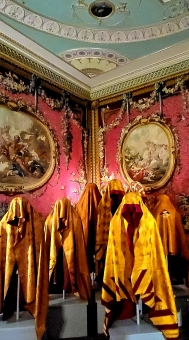
The exhibition at Osterley Park, “Journeys – Wedding Shawls, Baghs and Phulkaris from the Karun Thakar Collection”, is on until the end of October 2026. The ‘journeys’ in the title refer to the fleeing of Hindus from Pakistan during the Partition of India (in 1947) and to the travelling that is often necessary during Indian weddings (for example, the bridegroom has to travel to meet his bride, and the married couple might need to move elsewhere after the wedding celebrations are over).
Before I explain the textiles, let me outline Karun Thakar, who was born in 1960. The British Museum website (https://www.britishmuseum.org/collection/term/AUTH234453) summarises him as follows:
“Born Kenya, brought up in Delhi. Moved to UK as teenager. Former dealer and collector of ethnographic textiles and antiquities. Major collector of textiles from Africa and Asia.”
About 70 pieces from his vast collection are on display at Osterley. As part of the exhibition, there is a short video of him talking most interestingly and sympathetically about the wedding shawls.
The shawls on display are/were worn during weddings and other festivals. They are all embroidered, and fall into two categories: baghs and phulkari. They are both handmade, traditionally by groups of women working together. Each comprises silk thread embroidered onto a woven cotton cloth or backing. Michael Beste (www.m-beste.com) describes phulkari in his essay “Hopes & Dreams: Phulkari and Bagh from the Punjab” as:
“Phulkari in Punjabi literally means “flower work”and was originally used to describe all types of embroidery. In time, however, the term came to be used only for an embroidered head cloth or shawl …”
And he distinguishes the two categories in his essay:
“The major distinguishing feature between baghs and phulkaris relates to the amount of embroidery. In phulkaris, the motifs are more or less regularly divided over the whole cloth, and large areas of ground fabric are visible. As a rule, the ends have quite different patterns from the centre and are often much more richly worked. The motifs on a bagh, on the other hand, are embroidered so close to each other that the ground cloth shows as just a thin line around each motif. Also the ends of the bagh almost always pick up the motif of the main field.”
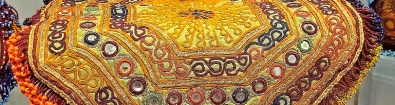
The patterns on the phulkari tend to be figurative with spaces surrounding them so that patches of the backing cloth are easily visible. The flowery motifs are like well-spaced plants in a garden. In contrast, the baghs are literally covered with geometric motifs that leave little or none of the underlying backing cloth visible.
All the shawls on display are beautiful and show evidence of painstakingly careful embroidering. At Osterley Park, each of the ground floor rooms, all of which had been decorated by Robert Adam, contains several of the shawls from Karun Thakar’s collection. A few of the shawls have been playfully placed to clothe some of the classical statuary that can be found within Osterley.
The presence of the Punjabi shawls at Osterley is not inappropriate. For some time, Osterley Park was owned by the Child family, owners of Child & Co., a private bank that financed some of the East India Company’s voyages and ships. The company had three trading ships named Osterley. The first of these, which was launched in 1757 was partially financed by Francis Child III (1735-1763). It was this man, who commissioned Robert Adam to redesign his country home, Osterley Park. The house contains several east Asian artefacts in its permanent collection. These were acquired through the Child’s involvement with the East India Company. So, Karun Thakar’s shawls feel, in a way, quite at home in Osterley.
Unlike the contemporary artworks that were being displayed at Claydon Hall and clashed, sometimes violently, with their historic surroundings, Thakar’s shawls seemed to harmonise with the historic environment in which they were being displayed. They are quite different to what surrounds them, but not at all out of place. To my great joy, what had been done at Osterley was far more satisfactory than what I had seen at Claydon.
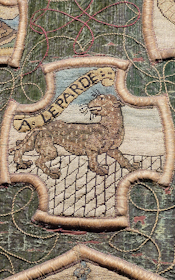

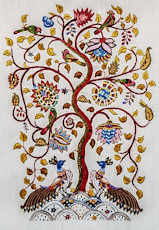 PONDICHERRY IS RICH in wonderful attractions, many of them souvenirs of its French colonial past. One of the most delightful of these is the Cluny Embroidery Centre on Rue Romain Rolland, a street named after a French writer and Nobel Prize winner who met Gandhi and was sympathetic to India and its philosophies.The Embroidery Centre is housed in an 18th century French Colonial building (a former residence, which was built by 1774) that forms part of a religious centre under the aegis of the Order of Cluny. It is believed that one of the former owners of the house donated it to help poor women in need. This must have been before 1829, when the Embroidery Centre was established. Every day except Monday and Sunday, at least twenty women of various ages arrive at the centre and take their places at tables in a large room with tall windows that open out into a verandah supported by neoclassical pillars and decorated with elaborate stucco bas-reliefs. The verandah looks out onto a courtyard surrounded on three sides by other buildings, parts of the convent, and the outer wall with a decorative entrance gate.This ensemble of buildings forms only part of a much larger complex of buildings, some of which surround another courtyard filled with a garden.After singing what sounds like a hymn, the women begin working on their elaborate embroideries. They stitch according to patterns designed by artists who work at the centre. While they work away silently with needle and thread, a simple sound system provides background music at a low volume.Dressed in white habit, Sister Agatha, who runs the convent, watches over the ladies at work and organises the sales of their labours to visitors who step into this peaceful sanctuary a few feet away from the noisy outside world.The resulting products are exquisitely beautiful. They embroider everything from coasters to handkerchiefs to napkins to pillowcases to table cloths and bedcovers. Visitors to the centre can purchase these treasures of fine needlework. Or, customers can place orders for specific items they need. The women who embroider at the centre get paid on a piecework basis. Some of them have had a history of mistreatment before joining the centre. Visiting the Cluny Embroidery Centre is a moving experience. It provides a very good example of how a religious order can work for the benefit of the ‘common’ folk.

