To Vienna and beyond

V Melk Abbey BLOG


IN 1971, I WAS AN UNDERGRADUATE STUDENT. That year, I made my first unaccompanied trip abroad. I was travelling by ferry and rail to Vienna and beyond. My late mother, who was very worried about how I would fare, wanted me to stay in a decent hotel for my first night on the Continent. That was to be in Cologne (Köln) in what was then West Germany. Back in 1971, there was no Internet to look up hotels in Cologne or anywhere else for that matter. The only guidebook to Germany in my possession was a pre-1914 Baedeker guide to The Rhine. Amongst the few hotels listed in the book in the entry for Cologne was a Dom Hotel. I rang the international telephone directory operator and asked if the place still existed. It did, and still does, and she supplied the number. I rang the Dom and booked a room for one night. My mother was happy about this, and said that as soon as I arrived, I was to ring her from the hotel.

I set off from London with my luggage in a metal framed canvas rucksack, kindly lent to me by my uncle Sven. I arrived in Cologne in the early evening and soon arrived at the very grand Dom Hotel, the ‘poshest’ in Cologne, in the late afternoon. It was a short distance from the Hauptbahnhof. I was greeted at the bottom of the steps leading up to its main entrance by a liveried doorman. He asked me for my luggage. So, I handed him my well-used rucksack. He held it gingerly as if it were a rat that had been dead for several days. At great expense, I telephoned my mother to assure her that I had survived the journey so far. From then on, she seemed to lose interest in my well-being during my adventure. I was not required to send progress reports back home.

After Cologne, I spent every night in a youth hostel or similar. From Cologne, I travelled by train to Würzburg, where I was planning to see the brilliant paintings by the Venetian painter Tiepolo inside the city’s Würzburger Residenz. Between Frankfurt and Würzburg, there was a middle-aged lady in my compartment. She wore what looked to me like very old-fashioned traditional German clothes including a hat with a feather stuck in its hat band. As the afternoon light began to fail, we began travelling through hilly country. I had just enough German to understand that the barely visible hills we were passing were the Spessart Hills. She told me that they were very beautiful. I have no idea why I remember her telling me about those hills. The next day, having spent a night in a comfortable youth hostel, I fulfilled my desire to view the Tiepolo wall and ceiling paintings.

At each of the German youth hostels in which I stayed, there was a different method employed to wake the guests in the morning. At Würzburg, A young man playing a flute wandered from dormitory to dormitory. At Munich, where I stayed one night, the morning call was someone shouting “Raus, Raus!”, which immediately conjured up thoughts about POW camps in Germany during WW2.

I decided to attend an opera performance on my first night in Munich. I bought the cheapest ticket for Berg’s “Wozzeck”. I note from the Internet that the opera was performed in Munich on March the 23rd 1971, which helps to date my trip. The ticket I bought allowed me to see the opera from the highest tier of the auditorium. When I arrived in my casual travelling clothes, I was the only man in the audience not dressed in formal evening wear. I enjoyed the opera from my eyrie near the ceiling of the theatre.

The following morning just after I had eaten a very modest breakfast, I met my friend, the late Michael Jacobs, at the famous Hofbrauhaus. We had arranged this sometime earlier when we were both in London. Each of us ordered a large stein of lager, probably a litre each. We chatted and drank in one of the establishment’s large noisy halls. Then, we went our own ways. I walked to the railway station with my rucksack on my back. It seemed to me that the hitherto flat pavements had become wavy. The alcohol had gone to my head.

My uncle Felix had recommended that I should make a stop at Linz in Austria in order to visit an interesting monastery nearby. I enjoyed the trip from Linz to Sankt Florian in what looked like an antique tram. The composer Anton Bruckner was associated musically with Sankt Florian.

From Linz, I travelled eastwards to another town with an important monastery. The monastery at Melk is perched on a hill overlooking the Rhine. I spent a night in the town’s youth hostel before continuing eastwards.

Deliberately, I overshot Vienna and continued from there by bus to the small town of Rust on Lake Neusiedl. The water of this shallow lake is shared between Austria and neighbouring Hungary. I was told that if the wind blows hard, the lake shifts position: more of it moves into Hungary or into Austria depending on the wind direction.  From Rust, little could be seen of the lake apart from endless beds of reeds. I was the only guest at the youth hostel because it was so early in the year. At night, I was left alone in the hostel. As I lay waiting to be overcome by sleep, I could hear an incessant croaking of a multitude of frogs coming from the direction of the lake. This strange sound did not help me fall asleep.

The next day, I took a bus to Mörbisch am See, a village on the lake, close to Austria’s border with the then communist Hungary. I asked a village shopkeeper if I could leave my heavy rucksack in his shop so that I could take a stroll. My aim, which was fulfilled, was to see for myself the notorious ‘Iron Curtain’. I walked south of the village and soon spotted the tall watch towers overlooking the no man’s land between the two countries. I only crossed the Iron Curtain for the first time about ten years later. Then, I hurried back to the village because I knew that there was a bus about to leave for Vienna at noon. The bus was waiting. I asked the driver to delay departure while I collected my rucksack. Unfortunately, the shop had closed for its lunch break. The forbearing bus driver helped me find someone to unlock the shop. We set off for Vienna.

My father had an American secretary called Nancy Berg. She and her husband had very kindly torn out and given me the pages about Vienna from their copy of “Europe on Five Dollars a Day”. From this useful source of information, I discovered that there was an extremely cheap, centrally located hostel near Mariahilfer Strasse in Vienna. This was no ordinary hostel. It was subterranean. It had been a bomb-proof underground shelter built by the Nazi Germans. The rooms were somewhat spartan, but each was served by an air-conditioning system that had been installed by the Nazis. The hostel required guest to leave the premises between 8 am and 4 pm. This was not a problem because there was so much for me to explore in and around Vienna.  The hostel was good value as was almost everything else in the city. In 1971, £1 Sterling was worth 80 Austrian Schilling. About ten years later, when I next passed through Austria, £1 only bought 20 Austrian Schilling.

I ate most meals at the popular Rathauskeller under the City Hall, which served good food at very reasonable prices. I particularly enjoyed ‘Gulaschsuppe’. One memorably enjoyable meal was at Grinzing at one of its Heurige, or wine taverns. I was not alone there. My friend Michael Jacobs had arrived in Vienna, where he was about to study German for a few months. He joined me and some other people, friends of my Uncle Felix. They were a couple in Vienna, whom my uncle had met. He was very keen that I should meet them. They invited me to afternoon at their residence in the city. It was a fine day and we sat on their terrace. I remember being given a cup of tea and a warm soft-boiled egg in its shell at the same moment. I had never been given this combination before. I hoped that it was not the local habit to break the egg into the tea. Had it been, I am sure that I would have not been able to even sip the strange mixture that would have resulted. Fortunately for me, the egg was designed to be consumed separately. I introduced Michael to this pleasant couple, and they became good friends.

By the time I travelled to Vienna, I had become a fan of the Dreigroschen Oper (Threepenny Opera) by Kurt Weill and Berthold Brecht. I had a gramophone record of the main songs in this work, which I never tired of hearing. Most people will be familiar with one of its opening songs, “Mack the Knife”. Many years later, I discovered a recording one of Ella Fitzgerald’s renderings of this song to a ‘live’ audience, during which she forgets the words following the first half of it. As luck would have it, there was a performance of the opera while I was in Vienna. I sat spellbound, listening to it at the city’s Volksoper.   

Amongst Vienna’s many attractions, there were several that I particularly enjoyed. One of these was the magnificent fairground at the Prater. This was on a scale I had never seen before. The Soviet War Memorial also sticks in my mind. I loved walking amongst the stalls in a street market that ran along the banks of a canal. Many of the stalls sold food from a part of Europe that I had not yet visited but wanted to: the Balkans and Communist Eastern Europe. Seeing road signs in Vienna pointing to places such as Bratislava and Budapest, both behind the Iron Curtain, thrilled me. I was also delighted by my visits to the Albertina art museum, Schönbrunn Palace on the edge of the city, and the Belvedere within the city.

It is curious that many details of my first ‘solo’ trip to mainland Europe remain in my mind but the return to London by train has left me no memories at all. I can only suppose that I travelled back without making any intermediate stops before reaching the English Channel. One thing that I regret is that I have mislaid the photographs, which I know that I took on this trip. I have an idea that they might be in a remote storage place that we rent on the outskirts of London. This is not accessible at present and even if it were, it might take hours or days sifting through what is being stored there to find them.


Photo: Melk Abbey from Wikimedia Commons
 

Park of memory

REGIMES RISE AND FALL, as was the case of the Roman, Ottoman, and British empires. Each has left a physical legacy in the form of buildings, works of art, and a plethora of monuments. In India, a part of the both the former Mughal and British Empires, visitors flock to see their tangible remains.

In the late 1980’s, it was turn of the Soviet Empire to decline and fall. In many of its former ‘colonies’, its citizens hastily tried to erase its physical traces. Statues were toppled and monuments destroyed. Some of these artefacts were removed from public view by governmental authorities (maybe because they feared a possible return of Russian domination?)

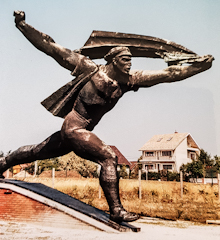
For good or evil, the Soviet Empire has had a profound influence on what followed in its wake. Whatever one thinks about the Soviet Empire, it has become a significant part of 20th century history and it is a shame to try to erase memory of it. This was also the opinion of the Hungarian architect Ákos Eliőd, who designed the Szoborpark (Memento Park) in the countryside near Budapest.

The Szoborpark opened to the public in 1993. About 6 years later, we drove to Hungary from London. We stayed with a good friend of ours, Ákos, a pioneer of Hungarian rock music, and his family in his home in the outskirts of the hilly Buda section of Budapest. It was Ákos who alerted us to the existence of the Szoborpark.

One sunny day, we drove to the park. It was a wonderful place containing a collection of the Soviet era statues and monuments gathered from all over Hungary. It was/is a treasure trove for those who like or are fascinated by socialist realism art forms, an aesthetic that I like. We spent a couple of enthralling hours in the hot sun, wandering about this open air exhibition.

I took many photographs of the Szoborpark, which I have ‘unearthed’ recently. One of them is of wall plaque celebrating Béla Kun (1886-1938) son of Samu Kohn, a non obervant Jewish lawyer. He was the dictator of a short-lived communist regime that terrorised Hungary for a few months in 1919. With its downfall, Kun fled to the USSR, where he organised the Red Terror campaign in the Crimea in 1921. He was executed in 1938, a victim of Stalin’s anti-Trotskyist purges.

Many years after seeing the Szoborpark, my wife and I visited Albania in 2016, more than 3 decades after the downfall of its highly repressive Marxist-Leninist regime piloted for 40 years by its dictator Enver Hoxha.
Interestingly, all over the country there were still numerous monuments erected during the dictatorial era. Many of them were in need of tidying up or cleaning, but they were still there despite being daily reminders of what was a difficult and fearful time for most Albanian citizens.

We believed that the endurance of these monuments erected during difficult times was due to at least two factors. One of these is that many of them were put up to celebrate heroic feats of Albanians carried out against their German invaders during WW2. The other is that despite Hoxha’s repressive regime, many things were done to move Albania from being a Balkan backwater in the former Ottoman Empire to getting nearer to being a 20th century European state.

This is not to say that statues of Enver Hoxha, Lenin, Marx, and Stalin (the mentor and hero of Enver Hoxha) were not pulled down in Albania. They were, but fortunately a few have been preserved by an art gallery in the country’s capital Tirana.

In countries like Hungary and the former Czechoslovakia, the arrival of the Soviet Army and the Russian domination of their countries was not felt by most citizens to have been even remotely beneficial. Obliteration of memories of this era were not surprising in places like these.

To conclude, I am glad that I have neither lost nor obliterated the photographs I took at the Szoborpark so many years ago.

The Gay Hussar

THE USAGE OF THE WORD ‘GAY’ to refer to same sex relationships dates back to the 1960s.

Before this time, back in 1953, Victor Sassie opened a Hungarian restaurant in Greek Street in London’s Soho district. It closed a few years ago in 2018.

Apart from serving Hungarian specialities, the Gay Hussar was a popular meeting place for politicians.

My father was often invited to meet his colleague, friend, and occasional co-author the Hungarian born (Lord) Peter Bauer at the Gay Hussar. Dad was not too keen on the fare at the restaurant because he found it too rich and a bit heavy. I only ate there once. I thought that the cooking in Hungary was better than that on offer in Greek Street.

The Gay Hussar was not the only Hungarian eatery in Soho. The other was Csarda in Dean Street. This closed long before the Gay Hussar. It is one of my few minor regrets that I was never able to eat at the Csarda.

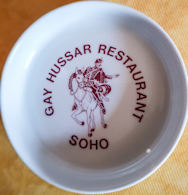
The ‘unearthing’ of an ashtray from the Gay Hussar is what prompted me to write about this no longer existing restaurant.

Hotel Lokomotiv

IT WAS 1982 WHEN THE ‘IRON CURTAIN’ still divided Soviet-controlled Europe from Western Europe most effectively. I was heading off towards Budapest from England in order to meet my friend and budding author the late Michael Jacobs, who was  becoming a renowned travel writer.


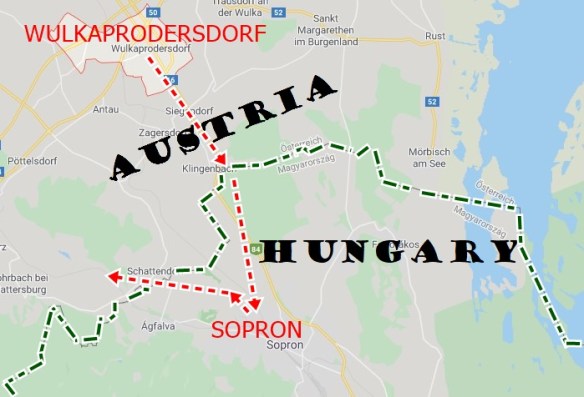
SOPRON 1

Before setting out on this trip, I had noticed that there was a railway line that began in Austria, crossed over the Iron Curtain into Western Hungary, and after running a short distance through Hungary, it crossed back into Austria. Intrigued, I checked whether it carried passengers, and found that it did. This, I decided would be the way that I would try to enter Hungary.

On reaching Vienna’s Westbahnhof, I travelled through the city to the Südbahnhof, where I caught a train that took me to Wiener Neustadt. When I disembarked, I noticed a diesel powered passenger rail bus standing on a siding. It was painted in a livery that I did not recognise. It was not the livery of OB (the Austrian State Railway), or of MAV (the Hungarian State Railway).  Two men wearing black leather jackets were standing next to it. I asked them in German whether this was the train to Sopron (just over the border in Hungary). With hand gestures, they motioned me on board. Soon, the two men boarded the train. One was its driver. We set off. I was the only passenger as the train drifted through vineyards and fields. After a short time we stopped at a small village called Wulkaprodersdorf.

The driver and his assistant disembarked, and so did I. From where I stood next to the ‘train’, I could see men in blue overalls working in a distant field. The two train men stood smoking and chatting to each other in Hungarian. An old steam engine with the logo ‘GySEV’ stood on a plinth, a memorial to times gone by. The rustic scene reminded me of lines from the poem ‘Adlestrop’ by Edward Thomas:

The steam hissed. Someone cleared his throat.

No one left and no one came

On the bare platform. What I saw

Was Adlestrop — only the name


And willows, willow-herb, and grass,

And meadowsweet, and haycocks dry,

No whit less still and lonely fair

Than the high cloudlets in the sky.


And for that minute a blackbird sang…

Just change Adlestrop for Wulkaprodersdorf, and you will know how I felt waiting there.

After a while, all of the workers in the field converged on the train and boarded it. I joined them in the now full train, and we set off towards Hungary.  To my surprise, we sailed past the rows of barbed wire fences, the sandy tracks, the watchtowers, the military men with dogs, without stopping. I had crossed the ‘Iron Curtain’ and entered Hungary without showing my passport. This was quite unlike any other time that I had travelled to Hungary by train.

The single carriage train pulled into Sopron’s station alongside a platform that had a barbed wire fence running along it. When I stepped out onto the platform, two uniformed guards came to meet me. How they knew that I was on the train was a mystery to me. They took me to an office, where their superior examined me and my visa, before stamping my passport. As the officials seemed friendly, I decided to ask them where I could find a private room to stay. Instead of directing me to the state tourist office, which usually arranged accommodation for foreigners, the official told me to come with him. He drove me to a house on the edge of Sopron, and told me to wait in its garage.

After a few minutes, he returned with a lady, who then took me to her house. Somehow, she managed to explain to me that I could rent a room from her, but I had to leave at 8 am in the morning. I rented her room for two nights.

On the following morning, I decided to try to ring Michael Jacobs at the number he had given me where he was staying in Budapest. I found a coin-box public telephone, but was completely flummoxed by the instructions which were only written in Hungarian. Undaunted, I entered Sopron’s fin-de-siècle central post-office. The large public hall was surrounded by desks each with signs above them in Hungarian. I looked for a desk with a sign that resembled ‘telephone’ or even ‘telefon’, but saw nothing remotely similar. While I was looking, a man in a suit and tie came up to me and announced in passable English:

Today is my day for helping foreigners. How may I help you?”  

I told him that I was trying to ring a number in Budapest, and he took me to a desk where I parted with a not inconsiderable amount of cash, only to discover that the call could not be made.

After that disappointment, my ‘helper’ asked:

You like wine?

I replied that I did.

Come with me then,” he said, leading me to a group of well-dressed middle-aged men.

“Visitors from Austria,” he said, leading me and his visitors to a minibus bearing the livery of OB, Austrian Railways. We drove through Sopron, and my new friend explained that he was hosting some Austrian railway officials who were visiting for the day.

We arrived at a wine cellar in a historic building in the heart of Sopron, and sat at wooden tables in a cellar with a vaulted ceiling. By now, I was getting quite hungry. My new friend sat me beside him, and for the rest of the time ignored his Austrian guests. In front of us there wooden platters with salami slices and what looked grated cheese. Greedily, I put a handful of this grated matter in my mouth, and sharp needles shot up towards my eyeballs. The ‘cheese’ was in fact freshly grated horse-radish! Wine was served, and all of us partook of it liberally.

During our drinking session, my friend said to me:

It is Vunderful. So Vunderful. You could have visited Paris; you could have visited Rome; you could have visited New York.  But you have come to our little Sopron. That is so Vunderful. So Vunderf…”

Eventually, it was time for the Austrians to return home. They piled into their minibus, and we waved farewell to them. Then, my Hungarian friend led me to a rather tatty looking faded green minibus, an East European model, and we entered. My host, an official of GySEV (Győr-Sopron-Ebenfurti Vasút) – the mainly Hungarian-owned railway company which had brought me into Hungary – drove me to a shabby hotel.

Hotel Lokomotiv,” he announced proudly, “now we drink more.”

By now, I had had enough wine, but insufficient food. I drank Coca Cola or its Hungarian equivalent whilst my friend continued drinking wine – all afternoon. After the sun had set, I decided that I should return to my room.

I will take you there,” he said slurring.

As we began walking through the town, I had to support my staggering friend, and also guide him through his own town. When we had nearly reached where I was staying, he said:

Next time you are in Sopron, you will stay in my house. I will put wife in another room. You will sleep in my bed.”

With that, we parted company.

I never took up his offer because the next time I visited Sopron, I was already married.

By train through Hungary and a slice of watermelon

I USED TO VISIT HUNGARY regularly in the 1980s before the end of Communist rule in that country. Sometimes I drove, other trips I travelled by rail.

BLOG KAP 1 KAPOSVAR 85 Hotel Kapos

In 1985, I boarded a train at London’s Victoria Station. As I was settling  down in my seat, a couple accompanying an older man asked me if I could look after on the journey to Hungary. He was their relative and only spoke Hungarian. My knowledge of that language was limited to a vocabulary of less than 100 words including ‘fogkrem’ meaning toothpaste and ‘meleg szendvics’ meaning heated (toasted) sandwich, and ‘menetrend’ meaning timetable and ‘kurva’, which you can look up yourself! I agreed to do my best to look after the gentleman.

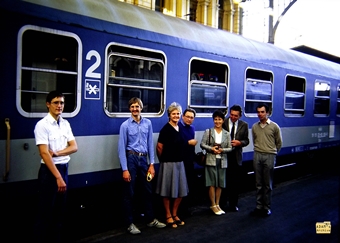
After taking the ferry across the English Channel,  we boarded an express train bound for Budapest. The gentleman and I were in the same couchette compartment along with some young people.

We stopped in Brussels early in the evening. A late middle-aged Belgian couple entered our compartment, and we set off eastwards. After nightfall, the Belgian couple left us. Several minutes later, they returned. They had changed their clothes. They had dressed in pyjamas and silk dressing gowns. Clearly, they were either unfamiliar with travel in 2nd class couchettes or had formery been used to travel in 1st class Wagon Lits sleeping cars.

We arrived at Hegyeshalom, a Hungarian border town close to Austria. As I was planning to visit southern Hungary, I disembarked there. So did the man who I was ‘looking after’. He was met by some of his family. Although they spoke no English,  they expressed their gratitude for me, and kindly offered to drive me to Győr, where I wanted to catch another train.

At Győr, they helped me find my train. I boarded a basic looking local train bound for Keszthely on Lake Balaton. After a while, the train stopped in the middle of the countryside and everyone except me disembarked.  I looked out of the train. We were not at a station. Someone saw me and signalked that I should also leave the train. We all boarded buses that had been laid on to substitute for the train that could not proceed further because of track repairs. 

After a ride through flat agricultural terrain, we reached a small station,  where we boarded another train, which carried us to Kesthely, arriving at about 4 to 5 pm.


I looked around the station at Kesthely and for some unaccountable reason I decided that I did not want to stay in the lakeside resort. I looked at a timetable and discovered that a train would be leaving soon, bound for Kaposvár, which was on the way to the southern city of Pécs.

A Hungarian couple with one child ‘got wind’ of my plan to join the train to Kaposvár, and took me into their care. I boarded the train with them and travelled in their company as the train followed the southern shore of Lake Balaton.

My ‘minders’ left the train at the lakeside station at  or near Balatonlelle. Before they disembarked,  they asked a man, a stranger to them, in our compartment to look after me. He spoke only Hungarian.

As the train wound its way inland through hills south if Lake Balaton, the sun set and it became too dark to see the countryside through which we were moving slowly.  Although there were light fittings with light bulbs in our compartment, they were never turned on. The two of us travelled in total darkness. We tried conversing, but with little meaningful success.

We both left the train at Kaposvár station. Darkness reigned. I had no idea where or even whether there was a hotel (szálloda) in the town. However, my latest ‘minder’ led me to a large state run hotel, the Kapos.

The young receptionist spoke good English. She asked me if I had any books in English. I did. I gave her one that I had already finished. She was very happy.

After a heavy meal in the hotel’s large restaurant (etterem), I  retired to my room. The hotel had poor sound insulation. There was a party somewhere in the building and my room seemed to be throbbing with the loud music.

After a while, there was a knock on my door. I opened it and found a waitress holding a plate with an enormous slice of watermelon. She muttered something about  ‘recepció’. I realised that the watermelon was a thank you gift from the receptionist.

I took the watermelon into my room and stared at it. Then and still now, I cannot stand eating watermelon.  I could not throw it away because it was bound to be discovered and that would have seemed very ungrateful on my part. So, after a bit of thought, I carried the slice of fruit downstairs to the receptionist to whom I had given the book. I thanked her, and then explained, telling a ‘white lie’, that I was allergic to watermelon.  She seemed to believe me.

That night, I found it difficult to sleep partly because of trying to digest my heavy dinner and the noise from the party.

On the following day, I took another train to Pécs having stayed in a city I had never heard of before.


Picture of Hotel Kapos in Kaposvar in 1985

Spare time

Now that many of us are being encouraged not to leave our homes unless it is strictly necessary, we have more time to enjoy our immediate surroundings and, maybe, do a little sorting out.

I have been looking through numerous photographs, scattered around our residence in albums or packets provided by the photographic shops that used to develop films and print the images on them. It is a fulfilling armchair journey of discovery.

Gradually, I am posting some of these photos, many of which were taken 20 plus years ago, on the internet. My only regret is that many of them are unlabelled, so that I am not always sure when and where I took them.

The photo attached to this short piece was taken somewhere in Hungary, probably in the late 1990s.

A powerful smell

Years ago, before the Berlin Wall was breached in 1989, I was visiting Budapest in Hungary with my friend the author, the late Michael Jacobs (he wrote Budapest, A Cultural Guide, published in 1998). We decided to eat dinner in a large restaurant called the Kárpátia, which was founded in 1877 and is one of the city’s longest surviving eateries.

cheese

The dining hall was very spacious. Its decor is Victorian Gothic revival. Diners are serenaded by a small band. As far as I can remember we ate well, as was often the case in Communist Hungary. One could enjoy the restaurants in Budapest if you were a western tourist, but for most Hungarians, who were low paid, eating in fancy restaurants was way beyond their means.  I remember eating a magnificent lunch at another restaurant and paying less than £5 for a gargantuan spread. When I told my Hungarian hosts that I had been to that place to eat, they could not believe that I was able to afford it. I was going to tell them what good value it was, but held my tongue.

At the end of the meal at the Kárpátia , I decided to try a cheese, which I had never heard of  and was on the menu. It was called Pálpusztai. I ordered a portion, and waited. The doors to the kitchen were at the far end of the large room in which we were dining. Our table was as far from the kitchen as was possible. Before the waiter re-entered the dining hall, a strong pungent odour could be sensed. The smell filled the entire dining hall. It was my cheese. Michael was horrified that first, I was prepared to try it, and then, second, that I liked it. Actually, I like most pungent cheeses. 

Pálpusztai is a cow’s milk cheese, which was first made by Pál Heller of the Derby és Vajtermelő Cheese Company in the 1890s. According to Wikipedia, the bacterium, Brevibacterium linens, that gives the cheese its odour is the same as that found on human skin, which contributes to body odour. Maybe, it was lucky I did not know that when I was looking at the menu at the Kárpátia!

Scene in a ticket office

BUDAPEST KEL PU 83 Farewell 2

I used to visit Budapest in Hungary frequently in the 1980s during the Communist era. I had many good Hungarian friends there. They were very hospitable to me.

One day, I happened to visit the advanced booking office at Budapest’s grand Keleti (Eastern) Station. I have no recollection of where I was planning to go, but that is not relevant to the true story that follows. The smallish rectangular room was lined with about ten (or more) counters at each of which there was a booking office official. 

A young Soviet Russian soldier entered the room. He was in an immaculately smart uniform and looked proud. He went up to the first counter and spoke to the person behind it. After about a minute, he was instructed to go to the next counter. Once again, he spoke to the official behind the window at the counter. And, after a few minutes, he was directed to the next counter. This went on until he had visited each counter in the room and reached the last one. At the last one, the official indicated that he should leave the room as he was in the wrong room for obtaining tickets for Soviet military personnel.

You might have thought that the official at the first counter he visited would have directed him to the correct place, but no. So great was the average Hungarian’s disdain for the Soviet soldiery that was keeping their country under the thumb of the Soviet Union that the officials in the booking office conspired together to waste the young Soviet soldier’s time and humiliate him. It was a beautiful example of passive resistance.

Two professions

We made several visits to Central Europe in our car during the mid-1990s.

CZECH

Twice during those years, we drove to the Czech Republic, entering it from the eastern edge of what had formerly been prosperous West Germany. The Western part of the Czech Republic, which had been the largely German-populated Sudetenland before 1945 is thickly forested with tall dark pine trees. We were dismayed to discover that for the first ten or so kilometres beyond the border, the roads through the Czech forests were lined with ‘gentleman’s’ clubs and prostitutes.

When we were in the middle of one forest, the rain began pouring down. At the corner of a road junction in the middle of the wood, we saw a young lady dressed in a shiny red jacket with matching short hot pants. Our three-year old child saw the woman, took pity on her, and said:

“Shouldn’t we offer her a lift.”

The innocence of our child was touching.

Hungary is south of the Czech Republic. In the late 1990s, we drove into it from Austria. For the first few kilometres of Hungarian territory, we saw no prostitutes, but numerous dental surgeries with signs both in Hungarian and German. Often the dental surgery was in a little compound that included a restaurant and a food shop. The presence of so many dentists offering their services so close to the border with Austria suggested that dentistry in Hungary was good value compared with that in Austria. And, while a member of an Austrian family is having his or her teeth repaired, the rest of the family could enjoy a good Hungarian meal and buy some tasty souvenirs to take back home.

Dental tourism is still popular in Hungary. English newspapers frequently contain adverts encouraging people to obtain supposedly cheaper dental treatment in Budapest.

The proximity of Bohemian prostitutes to the Czech border and Magyar dentists equally close the Hungarian border made me consider a possible uncomfortable comparison. I wondered whether people ever see some similarity between the two professions. I hoped not!

A lady in Budapest

My PhD supervisor’s wife was fondly known as ‘Wink’. When she learnt that I was about to visit Budapest in the early 1980s, she told me the story of her friend Dora, who lived in that city.

Sometime during the war, Wink got her first job. She became a supervising chemist at High Duty Alloys, a company that had its premises on the huge Slough Trading Estate, which had been established near Slough in 1920. It was the middle of the war, and there was a great need for metal for aircraft and armaments. Everything was being melted down in order to extract vitally needed metals. Wink was involved in developing ways of improving the extraction of the highly reactive metals magnesium and aluminium from seawater. Everyone was donating whatever metal items that they could spare to help the war effort. A great number of metal cooking pots reached High Duty Alloys. Sadly, Wink related, many of these were so full of unwanted metals that separating the desirable ingredients was uneconomical; the cooking utensils had been donated in vain.

DORA 1

Dora Sos in 1985 in Budapest

Soon after joining High Duty Alloys, Wink was assigned a technician. She was a Hungarian called Dora, who had been visiting the UK as the representative of a Hungarian chemical company when WW2 broke out. She was briefly interned as an ‘enemy alien’ until the authorities decided that she did not pose a security risk. When she was released, she took up the job at High Duty. Wink and Dora, who was a little older than her, became close friends. After WW2 was over, Dora was given British citizenship. However, she was getting homesick and decided to return to her home in central Budapest.

Every now and then during the late 1940s, the British embassy in Budapest held parties and receptions for British subjects living in Hungary. One evening when Dora was on her way to attend one of these, she was prevented from entering the embassy by Hungarian police officers waiting near to its entrance. She was taken in for questioning, warned never to try to enter the embassy again, and her British passport was confiscated. Dora continued her life working in a scientific laboratory in Budapest, but under appalling conditions. Each night at the end of a day’s work, all of the laboratory notebooks had to be locked up in drawers for which she had no keys. The Stalinist authorities who ran the country at that time were terrified of espionage and sabotage. Conditions became so bad in the laboratory that Dora, who was fluent in German and English, gave up being a scientist, and became a language interpreter.

Wink told me that after a few years when Hungary’s Communist regime became a little less strict, Dora was issued with a Hungarian passport and was given permission to travel to the West for a holiday. She went to The Hague in Holland and visited the British Embassy there. She related her story to the ambassador and his staff, and after they had checked up that she had once been issued with a British passport, they issued her with a replacement for the one that had been taken from her in Budapest. She was told that she could use the British passport whenever she was out of Hungary. All that she needed to do was to enter whichever British Embassy was near her, and then arrangements would be made to issue her with another British passport. And, before returning to Hungary, she could return her British passport to the nearest embassy for safe-keeping. Thus, she was able to visit Wink in Britain on a number of occasions.

When I began making regular visits to Hungary in the early 1980s, Wink gave me Dora’s address, and I met her. We became good friends. Whenever I was in Budapest, I used to visit her in her first floor flat in a late 19th century apartment building near to Moskva Ter in Buda. She always asked me for news of Wink and her family. A chain smoker, she was also a good cook. Whenever I visited her, she would serve me generous helpings of her home-made chicken paprika. This was always accompanied by noodles that she had just prepared with freshly made dough that she extruded through a mesh straight into boiling water.

Dora told me that under Communism very few young people learnt English in Hungary. Learning Russian was compulsory. Therefore, there was a shortage of English interpreters in the country. Often, she was asked to interpret at scientific conferences. She was able to perform simultaneous translations from German into English and vice-versa. This is no mean feat for someone whose mother tongue was Hungarian. Before my visits to Budapest, I used to write to Dora and my other friends there, announcing my travel plans. On more than one occasion, Dora commissioned me to bring the latest editions of particular technical dictionaries from London to her in Budapest, where these volumes were not available. She told me that whenever she was able to travel to the West, she would buy copies of Solzhenitsyn’s works. These were strictly forbidden in Hungary. She told me that whenever she returned to Hungary from the West, she would be asked by the Hungarian customs officials whether she was carrying any of these so-called ‘solzhis’.

DORA 2

In the house where Bela Bartok lived in Budapest

When I visited Budapest with my wife in about 1999, we visited the apartment house where Dora lived as I had been unable to get through to her by telephone. When we reached the door of her flat, which opened onto one of the galleries surrounding the building’s courtyard, I looked at the name on the doorbell.

It was no longer Dora’s.