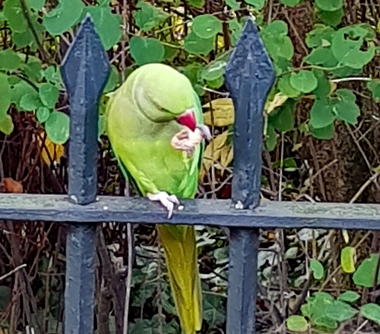
Parrot on a fence
gnawing on a nut:
Once wild, now a bit too tame!

Parrot on a fence
gnawing on a nut:
Once wild, now a bit too tame!
My late mother-in-law, an Indian living in Bangalore, made the best cucumber sandwiches that I have ever eaten. She used fresh slices of thin white bread with crusts removed. Each slice was spread with a small amount of butter mixed with freshly mixed English-style mustard. Then, finely sliced, peeled and de-seeded cucumber was inserted as the sandwich’s filling. The result was both delicate and refreshingly delicious. Having eaten these superb snacks on numerous occasions, I formed the idea in my head that India is THE place for cucumber sandwiches. This led to an amusing incident.

Photo by Pixabay on Pexels.com
Some friends of ours from England were spending a few days in Mysore, which is not far from Bangalore, where we were based. So, we decided to drive to Mysore to spend a day with them.
Our friends were staying in an old palace that had been tastefully converted into a hotel. After we had roamed around Mysore with them, they invited us to have afternoon tea in the lovely garden of the hotel. When we had sat down at a table, I said:
“This is the ideal place to eat cucumber sandwiches. The best cucumber sandwiches in the world are made in India.”
Everyone was happy to order a plate of these. When we asked the waiter for the sandwiches, he asked:
“You want vegetable sandwiches, with capsicum and all?”
“No, just cucumber sandwiches, no capsicums,” we replied.
Some minutes later, the waiter returned with A plate of sandwiches oozing with a bright red paste filling.
“What’s that?”, we asked him.
“Miner’s sauce”, came the reply.
“Miner’s sauce? What on earth is that?” asked one of our friends.
The waiter simply repeated the words “miner’s sauce”.
After a minute or two, the penny dropped, and I said:
“He means mayonnaise.”
Now, many non-English people pronounce this word as ‘my-on-nays’, which is closer to ‘miner’s sauce’ than the English pronunciation.
“We don’t want that sauce,” one of our friends protested, “Only cucumber.”
The waiter looked confused.
“What, no bread?” he asked.
“Let me show you what I mean,” said one of our friends, standing up and accompanying the waiter to the kitchen.
The waiter returned after a while with a very sub-standard collection of cucumber sandwiches.
Later my wife pointed out that just because her mother made excellent cucumber sandwiches, this was not necessarily the case all over India, as I had foolishly assumed.
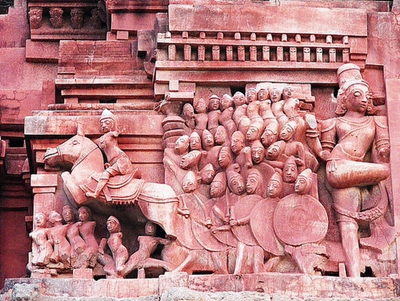
The state-run Mayura Hotel at Hampi is conveniently located in the midst of the extensive, picturesque ruins of the once very prosperous city of Vijayanagara. The former city was once the world’s second largest metropolis, but it was destroyed in 1565. I have stayed at the hotel on at least three occasions despite its shortcomings, some of which I will describe below. It is only fair to point out that the last time I stayed at this hotel was at least nine years ago. Things might well have improved by then.
On one occasion, we were driving to Hampi from Bangalore, and were running late. We rang the hotel to tell them that we would be likely to turn up by 6 pm. They replied that it would not be a problem: our room was waiting. And, so it should have been because check-out time was 12 noon. Whoever had occupied the room on the previous day should have vacated their room by noon.
When we turned up at the hotel, we were told that the room we had booked was still occupied. We were not pleased. The receptionist explained that the occupants of our room, who should have vacated it by noon, were still using it. We remonstrated and asked for an explanation. We were told that the family that was overstaying in our promised room had also arrived late the day before, and the hotel was kindly letting them extend their stay at our expense. We were tired and not amused.
The receptionist and another member of staff settled us temporarily in a small bedroom while we waited for our room to become vacant and cleaned up. After a couple of hours, we were shifted to our allotted family room. There were several workmen in the bathroom. They were trying to turn off a jet of water, like a geyser, that was shooting up from the floor. They managed after about an hour.
There were no towels in our accommodation. By now it was well after dark. We asked for towels and were told that we could not have them because the person with the (presumably only) key to the linen cupboard had gone home.
At the end of one of our stays at the Mayura, we asked to have breakfast at 7 am, when the dining area was supposed to open. When we arrived promptly at 7 am, there was no staff too be seen. Apart from us, the dining area was empty. After a few minutes, I walked into the kitchen: it was empty. All of the kitchen and serving staff were standing in a crowd in a nearby room, their eyes glued to a television screen. We learned the reason when, eventually, someone came to look after us. The television was showing the funeral of the much-loved Kannada film star Vishnuvardhan, who died on the 30th December 2009. Vishnuvardhan’s family were dismayed because his loss was not so greatly mourned as that of another star Rajkumar, who had died three years earlier. People had committed suicide on hearing of Rajkumar’s demise. Nevertheless, our driver thought it would be safer if we drove with a photo of Vishnuvardhan attached to the window as a mark of respect. Without it, we might have been attacked!
During one of our stays, we were curious to taste what appears on many South Indian restaurant menus. It is something called ‘Chicken 65’. What appeared resembled breaded chicken nuggets. They were bland and tasteless – very disappointing.
Some days later, we had dinner with an elderly Dutch couple, who were back-packing around India. It was clear to us that they had had enough of spicy food. We suggested that they ordered French fries (finger chips in Indian English), which, like omelettes and tomato soup, are almost always available wherever you are in India. Their eyes lit up at this suggestion. Also, we recommended that they order Chicken 65, which we assured them was not at all spicy.
After a while, the chips were served along with a plate of chicken pieces that did not resemble the Chicken 65, which we had ordered a couple of days earlier. Our new friends tasted this dish, and their eyes nearly popped out of their sockets. What had been served to them as Chicken 65 was far from bland; it was fiery hot. It seemed to us that the chefs in the kitchen paid little attention to what was ordered by the customers. We later learned that Chicken 65 is supposed to be hot and spicy. What we had been served before we met the Dutch people, was definitely not that dish.
The spicy dish was originally created at Buhari’s Hotel in Madras in 1965, hence the 65 in the name (see: https://www.thehindu.com/news/cities/chennai/the-hows-whys-of-our-chicken-65/article5042658.ece).
While we were staying in the hotel one visit, a tour group of Italians had dinner one evening. One man, who had had enough of spicy food, shouted out in a hysterical voice: “I want chicken, plain chicken with salt, nothing else, just chicken and salt, no spices, just chicken and salt.” He kept repeatng this, and we thought: “He should be so lucky in this eatery”.
Despite its elements of “Fawlty Towers” hospitality, the Mayura is a lovely place to base a few days of exploration of the substantial ruins of a once great city.

I became such close friends with my former PhD supervisor, ‘Doc’, and his wife ‘Wink’, that I accompanied them on their long summer holidays in Greece.

Camping at Platamon in 1977
Every year they drove down to northern Greece with their caravan, which they towed with their aged Land Rover. I accompanied them on several journeys during the late 1970s. Also, I used to join them at their favourite camping spot, a patch of uncultivated land just south of Platamon in northern Greece. This scrub-covered sandy area is now covered by a village known as Nea Pori.
On one occasion, I arrived at Platamon on a train, which I had boarded in Belgrade. It must have been almost 11 o’ clock at night when I disembarked. I was hoping that I would find my friends camping in their usual spot.
As I walked from the station through the village on my way to the camping spot, I passed the grocery shop that Doc and Wink always used. Its owners were sitting at a small table on the street outside it. They recognised me and invited me to join them in a drink. I was handed a tiny glass, such as one might use for shots of strong spirit, and they filled it with beer. We knocked glasses together and I downed the tiniest portion of beer that I have ever drunk. Then, they told me that my friends had arrived and were camping in their usual place. I walked there through the darkness, and saw them fast asleep under the awning. As silently as possible, I erected my tent and went to sleep. Fortunately, I did not disturb them.
The railway station was at the north end of the centre of Platamon, well beyond the shops that Doc visited. Whenever we drove into Platamon, Wink would rush to it because there was a small newsagent’s stall near it. She was hoping to find a copy of an English newspaper. She did occasionally but it was always a few days out of date. Apart from her, there were few others in Platamon who would have wanted to read an English paper.
By the time that we returned from Platamon, the sun would have been setting for a while, and it was time for our sundowners and olives. Doc used to prepare supper (dinner, if you prefer). He often fried the fresh fish which we had just bought in Platamon. He was a good cook. The fish or meat, if we were eating that, was often accompanied by a mixture of vegetables that included onions, aubergines, peppers (green or red), and tomatoes. It never contained garlic because he did not like it. These were stirred together in a pot until they were cooked.
Doc referred to this dish as ‘veggie mush’ (pronounced ‘moosh’). When I told him that the dish, which he believed to be his own creation, resembled the classic French dish ratatouille, I could see that he was flattered that his own creation could be compared to something enjoyed by gourmets.
The sky at Platamon was frequently cloudless. Where we were camping there was little ambient light so that the night sky could be seen easily. We used to stand looking up at the star-filled canopy that covered us. Shooting stars shot over us frequently, momentarily altering the map of celestial objects that twinkled down at us. Doc would stand with me and point out the various constellations. He showed me how to identify the North Star. We stood in a glorious silence that was only occasionally interrupted on some evenings. Otherwise, we could neither hear the sea, the sound of whose waves were lost in the dunes that were between us and it, nor the trains that ran along the tracks a few hundred yards to the west of us.
Food can be scarce
but when it’s abundant
let folk have plenty of choice

I attended Golders Hill School, a primary school in in Golders Green, between 1956 and 1960. It was a high-achieving school for boys and girls with an all female teaching staff. Founded in 1908, just after the Underground was extended from Hampstead to Golders Green, it still works today but in a greatly enlarged ‘campus’.
We used to spend all day at school. Lunch was served at 1 pm. We sat at various long tables. The children sitting on the table which ate its food fastest were rewarded with a piece of confectionary from a box of ‘Dolly Mixture’.
I was a fussy eater. Having had a difficult few first months of life, my mother was happy to see me eating anything at all. I was not forced to eat anything I did not fancy. Actually, there were few foods that I was prepared to put in mouth. A particular dislike of mine, which remains with me to this day, is green peas. Their taste, or even just thinking about them, makes me feel nauseous. I can recall that my mother was keen that I should get to like these nauseous little green spheres. She would put a few on my plate. To avoid eating them, I employed the following delaying tactict: I would first slowly peel a pe, and then carefully cut into four pieces. My parents soon tired of watching, and eventually attempts to make me consume them were abandoned.
Almost nothing that was served at Golders Hill appealed to me apart from steamed pudding and the oddly named ‘spotted dick’. Main courses often came served with cubed carrot, chopped green beans, and green peas. I would not touch them. No table that I sat on would ever be rewarded with pieces of Dolly Mixture.
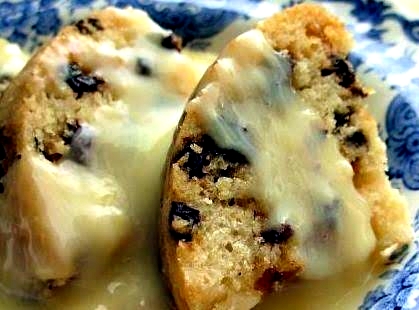
Spotted Dick with custard – source: https://www.justapinch.com
I was shifted to the slow table, where the four slowest eaters in the school sat trying to finish their food during the play time that followed lunch. I remember nothing about the three other members of the slow thable except that they were all girls and one of them was called Rhoda.
Even if I had been kept at the slow table for the rest of the day, there was no way that I would be able to finish what was in front of me. I devised a solution. I put whatever I could not eat into the pockets of my short trousers (‘shorts’), visited the toilet, and then emptied the unwanted food into the toilet pan, and flushed it away. This worked for most foods including slices of canned fruit.
My biggest challenge, and I can only remember it happening once, was gooseberries in hot custard. I felt that putting this in my pockets was not at all a good idea. In desperation, I carried my filled bowl to the closed door of the staff room. I knocked on the door, hoping that whomever answered would take pity on me. A forlorn hope because many of the teachers were quite formidable. I hoped that it would not be the large Miss Fitzgerald, who frightened me greatly. If it was Miss Dredge, I would have felt happier.
I cannot say who it was that opened the door. But, as soon as it opened I dropped the plate with all of its contents ont the feet of the teacher at the door. It still puzzles me why I was neither punished nor told off for my act of carelessness, or was it defiance.
PS: I still dislike peas, but now I love gooseberries.
High up in the sky,
a compartmented tray,
consuming airline food

Since I was a little boy (many decades ago), I have been travelling on aeroplanes, usually to and from holiday destinations. The food served during flights has always intrigued me. As a child, I used to collect the miniature containers of salt and pepper that appeared on the compartmented food trays. I can remember these better than the far from memorable food served with them.
In 1963, we took an overnight flight from New York to London. When the breakfast tray arrived, I remember that there was a hot, foil-wrapped item on the tray. Cautiously, I unwrapped it to reveal a long spindle of something yellow and rubbery. I hit it with a knife. The knife bounced off it. My mother told me that what I had revealed was an omelette. To this day, omelettes on ‘planes have repelled me. I love freshly made omelettes, but one made several hours earlier and reheated has no appeal for me.
The best food I have eaten in the air was on Air Lanka ‘planes in the mid-1990s when we were travelling between London and Colombo. The food was served in large foil containers, rather than in in tiny neat plastic dishes. Delicious Sri Lankan curries were served. They tasted as if they had been lovingly prepared in someone’s home rather than in an industrial kitchen. My wife recalls eating whole steaks and caviar on an Aeroflot flight between Moscow and New Delhi in the late 1980’s. The burly stewardesses served the food on real porcelain plates.
More recently, I have been travelling regularly to India. There is a direct flight between London and Bangalore operated by British Airways (‘BA’), on which we used to travel. The staff on these flights were coolly efficient. The meals were not so good. For some years I had a dental patient, a friendly fellow, who worked for BA as a cabin crew member. When I told him that I was not keen on what was served on BA, he suggested that I pre-order the seafood meals. These turned out to be better than the regular meals, and we ordered these on several successive flights. Then, on one BA flight I was seated next to a very devout Muslim couple, who did a lot of praying during the ten-hour flight. When their meals arrived, a delicious aroma spread from their trays. When they removed the foil from their hot dishes, I saw that they had been served with what looked like really nice curries and biryanis.
After seeing these halal meals, that is what I pre-ordered on all our subsequent bookings with BA. We were not disappointed. BA used a good quality halal caterer. Many people who order halal food are teetotal. The BA crew did not raise an eyebrow when we ordered gin and tonic or bloody Mary cocktails with our so-called ‘Muslim meals’.

Before BA operated the direct flights between London and Bangalore, we had to make the journey with one change of ‘plane. The German airline, Lufthansa, ran a convenient flight from Frankfurt (Main) to Bangalore. On one occasion, we were served two meals on the flight. The first meal included some meat. Several hours later, the second meal arrived. It was a selection of vegetarian food items. Now, I have nothing against vegetarians and vegetarian food, but I like a bit of meat or fish with my veg. I called the stewardess and asked if there was a non-vegetarian option as there had been during the earlier meal.
“No,” she said abruptly.
“Why?” I asked.
“In Germany,” she explained, “we only eat meat once a day.”
What nonsense, I thought. Whenever I have visited Germany, I have seen people eating meat at breakfast, lunch, dinner, and in between these repasts. I was not going to put up with her inaccurate reasoning.
“Well,” I replied, feeling a little bit hypoglycaemic, “I shall be ill if I eat this vegetarian offering. You must find me some meat.”
“One moment, please.”
She disappeared out of our cabin. Maybe, she was worried that I might eat her. After some minutes, she returned with a tray containing some very tasty pieces of fish.
Apparently, Germans who travel business class eat non-vegetarian food more than once a day.
POSTSCRIPT:
I cannot understand why airlines feel that they have to serve hot dishes mid-air. Most of these dishes are shoddy versions of the descriptions given to them on the tiny menus handed out to fool you into thinking that the airline will treat you to ‘fine dining’. I believe that many people would be happy with a selection of tubs of what the Greeks call ‘meze’. These could include things like hummus, taramosalata, tzatziki, olives, cole-slaw, nuts, mutabel, guacamole, salsa, etc. No cooking required, and fun to eat.
we don’t see ev’rything
that we consume:
might be germs with any bite
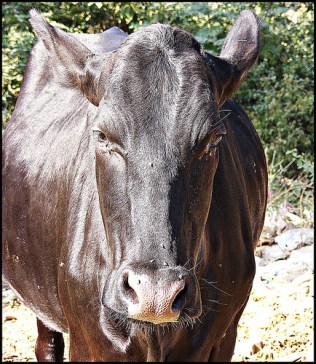
From time to time, the United Kingdom is subject to agricultural diseases that need to be accompanied by nation-wide restrictions to limit spreading. A frequently occurring example of this is so-called foot-and-mouth disease. During such epidemics, those not involved in agricultural activities, such as hikers and tourists, are confined to roads, told to keep out of fields where traces of the disease may be lying.
During one outbreak of foot-and-mouth, we were spending a holiday in Wales. Wherever we went, we saw signs and barriers that prevented free movement across the countryside. What with the incessant rain, it made our trip rather dreary. We stopped for lunch in an ugly little town in central Wales. The most attractive looking eatery was a dowdy pub, devoid of any architectural merit. We sat down in its ageing dining room, trying to avert our eyes from the peeling wallpaper and a horrible worn carpet that badly needed to be replaced. Things looked up when the inn-keeper arrived to take our food order. We were attracted to beef steaks. There was a bewildering range of options for this on the menu. Our host patiently explained the differences between the different types of beefsteak, explaining how the tastiness of the meat itself was related to its fat content and distribution within the cut. Fillet steak, for example, has little fat, not much taste without sauces, but wonderful texture. He recommended rib-eye as being the cut with just the right amount and distribution of fat to be tasty on its own. He was quite right, we discovered in that unattractive dining room in rainy Wales.

Some years later, Mad Cow disease (Bovine spongiform encephalopathy) became a concern in the UK. One evening, when we were going to a theatre near St Martins Lane in London, there were large headlines about the disease on the front page of the latest issue of the Evening Standard newspaper. Before the performance, we entered a branch of McDonalds for a quick snack. Almost everyone in the café was eating beef burgers, despite the headlines on the newspapers that some of the customers were reading!
Shortly after this, we went on a driving trip through France. In one small town, we walked passed a small restaurant with a sign hanging in its glass-fronted door. It read (in French): “We might be mad, but our beef is not.”
While the Mad Cow scare was at its height, we were invited to stay with some friends in Belgium. We had stayed with them often before. We asked them what they would like us to bring from London. They said they would love a home-made curry, enough for about twelve people. Although I am married to an Indian, it is I who makes the meat curries in our family. I prepared and cooked a huge lamb curry. As it is only a few hours’ drive between London and Belgium and the curry would have to be re-heated before being served, we thought it safe to transport the casserole containing it without refrigeration.
There were more security checks than usual at the English end of the Channel Tunnel. After our car had been examined, and the engine checked for hidden items including explosives, we were asked if we were carrying any meat products across the English Channel. We mentioned that we were transporting a casserole of cooked lamb curry. The security officials looked puzzled, told us not to move, and then walked away towards an office. One of them returned, and asked:
“It’s lamb, not beef is it?”
We confirmed that it was not beef.
“And thoroughly cooked?”
“Yes.”
“Well, what with all those spices, we’ll let you take it through the tunnel.”
Nobody asked us about meat when we arrived in France. We drove through a bath containing disinfected, and then headed for our destination.
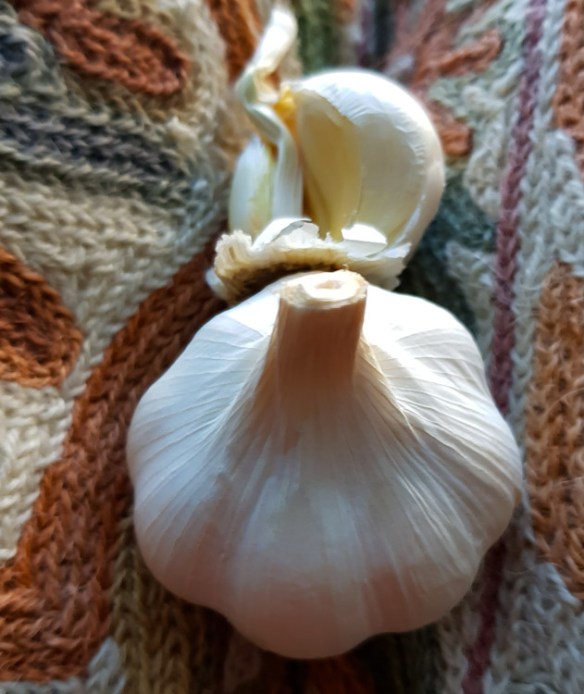
My late mother was a good cook. I know that you will think that often children praise their mother’s cooking however awful it is. In the case of my mother, her cooking was praised by many people, who still remember her skills in the kitchen many years after her demise at an early age. My mother was a keen disciple of the pioneering food writer Elizabeth David, who helped introduce Mediterranean cuisine to the British. Many recipes from the Mediterranean involve the use of garlic and parsley.
Although my mother did not permit my sister and me to cook in her kitchen, we were ordered to be in the kitchen with her either to keep her company and/or to do the washing-up. Our presence in the kitchen and proximity to a skilled cook engendered a life-long love of cooking in both my sister and me. When my mother died, I took over her kitchen and learned, by trial and error, how to cook. My sister did the same and ran a restaurant successfully for quite a few years.
Many of the dishes I cooked, and still make, contained copious amounts of garlic. This was not a problem until I qualified as a dentist, and moved to a practice in Kent, about 80 kilometres from London in distance, although it felt much further culturally and in many other ways.
Friends have often asked me whether the mouths that I treated emitted bad smells. The short answer is that although they might be malodorous occasionally, the dentist rarely smells them while treating the patient. However, the converse is true for the patient. In modern practice, the patient is often almost horizontal on the treatment chair. He or she can easily smell the dentist’s breath.
Soon after I began practising in Kent, I lived in local rented accommodation. I cooked for myself in the evenings, often preparing dishes with large amounts of delicious garlic.
One morning, Mrs G, a late middle-aged woman, attended my surgery. Soon after I had lowered the chair to a semi-reclined position, I commenced working on her teeth. In those days, the early 1980s, dentists did not routinely wear surgical gloves, nor did they wear facemasks. A paper facemask such as became ‘de rigueur’ after the beginning of the AIDs (HIV) epidemic, would not have prevented what was to occur after I began treating Mrs G.
After I had been at work for about a minute, Mrs G swept her hand in front of her mouth, and exclaimed: “Ooooh, Mr Yamey, you’ve been eating garlic.” I apologised, and from that day onwards I never ate garlic on a day before I was due to work.
After I had been in practice for about twelve years, I began working in inner London instead of ‘extra-terrestrial’ Kent. My patients in London came from all over the world, and most of them ate at least as much garlic as I do. The garlic restriction that I exercised in Kent became unnecessary.
Parsley was another problem I faced when I first arrived in Kent. I used to buy my lunch at the local Tesco supermarket. Many of its employees were patients in the practice where I worked. In addition to sandwiches and potato crisps, I enjoyed eating something containing chocolate with my midday meal. Many was the time when the lady at the check-out till would hold my Mars bar or Crunchie up in the air, and then shout at the top of her voice: “Look what the dentist is eating.” I digress.
One summer’s day, I needed some parsley for something I wanted to cook. I entered the local Tesco and asked an assistant where this herb was kept in the shop. Surprised by my request, she answered: “Sorry, love, we only get that in at Christmas.” I was shocked. Only an hour and a half’s drive away in London, parsley was available throughout the year. The Medway Towns, where I worked, were trapped in a 1950’s time-warp when I first arrived there. By the early 1990s, when I shifted to London, the area was emerging gradually into the present.
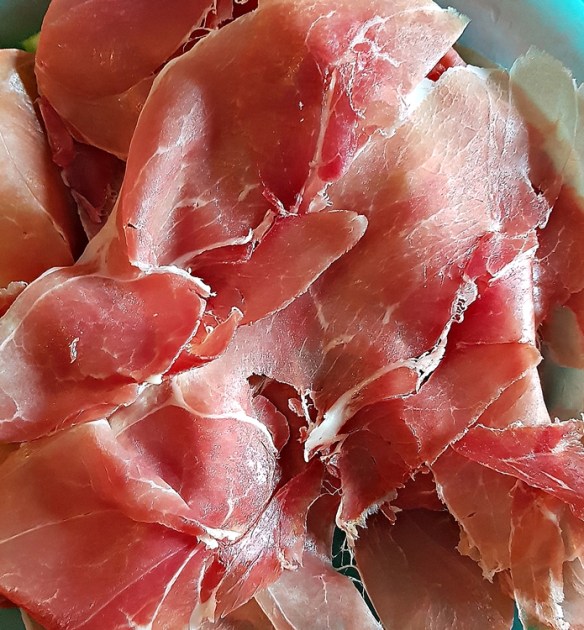
Portuguese presunto
pleasure on a plate:
no ordinary ham
Presunto is dry-cured ham from Portugal

croque monsieur or madame
welsh rarebit perhaps
cheese on toast basically

