Raw fish

raw


Japanese food was a relatively new addition to the Londoner’s diet in the early 1970s. It was then that I first tasted sashimi (i.e. raw fish).

Some friends including my future wife persuaded me, an impecunious PhD student, to join them at one of London’s few Japanese restaurants. This one was in St Christophers Passage that leads off Oxford Street. I ordered a serving of tuna sahimi. Four neatly cut cubes of tuna arrived in front of me. It was delicious. Fish had never tasted as good as this before. Cooking, however carefully done, removes something essential from the fresh taste of fish. The four exquisite cubes of fish soon disappeared. I did not order anymore because this tiny portion of sashimi  cost £7 Sterling, a huge amount in the early 1970s. The purchasing power of £7 in 1974 is roughly equivalent to the purchasing power of £66 today. Despite its enormous price, I became ‘hooked’ on sashimi

I must tell you that I left the Japanese restaurant with my hunger unassuaged. Without telling my friends, I sneaked off to a nearby … now, don’t frown disapprovingly … McDonalds outlet and filled up on junk food.

Fortunately, although not cheap, Japanese food, including sashimi, is relatively cheaper in London now than it was back in the 1970s,

Mashed potatoes

Some restaurants in India serve both veg (vegetarian) and non-veg (meat, fish, eggs) food. Recently, my wife and I were sitting near to a young lady in a very good Italian restaurant in Vadodara in Gujarat.

Our young neighbour is a vegetarian. She ordered a veg pasta and asked the waiter if she could have a portion of mashed potatoes. I know that pasta and mashed potatoes are an unusual combination, but that is what she wanted.

The waiter told her that she could not order mashed potatoes with a veg pasta. Puréed potatoes, which are pure veg, could only be served with a non-veg dish.

We overheard the waiter telling this to our neighbour. My wife, who always tries to be helpful, interrupted the waiter and told him to bring a small dish of mashed potatoes with the pasta. Eventually, and somewhat reluctantly, the waiter did as asked. Our neighbour was so happy to receive the mash with her pasta that she got up and gave my wife an affectionate hug.

I am not a vegetarian.

Although I have met numerous pure vegetarians during the 25 years I have been visiting India, I still find it hard to believe that there are so many people, who have never tasted meat, eggs, or fish.

A candle on the plate

I first visited India 25 years ago, arriving in January 1994. On the day before we left to return to the UK, my wife took me to Shezan, a restaurant in Bangalore’s Lavelle Road. This pleasant thoroughfare is named after a Mr Lavelle, who made his fortune at the (now disused) Kolar gold fields east of Bangalore.

My wife said to me that brilliant biryani, which I ought to try, was served at Shezan. We arrived at the restaurant, which was then housed in a picturesque colonial era bungalow.

Where this bungalow used to stand, there is now a modern office building called Shezan Lavelle. Since this was built, the restaurant has been situated at various other locations in Lavelle Road. Recently in late 2018, the Lavelle Road branch of this eatery has been discontinued. Shezan continues to operate in Cunningham Road, where there has been a branch for many years.

Back in 1994, I looked at the menu at Shezan and noticed that Chateaubriand beef steaks were being offered for the Rupee equivalent of 2 Pounds Sterling. I told my wife that I would have a steak rather than a biryani. After all, good biryanis were available in London, where a Chateaubriand used to cost eight to ten times the price at Shezan. The steak at Shezan was first class, and it continues to be so 25 years later.

Shezan used to be run by a man, who died in late 2018, and his elderly father. When we began bringing our young daughter to Bangalore in the late 1990s, we took her for meals at Shezan. Whatever was ordered for her arrived with a small candle flickering on her plate. The candle was placed in a hollowed out tomato that served as a shade.

In early January 2019, we visited the Shezan in Cunningham Road with our daughter, by now a young lady. The branch is run superbly by Aftab, a son of the recently deceased former owner.

Our daughter ordered a portion of Sholay Kebab, a slightly spicy chicken dish cooked with curry leaves. It arrived with a small candle flickering under a hollowed out tomato shell. Remarkably, the kindly Aftab had remembered our daughter after not having seen her since she was a small child.

Let loose in the kitchen

There is no love sincerer than than the love of food

George Bernard Shaw

Most people think highly of their mother’s cooking. Many people thought highly of my mother’s cooking. She was an early disciple of Elizabeth David, the cookery book writer who introduced Mediterranean cuisine to British kitchens.

My mother regarded our kitchen as her territory. Being highly protective of my sister and me, she would not let us near the cooker nor sharp knives. However, she was quite happy to have us accompany her in the kitchen for two main reasons. One was to give her company while she cooked. Another was to do the washing up of crockery and cutlery. I did not much mind keeping her company, but washing up was not much fun.

Eventually, in the 1960s we acquired a dishwashing machine. This did not prove to be much of a labour saving device because my mother insisted on us, often me, washing every item before putting them in the machine. And, unloading the dishwasher and stacking everything away was as time consuming as washing up manually.

Sadly, my mother died young in 1980. By then, my sister had left home. As my father had no interest in cooking, the kitchen became my own territory. At last, I could begin to use the cooker and all of the kitchen utensils that my poor mother had guarded so jealously. This did not compensate for losing a beloved parent, but it did open a new door in my life experience: the art of food preparation.

My love of cooking commenced. At first, I followed recipes from an excellent series of cookbooks published by the Sainsbury’s supermarket company. Then, I experimented with Indian food guided by a cookbook written by Madhur Jeffrey. Later, I made use of a very practical Chinese recipe book written by Ken Hom and published by the BBC. For middle eastern dishes, I was guided by the well-known Claudia Rosen, who has also written a very good book of Italian recipes, and a superb one by the lesser known Arto Haroutian. For Hungarian food, the book by George Lang is hard to beat. Since marriage, I have been guided in the art of cooking by my wife, who is a superb cook.

I suppose that over the years I have become a ‘foodie’. ‘Foodie-ism’ seems to run in my family. My sister, a very competent cook, ran a restaurant in Italy for about 15 years; she was the chef. My mother’s sister was an excellent chef and her two children, my cousins, have inherited her culinary skills. Our daughter has also inherited the foodie gene, both from me and my wife, both of whose parents had discerning palates.

There are those who consider food simply as fuel. They are missing out on one of the pleasures in life, which I value greatly: the preparation and enjoyment of cooking and eating.

Let me end by wishing you all A DELICIOUSLY HAPPY NEW YEAR!

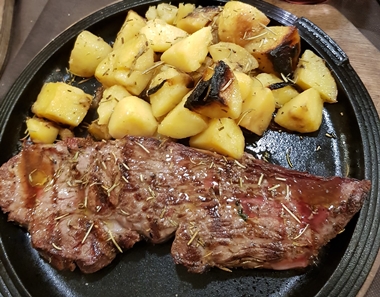
Claim your steak

STEAK

When I was much younger, my parents often took my sister and me to eat dinner in restaurants.

Before we looked at the menu, my late mother used to examine the plates and cutlery on our table. If there was a blemish on the cutlery or a crack or chip in the porcelain, the waiter would be summoned to replace the defective item(s). Often this delayed the arrival of any food. If we looked reproachfully at my mother, she would say:

“You can eat off cracked plates if you like, but I am not paying good money to eat off bad plates.”

She said this in such a way that meant that really there was no way that any of us could eat off damaged crockery, even if we wanted to.

As the years went by, I used to look at my plate and cutlery carefully as soon as we sat down. If I spotted a defect, I used to casually lay my hand on it so that my mother would not see it. I was always hungry before a meal and wanted to get on with it rather than having to wait for perfect eating utensils to be fetched. Once any defective cutlery/crockery was replaced, the meal could be ordered.

My mother was fond of beef steak. Rather unfashionably for London in the 1960s, she preferred her steak rare, almost what the French call ‘bleu’. This simple request was the real test for a restaurant. Frequently, the rare steak would arrive cold. My mother would then summon the waiter or maitre d’hote.

“My steak is cold.”

“Madame, I will ask the kitchen to heat it for you.”

The steak would then be returned, and my mother would begin cutting it. Soon the waiter would be called again.

“My steak is no longer rare; it is overcooked. Take it away and bring me another one cooked rare and warm.”

Any restaurant that could get this right without fuss, won my mother’s custom. She would then return there frequently.

Today, rare steak is the ‘in thing’. Most good chefs and discerning diners prefer the insides of steaks to be red, if not bloody.

Writing of steaks reminded me of Monty Modlyn (1921-94), a radio presenter and journalist. Occasionally he would speak on the early morning Today programme on the BBC Home Service (now ‘Radio 4’). He would report on steaks and other meat he had eaten. He had a metal ball that he would drop onto pieces of meat. The depth of the indentation made by the ball’s impact was his measure of the meat’s quality. It all sounded a bit mad to me when I listened to him when I was a young boy. Apparently, what he was doing was quite sound. The quality of raw meat can be judged by indenting it with a finger tip and then watching how quickly the indentation disappears. If the meat recovers quickly, then the quality is likely to be lower than if it recovers slowly.