Seven streams

Seven

At first, I was daunted at the prospect of watching a seven hour drama at London’s National Theatre. Then, remembering that I had endured an eleven hour bus journey in Gujarat and several long intercontinental flights, I decided that sitting comfortably at the theatre for seven hours including intervals would not be too bad, and I was right.

The play we watched, “The Seven Streams of the River Ota”, by Canadian playwright Robert Lepage (born 1957 in Quebec,), is divided into seven acts or installments. I found five of those installments to be highly enjoyable. The other two were less good in my humble opinion.

The River Ota runs through the Japanese city of Hiroshima, unfortunately famous for being the first civilian target of an atomic bomb in 1945. One of the main characters in the play by Lepage is a woman who was blinded, as a small child, by the atomic bomb blast’s flash. Each of the seven acts of the drama is linked to her or to characters connected with her directly or indirectly. Therefore, although the play’s plot is quite complicated, there is an easily discernible thread that runs through it.

At times the drama is witty and humorous and at others tragic. However, throughout the performance, the subject matter is both sensitive and moving. The ingeniously crafted play touches on all kinds of important historical events that affected Japan and the Japanese between 1945 and the late 1990s when the play was written. It also makes reference to Theresienstadt, one of the Nazi concentration camps. At first, I was not sure of the relevance of this scene set in the camp, but afterwards it dawned on me. It was an important background to one of the characters, who plays a major role in the latter parts of the play.

Another of the play’s myriad of topics reflects the playwright’s origin, Quebec. There are some very entertaining scenes in which the characters speak in Canadian French (with its particular accent) such as would be heard in Quebec. At times, Lepage makes use of the play to poke fun at cultural rivalry between the Canadian French and the French in France. He also makes reference to Canada’s objection to French nuclear tests that were being carried out in the Pacific between 1966 and 1996. And, nuclear tests relate directly to the main theme of the play, the atomic bomb exploded at Hiroshima.

Without going into detail about the very complicated plot, let me say that this play was highly fascinating, well acted by members of Lepage’s theatre ensemble Ex Machina, and the sets were superb. Sadly, this long play is only being given a short run at the National Theatre. Its final performance, viral microbes permitting, will be on the 22nd March 2020.

As for my initial fears about sitting for seven hours in the theatre, these were unrealised. The time shot past, so intriguing was the play. Lepage’s play was for me as exciting as at least two other epic length dramas I have enjoyed: “Angels in America” by Tony Kushner, and “The Coast of Utopia” by Tom Stoppard.

Renaissance

COVER SMALL


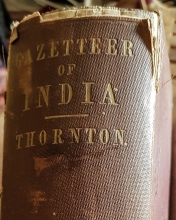
Last year, I published a book about an almost forgotten but important aspect of Indian history that began to interest me after visiting an almost completely unknown memorial in western India (Kutch, to be more precise). 

Since then, I have shown the book to various knowledgeable readers and also revisited the memorial. 

Those who have read the book have made valuable suggestions on how to improve it, including changing the title so that its subject matter is far more obvious to a potential reader, adding a preface and a time-line, and re-ordering the subject matter.

When I re-visited the memorial in Kutch, I met people, who showed me things I had not seen or even been aware of on my first visit. They also gave me new information. In addition, I have done further reading of source material, some of which I had not known about earlier. In addition, I have obtained photographic images that I did not possess before.

I felt that since I published my original text, a new expanded and, I hope, much improved version was necessary. My ideas needed a renaissance, so to speak.

I am now awaiting a proof of my new book, and will keep you informed of developments.


Why I use an Android

android

A wise old friend of mine, Margaret, told me that once when holidaying in rural Greece, she developed an excrutiating toothache. Wary of trusting her teeth to ‘any old dentist’, she decided to go into the nearest town and visiting the local bank manager. She reasoned that the bank manager probably consulted one of the better dentists in the town. So, she visited the manager’s dentist, and was not disappointed.

Once, Margaret told me how she chose a new washing machine. She asked the repairman, who came to service her machine, which models he had to repair most and which caused least trouble. Based on this information, she chose her new appliance.

A decade or more later, I decided to acquire a ‘smart phone’ to replace my unsmart device. The choice was broadly between an iPhone and an Android phone, such as a Samsung model.

Remembering my old friend, who had been dead for several years, I consulted the man who ran a mobile telephone repair shop near where I used to work. I asked him which kind of ‘phone he had to repair most often. Quick as a flash, he said:

“iPhones.”

When I asked him why, he replied that the screens on Samsung models needed replacing less often than those on Androids.  That was enough for me to decide on buying a Samsung.

I have had several models of Samsung ‘smartphones’ since my first. Now, I am using an S8, which has a superb camera.

I am pleased I adopted Margaret’s method of decision making.

Annoying and rude

During the last few years that I practised dentistry, most of my patients brought mobile telephones into my surgery.

You would be surprised how many patients tried to answer their ‘phones when my fingers were in their mouths or their mouths were filled with impression (mold taking) material.

Worse still, were patients who were ‘texting’ constantly when I was trying to explain their treatment options to them.

Once, a patient arrived late, speaking on his mobile phone. He muttered to me that he was in the middle of a telephone job interview. I had no choice, but to let him continue. After half an hour, he told me he was ready for me. I told him that he had wasted my time and his appointment and had to book another one.

In the end, I put up a large sign in my surgery forbidding the use of mobile phones, which was rude and inconsiderate. This solved the problem because, to my surprise, most people obeyed it.

I wonder

I wonder whether today’s parents would take more interest in their youn goffspring in buggies if they did not possess mobile telephones.

I wonder whether babies and young kids now in buggies will suffer later in life because their parents preferred paying attention to their mobile phones rather than their little children.

Cups of ice-cream and…

Remembering the 1960s in Florence, Italy

florence

The short Via dei Tavolini was another of our regular morning destinations in Florence. Situated in the heart of the city between the Duomo and the Uffizi, we visited this street frequently during each visit to the city. It contained 3 important shops: the ice-cream shop called Perché No? (‘Why not?’), a dress material shop, and a shop with the name  ‘Busti Biondi’. It was in the latter that my mother had her brassieres made to measure.

During my earlier visits to Florence, when my parents were less confident of their spoken Italian, they were assisted by Giorgio, who owned the material shop between the ‘bra’ shop and the ice-cream parlour. Giorgio, who had learnt English from British soldiers during WW2, translated for my parents. Like so many Italians, he was fond of children, and we grew to like him. For years, he used to send my sister first day covers of newly minted Italian postage stamps. His patience must have been impressive because my mother was not an easy customer. She and my father spent what seemed like hours in Busti Biondi whilst the bras were tried on, discussed, and returned for endless
alterations.

My mother was buxom, a trait shared by many ladies in her family, and extremely particular that things should be just right. As far as I was concerned, the positive feature of these visits to the Via dei Tavolini was seeing and talking with Giorgio as well as the chance to enjoy cups of some of Florence’s best ice-cream. We thought that Perché No? was the best ice-cream place in the city, but others favoured Vivoli, a gelateria close to the church of Santa Croce. We did try that place, but it failed to change our high opinion about our favourite place close to my mother’s bra shop. If it had not been for my mother’s breasts we would not have met Giorgio and might have never discovered Perché No.


This is a brief extract from my book “Charlie Chaplin waved to me” available on Kindle and also as a paperback by clicking HERE


photo source: wikipedia

An awkward moment

Signs_500


About 20 years ago, we drove to Loket, a small town in the western part of the Czech Republic, a part of the country that was once known as ‘Sudetenland’. It was home to a large German speaking minority, which was expelled from Czechoslovakia at the end of WW2.

We stayed in a small but cosy hotel with a fine restaurant. One evening, there was a couple of German tourists sitting at the table next to ours. Their pet Alsatian dog, Harry, was sitting under the table at their feet. We greeted them as they seemed quite jolly. We struck up conversation with them and soon we were clinking each other’s wine glasses.

They told us that they hardly ever travelled out of Europe because they did not want to leave Harry on his own. However, they said to us:

“Once, we visited Kenya”

“To see wild animals?” we asked.

They laughed, and then replied:

“The only wild animals we saw were Africans.”

This unsettled us a bit as did Harry who was, by now, licking our ankles with great interest. Somehow, the conversation drifted around to the Jews of Germany. At that time, the German Jewish community, such as it was, was under the leadership of Ignatz Bubis (1927-1999). One of the couple said:

“Whenever Bubis sneezes, Germany must pay the Jews one million Deutschmarks.”

Detecting a move towards further anti-semitic remarks, my wife said:

“By the way, we are Jewish.”

This brought the conversation to a swift end and also led to the couple failing to meet us for coffee and cakes on the next day, as we had planned earlier in the evening.

In a way, it was good that my wife had stemmed the possible flow of anti-semitism, but I was a bit disappointed. I would have been fascinated to discover how deeply they felt about the Jewish people in Germany so long after the end of WW2.

We never discovered the names of this German couple, but privately we christened them ‘Adolf’ and ‘Eva’. 

A couple of years later, we revisited Loket and stayed at the same hotel. As we parked outside the hotel, we saw a couple packing suitcases into the back of thier vehicle. Accompanying them, there was an Alsation dog. Yes, you have guessed right. It was Adolf and (und?) Eva packing up to return to Germany. We greeted each other politely, but not warmly.