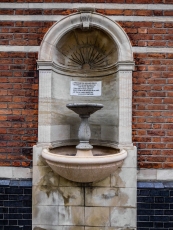
WE PARKED OUR CAR next to Petyt Place close to Chelsea Old Church and the Chelsea Embankment on the River Thames. Our aim was to cross the river to take a stroll in Battersea Park, but before we had gone a few yards, we came across a granite Victorian drinking fountain, which turns out to have connections with India.

The structure was designed by the architect Charles Barrie (Junior) who lived from 1823 until 1900. He is responsible for many buildings in London and the south-east of England. His father Charles (Senior) was the architect of the Houses of Parliament, which were rebuilt between 1840 and 1876.
The drinking fountain was erected by the widow of George Sparkes of Bromley (Kent), who died in 1878 during his 68th year. Sparkes had been in Madras (now Chennai) in southern India. Seeing this sparked my interest and inspired me to find out more about the man in whose memory it had been constructed.
George Sparkes (1811-1878) was the oldest of the six children of George Sparkes and his wife Ann Alice Wiple. He was educated at Eton. His great grandfather was John Cator (Senior). George spent his younger years in the Madras Civil Service possibly in association with his relative Peter Cator. The latter, who served as a barrister and Registrar to the Supreme Court in Madras, was involved in education in India and published a book, “Christian Education in India: Why Should English be Excluded?”, in 1858. According to an issue of “Asian Intelligence” dated 1835, Peter donated 10,000 rupees to the Society for Promoting Christian Knowledge in Asia.
Like his relative Peter, George was part of the legal system of the East India Company. He had been a judge. A book, “The Asiatic Journal and Monthly Register for British India and Its Dependencies, Volume 16”, records that in April 1835, George was appointed ‘assistant judge and joint criminal judge of Malabar’. Malabar, being on the west coast of southern India. Earlier that year he had been appointed ‘registrar of zillah court of Malabar’, a zillah being a subdivision of a British Indian province. The same volume states that George landed in India on the 17th September 1834 having sailed from London on a vessel named ‘Arab’. Just in case you are wondering what the Malabar coast had to do with Madras on the other side of India, let me explain that during the existence of the East India Company, part of the Malabar was under the jurisdiction of Madras.
By 1846, George had returned to his native place, Bromley in Kent. That year, he published “An Easy Introduction to Chemistry”. Its publication was noted in the ‘Books Received’ column of the ‘Provincial Medical and Surgical Journal’ dated 14th of October 1946. Clearly, Sparkes had versatile mind. Sadly, a review published in “The Chemical Gazette, Or, Journal of Practical Chemistry, in All Its Applications to Pharmacy, Arts and Manufactures” was critical of it, stating that it contained a number of mistakes and had failed to keep up to date with the latest developments in the subject.
By 1851, George, living in Bromley where today stand Bromley’s Central Library and Churchill Theatre, had become Director of the ‘Reversionary Society’. This might have been The Reversionary Interest Society Ltd, which dealt with reversionary interest connected with trust funds.
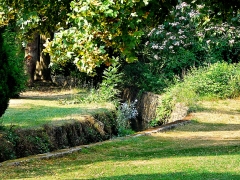
In the 1850s, George bought number 16 High Street in Bromley. He renamed it ‘Neelgherrries’, his spelling of the Nilgiris, hills in Tamil Nadu to which he would have retreated to escape the heat of Madras in the hot seasons. The author of a website, londongardenstrust.org, wrote:
“Contemporary photographs of Nilgiris in the 19th century show an Indian landscape very similar to the uninterrupted views that Sparkes enjoyed from his house in Bromley.”
Sparkes was a keen gardener and in 1872 he wrote to Charles Darwin, who lived nearby, to discuss the results of his experiments in crossing primula plants. By then, he had been married to his second wife Emily Carpenter (1819-1900), his housekeeper, for seven years. On his death, he left Emily the considerable sum of £140,000 and his house, Neelgherries. She remarried a Mr Dowling, but the union was not a great success. It was Emily who was responsible for commissioning the drinking fountain on Chelsea Embankment. When Emily died in 1900, she:
“… left Neelgherries and grounds to the town of Bromley for ‘education and learning’, in accordance with George Sparkes’s wishes. In 1906 the Scottish philanthropist Andrew Carnegie donated £7,500 for a new library in Bromley and this was erected on the site of Neelgherries. The gardens became the pleasure grounds, these were the first Bromley Library Gardens…”
Had it not been for Emily’s decision to provide Chelsea with a public drinking fountain, George Sparkes would most likely have been completely forgotten outside Bromley. I suspect that most people walk past this memorial to an erstwhile Civil Servant of India and textbook writer without giving it a thought. I have done so several times in the past but am glad that I stopped to examine it today.
SOURCES INCLUDE:
http://www.beckenhamplaceparkfriends.org.uk/catorsbyPManning.pdf