A new skill

A progressive disease is one that keeps getting worse.

Waiters in restaurants used to confine themselves to serving food and drinks to customers.

With the advent of digital cameras and mobile telephones with built-in cameras, things have changed. Waiters need to become competent photographers, able to use any kind of image capturing device handed to them by customers seated around a table. Not only do these carriers of food need to be able to operate whatever camera is handed to them, but also they need to be good at composing photos, and many of them are.

When I first began practising dentistry back in 1982, dentists confined their activities in the surgery to dental matters. When I retired 35 years later, not only did we dentists still deal with dental matters but also with general lifestyle behavioural assessment and advice.

Like the waiters, our additional workload is rarely appreciated or adequately rewarded.

Is this progress?

Thank you so much

When I was young in the early 1960s, if something was wonderful, we would have said it was “super”. Later, something super was described as “fab”. Moving closer to the present, something fab became described as “wicked”. Now, something wicked has become “awesome”, an overused word which I do not consider to be super in any way. In fact, it is used so much that I regard it as being wicked in the old sense of that word.

“THANK YOU SO MUCH” is also currently in frequent use. Call me a “fuddy duddy” if you wish, but I have problems with this expression. I have no difficulty with people expressing gratitude, but how much is “so much”? What is wrong with just “thanks” or “Thank you very much”?

Art on the road

We have recently returned from Cochin (in Kerala, South India), where every two years there is a huge art exhibition, the Kochi Muziris Biennale, that is open for just over three months. The artworks on display are supposed to conform in a loose way to a theme chosen by the chief curator. The artworks are not for sale at the Biennale.

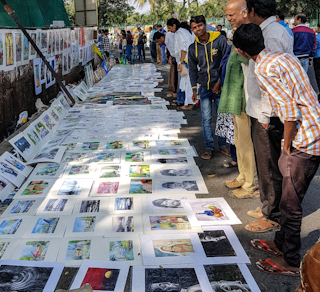
Once a year early in each January, a one day art festival called Chitra Santhe is help along Kumara Krupa Road in Bangalore. This tree lined thoroughfare runs past both the Bangalore Golf Club and also the Chitrakala Parishadh, a leading art school.

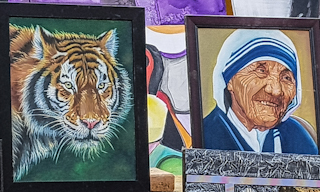
Many artists display their works along the street. Their aim is to sell to the thousands of passers by, who amble leisurely past them. The quality of the artworks varies from highly skilled to colourful kitsch. All tastes are catered for. Many visitors wander about with their wrapped purchases under their arms.

The atmosphere at Chitra Santhe is festive. The January temperatures make for pleasant outdoor art viewing. Unlike the Biennale in Cochin, there is no theme unifying the artworks on display apart from the artists’ desire to sell. The artists are happy to discuss their works and are not pushy salesmen. Prices range from very low to not unreasonably high.

If you happen to be in Bangalore on the first Sunday in January, then an hour or so at the Chitra Santhe should prove to be a rewarding and enjoyable experience.

Such is life

red and white sale illustration

Photo by rawpixel.com on Pexels.com


When we were trying to sell a house in Kent many years ago, the estate agent put a “sold” sign outside it when, in reality, someone had made an offer, but only an offer without much commitment. I removed the “sold” part of the sign to reveal the “for sale” part of the sign that was hidden underneath it. Then, I rang the agent, told him off for being premature about advertising our house as being sold. Also, I told him what I had done about it. He replied cheekily: “Good man”, without making any apology. This same agent had told us days after we put our house sale in his hands: “Don’t worry about it. I’ll sell it, okay. Now, you can just go out and spend the money right now.”

The agent’s somewhat infuriating, unapologetic answer regarding his sign was typical of people living in that part of Kent. If, for example, someone caused a problem, such as, for example, scratching your car or blocking you into a parking place, and then you alerted the miscreant to the problem, he (usually) or she would not apologise, but instead say cheekily: “Oh yeah?”

There are two other nonchalant responses that continue to infuriate me after complaining about something or having pointed out a serious problem. These are: “These things happen” and “such is life”.

A candle on the plate

I first visited India 25 years ago, arriving in January 1994. On the day before we left to return to the UK, my wife took me to Shezan, a restaurant in Bangalore’s Lavelle Road. This pleasant thoroughfare is named after a Mr Lavelle, who made his fortune at the (now disused) Kolar gold fields east of Bangalore.

My wife said to me that brilliant biryani, which I ought to try, was served at Shezan. We arrived at the restaurant, which was then housed in a picturesque colonial era bungalow.

Where this bungalow used to stand, there is now a modern office building called Shezan Lavelle. Since this was built, the restaurant has been situated at various other locations in Lavelle Road. Recently in late 2018, the Lavelle Road branch of this eatery has been discontinued. Shezan continues to operate in Cunningham Road, where there has been a branch for many years.

Back in 1994, I looked at the menu at Shezan and noticed that Chateaubriand beef steaks were being offered for the Rupee equivalent of 2 Pounds Sterling. I told my wife that I would have a steak rather than a biryani. After all, good biryanis were available in London, where a Chateaubriand used to cost eight to ten times the price at Shezan. The steak at Shezan was first class, and it continues to be so 25 years later.

Shezan used to be run by a man, who died in late 2018, and his elderly father. When we began bringing our young daughter to Bangalore in the late 1990s, we took her for meals at Shezan. Whatever was ordered for her arrived with a small candle flickering on her plate. The candle was placed in a hollowed out tomato that served as a shade.

In early January 2019, we visited the Shezan in Cunningham Road with our daughter, by now a young lady. The branch is run superbly by Aftab, a son of the recently deceased former owner.

Our daughter ordered a portion of Sholay Kebab, a slightly spicy chicken dish cooked with curry leaves. It arrived with a small candle flickering under a hollowed out tomato shell. Remarkably, the kindly Aftab had remembered our daughter after not having seen her since she was a small child.

The Old year in flames

The ending of the old year and beginning of the new one is celebrated all over the world in a variety of ways and at different times of the modern calendar. For example, the Chinese, the Gujaratis, the Parsis, the Jewish people, and the Russian Orthodox all celebrate the start of a new year on different dates. People, whatever their personal beliefs, also celebrate the end of the year on the 31st of December.

Cochin, which is a historic port in the southern Indian state of Kerala, was a Portuguese colony for a while in the 16th and 17th centuries. The Papaanji (spelling varies!) is named after a Portuguese word meaning ‘old man’.

Every year, a giant Papaanji is erected in a centrally located open space in historic Fort Cochin. During the afternoon of New Year’s Eve, the Papaanji is stuffed full of dry straw and fireworks. The roads around the open space are closed to motorised traffic. Despite this, a few youths on motor bikes manage to enter illegally.

After sunset and during the evening of the 31st of December, the area around the Papaanji fills with vendors and ever increasing numbers of people. Some of these merrymakers wear masks and others wear glowing red devil’s horns.

During the few minutes before midnight on the 31st, unbelievable numbers of people gather. The strong tide of people resembles a powerful surge of water such as you might expect if a large dam has just been breached. The crowd adds much noise to the cacophony of sound being relayed over various loudspeakers. Several times, I was almost knocked over by this human tsunami.

At midnight, the crowd became even noisier when flames began leaping from the ignited Papaanji. First, I could only see billowing clouds of smoke. Soon, frightening flames became visible. Then, bursts of stars appeared as the fireworks exploded.

Within minutes, the conflagration and fireworks ended. The old year, represented by the Papaanji, had been burnt out to make way for the new one. The crowds began to thin out a little, but despite that, it was quite hazardous trying to leave the area.

For an hour or two after midnight, boisterous revellers created much noise in the streets. The whole affair seemed to be generally good natured.

I am glad that I have seen the Papaanji aflame, but once in a lifetime is enough for me.

Indian way of worship

Over and over again, I am impressed by the “Indian-ness” of worshipping in India. I will illustrate what I mean by this by describing a small Orthodox Christian chapel I visited on Bazaar Road in the Mattancherry district of Cochin (“Kochi”) in Kerala.

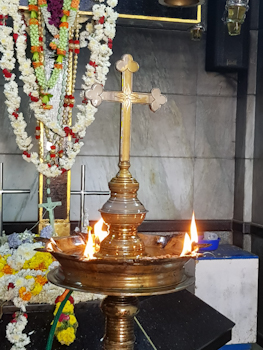
Outside the chapel, there stands a carved stone stand with indentations for oil lamps (diyas). It looks just like any diya stand that you could find in a Hindu temple, except that it is surmounted by a Christian cross.

The crucifix that stood above a small high altar within the chapel was draped with flower garlands (malas). Again, these are commonly found draped around effigies of Hindu deities.

I saw a brass diya stand with burning oil lamps directly in front of the crucifix. Like the lamp stand by the entrance, this one was also topped with a Christian cross.

If one were to replace the crucifix with an effigy of a Hindu deity and were to remove the crosses from the diya stands, the chapel would become identical to a Hindu temple.

The use of diyas and also agarbati sticks (incense sticks) is not confined to Hindu temples. I have seen them used in Christian as well as Islamic (especially Sufi) and Jain places of worship.

At a Sufi shrine at Sarkej Rauza on the edge of Ahmedabad in Gujarat, I have seen tulsi leaves being sold. These are commonly associated with Hinduism, but the vendor in the Sufi shrine told me that they were also used by worshippers who came to the shrine.

I have seen threads tied around the trunks of peepal trees by pious Hindu women hoping to have their wishes granted. I have also seen threads tied by women around pillars in Moslem shrines for the same reason.

Hinduism was probably one of the earliest religious belief systems to become evident in the Indian subcontinent. Christianity and Islam were relatively recent arrivals. Many Hindus converted to these two religions, but, I imagine, they were reluctant to abandon their Hindu heritage completely. Hence, the Hindu-ness or Indian-ness of some aspects of other religions in India.