Unknown's avatar

About yamey

Active author and retired dentist. You can discover my books by visiting my website www.adamyamey.co.uk .

Book shopping

I have been addicted to buying and owning books since I can first remember. Since my youth, the ways of purchasing books have changed considerably, not least due to the use of the Internet.

BOOKSHOP 0

When I was a child, there were two main options open to the purchaser of books: new and second-hand. Both types of books had to be bought in shops. There was also a third option: book clubs. These issued a list of books, which the customer ordered by post. Many of these clubs discounted books but made it a condition of joining that a member should make one purchase a month or every several months.

Every Saturday morning when I was a child, that is during the 1950s and ‘60s, I used to accompany my parents to Hampstead Village in north-west London. Each visit included spending time in the High Hill Bookshop, which used to exist on Haverstock Hill. My sister and I were each allowed to choose one book each week. It was that way that I built up my collection of Tintin books, written and illustrated by Hergé. In addition to these, I bought many books suitable for children and young adolescents.

To reach the High Hill Bookshop, we used to walk along Flask walk, where there used to be a shop that sold used, but not quite antiquarian, books. This was opposite what is now one of Hampstead’s only remaining second-hand books shops, Keith Fawkes. It was at the now non-existing shop that I believe my love of second-hand bookshops began. I recall finding a used but detailed guidebook to Indonesia and Malaysia one Saturday. I had already been bought a book at High Hill. My parents said that I could not buy the guide-book that day but if it was still in the shop the following week, I could buy it then. Sadly, it had been sold when I returned the following Saturday.

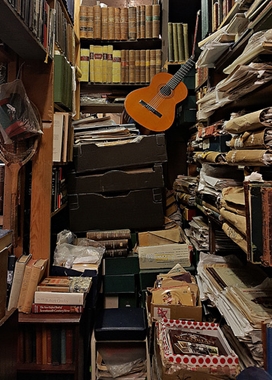
Hampstead was rich in second-hand bookshops in the ‘50s, ‘60s, and ‘70s. One of my favourites was in Perrins Lane.  At number 25 Perrins Lane, there is what looks like a small, typical late 18th/early 19th century terraced house. This was the home and shop of the second-hand book seller Mr Francis Norman. John Fowles, author of “The Collector”, “The Magus”, and “The French Lieutenant’s Woman”, wrote in his “The Journals (Volume 1)” that Norman was:

“… a bluff, awkward, friendly second-hand bookseller with a mind like a jackdaw’s nest and a shop which must rank as one of the dirtiest, most disorganised and lovable in North London. … Prices vary according to Norman’s mood.”

That was in 1956. Ten years later, Norman’s bookshop had become a regular haunt for me and my friends the Jacobs brothers. By then, Mr Norman, whose name I only discovered recently, seemed to us to be a very old man. We used to call his, un-named shop, ‘the old man’s shop’. It was just as Fowles described.

In “Old Books, Rare Friends: Two Literary Sleuths and Their Shared Passion”, M Stern and L Rosenberg wrote of Mr Norman:

When he moved from his Gower Street basement to Hampstead Heath, he had moved not only his books but all the dust and grime and debris …”

Mr Norman did not mind us spending hours rummaging through his totally un-organised heaps of books. I believe that he enjoyed our company. Every now and then, he would read something out of a book, often in Latin, and began to guffaw. We had no idea what he had found so humorous. I found all kinds of wonderful books in his shop, including several beautiful world atlases dating from between the two World Wars. Mr Norman never charged us much for whatever we managed to dig up in his ground floor shop. He kept the valuable old books on an upper floor in his personal quarters. Occasionally, on Sunday mornings, we would visit Mr Norman’s shop when it was closed. We used to knock on his front door, and he would open up the shop for us, still dressed in his pyjamas.

By the time I knew Mr Norman, he was a very sad man. Fowles writes in his “The Journals (Volume 2)” that in November 1968, he visited the ‘Old Man’s shop’ and learnt that not only had Mr Norman recently lost his fifteen-year-old daughter Janey, when she slipped off the roof of his shop whilst trying to rescue her cat. Also, his wife had been so seriously schizophrenic, and he had not seen her for years. Mr Norman had had to be both father and mother to Janey. In addition to all these misfortunes, Mr Norman had lost his first wife and family when they were all killed by a V (‘flying’) bomb in WW2. It is no wonder that Norman told Fowles:

Money does not mean anything to me now … The shop keeps me alive, that’s all I keep it on for.”
BOOKSHOP 1

All of that was long ago. Today, there are still bookshops that only purvey brand new volumes. There are still antiquarian bookshops, but their number is decreasing. And, there are newcomers on the scene. There are the familiar on-line booksellers like Amazon, ABEbooks, and Bookdepository, which sell new and used books over the Internet. These are useful for buying books at discounted prices. However, browsing on-line bookshops is more tedious than looking at physical bookshelves in a bookshop. I have to admit – and I hope that no one running a physical, real bookshop will be upset by this – that if I find a new book in a real bookshop, I will often buy it on-line if that allows me to benefit from a discounted price. Clearly, not everyone thinks like me because there are still many large bookshops occupying prime sites in Britain’s main shopping precincts and streets.

For the lover of hard to find books, the Internet offers another useful facility, namely http://www.bookfinder.com. This incredibly useful site allows the reader to search all over the world for books that are not available locally. If the book is still available for sale, bookfinder will let you know where they are available, and at wat price, and will then allow you to buy it. This system helps both the customer and the book seller. Say, for example, you have a bookshop in a hardly visited town in Alabama, which attracts the footfall of only local customers. Buy listing your stock on bookfinder, people all over the world can become aware of your stock and pay for it.

BOOKSHOP 2

The advent of the Internet may have made book buying more versatile, but nothing quite beats the book buyer’s excitement of browsing the overstocked shelves of a somewhat shambolic second-hand bookshop. So long live dusty second-hand bookshops and book-filled charity shops (‘thrift shops’)!

Herodotus and ants in the refrigerator

My PhD supervisor, ‘Prof’, and his wife ‘Wink’ used to spend their summers camping by the sea in northern Greece. Prof spent his days profitably studying an aspect of the area’s local fauna.

Prof, a good scientist, had an insatiable curiosity about everything. This knew no rest periods. Quite a few years before I met him, Prof and his family began taking summer holidays in Greece. They camped there in their caravan, which they hauled across Europe with their old Land Rover. At first, they visited many of the tourist sites in Greece as well as spending time relaxing by the sea. One of the beach resorts that they visited was Platamon in the Greek part of Macedonia. While his family were enjoying the sun and swimming, Prof noticed some large ants scurrying about on the sand. They were large enough to be seen from quite a distance. What interested him particularly was that they were most active around midday when the air temperature was at its greatest. At this time of day, hardly any creatures, let alone insects, were active. The temperature of the surface of the sandy soil on which these ants were busy carrying out their daily chores was in excess of 40 degrees Celsius. The two-coloured (red and black) ants whose bellies were carried vertically were members of the species known to taxonomists as Cataglyphis bicolor. Prof nicknamed these ants ‘catas’.

These desert ants caught Prof’s interest. After all, they were far more interesting to him than swimming or reading books. Why bother with fiction, he would have asked, when life itself is so interesting? This fascination with insects was not new; it began in his childhood days, when he had been keen on entomology. He began observing the ants in his usual methodical way. This had two results. First, their behaviour began to obsess him to such an extent that his interest in connective tissue gave way to his study of the ants’ behaviour and ecology. Secondly, because of this interest every summer holiday had to be spent in Platamon. He could not get enough of his ants. I will return to them later.

Prof’s curiosity was unending.  It extended to bizarre extremes as I was to discover shortly after I began working with him. Wink was keen on arranging large parties at their home in the Home Counties. Prof noted that the guests standing chatting with glasses of drinks in one hand helped themselves to whatever was offered to them on trays. At one of these parties, Prof, who was not keen on small talk, retired to the kitchen and opened a tin of fish-flavoured cat food. He spread this in thin layers on salty Ritz Crackers before laying them out neatly on a tray. He called the pretty young daughter of one of his guests, one of Wink’s cousins, into the kitchen and asked her to offer his unusual snacks to the guests. He wanted to test his theory that people at parties would eat anything that was offered on a tray. The young girl, who was aware what Prof was up to, began carrying the fishy snacks towards the living room, but halfway down the long corridor she turned around and returned to the kitchen. She told Prof that she felt a fit of giggles was about to begin, and that she would not be able to keep a straight face whilst offering the crackers to the guests. Wink, who told me about this later, was both furious and amused.

After many years without one, Prof and Wink acquired a small camping refrigerator. This allowed my friends to refrigerate bacon and butter and to keep milk for longer periods in the summer heat. It also allowed Prof to refine his research in an interesting way. He used to pick up a cata and then pop it into a small specimen jar. Ant and jar were then put in the refrigerator for a few minutes. The ant’s metabolism slowed down in the cold, and the creature became immobile. When it was so anaesthetised, Prof removed the ant and painted a small identification mark on its belly with the kind of paint (it was the ‘Humbro’ brand) that was used to decorate model aeroplanes made from kits such as used to be manufactured by companies like Airfix. When the ant warmed up and awoke, Prof placed it carefully exactly where he had found it.

ANT 1

Prof ‘stalking’ marked ants in northern Greece

Prof was delighted when he saw his first marked ant reappearing the following day, and again the day after. Now, he was able to follow the activities of individual ants. The marked ants were not given numbers; they were given names. Thus, ‘Alybel’ had a spot of silver coloured aluminium painted on its belly; ‘H’, who had a particularly plump belly, was named after Prof’s school friend, the larger than average Canon H; and so on. Another was named ‘Canon’. These names appeared in the scientific papers that Prof published eventually.

Once he had developed a method for tagging ants, Prof began to follow them about as they carried out their daily labours. He bought an enormous number of aluminium garden tags before leaving England for Platamon. Each of these had a rectangular part that was to be used for writing the name of a plant and a contiguous tapering section that was supposed to be stuck into the soil next to the labelled plant or seedling. Prof numbered his miniature labelling stakes from 1 upwards and kept them in numerical order on a long wire. When a marked ant poked its head out of the nest, Prof began stalking it. Every 10 seconds, he placed one of his numbers with its sharp point on the position where the ant had been, beginning with tag number 1, and then 10 seconds later number 2, and so on until the ant returned to its nest. Thus, he left a trail of aluminium labels that mapped out the ant’s footsteps. After the ant returned to the nest, he plotted out the ant’s exact path on a paper map. He did this without difficulty as he had learned how to draw maps during his spell in the army at the end of WW2.

While Prof was stalking ants, he must have looked quite odd to the casual passers-by. Dressed in a khaki safari jacket and unfashionably long khaki shorts, his head, which was largely hidden by a wide-brimmed straw hat, bobbed up and down at regular intervals as he laid each successive marker. He hoped that no one would disturb him or his markers but made no fuss when the goatherd’s goats strolled over his open-air laboratory. Once, I remember him trying to explain to the goatherd (in broken Modern Greek) what he was trying to do. The goat man remained mystified. The Greeks, incidentally, referred to the catas as κλέφτες (‘thieves’ or ‘robbers’). Prof used to wonder whether the catas, which were capable of carrying loads much heavier than themselves, were the same ants that Herodotus claims carried gold in India.

Herodotus (c480-c429 BC) wrote

(see: http://www.livius.org/sources/content/herodotus/the-gold-digging-ants/):

Besides these, there are Indians of another tribe, who border on the city of Caspatyrus, and the country of Pactyica; these people dwell northward of all the rest of the Indians, and follow nearly the same mode of life as the Bactrians. They are more warlike than any of the other tribes, and from them the men are sent forth who go to procure the gold. For it is in this part of India that the sandy desert lies. Here, in this desert, there live amid the sand great ants, in size somewhat less than dogs, but bigger than foxes. The Persian king has a number of them, which have been caught by the hunters in the land whereof we are speaking. Those ants make their dwellings under ground, and like the Greek ants, which they very much resemble in shape, throw up sand heaps as they burrow. Now the sand which they throw up is full of gold. The Indians, when they go into the desert to collect this sand, take three camels and harness them together, a female in the middle and a male on either side, in a leading rein. The rider sits on the female, and they are particular to choose for the purpose one that has but just dropped her young; for their female camels can run as fast as horses, while they bear burthens very much better.”

However, these ants, according to Herodotus, hid from the heat:

When the Indians therefore have thus equipped themselves they set off in quest of the gold, calculating the time so that they may be engaged in seizing it during the most sultry part of the day, when the ants hide themselves to escape the heat.”

So, the ants that Herodotus describe differed from the Cataglyphis ants in northern Greece in that they became invisible during the hottest part of the day. Maybe, it was hotter in the area that the ancient Greek described than in Greece.

A lady in Budapest

My PhD supervisor’s wife was fondly known as ‘Wink’. When she learnt that I was about to visit Budapest in the early 1980s, she told me the story of her friend Dora, who lived in that city.

Sometime during the war, Wink got her first job. She became a supervising chemist at High Duty Alloys, a company that had its premises on the huge Slough Trading Estate, which had been established near Slough in 1920. It was the middle of the war, and there was a great need for metal for aircraft and armaments. Everything was being melted down in order to extract vitally needed metals. Wink was involved in developing ways of improving the extraction of the highly reactive metals magnesium and aluminium from seawater. Everyone was donating whatever metal items that they could spare to help the war effort. A great number of metal cooking pots reached High Duty Alloys. Sadly, Wink related, many of these were so full of unwanted metals that separating the desirable ingredients was uneconomical; the cooking utensils had been donated in vain.

DORA 1

Dora Sos in 1985 in Budapest

Soon after joining High Duty Alloys, Wink was assigned a technician. She was a Hungarian called Dora, who had been visiting the UK as the representative of a Hungarian chemical company when WW2 broke out. She was briefly interned as an ‘enemy alien’ until the authorities decided that she did not pose a security risk. When she was released, she took up the job at High Duty. Wink and Dora, who was a little older than her, became close friends. After WW2 was over, Dora was given British citizenship. However, she was getting homesick and decided to return to her home in central Budapest.

Every now and then during the late 1940s, the British embassy in Budapest held parties and receptions for British subjects living in Hungary. One evening when Dora was on her way to attend one of these, she was prevented from entering the embassy by Hungarian police officers waiting near to its entrance. She was taken in for questioning, warned never to try to enter the embassy again, and her British passport was confiscated. Dora continued her life working in a scientific laboratory in Budapest, but under appalling conditions. Each night at the end of a day’s work, all of the laboratory notebooks had to be locked up in drawers for which she had no keys. The Stalinist authorities who ran the country at that time were terrified of espionage and sabotage. Conditions became so bad in the laboratory that Dora, who was fluent in German and English, gave up being a scientist, and became a language interpreter.

Wink told me that after a few years when Hungary’s Communist regime became a little less strict, Dora was issued with a Hungarian passport and was given permission to travel to the West for a holiday. She went to The Hague in Holland and visited the British Embassy there. She related her story to the ambassador and his staff, and after they had checked up that she had once been issued with a British passport, they issued her with a replacement for the one that had been taken from her in Budapest. She was told that she could use the British passport whenever she was out of Hungary. All that she needed to do was to enter whichever British Embassy was near her, and then arrangements would be made to issue her with another British passport. And, before returning to Hungary, she could return her British passport to the nearest embassy for safe-keeping. Thus, she was able to visit Wink in Britain on a number of occasions.

When I began making regular visits to Hungary in the early 1980s, Wink gave me Dora’s address, and I met her. We became good friends. Whenever I was in Budapest, I used to visit her in her first floor flat in a late 19th century apartment building near to Moskva Ter in Buda. She always asked me for news of Wink and her family. A chain smoker, she was also a good cook. Whenever I visited her, she would serve me generous helpings of her home-made chicken paprika. This was always accompanied by noodles that she had just prepared with freshly made dough that she extruded through a mesh straight into boiling water.

Dora told me that under Communism very few young people learnt English in Hungary. Learning Russian was compulsory. Therefore, there was a shortage of English interpreters in the country. Often, she was asked to interpret at scientific conferences. She was able to perform simultaneous translations from German into English and vice-versa. This is no mean feat for someone whose mother tongue was Hungarian. Before my visits to Budapest, I used to write to Dora and my other friends there, announcing my travel plans. On more than one occasion, Dora commissioned me to bring the latest editions of particular technical dictionaries from London to her in Budapest, where these volumes were not available. She told me that whenever she was able to travel to the West, she would buy copies of Solzhenitsyn’s works. These were strictly forbidden in Hungary. She told me that whenever she returned to Hungary from the West, she would be asked by the Hungarian customs officials whether she was carrying any of these so-called ‘solzhis’.

DORA 2

In the house where Bela Bartok lived in Budapest

When I visited Budapest with my wife in about 1999, we visited the apartment house where Dora lived as I had been unable to get through to her by telephone. When we reached the door of her flat, which opened onto one of the galleries surrounding the building’s courtyard, I looked at the name on the doorbell.

It was no longer Dora’s.

A Chinese gong in Bangalore

The Bangalore Club, until 1947 a British officers’ club (the Bangalore United Services Club), was founded in 1868.

gong

At the entrance to the dining hall, there stands a heavy metal Chinese gong shaped like a ship’s anchor. It is held in a wooden frame surmounted by carved wooden dragons. On each of its flat surfaces, there are Chinese pictograms (writing characters).  My friend Pamela Miu has kindly translated these Chinese pictograms. What she tells me gives some clues as to the history of the gong, which I have been seeing regularly for 25 years.

On one side, the inscription reads that the gong once  belonged to the imperial navy school of the late Qing dynasty’s Beiyang Fleet, dating the object to the late 19th century.

The other side of the gong includes a date. This refers to the Qing Dynasty period. It mentions the the gong’s date is October in the 21st year of the reign of the Guangxu Emperor, who ruled 1875-1908. This dates the gong to 1897.

How the gong reached Bangalore from the Chinese naval school is a mystery at present. Apparently, the Beiyang Fleet suffered many defeats. Also, the British, along with seven other nations, fought the Chinese and looted many treasures from China. Tjis gong might well be be part of the loot. Finally, Pamela mentioned that when the British took (leased) Hong Kong in 1898, many of its police force were brought over from India.

So, there is a bit of the history of a dinner gong, which I have never seen used.


Many thanks to Pamela Miu

Flight to Crete

As a youngster, I had problems at high altitudes. These first became manifest during the early 1960s when my parents took me on a driving holiday through France to Switzerland. We were driving up a mountain pass – I cannot remember which – and I felt extremely unwell. My parents attributed my (temporary) malady to the high altitude we had reached.

CRETE

Some time later, in the late 1960s, we flew from Athens to Iraklion in Crete. We boarded a propeller driven aircraft at Athens Airport. I had forebodings from the moment the ‘plane began to move. Before taking off, the ‘plane made an excessively long trip around the airport. On our way, we passed several disastrous looking aeroplanes. Some of them were burnt out, and others looked as if they had been involved in collisions. Seeing these did nothing to assuage the fear of flying that I used to have.

Eventually, we became airborne. I was seated next to a chain smoker, who produced a persistent cloud of smoke, and my mother. From the moment we rose above Athens to a few minutes before we landed in Iraklion, the aircraft was shaken horribly by turbulence. After a few minutes in the air I felt tingling in my fingertips. Naively, I thought that this was something to do with my neighbour’s cigarettes.

Suddenly, I felt a plastic mask being placed over my face. My mother had noticed that my skin was becoming blue. She had called the stewardess, who immediately supplied me with oxygen from a portable cylinder. I wore this for the rest of the uncomfortable flight. All of us felt dreadful when we landed in Crete. It took us a day to get over the flight. My parents made sure that our return flight was booked on a jet rather than a prop ‘plane. The newer jet-propelled aircraft had better cabin pressurisation, and the problem, which I had on the outward-bound journey, was not repeated.

Since those long off days, I have never suffered from high altitude problems. I have crossed alpine passes without illness, and Bangalore in India, which I visit often, is almost a thousand metres above sea-level. Although I have studied physiology, I have no real idea why as I grew older high altitudes affected me less. As I write this, I wonder whether when I was a young boy, I had a mild anaemia, which only manifested itself when suddenly reaching a higher altitude. Who knows?

Things go better with Coke

It was the day after the much-loved fimstar Ambareesh died. He was a hero all over the Indian state of Karnataka. To respect him, alcohol sales were forbidden in Bangalore. It was what is called a ‘dry day’. One could not order any alcoholic drink at a bar, restaurant, etc.

So, being unable to order an alcoholic drink, I ordered Coca Cola.

“Coca Cola” the waiter queried, “it’s not available. Today is dry day, sir”

“But Coca Cola is not alcoholic” I protested, adding “Coke, you know”

“Ah, Coke, sir. I can bring you that,”the waiter said, at last understanding what I was trying to order.

Chewing gum


It was in Turkey that I first tried chewing gum. I was ten years old. It was 1962, and we were staying at the Hotel Çınar at Yesiliköy on the Marmara Sea just west of Istanbul. We walked from the hotel into the nearby village, where my parents bought me a small pack of chewing gum. The pieces of gum were coated with a hard, sugary outer layer. I thought that this layer extended right through the piece, and I was surprised to find when I bit into it that it contained a soft gooey substance. I was not impressed.

GUM 1

Source: wikipedia

A year later, the family spent the last three months of 1963 in Chicago, Illinois. It was while we lived in the USA that I became very keen on chewing gum and its close relative bubble gum (specially the Bazooka brand). Between arriving in America and leaving Turkey, I had learned how to enjoy chewing gum. In America, the range of flavours of gum was huge compared with what was available in the UK. I used to chew a piece of gum and when its flavour had weakened, I added another piece, and then another, and so on until there was a huge mass of gum in my mouth. This ever-growing glob of gum would remain in my mouth for several hours.

I attended school while we were in Chicago. In each class room there were desks with swivelling desk-tops for writing on. I soon discovered that the undersides of these desks were covered with soft blobs. After touching these blobs, I discovered that the tips of my fingers acquired different pleasant odours. Naïve as it may sound, I only discovered after returning to England that these ‘perfumed’ squishy mounds were bits of discarded chewing gum.

In the late 1960s and the following decade, we used to visit Greece almost every year. In those days, Greek cities and towns had numerous kiosks selling newspapers, magazines, and … chewing gum. The most commonly found brand of gum was ‘Chiclets’. This trade name, established in 1900 in the USA is derived from the Spanish word chicle, which means ‘chewing gum’. The range of flavours available at these kiosks was much greater than what was available in the UK at the time.

We took many flights during my childhood. In the 1960s and ‘70s, many ‘planes were not as well pressurised as modern aircraft. During take-off and landing, there was a risk of much ear-popping. Sucking sweets or chewing gum was recommended to reduce the unpleasantness of the ear popping.

I was happily chewing gum as was usual on a flight when a thought occurred to me. The endless chewing of gum brought the rumination of cattle to mind. Suddenly, I compared myself to cattle chewing the cud. Although I have no objection to cattle moving their jaws endlessly, I felt that it was inappropriate that I should be doing the same. Since then, I have rarely chewed gum, and when I have done so I have found that my jaw muscles tire easily.


GUM 2

Source: CollectingCandy.com

Garden city

Bangalore in South India has long been known as the ‘Garden City’.

There are still many trees and gardens in the city, but these are gradually disappearing. With a population of 10 MILLION or more, there are excessive demands on the water supply. Trees are being chopped down to allow for road widening. This is causing the water table to sink lower and lower beneath the surface. The loss of tree cover and green space, which is becoming gobbled up by property developers, is causing the average ambient temperature to rise.

The ‘Garden City’ is under threat: it will soon be a concrete jungle, a jungle with few plants. Some say that within a decade or two, Bangalore will become uninhabitable. I hope this will not happen because the city is still a vibrant metropolis with a rich cultural and commercial life.

Archimedes and Eureka!

As a young child I was fascinated by the following story, which may be apocryphal. Archimedes (c287-c212 BC), the great Greek physicist, mathematician, engineer, and general genius, is reputed to have made an important discovery whilst taking a bath. He noticed that the level of water in his bath rose as he immersed himself in it. This led to his famous Principle. When he realised the significance of the change in water level, he is said to have leapt out of his bath yelling “Eureka”, which is the Greek for “I have found it.”

ARCHIMEDES

In 1960, my father had to attend a conference at Kyrenia (Girne in Turkish), which is now in Turkish Northern Cyprus. It was then part of one unified country. We, the rest of my family, accompanied him. On our way, we had to change ‘planes in Athens. I remember walking down the steps that led out of the aircraft from London and feeling my face hit by a wave of burning hot air. I thought for a moment that I was feeling the exhaust from the ‘plane’s engines, but soon realised that the air at the airport had a very high ambient temperature.

On our return from Cyprus, we spent a few days in Athens. Our visit happened shortly after I had learnt about Archimedes and his Principle at school. In Athens, we visited numerous ancient Greek and Roman sites, and this put the idea into my head that somewhere amongst these ancient ruins we should be able to locate the famous bath out of which Archimedes leapt. Rather sportingly, my parents hired a taxi and explained to the driver the nature of our quest. He was happy to spend hours driving us around Athens, stopping regularly to enquire about the location of the bath. It was a fruitless quest. During the hours that we spent with our driver, he told us that he was Jewish. When he realised that we were his co-religionists, albeit completely non-practicing, he took us to see a synagogue, which was unmemorable architecturally.

Sadly, after spending time in the taxi, we were not able to exclaim “Eureka.”

Some months after we returned to London, I discovered that Archimedes had lived in Syracuse (Sicily) rather than Athens. If his bath had ever existed and still happened to be in existence, which was highly unlikely after so many centuries had elapsed since his death, it was there that one needed to search for it, rather than in Athens.


To read about more of Adam Yamey’s childhood travels, CLICK HERE