Unknown's avatar

About yamey

Active author and retired dentist. You can discover my books by visiting my website www.adamyamey.co.uk .

Two famous vegetarians

Some famous vegetarians…

yamey's avatarGUJARAT, DAMAN, and DIU

gandhi

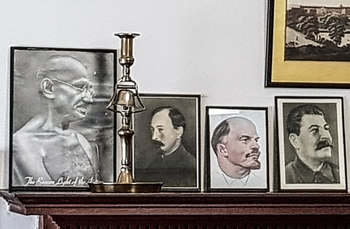
A photograph of Mahatma Gandhi stands above a fire place in the home of the great paywright George Bernard Shaw at Ayot St Lawrence in Hertfordshire. Gandhi, born in Porbandar in Gujarat, met Shaw in London in 1931.

Both of these great men were vegetarians. Shaw said: “Animals are my friends . . . and I don’t eat my friends.” And Gandhi said: “To my mind, the life of a lamb is no less precious than that of a human being.  I should be unwilling to take the life of a lamb for the sake of the human body“. 

While Gandhi never visited Shaw at his home, Jawaharlal Nehru did in 1950.

In the UK, Jeremy Corbyn, the Labour politician, is also a vegetarian. I wonder what Shaw would have thought of him and whether he would have put Corbyn’s photograph on his mantle-piece.

Quotes from https://shawsociety.org/Sri.htm

View original post

Green and wet

The heart of Central Europe_800


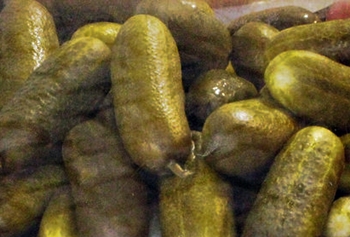
As a child and teenager, I did not like gherkins (pickled cucumbers). My parents ate them, but refused to buy them if they were made behind the Iron Curtain, for example in  Bulgaria, Czechoslovakia, Hungary, or Poland. They would only by jars of these green, wet vegetables if they were made in Western Europe, say in West Germany or Holland. You may well wonder why my parents were so fussy about the origin of their gherkins. The answer is simple. They were unwilling to buy anything from Soviet-dominated parts of the world because they felt, rightly or wrongly, that every penny they paid for goods from these areas would help the Soviet Union pay for yet another atomic bomb or some other military equipment that could be used against the West.

I did not worry me where my parent’s gherkins were grown and bottled, as I did not eat them. This was true until the late 1970s when McDonalds opened a branch of their hamburger restaurant chain in London’s Haymarket.

At first, I felt that I was too superior to enter a McDonalds, and developed an irrational prejudice against the company. Eventually, some friends decided to eat at the Haymarket branch andas I was with them and also a little curious about McDonalds, I joined them. I cannot recall which burger I ordered, but whatever it was, it contained slices of gherkin. I did not remove the gherkin as I might have done had I been served it a few years earlier. I bit into the burger and realised that it was the gherkin that made the rest of the burger sandwich delicious. From that moment onwards, I have become a gherkin afficionado.

I am happy eating gherkins anywhere. However, some of the nicest gherkins that I have found are those often served in fish and chips shops. These large, very tasty specimens often come Holland. Served from large glass jars, these gherkins are often known as ‘wallys’ (pronounced ‘wollees’) in London and South-East England.

Finally, here is something that you might not know about gherkins. The south of India, which I visit often, hasbeen a major producer and exporter of gherkins since the early 1990s. The soil condition in that region are perfect for growing the cucumbers that will be pickled. For more information, see: http://igea.in/.  Had these been around in the days before the fall of the Iron Curtain, I wonder whether my parents would have bought them.

Every day I am a tourist

LONDON PIC

Recently, I was walking along the South Bank close to London’s National Theatre when I saw two friends approaching each other. One said to the other:

“Hello, tourist!”

The other replied:

“I am a tourist everyday.”

This got me thinking that I am also a tourist every day. Since I retired in September 2017, my time is more or less my own. However, I do not sit at home bemoaning the fact that I have no work to do. On the contrary, I love my freedom to do what I wish. 

Almost every day, when not travelling abroad or to some other part of the UK, I visit somewhere in London. It may be local or more distant, it does not matter where. Wherever I go, I discover something new, something that either did not exist before because it is newly built or opened or something that has been around for ages, which I have never noticed before.

London is so rich in experiences and sights that even a person like me, who has lived there for over 60 years, can always find novelty when stepping out of the house. Every time I leave home, I enjoy and appreciate London. Every day, I become a tourist in my own city.

Venice observed


Venice is a special place in many ways. This meeting place of oriental and occidental art is bathed in light of a special quality. Maybe this is due to the fact that there is so much water reflecting the daylight and thereby increasing its intensity. Maybe, it is something else, but whatever it is, part of the beauty of Venice is its lovely light.

Artists have long been attracted to portraying Venice. Canaletto portrayed the city almost photographically in his paintings.  Guardi captures the city brilliantly by using an almost impressionistic technique. Ruskin captured the beauty of the Venetian architecture scholarly yet attractively. Other artists such as Manet, Monet, Moran, and Turner have also portrayed some of the ‘essence’ of Venice’s attractiveness.

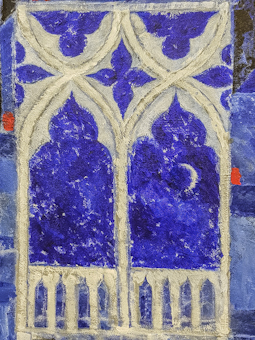
Yesterday, I visited an exhibition of new paintings inspired by Venice by the British contemporary artist Joe Tilson (born 1928). Each of his deceptively simple canvases capture several aspects of what makes Venice attractive for me. Architectural details, coloured patterning like tiles or brickwork, and moonlit skies  conspire to evoke the special light an appearance of Venice. His painting is both simple and subtle, and above all visually satisfying.


The exhibition is at Marlborough Fine Art, 6 Albermarle Street, London W1S 4BY until 18th May 2019

Why I started to write

Cuneiform_240


Well over 10 years ago, I came across a website specialising in genealogy relevant to my background. I was curious about my ancestry, but knew very little about it. So, I registered with the site.

One of the sections of the website allowed members to insert surnames alongside towns with which the surnames were associated. So I put my mother’s maiden surname next to the name of a small town in South Africa, where she lived with her parents as a young child. I did the same with my father’s surname. The idea behind this particular section is fo researchers to see if any of the surnames that they are looking into match entries that other researchers had entered. For example, I might have entered ‘Goldberg’ alongside ‘Cape Town, South Africa’. If another person was interested in ‘Goldberg’ families either in Cape Town or South Africa searched this section of the website, they would find all of the Goldbergs in Cape Town or South Africa, which had been entered by other researchers, alongside a link for contacting the person who had entered the information.

So, I entered the two names as described earlier, expecting very little or nothing to happen. My skepticism mas ill-founded. Two days later, I received a message from someone, whose name I did not recognise. He had found my mother’s maiden surname alongside the small town where she lived in South Africa. My new correspondent had worked out that he and I are second cousins. Subsequently, he sent me a family tree for my mother’s father’s family. 

When I told my mother’s brother about this beginner’s luck, he added to it by giving me the family tree for another of my ancestors. One thing led to another, and soon I had compiled an enormous composite family tree. 

My wife commented that it was all very well collecting ever increasing numbers of names to add to my family tree, but that it was not particularly interesting. She suggested that what would be far more interesting would be to look into what the individuals on the tree did when they were alive. This proved to be fascinating, and was the reason that I began writing and publishing books and articles. I fell in love with writing. Regular readers of this blog will know by now that my interests are no longer confined to tales about my ancestors.


Picture shows Cuneiform writing at the British Museum

Glass in the garden


Once again, London’s Kew Gardens is hosting an exhibition of glass sculptures by Dale Chihuly (born 1941). The amazingly crafted glass artworks of often quite complex design have been placed both in the open-air and inside some of Kew’s lovely old glass-houses. 

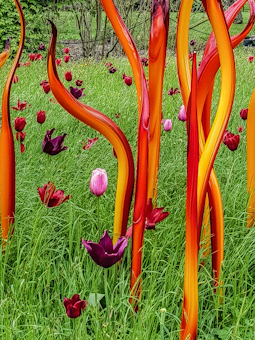
The curvy tubes with pointed ends shown in my photograph have been tastefully planted in a grassy field dotted with tulips. In the Temperate House, a large glass mobile has been suspended from the ceiling and smaller objects mingle with the plants. Wherever you look, you will find glass artefacts in  intimate contact with the plants growing around them. In the Water-Lily House, large glass sulptures evoking the flowers of water-lillies mingle with the real plants whose fronds float on the water.

As time passes and the plants grow more, some of Chihuly’s colourful glass objects will become harder to find.  The plant-like forms of many of the artworks mix with the plants to provide in some cases a stark contrast or in others they almost blend with the plants around them.

It is well worth visiting Kew whilst these sculptures are on display. However much I like the glass artworks, the stars of the show are for me the plants themselves (rather than the sculptures). This highlights how difficult it is for man to compete with nature on the aesthetic playing field.


The Chihuly works are on display at Kew Gardens until the 27th October 2019

Getting to grips in the kitchen


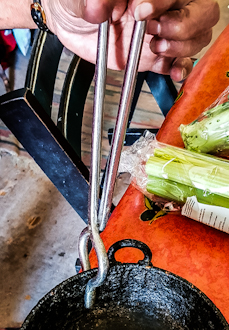
Just in case you have not got one in your kitchen, here is an implement that is extensively used in Indian kitchens and tea stalls.

The sandasi (pronounced roughly like ‘sun-er-see’ said fast), which is is also known as a pakad (from the verb ‘to hold’ in Hindustani) or a chimta (from the verb ‘to pinch’ in Hindustani), is essentially a pair of sturdy hinged metal (stainless steel) tongs. The handles of the implement are several times as long as the gripping elements. This means that quite heavy things may be lifted with the beaks of the tongs without any risk of them slipping out of their grip.

The sandasi’s long handles also mean that the user’s hands can be kept at a safe distance from the hot cooking vessels that are lifted with this pair of tongs. For example, the tea maker can lift and manipulate with ease the huge pots containing several litres of a bubbling, boiling mixture of milk, tea, and spices. 

I find the sandasi very useful for gripping the edges of large casseroles when I am stirring hot food like stews or curries.

Cooking tongs are, of course, available in countries other than India, but the sturdy construction and long handles of the sandasis have much to reccommend them.

The first fly

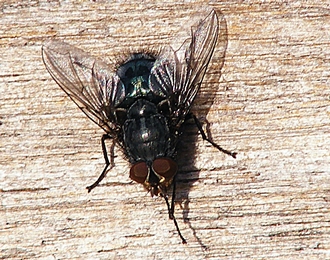
Fly on wood


The first fly of this year flew into my room just after the short warm spell we had in London over the Easter weekend. It was not the first fly that I have seen this year because the first couple of months of this year I spent in India. However, the fly in question, which arrived in late April, was the first fly that has tried to annoy me in London.

Although its buzzing and endless fly-passes can become annoying, there is another sensation that seeing and hearing the insect evokes in me. It reminds me of summer, a season I love. So, despite it annoying me, seeing this first plump fly also makes me joyful and gives me the feeling that warm, long bright days are not far off in London.

Tastes differ


food toast meal morning


When I was a child, I spent a great deal of time with my aunt and her children. They lived a few minute’s walk from our family home and I enjoyed spending time with them. Often, my sister and I used to spend a whole day at my aunt’s house, sometimes over night especially when my parents were away on a trip.

My aunt fed us. Sometimes she made us fried eggs. Then, I was a very fussy eater. In those far-off days, I only liked the white part of the fried egg, not the central yellow bit. One of my cousins only liked the central yellow part, but disliked the white surrounding it.  My aunt was an extremely down-to-earth individual, laden with more than a fair share of common sense. Her solution to the fried egg situation was that after making the fried egg, she used to carefully dissect the yoke portion of the finished product and serve it to my cousin. I was given the white portion of the egg with a neat hole in it where the yellow had been.

Today, many decades later, I am not keen on any part of a fried egg and do not eat eggs prepared in this way. I much prefer omelettes and hard-boiled eggs. However, I do enjoy making them for other people, The challenge is to avoid breaking the yoke. 


Photo by Pixabay on Pexels.com