Diana and the deer

LIKE AN ORIENTAL PASHA with his harem, a large stag with huge branching antlers sat in the shade of a big tree on a warm September afternoon in Bushy Park. Five female deer sat close by, all of them looking at him attentively.

Bushy Park abuts the grounds of Hampton Court Palace, which was built in 1515 for Henry VIII’s former favourite, Cardinal Wolsely, who died in disgrace in 1530 after losing the king’s favour. The area where the Park stands has known human usage since the Bronze Age, maybe as long ago as 4000 years. In mediaeval times, the area was used for agricultural activities.

In 1529, when Henry VIII took over Hampton Court from Cardinal Wolsely, Bushy Park became used for deer hunting. Later, in the 17th century, King Charles I (reigned 1625-1649) ordered the building of a canal, the Longford River, which carries water for 12 miles from the River Colne (a tributary of the Thames) to the grounds of Hampton Court Palace. The man-made waterway, designed by Nicholas Lane (1585-1644) and dug by hand in only 9 months in 1638-39, flows through Bushy Park, supplying water to its numerous water features. The water was drawn from the river Colne at a point (Longford near Slough) whose altitude (72 feet above sea level) was great enough to ensure a fast flow to Hampton Court Palace, which is only about 13 feet above sea level. Today, the water still flows rapidly through the Park’s numerous streams.  Later, the architect of the current St Pauls Cathedral, Sir Christopher Wren (1632-1723), designed the mile-long avenue (Chestnut Avenue), which runs through the Park, and its water feature as a grand approach to Hampton Court Palace.

During the two World Wars, large parts of Bushy Park were used temporarily to grow much-needed food for the British public. Before it became a royal hunting ground, much of the park was common land, accessible to all and sundry. The general public had to wait to have access to this lovely area until the reign of William IV (reigned 1830-1837), who requested that there should be free admission of the public to ‘his’ park. In 1838, when Queen Victoria opened the grounds of Hampton Court to the people, visits to Bushy Park increased. The park’s popularity grew significantly when the railway reached Hampton Court from London in 1849. Today, judging by how difficult it was to find a space in the car park, Bushy Park’s popularity continues to be great.

We entered the park, driving along the Chestnut Avenue. With its tidily arranged rows of trees, it reminded me of an entrance driveway to a French chateau or one of the opening scenes in the film “Last Year in Marienbad”.  Each tree is protected from the park’s deer by its own fence. We drove off the avenue into the car park near the Pheasantry, café with pleasant outdoor tables and chairs, housed in a pleasing contemporarily designed building (built 2014, designed by Mizzi architects, who have been responsible for many attractive kiosks in Kensington Gardens and Hyde Park and other Royal Parks).

After drinking coffee, we took a walk in the park. There are patches of woodland fenced off from the rest of the park, doubtless to prevent deer from entering. The Woodland Gardens have many trees and bushes. The shady area is dotted with ponds, some of them almost covered with waterlilies, and fast flowing, shallow streams. Small bridges cross the streams in this delightful part of the park and many ducks swim in the water.

We left the woodland area to enter the rest of the park. This consists of wide expanses of grassy terrain with isolated, and, also, clumps of trees. These areas allow the visitor to enjoy wide vistas and huge expanses of sky. It does not take long before you spot deer grazing, some of them quite close to visitors enjoying the park. What at first sight looks like a distant leafless tree branch will suddenly begin moving, proving that what you had spotted was not a piece from a tree but the antlers of a stag. Seeing the deer running wild is a joy that adds to the loveliness of the park. We also saw horseriders and cyclists, but these are not as visually interesting as the deer.

After taking a somewhat circuitous but very picturesque route through the park, we arrived at a circular pond, which is near the Hampton Court end of Wren’s Chestnut Avenue. Part of the original design, the avenue skirts the circumference of the pond. As we approached the pond, a solitary heron sitting on its edge, noticed us and then flew elegantly across the pond, less than 3 feet above the water’s surface.  The middle of the pond is occupied by a fountain surmounted by a gold-coloured statue. The stone plinth on which the statue stands has several more metal statues, which are not gilded. These are most probably, but not definitely, works of the Italian Francesco Fanelli (c1590-1653). The tall stone plinth was designed by, amongst others, Nicholas Stone (c1586-1647).

The gilded figure on the top of the fountain depicts Diana, the Roman goddess associated with hunting. This seems like an appropriate statue to stand in what were royal hunting grounds until the 19th century. However, when the French sculptor Hubert Le Sueur (1580-1658) was commissioned by King Charles I to make this statue to adorn the garden of his wife, Queen Henrietta Maria, it stood at London’s Somerset House. There, it stood on a lower pedestal than it does today. Incidentally, Le Sueur’s bronze equestrian statue of King Charles I stands in Trafalgar Square close to the point from which all distances from London are measured. Both Hubert Le Sueur and Francesco Fanelli had had experience working in the Florentine studios established by the Flemish born sculptor Giambologna (1529-1608), who was famous for his bronze statuary.

The Diana statue and the rest of its associated artworks were moved to Hampton Court Palace by Oliver Cromwell during the English Commonwealth (1649-1660). The fountain topped by Diana was moved to its present position during the works carried out to the designs of Sir Christopher Wren. The current plinth was completed in 1713 during the reign of Queen Anne. So, it was not until the 18th century that the goddess of hunting stood amongst the hunters’ prey. Although it is commonly held that the gilded statue represents Diana, some believe that it might depict Arethusa, Proserpina, or Venus. The one person that she does not depict is the late Diana, Princess of Wales.

After the heron had taken flight, we noticed about four black-coloured birds perching on the sculptures on the fountain’s plinth. One of them was on top of Diana’s head. The birds had largeish bodies and long necks that were often in sinuous poses. They resembled cormorants, but none of them had their wings unfolded, which is what these creatures do to dry them.

It was my first visit to Bushy Park, and I hope that many more will follow. I have learnt much about the park whilst researching this essay. Future visits will be enhanced by the knowledge I have acquired. I am grateful that our friends in Richmond have introduced us to yet another part of London that was until recently quite new to me.

Finally, it is useful not to confuse Bushy near Hampton Court with Bushey in Hertfordshire.

TV licence

WE WATCHED TELEVISION FOR less than two hours in the whole year of 1993 and decided neither to renew our TV licence nor to watch anything more on our ageing TV set, which we got rid of. At monotonous regularity, we received letters from the TV licensing authority, asking us whether we had a licence and informing that if we did not have one, there would be dire consequences. They were all aggressive and threatening in tone. We always replied that we had no TV. Eventually, my wife got fed up with these annoying missives.

She took the latest threatening letter from the TV licensing authority and wrote a letter on it that went something like this:

“To whom it may concern. We neither own guns nor sell liquor. Neither of the authorities that license these things pester us for licences. We do not possess a television, as we have told you before. Why do you persist in sending us letters regarding TV licences? Please cease forthwith.”

My wife read me her letter and asked me whether I thought it was alright. I asked her in whose name she had signed it. She told me that it was in her maiden name. I told her to go ahead and send it.

For a while, we did not hear any more from the TV licensing authority. Now, we receive differently worded but still threatening letters from the authority, but these are addressed to “The Occupier” rather than to anyone in particular.

A few days ago, at the end of August 2020, there was a small piece in the London ‘Times’ newspaper. It reads as follows:

“Rachel Mackay, a manager for Historic Royal Palaces, gave a sigh when she received a familiar brown envelope addressed to ‘The Current Occupier, Kew Palace, which has not been lived in for two centuries. ‘Oh good,’ she said, ‘it’s the time of year where I have to explain to the TV Licensing Authority why George III hasn’t paid his TV licence since 1820.”

We know how Rachel Mackay must be feeling.

Abolishing slavery and an obelisk

BLACK LIVES MATTERED MUCH to young Thomas Clarkson (1760-1846), who was born in Wisbech, Cambridgeshire. One day when he was walking with his horse from Cambridge to London, he stopped on a slope that was above and in sight of the Feathers Inn at Wadesmill (Hertfordshire) next to a bridge crossing the River Rib on a stretch of the old Roman road known as Ermine Street.

A student at St Johns College in Cambridge, he had just won a prize for his essay (in Latin) that addressed the subject “Is it right to make slaves of others against their will?” Soon after writing his piece, he published an English translation of it. Clarkson, who had done much research into slavery past and in his time, was thoroughly disapproving of the slave trade. The concluding paragraph of his long and well-reasoned essay, rich in factual material, summarises the young man’s objection to slavery:

“For if liberty is only an adventitious right; if men are by no means superiour to brutes; if every social duty is a curse; if cruelty is highly to be esteemed; if murder is strictly honourable, and Christianity is a lye; then it is evident, that the African slavery may be pursued, without either the remorse of conscience, or the imputation of a crime. But if the contrary of this is true, which reason must immediately evince, it is evident that no custom established among men was ever more impious; since it is contrary to reason, justice, nature, the principles of law and government, the whole doctrine, in short, of natural religion, and the revealed voice of God.”

With the Feathers inn ahead of him, he had a revelation. In his own words:

“Coming in sight of Wades Mill in Hertfordshire, I sat down disconsolate on the turf by the roadside and held my horse. Here a thought came into my mind, that if the contents of the Essay were true, it was time some person should see these calamities to their end. Agitated in this manner I reached home. This was in the summer of 1785”

That revelation, like a Dick Whittington moment or the apple falling on Isaac Newton’s head, set Thomas on his life’s mission to abolish slavery. His essay inspired the formation of a small group of Quakers, whose aim was to lobby the British Parliament to campaign against slavery. Soon, this led to the formation of a non-denominational ‘Committee for the Abolition of the Slave Trade’ (in 1787).  Clarkson was a member of this committee. It was he who encouraged the young (and now well-known) William Wilberforce (1759-1833), a Member of Parliament, to join the group.

Although it was Wilberforce who introduced the first Bill to abolish the slave trade in 1791, it was Clarkson, who worked tirelessly to persuade the British public of the desirability to bring an end to the trade in human cargoes. Clarkson travelled about 35,000 miles throughout Britain, amassing information about the slave trade and persuading people of its evil nature. He collected evidence of the cruelties and injustices of slavery from 20,000 sailors who had worked or were working on slave carrying ships. He wrote several pamphlets about the slave trade and its impropriety and assembled visual aids with which he could dramatically purvey its horrors and cruelties to the British public, whom he encountered during his extensive travels.

When, finally in 1807, the Act for Abolition of the Slave Trade was passed by the British Parliament, the poet William Wordsworth (1770-1850) wrote a sonnet in honour of Clarkson’s immense efforts to defeat the slave trade. Called “To Thomas Clarkson On the final passing of the Bill for the Abolition of the Slave Trade, March, 1807.”, it goes like this:

“Clarkson! it was an obstinate Hill to climb:

How toilsome, nay how dire it was, by Thee

Is known,—by none, perhaps, so feelingly;

But Thou, who, starting in thy fervent prime,

Didst first lead forth this pilgrimage sublime,

Hast heard the constant Voice its charge repeat,

Which, out of thy young heart’s oracular seat,

First roused thee.—O true yoke-fellow of Time

With unabating effort, see, the palm

Is won, and by all Nations shall be worn!

The bloody Writing is for ever torn,

And Thou henceforth shalt have a good Man’s calm,

A great Man’s happiness; thy zeal shall find

Repose at length, firm Friend of human kind!”

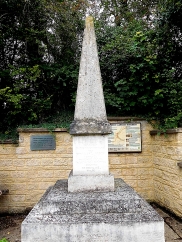
It was descending the hill to Wadesmill that set Clarkson, the real initiator of the abolition of the slave trade, that set him to “… climb that obstinate Hill…” And his halt near Wademill, in sight of the Feathers inn has not been forgotten. An obelisk by the roadside commemorates Clarkson’s ‘light bulb moment’. The base of the obelisk bears the words:

“On the spot where stands this monument in the month of June 1775 Thomas Clarkson resolved to devote his life to bringing about the abolition of the slave trade.”

The monument was erected in 1879 for a chess playing barrister, Arthur Giles Puller (1833-1885) of Youngsbury, which is close to Wadesmill. According to a web page , http://abolition.e2bn.org/source_27.html:

“In 1833, Basil Montague asked Thomas Clarkson to show a party of abolitionists, the exact spot where he decided to dedicate his life to ending slavery. A young Charles Merivale went with them. Years later he became Dean of Ely and told his story to Arthur Giles Puller, of Youngsbury, who offered to help him fulfil his promise to mark the spot. Charles Merivale unveiled the monument on 8th October, 1879.”

Charles Merivale (1808-1893), apart from becoming the Dean of Ely, was one of the founders of the annual Oxford and Cambridge boat race, which was first held in 1829. Destined for a career in India (which he decided against), he studied both at Haileybury College and St Johns College Cambridge, where Clarkson had also studied.

Clarkson’s monument was restored by members of the US Airforce in the 1950s. in June 1972, it was moved 9 yards up the road to allow some road widening. Finally, in November 2007, a very thorough restoration and repair of the monument was completed. Now in 2020, part of the base looks as if it could benefit from some more repair work.

The monument, unlike many of those that commemorate slave-owners, is a modest memorial to a man whose efforts and achievements have been overshadowed by those of his fellow abolitionist, William Wilberforce. I am very grateful to our dear friends who live in Hatfield (Hertfordshire) for showing me this monument after we had enjoyed a large lunch at the Feathers Inn that Clarkson was able to see when he resolved to bring the slave trade to an end.

All that remains is …

OUR GOOD FRIENDS IN HERTFORDSHIRE always take us out into the countryside for a walk with their two friendly dogs. Invariably, we visit countryside that is both beautiful and contains something of interest. This time, we parked in the small hamlet of Thundridge (in Hertfordshire), which is located on what was once the Roman road, Ermine Street (from the Old English ‘Earninga Straete’). This thoroughfare linked London with York. We set off by walking along a small road named Old Church Lane. This soon becomes a footpath that runs alongside the River Rib, a tributary of the River Lea, which in turn is a tributary of the River Thames. The Rib merges with the Lea in the town of Hertford.

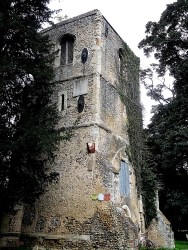
We walked past a vast field in which some grassy crop was growing. Far across the field there was a small wood. A church tower could be seen rising from amongst the trees. We followed another path towards the clump of trees and soon arrived at the tower. This tower and a graveyard is all that remains of the church of St Mary and All Saints (some call it ‘All Hallows and Little St. Mary’ and others ‘Thundridge Old Church’), which was demolished (apart from the tower) in 1853, when a new church was built in Wadesmill. The tower was constructed of flint and mortar in the 15th century. The rest of the church, now demolished, was built in the 11th to 12th centuries. A Romanesque archway now set into the eastern wall of the tower is the only visible remains of that former church.  Although this ruined tower might well appeal to those who find ruins romantic, it is in a bad condition with some of the structure covered with corrugated iron sheeting and other parts with graffiti. There are some plans to conserve it and others to demolish it to make room for new housing.

The reason that the old church was demolished was that the old manor house, which was close to the old church, was demolished in the 19th century. Consequently, the population of Thundridge moved nearer to the new manor house that was built where the church built in 1853 now stands.

Just before we reached the old church tower, we passed a field which had a long grass-covered trench running along it. This is the remains of a moat built long ago when Thundridge village was located near to the the old, now demolished church. The banks of the moat were liberally studded with mole hills. This moat is believed to have been dug in mediaeval times. What remains of it is ‘D’ shaped and encloses an area bounded by sides of approximately 660 feet north to south and by the same east to west. The moat enclosed the site of the former manor house.

Having seen all that remains of Thudridge Old Church, we retraced our steps to Ermine Street, crossed the fast-flowing River Rib, and then ate an enormous roast lunch in the garden of the nearby Feathers pub in Wadesmill, which is about two minutes’ walk from Thundridge.

The watch repairer of West Hampstead and Auroville in India

TODAY, I WAS WALKING ALONG Mill Lane in West Hampstead when I spotted a plaque almost hidden in a doorway. It commemorated a craftsman who used to work in the building. I wondered why anyone had bothered to put up a notice to remember him.

Mill Lane connects West End Green (in West Hampstead) with Shoot Up Hill, which is a stretch of what was once the Roman Watling Street. West End Green was known as ‘Le Rudying’ (a name given to a woodland clearing) in the 14th century. By 1534, the area around the Green was known as ‘West End’. Currently, this green is a part of the district of West Hampstead. Although not so named until later, Mill Lane existed in the Middle Ages. A detailed map published in 1870 reveals that at that time, there were scarcely any buildings along it.  It was not until the late 19th century that Mill Lane began to be lined with houses and shops. A pub on the lane, The Alliance, bears the date 1886, suggesting that before that time there was not sufficient local population to warrant building such a large hostelry.

It was the doorway of number 54 Mill Lane that caught my attention. Number 54 is sandwiched between AK locksmiths Ltd and Computer Clinic. Its shop front has frosted glass. It is the window of an office connected with St Johns Wood Cars, a taxi and private vehicle hire company. The commemorative plaque that I noticed is close to the doorway that gives access to a staircase that leads to the upper floors of the building.

The wording on the commemorative plate reads:

“Clifford Norman Bowler, watchmaker and jeweller, lived & worked here. 1899-1993. A Mill Lane tradesman for over 67 years.”

Well, 67 years is a long time and no doubt Clifford (1899-1993) was a well-known local. Articles published on the Internet (www.watchrepairtalk.com/topic/3184-clifford-norman-bowler-watchmaker and westhampsteadlife.com/2014/01/15/a-moment-in-time-on-mill-lane/9921 ) show that that Clifford was a remarkable member of his profession. Clifford was born in Northumberland in July 1899 and served in the Machine Gun Corps during WW1. By 1926, he was on the Electoral Register, registered as residing at 54 Mill Lane, and in 1929 he married Mabel in nearby Willesden.

He bought the shop on Mill Lane for £100 in about 1926 after leaving the army and having worked for a while with other jewellers and watch-repairers in Manchester. His shop used to be painted red and has been immortalised in a documentary film shot for Channel 4 by a local film-maker, Conrad Blakemore, who currently teaches at the City Lit college in London. His charming short film “The Watchmaker”, a working day in the life of Clifford Bowler,  can be viewed on YouTube (https://youtu.be/BU2nOQwxiWw). In it, Clifford, a charming old man, explains that he left the army in 1919 and began learning watch-repairing in Manchester. Faced with a wage cut, he asked his brother, who was already living in London, to find him some premises. The shop he acquired in Mill Lane was already a watch and clock repairing business. The £100 he paid for it included much equipment required for his trade.

Clifford’s father was a professional banjo and mandolin player. Clifford and Mabel had two children. One of them, Norman Clifford Bowler (born 1932), has followed in his grandfather’s footsteps by having a career in entertainment. Between 1961 and 2012, he appeared in many plays mainly on television.

Although his watch repairer father probably had nothing to do with India, Norman Clifford did forge a connection with the far-off country. In 2011, Norman Clifford recorded “The Rime of the Ancient Mariner” by Samuel Taylor Coleridge (1772-1834) in Bristol. Incidentally, Coleridge’s remains lie in St Michael’s Church in Highgate, where my school used to attend services regularly. The recording was made by Norman Clifford to raise money for a school, The Aikiyam School, in the settlement of Auroville, which is close to the city of Pondicherry, a former French colony, in the south of India. A website (lanternmanproductions.bandcamp.com) that gives access to the recording also notes:

“After falling ill a number of years ago, Norman, as part of his recuperation began to spend time in the warmer climes of Southern India with his wife, Diane. As a result, he became directly involved with The Aikiyam School as a teacher of English and Drama. As the years have gone on, Norman spent more and more time in India, only returning to England to spend time with family and friends, and raise money for the school with poetry readings and personal appearances.”

Clifford is privileged to have met Sri Aurobindo (1872-1950) and The Mother (Mirra Alfassa; 1878-1973), Aurobindo’s spiritual companion/muse, and there exists a recording (www.aurovilleradio.org/satprems-my-burning-heart-a-reading-by-norman/) in which he describes his impressions of her.

When I chanced upon the almost hidden memorial to a watch and clock repairer in Mill Lane, little did I expect to discover a connection between a somewhat non-descript shop in West Hampstead and the south Indian utopian settlement of Auroville, where we have some good friends and have visited a few times. Well, they say that ‘curiosity kills the cat’. Luckily although I am curious about what I see whilst out and about, I am not a cat.

Gardening and me

I LOVE GARDENS BUT I am not, and never have been, a great gardener. As a child, I used to mow the lawn and cut parts of the privet hedge surrounding our garden in Hampstead Garden Suburb. Neither of these activities endeared me to gardening. In 1983, I became a homeowner in Gillingham, Kent. My house had a 180-foot-long garden which was about 30 feet wide. About 120 feet of it was lawn bordered by narrow beds and the rest of it was, I imagine, once dedicated to growing fruit and vegetables. On taking possession of my new home, I was determined to make a success of the garden.

For a few weeks, I dug up weeds, hoping to clear a space to plant potatoes and onions. Day after day, I would return home from a session of pulling out teeth and other dental activities and then get down to pulling up weeds. It was disheartening to discover that a patch, which I had cleared a day earlier, was already becoming refilled with weeds. What I did not know at the time was that my garden was infested with a weed that was extremely difficult to eradicate manually or even with chemicals. The smallest fragment of this horrendous plant was enough to ensure its rapid and thorough propagation.

After a while, I abandoned my grand ground clearance plans and lowered my ambitions. I decided to clear a small patch to grow some parsley, a herb that was only available in local shops at Christmas time. I planted the seeds as instructed on the packet, watered them as required, and inspected the parsley patch every day.  Soon, tiny green shoots began appearing. I was horrified. I thought that once again the weeds were beginning to defeat me. So, I plucked them out to clear the ground for my parsley to have the best chance of its survival. It was only later that I realised that what I had regarded as weeds was in fact the parsley I was hoping to grow.

My solution to managing my garden was simple and effective. I began visiting garden centres to buy fast-growing shrubs. I had decided to let them compete with the weeds instead of me. This plan was successful. Soon, I had plenty of attractive plants that were growing larger in height and volume at high speed.

The long lawn proved problematic after a while. I bought an electric mowing machine that trimmed the grass nicely. However, it was not long before I began sneezing violently whilst mowing the lawn or even driving past a lawn that was being mowed. I tried mowing while wearing a paper face mask such as is commonly seen today during the covid19 pandemic. The mask proved to be useless even though it covered nose and mouth. My solution was to abandon mowing and just to let the grass do ‘its own thing’.

My neighbours were not happy about my wild looking garden, which, incidentally, became a haven for butterflies. They complained to me. My solution was to mow a winding path, the width of the mowing machine, through the savannah that was developing on my lawn. I explained to my neighbours that this was a carefully conceived plan to create a wildlife garden. I am not sure that this convinced them, but the level of complaining diminished. My neighbours were not so keen on wildlife as the following will demonstrate. One evening, someone living in my neighbourhood rang my doorbell. He asked me whether I wanted to contribute some money to help pay for the hire of a professional gun man to shoot the local foxes. I sent him away empty handed.

One evening, I returned from dinner with friends and as it was a pleasant night, I stepped out into my garden. I was surprised to smell burning but could see no fire. On the next morning, I met one of my neighbours and mentioned the burning to him. He told me that he had extinguished the fire before it reached my house. He said that the elderly lady who lived on the other side of my house had become fed up with the state of my garden and had set fire to it hoping that might prevent the spread of weeds from my garden to hers.

What is interesting is that when I came to sell my house back in 1995, at a time when the property market in the area was sluggish, it was the garden that appealed to the buyers. Apart from the fact that the house was the kind that they were seeking, it was the prospect of taming the garden, which the estate agent had described as being “in its natural state”, that appealed to the buyers. Sometime after the purchase was over, we dropped in to say hello to the new buyers. They showed us the garden. It looked as if it had been sprayed with a strong herbicide. The grass had gone, so had the atmosphere of wildness; the garden seemed sterile. However, I noted that all my shrubs had been preserved.

Now, I do not want you to get the impression that I have something against gardening. I do not like doing it, but I admire those who do it. Gardening is a complex art form in which human beings have to harmonise with nature to produce aesthetically pleasing results. Not only does the geometry of the laying out of plants have to look good, but garden planning must take into consideration the passage of time, the seasons, meteorology, the behaviour of pests and weeds, and ecology. In addition, there is also the distribution of form, colour, and odour that must be planned. And above all, the maintenance of healthy growth adds to the complexity of gardening successfully. A successful garden is multi-dimensional artform involving all the six senses as well as the relentless passage of time and the endless changes in the weather.

Rather like music, which I enjoy listening but cannot perform, I gain great pleasure from gardens, but prefer others to create and maintain them.

Autobahn

SOME YEARS AGO, I began listening to music performed by the German group Kraftwerk, formed in 1970 in the West German city of Düsseldorf. They specialise in electronically generated music, a field in which they were pioneers in their country. In the 1980s, I used to drive across Europe from my home in North Kent to places as far afield as Italy, Hungary, and Yugoslavia. The cars I drove at the time were equipped with music cassette players. I recorded my own cassettes from LPs and CDs in my own large collection. Amongst the music I found satisfying during the long journeys I made were some of the creations of the Kraftwerk band. Amongst my favourite of their albums were “Autobahn” (first released 1974) and “Radio-Aktivität” (released 1975). The music was a great accompaniment to speeding along the highways of Europe including Germany’s Autobahns.

I used to break my journeys along the highways at regular intervals, stopping in villages or towns to take a short rest and refreshment. On one journey, I drove off the Autobahn into a picturesque small town in Bavaria, whose name I have forgotten. I entered a busy Gasthaus (pub with a restaurant) and found a vacant seat next to an elderly gentleman who was enjoying a stein of lager.

I remember seeing people sitting nearby drinking beer with slices of lemon. However, what I remember most is the brief conversation I had with my elderly neighbour. My German was, and still is, rudimentary but sufficient to have a simple conversation. He asked me where I was from and what I was doing. I explained that I was driving to Yugoslavia. Then, I said something about the high quality of motorways (Autobahns) in what was then West Germany. The old man smiled, and said (in German):

“Naturally. They were made by our leader Adolf Hitler.”

I was at a loss for words because few if any Germans I had met until then had ever mentioned Hitler and certainly not in such a favourable light. Without waiting for me to respond, he explained that he had been taken as a prisoner of war by the Russians during WW2 and had spent many years in prison camps there. I would have loved to have discussed this with him in detail, but my German was not up to it and also, I had to get on with the journey I had planned for that day.

Most people, including yours truly, credit Hitler with stimulating the building of Autobahns and similar highways. This is a mistake depending how one defines a motorway. In this context, a motorway is a road often with limited access and limited to motorised vehicles.

While Germany was being ruled by the government of the Weimar Republic, work began on an ambitious scheme to build a car only highway/motorway linking Hamburg to Frankfurt/Main and Basel (Switzerland). Parts of this were constructed before Hitler came to power. That road lacked a central reservation as found on modern motorways, but excluded traffic such as cyclists, pedestrians, and vehicles pulled by animals. The Autobahns constructed after Hitler came to power were similar to those currently constructed.

In the 1920s before Hitler ruled Germany but after Mussolini became Italy’s dictator, Italy was the first country in the world to build motorways reserved for motorised vehicles travelling at speed. The first Italian autostrade (motorways; singular: autostrada) were completed between 1924 and 1926 and by the end of the 1930s, the country had over 250 miles of both single- and dual-carriageway autostrade. It is sad to relate that the UK had to wait until 1958 for its first motorway, the Preston by-pass, now part of the M6. In 1959, the first section of the M1 was opened, linking Watford and Rugby. This stretch of highway had no central reservation, no lighting, no crash barriers, and no speed limit. Things have changed since then.

When I used to cross Germany, the motorways (Autobahnen) had long stretches where there were no speed restrictions. Once, I decided to check out the ability of my box-like Volvo 240 estate car on a German Autobahn. To my surprise, the vehicle whose shape looked anything but aerodynamic, effortlessly achieved a speed of 105 miles per hour going up a steep incline. When driving at high speeds in Germany, you can be sure that there will be plenty of vehicles that shoot past you at even higher speeds.

After the Berlin Wall crumbled in 1989, many former East Germans flooded the Autobahns with their poorly powered Trabant vehicles. Often when driving along the motorways in Germany I saw these slow-moving cars valiantly sitting in the overtaking lanes trying to pass vehicles with far more powerful engines. The drivers of speedy cars like Porsche, Audi, and Mercedes Benz, needed fast reflexes and good brakes to avoid crashing into the Trabants being driven by those who were enjoying the freedom of travel after many years of repression in the former DDR.

My days of driving across Europe from the UK have ended. The short journey from Kensington to the Channel crossings is tedious on account of the heavy traffic in London and South East England. Also, it is tiring to drive for at least a day and a half before reaching lovely countryside, be it the south of France or the mountains of Switzerland or Austria. I still enjoy driving but not the great distances I used to cover, and my enjoyment of the music of Kraftwerk remains as great as ever.

One shirt, two pockets

SOME OF YOU WILL KNOW that I am interested in the mythical birds that have one body and two heads (for example, the Russian, Serbian, and Albanian double-headed eagles). Few will know about my interest in shirts with two pockets. Most people are happy if their shirt has only one pocket, but not me. For, I like to keep my mobile telephone in one shirt pocket and my small point and shoot camera in the other.

About twenty years ago, during one of my frequent visits to Bangalore (the capital of an Indian state whose crest bears a double-headed bird), we found a store in the busy Commercial Street that sold short-sleeved (‘half-sleeve’ in Indian English) shirts with two pockets bearing the brand name ‘Camel Classics’. The store no longer exists but was close to another clothing shop called ‘Favourite Shop’ and not far from a Bata shoe shop.  Year after year, I returned to refresh my stock of double-pocketed Camel shirts. Then, some years ago, the assistants, who by then knew me well, informed me that the manufacture of my favourite Camel shirts was about to be discontinued. Hearing this, I bought all the shirts in my size that were available in the shop.

Nothing lasts forever. This was true of my Camel shirts, which I wore almost everyday both when at work and, also, when not working. The collars tended to fray. This could be remedied during our visits to Bangalore when we found various helpful tailors who were happy to turn the collars. Even with these repairs, some of the shirts became to disreputable to wear in public.

It appeared that two-pocketed shirts had become unfashionable and therefore less easy to obtain. My wife came up with the solution to the problem of replenishing my shirt stock.

We spent a fortnight in Panjim (Goa) in April 2018. While wandering about in the steamy heat, we spotted a tailoring shop. The tailor was asked if he could replicate one of my remaining Camel shirts. He said that he was able to do so, and we were to return after a week. When we went back after seven days, he had produced two perfect replicas. We wished that we had asked him to have made more than two, but our time in Panjim was running out.

The following trip to India, we decided to find tailors in Bangalore, who were willing to replicate my favoured shirts. We found two, both in the Commercial Street district of the city. We got each to make one shirt so that we could assess who did the best job. A tailor on Dispensary Road ‘won the contract’. He made me another five Camel-style shirts. My stock of double-pocketed shirts is currently up to date. Given the present covid-19 pandemic is preventing us from returning to India in the foreseeable future, I am pleased that we had so many of these items manufactured.

Discussing my liking of the double-pocketed Camel shirts with friends and their unavailability, one of them looked at my Camel shirt, and then pointed out that the American Wrangler company makes the same shirts, which are still easily available. So, I could have replenished my stock by buying them on-line, but this would have been far less enjoyable than finding and getting to know tailors in India.

Pleasure Gardens then and now

BATTERSEA PARK IS but a very few miles (only three!) from where we live in London, yet it is a place that until now we have hardly ever visited. Maybe, this is because it is across the River Thames on its south bank. To those who live on the north side of the Thames, anything across the Thames seems extremely far away and almost in another country. That sounds ridiculous, but it is the case. The river is like a psychological barrier to us ‘northerners’, but it is well worth crossing it. We parked our car in Chelsea close to the Albert Bridge, an elegant structure built in the early 1870s. A short stroll across the bridge brings you to Battersea Park, which stretches along the south bank of the Thames to Chelsea Bridge, which is downstream from the Albert Bridge.

Before 1858, when the park was opened, the land on which it now stands was marshland reclaimed from the Thames and used by market gardeners. Prior to the opening of the park, the area was a popular location for duels. The Duke of Wellington challenged the Duke of Winchilsea in this area in 1829.

The name Battersea is derived from the Anglo-Saxon name ‘Badrices īeg’, meaning ‘Badric’s Island’. In the Domesday Book, it was called ‘Patricesy’. Gradually, the name evolved into its present form. The park was laid out between 1846 and 1854 by the architect Sir James Pennethorne (1801-1871), but when it opened in 1858, the year that Chelsea Bridge was completed, it differed somewhat from his original plans. In 1889, the year when the Eiffel Tower opened in Paris, the park came under the control of London County Council (‘LCC’). Moving forwards to 1951, the year of the Festival of Britain, much of which took place near Waterloo Station on what is now called the South Bank, Battersea park was used to stage a part of the festival known as the ‘Pleasure Gardens’.

You can read much about the Pleasure Gardens on an interesting and informative illustrated website at https://alondoninheritance.com/eventsandceremonies/the-festival-of-britain-pleasure-gardens-battersea-park/ . In contrast to the rest of the Festival, the aim of the Pleasure Gardens:

“… was to balance the other events and add an element of fun to an otherwise mainly serious festival.”

Unlike other parts of the great event, the Pleasure gardens allowed commercial sponsorship. This was because the cost of these gardens was greatly in excess of what the government could afford. The Pleasure Gardens’ attractions included: a shopping area, ‘The Parade’; the Grand Vista with its fountains, arcades, towers, eating areas, and firework displays; a miniature passenger-carrying railway with two stations (Oyster Creek and Far Tottering); a fun fair; lawns and flower gardens; a dance pavilion; specially designated areas for children’s performances such as ‘Punch and Judy’; and a zoo. It must have been quite a wondrous place and a great relief for many people who had suffered hardships during WW2 and just after it. Many of the structures in the Pleasure Gardens were designed by well-known artists of the time including, to mention a few, John Piper, Osbert Lancaster, and Hugh Casson.

The former Pleasure Gardens were on the north side of Battersea Park close to the river. Little remains of what must have been a wonderful sight. The Children’s Zoo flourishes. It is the descendant of the zoo created in 1951. It nearly closed in 2003, but was rescued by Carol and Roger Heap, a couple intensely interested in wildlife education and conservation. Their son Ed is involved with the zoo’s management and his wife Claire is the zoo’s resident vet. I have yet to see the zoo, which we did not visit recently on account of the rain.

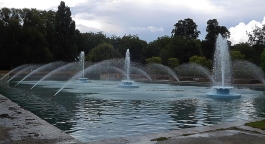
Hardly anything remains of the other parts of the Pleasure Gardens. The funfair that was opened in 1951 continued to operate until the early 1970s when an accident involving the Big Dipper occurred on the 30th of May 1972 hastened the fairground’s demise. What little remains of the Pleasure Gardens today has been conserved well by Wandsworth Council. This includes, The Parade (a tree-lined avenue running inside the park parallel to the riverbank), the Fountain Lake, and a few remnants of the Grand Vista. The prominent Peace Pagoda (erected 1985) with its gold coloured Buddha stands where once the Mermaid Fountain (sponsored by Lockheed Hydraulic Brakes) stood.

We visited Battersea Park on a grey weekday when few other people were in the park. The remnants of the Pleasure Gardens, where many people once congregated to have fun, was eerily empty, almost surrealist in appearance. Next year, it will be 70 years since the Festival of Britain. Being optimistic, it would be nice to imagine that maybe the pandemic will have subsided significantly, and we might be able to celebrate again, possibly with an element of ‘socialdistancing’ as one of the ‘attractions’.

Jacob’s cross in Lavenham

HAD IT NOT BEEN FILLED WITH parked cars, Market Square in Lavenham (Suffolk in East Anglia) would probably be recognisable to those who lived in the town several hundred years ago. The square is surrounded by old buildings, many of which are half-timbered. The most impressive of these is the Guildhall that was built in 1529. This large building attests the former wealth of the town, when it was an important centre of the wool trade in East Anglia. In its heyday, cloth from Lavenham was sent all over Britain and exported to Holland and Spain via the port of Ipswich. During the reign of Henry VIII (1509-1547), Lavenham was the fourteenth richest town in England.

Lavenham boasts a 16th century market cross. Market crosses were erected to indicate that an area had been designated as being a market square by a bishop, or a baron, or the monarch. Lavenham’s market cross is made of stone. A three stepped pyramid supports a slender column surmounted by a stone sphere. A metal plate informs the visitor that:

“The market cross was erected in 1501in accordance with the will of William Jacob”.

So, who was William Jacob?

Jacob was one of Lavenham’s wealthy clothiers, involved in the wool textile trade. Despite his surname, it was highly unlikely that he was Jewish because most Jews had been expelled from England in the 13th century (and it was not until the mid-17th century that Jewish people began returning).  According to text on the website deverehouse.co.uk:

“William Jacob was the tenth wealthiest clothier and businessman in England, making an annual profit of 67 marks and with a gross turnover of 223 whole cloths (a gross turnover of £12m in today’s money, around 400 marks).  On his death he paid for the erection of the market cross that is still there 520 years later.  He did not branch into “straites” or “narrow cloths” and within 25 years of his death the cheaper narrow cloth was dominating the market and Jacob’s family were seeking other work.”

In his will, dated 1500, he wrote:

“I will have a cross made of my perpetual cost that shall be set upon the market hill in the village of Lavenham.”

The cross that was erected in Lavenham in 1501 was a copy of the market cross already present in the city of Cambridge. The Cambridge market cross has long-since disappeared. The stepped base is all that remains of the cross paid for by Jacob’s estate. The slender shaft that now stands on it was put up in 1725. It is interesting to note that far away in Florence (Italy) Michelangelo was beginning work on his famous statue of David in 1501. That sculpture was completed in 1504. Although many visitors come to Lavenham, many more visit Florence.

Suffolk was the most important clothmaking county in 15th/16th century England. William Jacob was one of the county’s 100 clothiers in business between 1480 and 1500. Other counties had far fewer members of this trade. Although William Jacob was the tenth most wealthy, the wealthiest was Thomas Spring III (c1474-1523) of Lavenham. By 1500, Suffolk was the most industrialised and urbanised county in Britain, but by 1700, the county had become a rural backwater. Suffolk and much of the rest of East Anglia might be regarded as a bit of a backwater nowadays, but it is a largely picturesque one with wonderful landscapes and a great architectural legacy due to its past prosperity during the golden age of the wool trade.