HERE IS A BOOK that provides a fascinating view of the crisis that afflicted Bosnia and its people during the 1990s. It reveals that what happened in that beleaguered part of the Balkans was far from a simple black and white conflict in which Serbians were the villains and the Bosnian Muslims were the innocent victims. It records that often the Bosnian Muslims and their allies behaved far from virtuously. What the book reveals is extremely disturbing and of great relevance today, so many years after the end of fighting in and around Bosnia.
“UNHOLY TERROR” by John Schindler is about the Bosnian crisis in the 1990s and its dangerous consequences. Using his personal experiences (he was a US spy in the Balkans) and a variety of credible sources, he demonstrates how Bosnia’s post-Communist Muslim government misled the West, and especially the USA, into believing that the Bosnians were fighting the Serbs and Croats to achieve a multi-ethnic non-sectarian state, where all beliefs are tolerated. The author describes that the opposite was true: the Bosnian government was converting Bosnia from a racially and religiously tolerant community to a hard-line fundamentalist Islamic state.
Schindler convincingly demonstrates how the Bosnians hoodwinked the West into believing that it was only the Muslims who were victims of aggression in the fighting following the collapse of the former Yugoslavia. Most in the West, including a former US president, were happy and only too willing to believe that it was the case that the Muslims were being subjected to genocide by the Serbs. Anyone who dared contradict this was ignored and/or ridiculed. Whilst it was true that many Bosnian Muslims were being murdered and otherwise persecuted, Schindler gives evidence that they were not alone: the Serbs, Croats, and moderate (not hard-line or Wahabi) Muslims living in Bosnia received much aggression from the forces under the control of the Government of Bosnia.
The USA and its allies helped the Bosnian Muslims with military matters alongside(!) the Iranians, the Saudis, and other promoters of hard-line Islamism.
This book describes how Muslim fighters, Mujahadin and jihadists, moved into Bosnia (some had been fighting in Afghanistan) to assist their Muslim ‘brothers’ with the struggle. Schindler suggests and gives evidence for these imported fighters’ role in establishing a fundamentalist Muslim state in Bosnia, a state in which Christians and moderate Muslims were treated as hostile.
Bosnia’s wartime president Izetbegovic skilfully hoodwinked the West into believing he was creating a tolerant forward-looking state whilst he was actually creating an Islamic state that adhered to a hard-line form of Islam known as Wahabism.
Following the apparent end of hostilities, Bosnia became home to many determined Jihadists and a nest of terrorists whose activities included likely involvement in the 9-11 attacks in New York City, the Madrid bombings and many other dreadful acts. It appears that many terrorist activities after 1990 can be traced back to Bosnia.
Schindler’s fascinating and highly readable book could well be called “Blinded by Bosnia” because that is precisely what Izetbegovic and his government did to the critical faculties of the USA and its allies. I read this book with great sadness. I was upset to read that a part of the Balkans, which I had grown to like during the 1980s, had been transformed into what Schindler’s book (published 2007) describes as having become a dangerous rogue state after the collapse of the former Yugoslavia.
COCKAYNE HATLEY IS A BIG name for a tiny rural settlement in Bedfordshire, close to the county’s borders with both Hertfordshire and Cambridgeshire. Today, it consists of a small parish church and a few buildings about one hundred and fifty yards away. Its population in 2007 was 75 souls. Over the centuries, the place has had various names: Hettenleia (10th cent.); Hatelai (11th cent.); Bury Hattele (13th-15th cent.); Hatley Port, and then from the 16th century as Cockayne Hatley. The name ‘Hatley’ is from the Old English words ‘haett’ and ‘leah’, meaning ‘woodland clearing on the hill’. The first part of the place name, Cockayne, was added to Hatley in the 15th century after John Cockayne (died 1429), Chief baron of the Exchequer, acquired the manor in 1417.
We travelled to Cockayne Hatley to see its church, built during the 13th and 14th centuries and dedicated to St John the Baptist. It was locked up and we did not have enough time to ring the person who holds the keys. However, we took a stroll around the church’s well-maintained small graveyard and found some graves and memorials of great interest.
A pinkish granite stone records the death of Margaret Lindsay (died 1941), whose husband, Lt Col WG Cooper DSO, died in 19?8. What interested me was its Indian connection. WG Cooper had served in India in ‘The Poona Horse’. He was in 34th Prince Albert Victor’s Own Poona Horse, a unit of the Bombay Presidency. His wife Margaret was born in India, the daughter of Peter Stephenson Turnbull, Surgeon General of the Government of Bombay and later, Honorary Physician to the King. William and Margaret married in Bombay Cathedral. The Poona Horse was founded in about 1820, and served in the two world wars, and after India became independent, it served in the India-Pakistan conflicts of both 1965 and 1971 (by which time Cooper was no longer living).
A white stone memorial close to Cooper’s records the death of Private Herber Saunderson in 1919. A Canadian serving in the 17th (Reserve) Battalion, Canadian Infantry (www.roll-of-honour.com/Bedfordshire/CockayneHatley.html), he was aged 40 when he died. He was born in Cockayne Hatley, and then moved to Ontario (Canada) after marriage.
A few feet away from the Canadian’s gravestone there is a black stone monument dedicated to the memory of the crew of a Liberator KN 736 aircraft, which crashed in nearby Potton Woods on the 18th of September 1945. Four men were killed and three were saved as well as a dog called Bitsa. Local people came to their rescue. None of the men who were killed were buried at Cockayne Hatley.
Apart from the graves with military connections, there is one which has many literary associations. The monument to William Ernest Henry and his family is in the art-nouveau style and is the most prominent memorial in the tiny cemetery.
William Ernest Henley (1849-1903) was, according to that font of all knowledge Wikipedia, “…an English poet, critic and editor in late Victorian England.” At the age of twelve, he began suffering from tuberculosis. This resulted in him having to have the lower part of his left leg amputated sometime between 1868 and 1869. Incidentally, Henley was looked after by the eminent Dr Joseph Lister (1827-1912), founder of surgical sterile techniques. The amputation led to an important landmark in British literature. Henley was a good friend of the Scottish writer Robert Louis Stevenson (1850-1894), author of “Treasure Island” (published 1883). It is said that Stevenson’s well-known character, the pirate Long John Silver, was inspired by his “… crippled, hearty friend” (www.britannica.com/biography/William-Ernest-Henley).
Poor old Henley fell out of a train in 1902. This accident caused a flare up of his tuberculosis, which caused his death in 1903. He was cremated at a crematorium near his home in Woking. His ashes were interred in the graveyard at Cockayne Hatley where his daughter was buried. This brings us back to fictional pirates: not Long John Silver but one with a hook instead of a hand: Captain Hook (created by JM Barrie [1860-1937]), who was an enemy of Peter Pan.
Ernest and his wife Anna (née Hannah Johnson Boyle; 1855-1925) married in 1878. They had one child, Margaret, who was born in 1888. The author of “Peter Pan”, JM Barrie, was a friend of the family during Margaret’s short life. Unable to pronounce the word ‘friend’ the small child called her friend Barrie ‘fwendy-wendy’. As a result of this, Barrie used the name ‘Wendy’ for Peter Pan’s female companion in his famous children’s book, “Peter Pan”. It was published in 1904. Margaret did not live long enough to see it; she died in 1894, aged 5. She was buried at Cockayne Hatley, the estate of her father’s friend, the politician and editor Henry John Cockayne-Cust (1861-1917). The monument to Margaret is on the back of that to Ernest and his wife.
Although our visit to Cockayne Hatley was brief, it turned out to be full of interest. If we had not visited the place, we would have been unlikely to have ever heard of William Ernest Henley and his family’s contribution to the richness of British literature. One of the many things that gives me pleasure during our forays into the English countryside is observing things that trigger my curiosity and often generate new interests for me.
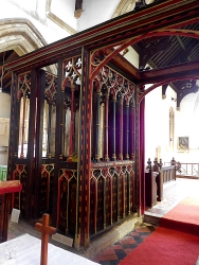
AN ELDERLY LADY WALKING with the help of a walking frame beckoned to us just after we had walked around the Church of St Mary in the village of Guilden Morden near Royston in Cambridgeshire. As with so many country churches we have visited since the onset of the covid19 pandemic, we had found that the church was locked up. However, the lady, who had called us over, was holding a large old-fashioned key and asked us whether we would like to see inside the church. I am so glad that we accepted her offer because she pointed out something that is very rarely found in English churches: a double rood screen.
A rood screen is often found in late mediaeval churches. Commonly made of wood and often ornate, the screens separate the nave where the congregation assembles from the chancel where the choir sings and the clergy officiate near to the high altar. The rood screen at St Mary’s in Guilden Morden, whose construction began in the 12th or 13th centuries, consists of two parallel screens on either side of a central passage leading between the chancel and the nave. It is decorated with some paintings of saints and on each side of the passage, there are small enclosures large enough for several congregants to sit during a service.
The lady, who pointed out the special nature of the rood screen, told us that in the past, the lord of one manor sat with family members in the ‘cubicle’ on one side of the central passageway and the lord of another manor sat in the cubicle on the other side. She told us that when she was a small child in the village, she had seen the local aristocrats occupying the rather cramped-looking booths between the parallel screens.
The website www.english-church-architecture.net doubts the church’s claim that the double-rood screen is an original feature of the church. It quotes the architectural historian Nikolaus Pevsner, who:
“… declared it to be reassembled from the original rood screen and one or more parclose screens, to form “a double rood-screen, i.e. with a kind of pew left and right of a central passageway. Three designs are represented, two very similar and clearly not too late in the fourteenth century, the third, early Perp.” In fact, the early Perpendicular work forms the back of the screen and the re-used sections of parclose screens, if that is what they are, appear to have been built up against it on the side towards the nave.”
Whatever its history, neither my wife nor I had ever seen anything quite like that in British churches … and we have visited quite a few of them.
Before leaving the church and the kind old lady, I spotted the baptismal font that looks far older than the church. Our new friend thought it predated the present church. According http://www.british-history.ac.uk, the font’s basin is 12th century and the pillars supporting it are later.
Before we left the church and the lady locked it up, I asked her about the name Guilden Morden. She believed that it might mean something like ‘golden moor’. She was not far off the truth, which is that the name is derived from the Old English ‘Gylden More Dun’, meaning ‘Golden’ (rich or productive) ‘Moor Hill’.
Once again, a trip out of London into the countryside has proved to be not only refreshing but also enjoyable. England, from which we have always travelled abroad during the years before the current pandemic, is proving to be at least as interesting as the many far more exotic destinations we have been enjoying over the years.
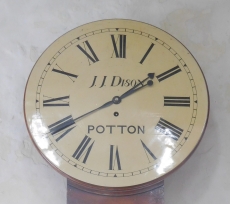
I NOTICED THAT A CLOCK on the south wall of the nave of St Mary’s Church in Ashwell (in Hertfordshire, north of Baldock) bore the makers name “JJ Dison, Potton”. Being by nature curious, I wondered whether any trace of JJ Dison remained in Potton, a small town in Bedfordshire, about nine miles north of Ashwell. So, off we went to Potton, and what we found there was delightful.
In the tenth century, the town’s name was ‘Potun’ and in the Domesday Book (1086), it was listed as ‘Potone’. These names are derived from the Old English meaning ‘farmstead where pots are made’. During the Middle Ages, the Tudor, and Stuart eras, the Market at Potton was one lof the largest in Bedfordshire. This declined after the Great Fire of 1783 during which much of the centre of the town was destroyed. In 1797, the Shambles (a market area including brick buildings) were erected, but these fell into decline in the 1930s. A smaller version of the market building was constructed later, and this now serves as the town’s library. The two women working there were friendly but knew nothing of the clock makers of Potton They sold me three fascinating books that contain historic photographs of Potton.
Today, Potton, which once had its own brewery, is now a commuter town. Its station, first built in 1850, is on the former Great Northern Railway. Currently, commuters can travel into London on trains that terminate at London St Pancras.
We wandered around Potton looking at various old buildings and enjoying a coffee at a pleasant café that had only just reopened after several months of having been closed because of the covid19 pandemic. A pleasant walk along Church Causeway brought us the parish church of St Mary’s, perched on the highest spot in the town. Its construction began in the 13th century and many additions were made in the centuries following. As with so many churches we have visited recently, it was locked up. We walked around its exterior, admiring the many decorative gravestones in the crowded cemetery that surrounds it. We returned to the centre of Potton along the causeway, crossing a couple of fast-flowing streams along the way. These waterways are part of the Potton Brook network, tributaries of the River Ivel, which is itself a tributary of the River Great Ouse which flows into The Wash.
Well, enough about Potton: you must be wondering whether I have forgotten JJ Dison. I have not, but there is not much to say about him, but more than I had expected to discover. James Jeremiah Dison thrived in the early 19th century. His exact dates are not known. Amongst the Potton churchyard inscriptions (pottonhistorysoc.org.uk), there is one for ‘Jeremiah James Dison’, dated 29th September 1844, when Dison was aged 35. His wife, Jane (née Edwards) died in 1840, aged 31. The couple had two children, named George and Sarah.
Dison is listed (www.clockswatches.com) as working both in Cambridge and Potton. The British Museum contains a beautiful printed watch paper (an ornamental paper place inside a watch case by the maker or repairer of a watch) which informs us the JJ Dison was a ‘silversmith and jeweller’ as well as a ‘clock & watch maker’. It also mentioned ‘jewellery &c carefully repaired’. In a directory of Potton (in a “Directory of Bedfordshire”) dated 1839, JJ Dison is listed as a watch and clock maker at Bull Street. There was another member of his trade, Mr Henry Reynolds, at Moon Corner.
The National Archives in Kew contains an undated will prepared by JJ Dison, which has within its wording:
“Jeremiah James Dison of the towne of Cambridge in the county of Cambridge watchmaker…”. Whether Dison lived both in Potton and Cambridge, it is not clear. However, the watch paper and the clock in Ashwell’s church suggest that at the very least he worked there. Also his burial in Potton, rather than Cambridge, suggests that his main residence might well have been Potton. That he worked in Cambridge is suggested by a post placed on a watch collecting website (https://mb.nawcc.org/) in which the collector noted that he had acquired a watch “…sold by John Dison Cambridge…”. Another website (i.collector.com) listed:
“Late 18th Century pair cased Pocket Watch, J J Dison, Cambridge, number No 570, the pierced and engraved cock to a Roman enamel dial with later hands, both cased marked for London, 1789, Makers mark W L …”
It might be coincidence or possibly more than that, but James Jeremiah was not the only Dison working on timepieces in the east of England. There was Joseph Dison of Whittlesey and Thomas Dison of Biggleswade. Biggleswade is close to Potton and Whittlesey is just north of Cambridge.
The clock at St Mary’s in Ashwell is a product made by JJ Dison in Potton. A small plaque, which I was unable to read, the clock being too high above the ground, suggests that the timepiece was a donation to Ashwell’s church. Whatever its origin and story, seeking out its maker has been fun and introduced us to a pleasant town not far from London, which we hope to visit again.
YESTERDAY MY WIFE visited the hair salon for some routine hair maintenance. On that visit, her hair was treated by ‘G’, a hairdresser from Greece. He told my wife that he had had a salon in Athens and had come to London in March 2020 to try his luck here and to satisfy his dream to live in London. Nine days after he arrived in London, everything closed because of the covid19 ‘lockdown’, which put an end to hairdressing for several months. He was pleased to be back at work again.
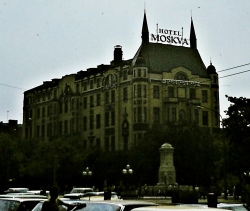
Hotel Moskva in Belgrade in the 1980s
G spent a great deal of time with my wife’s hair. She told me that he had sprayed various things on her head, far more than other hairdressers at the same salon usually used. When G was finished, he showed her the result in the mirror and took several photographs because he was pleased with his creation, as was my wife. G had used the various chemicals to give her hair more body than it had previously. He explained:
“You are now like beautiful Greek lady. You have style like Greek ladies. Much better than British, English like only too simple: no style.”
When my wife walked out of the salon, she looked as spectacular as ever, but even more so. Seeing the wonderful hairstyle that G had created reminded me of something that happened to me sometime in the 1980s.
I was staying in Belgrade, the capital of the former Yugoslavia. As was often the case, I stayed in the centre of the city with my good friend, the late ‘RR’. One day, he suggested that we should visit his barber and that I should have a haircut. The barber, who was clearly a good friend of RR, said that he was thrilled to have a British customer. I felt honoured to be the first of his British clients. He told me (RR was translating) that it was his ambition to work as a barber in London. I expressed the hope that his dream would be fulfilled.
The barber spent an hour and a half working on my hair, far longer than any other barber had ever taken to deal with my coiffure. Some years later, I attended a hairdressing school near Holborn (London) and volunteered myself as a model for a trainee. After more than two and a half hours, the trainee had barely done anything. Fortunately, the teacher came to my rescue and completed my haircut excellently and in only a few minutes. But, returning to Belgrade, my Serbian barber had not been idle during the ninety minutes I was in his capable hands.
Both the barber (‘бријач’ in Serbian) and my friend were very happy with my new hairdo. I looked quite different, but not improved as far as I was concerned. I felt that at least I had made two people happy by submitting my ‘Barnet’ (Cockney rhyming slang for ‘hair’) to the care of a ‘Dover Harbour’ (‘barber’) in Belgrade.
When we left the barber, I tried to run my fingers through my hair. It was impossible. All of the hairs seemed to be stuck together. My hair felt rigid rather than flexible. My hair had the texture of cheap dolls’ hair. A comb just bounced off the carapace that was covering my skull. The barber had used some kind of lacquer to render my hairstyle immutable. Not wanting to hurt my friend’s feelings, I made no complaints. However, as soon as I left soon as I left Yugoslavia, I washed my hair more thoroughly than usual and managed to get rid of whatever had given my hair its unpleasant rigidity.
IT WAS HUNGER that drew us to Lighthorne, a tiny rural village just over six miles south-east of the city of Warwick. Our aim was to eat lunch at the highly recommended Antelope Inn before visiting the magnificent Compton Verney House with its gardens that were designed by Lancelot (‘Capability’) Brown in the 18th century.
Lighthorne is an attractive village nestling in a steep sided basin. Some newer buildings have been built on the slopes above what was the heart of the old village. The etymology of the village’s name is uncertain. Close to the Fosse way (a road built by the Romans; it linked Exeter with Lincoln in an almost straight line), it was in existence in 1086 when the Domesday Book was compiled. Throughout the centuries, the village has been ‘in the hands’ of various noblemen and religious institutions. Time constraints did not permit us to visit the village’s Church of St Lawrence, whose construction began in the late 14th century, but we hope to see it on a subsequent visit.
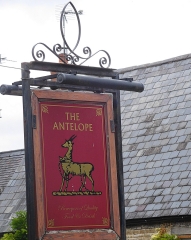
The Antelope Inn is housed in a building whose construction began in the early 18th century. The earliest record of the pub’s existence is a document dated 1838. This was signed by the then publican Joseph Lattimer. I was curious about the pub’s name because I thought that antelopes were not common in Warwickshire. The friendly staff in the inn suggested that there were two possible explanations for the name. One was that some previous owners of the pub had been a South African couple. Far more likely than this is the fact that the antelope is taken from the badge of the Warwickshire Regiment. A useful website, www.lighthornehistory.org.uk, explains the pub’s sign:
“The Antelope is standing on a strip of six pieces. This is said to be the six feet of turf representing the old name of the 6th Regiment of Foot.”
Always on the lookout for Indian connections, I found the following (www.forces-war-records.co.uk/units/316/royal-warwickshire-regiment):
“The Regiment took part in two campaigns in South Africa known as the Kaffir Wars (7th Kaffir War 1846-47 and 8th Kaffir War 1850-53), protecting Dutch and English settlers from the aggressive native tribes north of Cape Town. The Regiment also took part in the suppressing the India Rebellion of 1857.”
So, the regiment had taken part in campaigns both in South Africa, where my parents were born, and in India, where my wife was born. Regardless of the activities of the local regiment, we ate an excellent meal at The Antelope Inn.
More recently, in 1972, Ugandan Asians who had fled from Idi Amin’s Uganda were housed temporarily at Gaydon Airfield (now ‘Lighthorne Heath’) that is near Lighthorne (see: http://www.lighthornehistory.org.uk/wp-content/uploads/Shorthistory.pdf). Some of the inhabitants of Lighthorne assisted the distressed Asians during their first couple of months in England.
Almost opposite the inn, there is a well or spring that issues from an elaborate stone structure with a badly weathered coat-of-arms. It is a ‘broadwell’, a word derived from the Old English ‘breac-well’, a well that is supplied with water from a brook (rather than a spring). The well is likely to be as old as the village. However, the stone structure probably dates from 1746, as the Lighthorne history website notes:
“… the quoins and coving, were probably built in 1746, the remainder of the fascia, pool and paving are from the 19th and 20th centuries. The old ironstone escutcheon inserted in the fascia is older and is believed to be the arms of the Pope family, Lords of the Manor in the 16th and 17th centuries.”
There was green mildewed water in the two receptacles of the broadwell. It has been suggested that this well might have been used for washing in the past.
Close to the well, we spotted red grapes ripening on a vine growing on the side of a cottage facing the Antelope. They are located in what must be a fine sun trap. Our Sunday lunch in the inn, one of the best Sunday roast meals that I have eaten for many a year, ended soon before we were due to take up our timed entry at Compton Verney. Next time we visit the latter, spending more time in Lighthorne and The Antelope will be given top priority.
MANY ENGLISH CHURCHES REMAIN closed much of the day since the outbreak of the covid19 pandemic. During our recent roving around the countryside, we have found this to be the case and as a result have not been able to enjoy exploring the often interesting historic and architectural features within country (and urban) churches.
Drawing of Old St Pauls Cathedral in the church at Ashwell
When we arrived in the attractive Hertfordshire village of Ashwell near the town of Baldock that lies between London and Cambridge, we were pleased to discover that the Church of St Mary’s (Ashwell) was open. Despite the dustiness created by building works that were in progress, this church contains much of interest. In fact, the builders have uncovered remains of structures that existed possibly prior to the present church’s construction in the 14th century. These remains were revealed to us by a kindly lady, ‘M’, who helps run the church’s administration. She pulled aside some heavy plastic sheets to reveal where the builders had dug beneath the floor.
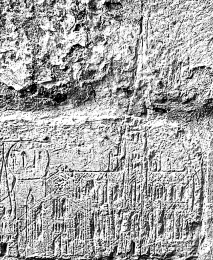
After viewing the excavations, M drew our attention to the west end of the nave, beneath the bell tower. The north wall of this section of the church has graffiti scratched into its wall. This is not the work of modern vandals but that of people living as long ago as the 14th century, a time of plague, pestilence, and much mortality (the so-called Black Death was at its peak from 1347 to 1351).
Some of the graffiti is in the form of inscriptions in Latin. According to a useful booklet, which we bought at the church, “Ashwell Church. Mediaeval drawings and writings. A Guide” by David Sherlock (publ. 1978), the inscriptions when translated include the following (to quote but a few):
“Just the first plague was in 1349”
“In 1349 there was plague and in ‘50”
“1000, three times 100, five times 10 [i.e. 1350], a pitiable, fierce violeny (plague departed); a wretched populace survives to witness (to the plague) and in the end a mighty wind, Maurus, thunders this year in the world 1361.”
Maurus refers to St Maur (512- c584), a disciple of St Benedict of Nursia. St Maur’s feast day was the 15th of January before 1969 and is now the 22nd of November. According to an article in the Irish Times (16th of January 1998):
“The late 1300s in Ireland were remarkable for the abundant rainfall, and also for a succession of fierce storms which caused frequent and widespread devastation in countryside. One of the worst of these, St Maury’s Wind, occurred on January 15th, 1362, and caused great damage, particularly in Dublin.”
These storms were most likely to have been the same as those recorded on the wall of Ashworth Church.
Fascinating as the inscriptions are, even more interesting is a drawing incised in the wall close to them. Although it is not known when it was drawn, it was probably before 1630. It is a detailed sketch of the old (pre 1666, Fire of London) Gothic St Pauls Cathedral in London. It depicts the old church before Inigo Jones re-faced it in 1630. The drawing includes the spire, which was destroyed by lightning in 1561. One authority has suggested (tentatively) that the drawing might have depicted Westminster Abbey, but this is unlikely even though Ashwell Church was under the control of the Abbott of Westminster until The Dissolution of the Monasteries in 1540. The drawing in Ashwell has many resemblances to illustrations of the old St Pauls made in about 1550 by the Flemish Anton Van den Wynegaerde (1525-1571), and in 1616 by the British artist John Gipkyn (active 1594-1629). It is unlikely that whoever drew the image in Ashwell would have seen either of these pictures.
In addition to the image of St Pauls and the plague inscriptions, there are many other examples of mediaeval graffiti in the church at Ashwell. If our cousins in Baldock had not recommended us to visit nearby Ashwell, we might never have seen the fascinating graffiti described above. It was particularly poignant to see the souvenirs of plague that occurred so long ago during the current era of plague that is disturbing our lives so much.
MY MOTHER OFTEN TOLD ME that if one did not buy Premium Bonds, there was no chance of winning any prizes. Likewise, if one did not play the Football Pools, promisingly large financial prizes could not be won. The Football Pools is a form of gambling based on trying to predict the results of football (soccer) matches. My mother knew nothing at all about football. So, she paid a monthly fee to let someone else fill in the Pools forms on her behalf. Once, she won about £13 (or was it £30?), thus proving to me and the rest of the family that by participating it was possible to win occasionally. What she did not mention was that she was spending far more on submitting Football Pool forms than she ever recouped in winnings. Her argument was that if she gave up on the Pools, she would miss winning one of the enormous prizes that other folks sometimes collected. One of the biggest Football Pool companies was Littlewoods, which also owned a retail chain. This was once owned by the family of Sir Peter Moores (1932-2016). Some tiny proportion of the money that my mother spent on Littlewoods Pools would have helped Sir Peter to create a fine collection of art. Although my mother did not live long enough to have known that, she would have been pleased because she was a painter and a sculptor during her short adult life.
Sir Peter bought Compton Verney House and its extensive grounds in Warwickshire in 1993. I will relate his role in the history of this estate later. Compton (meaning ‘manor’ or ‘large farm’) Verney was granted to Robert Murdak in 1150. Until 1582, when the manor was taken over by Richard Verney, who died in 1490, it was known as ‘Compton Murdak’. Richard’s grandson, Richard Verney (1465-1527) renamed the estate (and the long-since vanished village near it) ‘Compton Verney’.
The Verneys built a large manor house at Compton Verney in Tudor style in about 1442. In about 1711, George, Baron Willoughby de Broke (1659-1728), a Verney, rebuilt the manor house at Compton Verney. Its designers were the master stone-masons John Townesend (1648-1728), briefly a Mayor of Oxford, and his son William (1676-1739), who worked on several major buildings for the University of Oxford. The baroque edifice they created is what we see today.
My namesake, the architect Robert Adam (1728-1792), made major alterations to the recently built ‘new’ Compton Verney House. Visitors to the house enter via the magnificent ground floor hall he designed, Splendid as it is, it is easily rivalled by the work he did at Kenwood House in North London. This might be because during the 1950s, the house in Warwickshire was allowed to deteriorate.
The well-maintained grounds of Compton Verney are spectacularly beautiful. They were artfully designed by Lancelot (‘Capability’) Brown (1716-1783). Not only did he plant fine trees but he also invented a machine for transporting mature trees in order to transplant them in positions chosen for artistic effect. To achieve the effect that Brown and his patron desired, the new gardens eliminated all traces of an earlier formal garden and a mediaeval chapel that had existed until he began work on the garden in 1768. An obelisk and a few partially submerged gravestones stand on the site of the old chapel.
After WW1, in 1921, The Verney family sold their estate to the soap manufacturer Joseph Watson (1873-1922). After his death, Watson’s son sold Compton Verney to Samuel (a cotton magnate) and Gita (a German opera singer and a Nazi sympathiser) Lamb in 1929. During WW2, the estate was used by the military as a centre for experimenting with smoke-screen camouflage.
After the end of WW2, the estate fell into disrepair. In 1958, Harry Ellard, an industrialist from Wolverhampton, bought Compton Verney but never lived there. The place continued to decay seriously. In 1983, the property developer Christopher Buxton bought the estate, planning to redevelop it as a centre for performing opera. His plans did not materialize. The future of Compton Verney was beginning to look exceedingly bleak. This changed in 1993. For it was in that year that some infinitesimally minute fraction of what my mother spent on Littlewood’s Football Pools helped to save Compton Verney.
In 1964, Sir Peter Moores set up the Peter Moores Foundation, whose aim it was to assist opera, the visual arts, and education. In 1993, the Foundation acquired Compton Verney. A year later, conservation experts began restoring the old house to enable it to become a modern gallery. They also designed a modern annex to serve as an exhibition space as well as to house a collection of British Folk Art and the Marx-Lambert Collections. The gallery was opened to the public in 2004 and the grounds were finally restored in 2016.
The collection of British Folk Art consists of artefacts collected by the art dealer, founder of the Crane-Kalman Gallery, Andras Kalman (1918-2007) and was bought by the Moores Foundation in 1993. The Marx-Lambert Collections, derive their name from Margaret Lambert (1906-1995) and Enid Marx (1902-1998). Unwittingly, most Londoners will be familiar with some of the work created by the designer Enid Marx. She was commissioned to design some of the fabrics that used to cover the seats on the London Underground trains. Lambert was a historian. Lambert and Marx were good friends, who shared an interest in British folk art, which they both collected. It is their collection that can be viewed at Compton Verney.
It was Peter Moore’s love of travelling and collecting artworks that resulted in the fine collection of paintings, sculptures and other artefacts within Compton Verney House and its attached modern gallery annex. His acquisitions fall into four main groups: Northern European (mainly German) paintings and sculpture from the renaissance and earlier periods; British portraits; art from mainly 18th century Naples; and Chinese art. Each group includes works of the highest artistic quality, making a visit to see them at Compton Verney very worthwhile.
Compton Verney also hosts temporary exhibitions. At present (September 2020) until very early January 2021, there is a fine selection of works by Luther’s friend and contemporary, Lucas Cranach the Elder. I have written a little about this elsewhere. In addition to viewing the indoor artworks, the gardens of Compton Verney are a joy to explore. My late mother would have liked seeing Compton Verney, maybe thinking to herself that her involvement with Football Pools had helped to create what the visitor can enjoy today.
MANY LONDONERS WILL HAVE walked past Mortimer Market without knowing it exists. Yet, I used to visit it every working day for about five years. It played an important role in my life and greatly affected my career. How it did, I will reveal later.
Mortimer Market lies a few feet east of Tottenham Court Road (‘TCR’) between Capper and University Streets. Immediately to its east, runs Huntley Street that is parallel to TCR. I used to enter Mortimer Market through a short, covered passageway leading off TCR. Vehicles can enter the Market via Capper Street.
Mortimer Market before 1949 when this photo was published
Until 1886, Capper Street was known as ‘Pancras Street’. This street has existed for over 300 years. Its history is outlined in some detail on an interesting website (https://regencyredingote.wordpress.com/). Before it was laid out, the land on which it runs was part of Capper Farm, which was in existence by 1693. The farmer, Christopher Capper, whose widow died in 1739, kept cattle. Members of his family, his daughters, kept the farm going until at least 1768. After his death, the family moved to crop growing in preference to rearing cattle. In 1756, the Duke of Grafton constructed the Euston Road that ran along the northern boundary of the Capper’s farm. At first, the Capper sisters raised an objection to it, saying that the dust raised by traffic along the new road would spoil their crops. The Duke and the sisters eventually came to some agreement. By 1770, the Capper sisters gave up their farm. It was then bought by Hans Winthrop Mortimer (1734-1807), who merits an entry in Wikipedia and on the History of Parliament website (www.historyofparliamentonline.org/volume/1754-1790/member/mortimer-hans-winthrop-1734-1807 ).
Mortimer was a property speculator and a Member of Parliament between 1775 and 1790. In the 1774 General Election, he was defeated by Sir Thomas Rumbold (1736-1791), who served as British Governor of Madras between 1777 and 1780. Rumbold became well-known for being corrupt. His misdeeds included what was effectively the theft of a precious ring from the Nawab of Arcot (Muhammad Ali Khan Wallajah, who reigned 1749-1795). Rumbold’s corruption preceded his stay in India. This involved, amongst other things, bribery during the election he contested against Mortimer. After a court case against Rumbold, Mortimer was awarded £11,000 in damages in 1776 and also gained the parliamentary seat that Rumbold had tried to win by cheating (bribery). It is a sign of the East India Company’s wobbly ethics that a man as corrupt as Rumbold was appointed the Governor of Madras so soon after losing his case of corruption.
Mortimer spent a great deal of money acquiring property in Shaftesbury, his constituency and also in London.
The land, which Mortimer bought that had been the Capper’s farm, became known as ‘The Mortimer Estate’. Some of this estate was later sold and became the site of University College (‘UC’) London, which established in 1826. Mortimer Market began to be built on the western part of the estate in 1795. Old maps of the area show that in the 19th century Mortimer Market was like a piazza containing two parallel rows of small shops. This can be seen in a photograph published in 1949 and reproduced on a British history website ( www.british-history.ac.uk/survey-london/vol21/pt3/plate-27).
By 1963, the shops in Mortimer Market had been demolished. In that year, a purpose-built structure standing where the rows of shops had once stood was opened as University College Hospital Dental School (‘UCHDS’). It was this architecturally undistinguished building that I used to visit during the clinical years (1977-1982) of my studies of dentistry. The building is so non-descript that it does not get even a tiny mention in Pevsner’s detailed guide to the buildings of north London. Prior to 1914, what was to become UCHDS was known as the National Dental Hospital, founded in 1861 and located at 187-191 Great Portland Street (see: https://ezitis.myzen.co.uk/uchdental.html). In 1894, the establishment relocated to 59 Devonshire Street. Twenty years later, it amalgamated with University College Hospital. From 1963 until its closure in 1991, 9 years after I qualified as a dentist, UCHDS was housed in Mortimer Market. The former dental school building still stands and looks very much like I remember it, but now it houses a centre for the treatment of sexually transmitted diseases.
As mentioned earlier, I used to reach the entrance of the dental school by way of the passageway from Tottenham Court Road. However, the hospital could be reached via the network of underground passageways that linked various building of the hospital both with each other and UCL itself. To the right of the passageway if you face it from TCR, there used to be the premises of the Iraqi Cultural Centre. I went in there several times. On one occasion, I mentioned to one of the friendly men who worked in their shopfront office that I am fascinated by folk music from all over the world. He told me to wait and within a few minutes he returned and presented me with an album containing two LPs of recordings of Iraqi folk music. For years after this, I enjoyed listening to them.
During several of my brief lunchtime visits to the Iraqi Cultural Centre near Mortimer Market, I noticed something strange in it. Men would suddenly appear from what seemed like nowhere, maybe from doors hidden in the shop’s internal walls. When Saddam Hussein’s regime (1979-2003) began to attract western military attention, I remembered these curious appearances, and wondered whether there was something other that cultural promotion going on in this place so near my dental school. My suspicions have been confirmed: according to the writer Said K Aburish (born in Palestine in 1935), writing in 2004:
“Years ago Saddam Hussein used the Iraqi cultural centre in Tottenham Court Road to conduct intelligence against dissident Iraqis and to eliminate political opponents.”
Also, The Guardian newspaper noted on the 30th of April 2002:
“The Iraqi government also used some of the students on its scholarships as spies, and set up a London surveillance network based at a “cultural centre” on Tottenham Court Road. There were sporadic assassination attempts against dissidents: in 1995 Latif Yahia, a defector previously employed by the Iraqi government as the official double of Saddam’s brother, alleged that he had been attacked with knives by five men speaking Arabic while stuck in traffic on the capital’s Edgware Road.”
My time studying in Mortimer was quite exciting but not as much as what must have been going on nearby in the cultural centre. Thinking back to my years of study, we had some lectures given us by a young Iraqi dentist, who was working on his PhD – something to do with denture fixatives. He seemed very pleasant, but now I wonder…
While I was studying at UCHDS, I had wanted to write about the history of Mortimer Market. In those days before the Internet, although I looked at several books in UCL’s very well-stocked library, I did not find anything about the story behind this little-known part of London. So, what you have just read is what I was hoping to write more than 38 years ago.
THE FRENCH COMPOSER Darius Milhaud (1892-1974) composed the music for a surrealist ballet, “Le Boeuf sur la Toit” (i.e. ‘The Ox on the Roof’) which had its premiere in February 1920 in Paris. Today, the 4th of September 2020, I saw a pig on a roof and on other roofs I saw birds and dogs. None of them moved a muscle. They just sat or stood where they were without moving. No, I have not been taking hallucinatory drugs or daydreaming. These creatures are made of straw and sit on the ridges of thatched roofs in country villages north of London including Abbington Piggot in Cambridgeshire. On previous occasions I spotted these straw animals on the ridges of roofs in Suffolk villages including Stoke by Clare.
In many parts of England, thatchers, proud of their skills, sometimes add decorative straw creatures as finishing touches to their fine handiwork. These ornaments are variously known as ‘dollies’ (not to be confused with ‘straw dollies’) and ‘straw finials’. Many contemporary thatchers are still willing to add a straw finial to a thatched roof.
There are records of sightings of straw ornaments such as I have described dating back to 1689. The use of thatching probably goes back many thousands of years. However, because of its organic composition, thatch does not usually survive long enough to be detected by archaeologists. The remains of some buildings found on archaeological sites have structural features that are strongly suggestive of their suitability to support thatched roofing. Thatching is not confined to the British Isles. It can be found almost all over the globe.
Thatch, being made of straw and other related material does not last forever. It has to be replaced periodically. The same is true of the straw finials. They look great when they are relatively new, but like the thatch, they decay gradually and become deformed. In one village that we visited today, we saw what looked like a squirrel perching on the ridge of a thatched roof. On closer examination, what we were looking at turned out to be the tattered remnants of what might once have been a fine straw animal.
We saw the straw pig on a roof in Abbington Piggott. Having seen this and having had a drink in the village’s pub, the Pig and Abbott, I wondered if the place’s name had anything to do with pigs. The Domesday Book of 1086 list the village as ‘Abintone’, which means ‘estate associated with a man called Abba’. The village became known by its present name by the 17th century, the name being taken from the Pykot or Pigott family who owned the manor between the 15th and 19th centuries. And, just in case you are wondering whether the surname Pigott has anything to do with swine, it does not. It is derived from the Old English word ‘pic’ meaning a hill topped with a sharp point.
We would never have discovered the village of Abbington Piggott had we not been advised by our cousins in Baldock (Hertfordshire) to visit nearby Ashwell, a very attractive village. It was in Ashwell, where there was only one pub open (and it did not serve food), that we were advised that we should continue to Abbington Piggott where we found the welcoming Pig and Abbott as well as the pig on the roof.





 yamey
yamey 