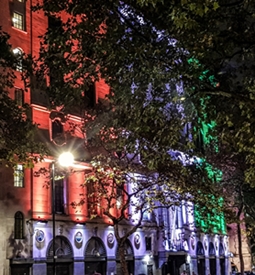
The FREEdom of the press

EVE STAND


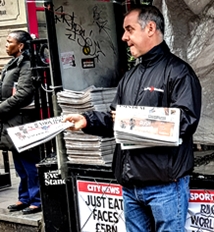
In my youth, there were no free newspapers in London. There were, and still are, daily newspapers that were available to buy every morning. In the evening, there was a choice of the Evening Standard and the Evening News. Both were available to buy for a few pennies.

The Evening News disappeared some years ago. The Evening Standard remained on sale. Then, a few years ago (in 2009), the Standard became available free of charge. In my opinion, its quality decreased a bit after it became free. Shortly before the Standard became free of charge, a morning paper, the Metro, came into existence in 1999. It was free of charge.

The Metro is a perfect read for a bus or train journey lasting 15 to 25 minutes. It covers much news and contains plenty of other interesting features. As free newspapers go, I would far rather have a copy of the Metro than the Standard.

Time Out is a weekly which provides fairly thorough information about what is happening on the London leisure scene and includes often useful reviews of films, restaurants, bars, theatres, etc. Founded in 1968, it provided a far more intelligent and edgy account of the London scene than its rivals. Until 2012, Time Out was sold to readers for a fee, which was well worth paying. Since September 2012, it has been handed out free of charge each week. For sveral years, I thought that the free version was not as interesting as the former paid version, but of late the quality of Time Out‘s contents has been improving.

These various free periodicals are great but in these days of worrying about the planet, should we not be minimising the amount of paper being used just as we are trying with plastics? Although I am not so keen about using on-line versions of newspapers, they do not involve sacrificing trees or rubbish creation.

Houses of Parliament

westmin


Recently, I attended an event, a performance of Albanian polyphonic singing by the ‘Grupi Lab’ ensemble from Vlore (Albania), in a room in the Palace of Westminster in the heart of London. For those who are unfamiliar with the Palace of Westminster, this enormous building contains the two Houses of Parliament.

To enter the Palace, it was neccessary to weave around the barricades put up to limit the activities of the Extinction Rebellion climate change activists. The public entrance is in Cromwell green, close to a statue of Oliver Cromwell. After a series of security checks that resemble those at Heathrow Airport, we followed a path that leads into the huge Westminster Hall. Although restored in parts, this hall dates back to 1097 AD. Its marvellous hammer beam timber roof  was built in the 14th century. Much of the timber is original, but some of it had to be replaced after a bomb struck in 1941.

After the concert, we decided to visit the public gallery of the House of Commons. After a short wait, we were issued with tickets and then escorted to another security check point. The examination here was very thorough. 

The public gallery overlooks the chamber in which Members of Parliament debate and make speeches. When we arrived at about 5.30 pm on the 14th of October (2019), there were more people in the public gallery than in the chamber. A Labour MP was delivering a lengthy, dull speech. Nobody seemed to be paying him the slightest attention.  After what seemed an eternity – actually, about ten minutes – he stopped. He was followed by a Conservative MP, who made an interesting speech, concisely and powerfully phrased. Again, this did not appear to interest anyone else in the chamber. During the couple of speeches we heard, we could see the few other MPs present sitting quietly, many of them fiddling with their mobile telephones or tablets. This, my first ever visit to a sitting of the House of Commons, was interesting but hardly scintillating.

What impressed me most about my visit to the Palace of Westminster was the staff. Everyone we encountered was not only helpful, but also kind and couteous. The ‘pomp and circumstance’ of the Palace did amaze me, but not nearly as much as the superb staff.

My artistic mother

HELsculpt2


My late mother died at the age of 60 in 1980. Her mother, who was born late in the 19th century in South Africa, held an old-fashioned opinion that girls should not attend university however bright they were. My mother would certainly have been able to cope with a university course of study, but, instead, she enrolled in the prestigious Michaelis  School of Fine Art in Cape Town. Founded in 1925, it is now ironically a department of the University of Cape Town.

Mom studied commercial art. Her first employment was hand painting posters, advertising cinema films. When I began visiting India in the 1990s, many film posters were still being painted by hand. Often, we saw workers perched on rickety bamboo scaffolding, painting the details of huge posters. Two years ago while visiting Bhuj in Kutch (part of Gujarat), we found a workshop where two men produced hand painted posters. They told us that the demand for these was dying out rapidly. It is interesting to note that, like my mother, the great Indian artist MF Hussain began his creative life as a painter of cinema posters.

Returning to my mother, she designed and painted advertising material for the Red Cross in Cape Town during WW2. In 1947, she followed her fiancé, my father, to the UK. She married in 1948, and I arrived a few years later. According to my father, Mom took painting classes with the the famous Sir Stanley Spencer (1891-1959).  Sometime after that, she began creating sculptures.

When I was born, I had a torticollis (twisting of muscles of the neck beyond their normal position) that caused my head to be bent to one side. At that time in the early 1950s, the doctors told my mother that there was nothing to be done about this, and we would just have to live with it. My feisty mother refused to believe this. Every day, she manipulated my head and neck and gradually corrected the situation. Whether it was this manipulation that caused my mother to become a sculptor, I cannot say. However, one of her first sculpures was a terracotta mother and child, which she reproduced much later as an alabaster carving (see photo above).

When I was a young child, my mother used to attend the sculture studios at the St Martin School of Art in London’s Tottenham Court Road. She was not a student; she used the facilities and received advice from other sculptors including Philip King and Antony Caro. At that time, she became a close friend of the sculptor Dame Elizabeth Frink, who visited our home regularly. At St Martins, Mom learnt how to weld and work with metal. She created several quite attractive abstract metal artworks. Being a perfectionist, she destroyed much of what she made, but not before having it photographed by a competent photographer. Sadly, these photos have gone missing.

By the time I was a teenager, my mother had ceased working at St Martins, possibly not of her own volition. She rented a large garage in Golders Green and used it as a studio, where she created huge abstract sculptures in timber. She found working on her own to be lonely. However, without the benefit of proper lifting equipment, she produced quite a few sculptures.

Around about 1970, Mom began complaining of back pains, which she thought were the result of the heavy work she was doing in her garage. She abandoned the garage and more or less stopped creating any artworks except for a very few abstract pen and ink drawings, which she considered good enough to be framed.

The back pains continued. My mother became disillusioned with the contemporary art scene. She was familiar with the great renaissance  works of art which she visited every year in Florence (Italy), and comparing these with what she and her contemporaries were producing added to her disinclination to produce any more art of her own. For the last ten years of her life, Mom continued to search (unsuccessfully) for an interest to replace the creation of art. Tragically, she died young because of a cancer, which might well have been contributing to her long-lasting back pain.

Whatever the reason, if an artist loses the urge to create, it must produce a huge hole in his or her life, something like losing a loved one.

Hall of fame

CAXTON blog

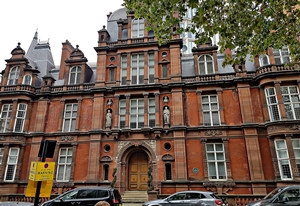
Caxton Hall is close to major London landmarks such as Westminster Abbey, the Houses of Parliament, St James Park, and Buckingham Palace. Yet, it is hidden away in Caxton Street, not only from the casual visitor but also from the attention of contemporary London life. However, this has not always been the case.

Built as Westminster’s Town Hall in 1878-82, it was designed by the architects W Lee and FJ Smith. Its architectural style has been described as an “Ambitious but coarse essay in Francois I style”.[1] It is distinctive looking building that attracts the eye.

The Town Hall contained two large public spaces known as the Great and York Halls[2]. Prior to the 1930s, these halls were used for a variety of gatherings including political meetings. Between 1933 and 1979, Caxton Hall became a registry office where weddings (often of celebrities) were held.

In 1900, the first Pan African Conference was held in Caxton Hall. From February 1906, it was the venue for meetings of The Women’s Social and Political Union, which was founded in 1903 by Emmeline Pankhurst, a fighter for women’s suffrage. Being close to the Houses of Parliament, Caxton Hall was a convenient place for the women to gather before their regular marches to the home of Parliament.

On the 1st of July 1909, Sir William Hutt Curzon Wyllie was shot dead at the Imperial Institute in South Kensington by an Indian nationalist, Madan Lal Dhinghra, from the Punjab. On the 5th of July[3], four days after the assassination, many Indians gathered at Caxton Hall to condemn the actions of Madan Lal Dhingra. Although most of those attending supported the motion “ that those present at the meeting and all the communities of Indians both in India and Great Britain express horror and condemnation of the murders of Curzon Wyllie …”, there was at least one person who opposed it as this extract from my book “Ideas, Bombs, and Bullets” describes:

“When the Chairman announced that the resolution had been passed unanimously, Veer Savarkar, who was in the audience, shouted:

No, not all!

Thereupon, mayhem broke out. People were filled with fear as many of them knew Veer’s connections with revolution and bomb-making . Many shouted that he should be thrown out and a few chairs were brandished angrily. A Mr Edward Palmer[4], of mixed British and Indian ancestry, took it upon himself to:

“… plant a truly British blow between the eyes of Savarkar who had raised a chair to fell me… ”

Tirumal Acharya, who helped to defend Veer from further attacks by Palmer, first thrashed Palmer and then began helping his friend get away from the hall .  Before this, VVS Aiyar had threatened Palmer with a gun, but Veer winked at him to restrain him . A few days later, Virendranath Chattopadhyaya, who was unable to attend the meeting, wrote to the London Times, saying that if he had been present, he would have supported Veer’s objection even at the risk of being thrown out . He added that although he objected to the resolution and believed in the right to express one’s own opinion, he did not consider that assassination and anarchism was the right way to achieve the independence of his country.”

For those who do not know, Veer Savarkar (VD Savarkar: 1883-1966) has assumed great importance in today’s India. He was a prolific writer, an Indian nationalist and freedom fighter, and helped formulate the concept/philosophy of Hindutva, which is part of the foundation of Hindu Nationalism.

Although Savarkar did not remain in the UK for much longer after this meeting, seeing Caxton House, now converted to luxury dwellings, and knowing its connections with those people I have researched in some detail sends a shiver down my spine.

“IDEAS, BOMBS, and BULLETS”

by Adam YAMEY

is available from:

Amazon, bookdepository.com, lulu.com, and Kindle

Notes to the text of the blog:

[1] https://historicengland.org.uk/listing/the-list/list-entry/1357266

[2] https://en.wikipedia.org/wiki/Caxton_Hall

[3] Much detail from Times (London) 6 July 1909

[4] Edward Palmer was of mixed Indian and British descent. Maybe, it was he who founded Veeraswamy’s Restaurant in London in the 1920s (see: https://erenow.net/biographies/white-mughals-love-and-betrayal-in-eighteenth-century-india/1.php, and https://www.historic-uk.com/CultureUK/The-British-Curry/, both accessed 15 June 2019)

Drama at the theatre

stage


In the past, I preferred watching films (‘movies’) to attending live drama at the theatre. Now, my preferences have reversed. In live theatre there is an interraction between the actors on stage and the audience. Good actors engage the audience  psychologically and almost physically. And, I suspect that the actors are also engaged by the audience – its attentiveness, its reactions (facial and otherwise), and other signs of the audience’s feelings provoked by their actions. So great is that interaction between performers and the audience that often I leave the theatre at the end of a performance feeling physically exhausted. Even with superb cinema productions, I never feel as gripped by the performance as I do whilst watching live theatre.

Having stated the above, I am now going to be a bit critical. I have watched many live performances of drama on stage, much of which was excellent. However, I have noticed that in some plays, the first (opening) act is often very weak compared with what follows later. On several occasions, I have walked out of the theatre because a play’s first act or first half has been unpromising. This is sad because now I know that many plays improve as they progress.

I cannot understand why so many plays have weak opening scenes. If I were reading a book and the first 10 or 20% of its pages did not capture my attention, I would abandon the idea of reading it through to its end. Why do so many people remain in the theatre when the opening act is unpromising? Is it because they have paid so much for the tickets? Or, is it because they, like me, have realised that most plays take time to build up to an engaging/enjoyable momentum?

Recently, I saw a play “Amsterdam” by Mayur Arad Yasur at the Orange Tree Theatre at Richmond (SW London). From its first moment, neither the actors nor the play were able to engage me. The same seemed to be the case for several other members of the audience, who walked across the stage and out of the auditorium within a few minutes of the play’s beginning.

Mercifully, about half way through the performance, which did nothing to make me forget the discomfort caused by my seat – it did the opposite, there was a technical hitch. The performance was paused, and some member of the theatre staff mumbled something, which I imagine was to notify us of the hitch. After almost 10 minutes during which no further information was given to the by now restive audience, I decided to follow the actors backstage to find out what was going on. Only then, did someone come out on to the stage to give some information. As what we had already seen of the play had been so unbearable and there seemed to be no sign that the performance would be resumed in the near future, we walked out. Had the play been more enjoyable or in some way worthwhile, we would have waited for it to continue.

Well, you cannot win every time. For each disaster such as “Amsterdam”, we have have seen plenty of highly satisfactory plays.

The dream coat

jacket

About 28 years ago, I was looking for a new winter coat or outdoor jacket. I knew that it had to be warm and have pockets both inside and outside the garment. One Saturday afternoon, I entered a clothing shop on London’s Oxford Street. A well-dressed male shop assistant politely listened to me explaining what I was seeking. He thought for a moment before saying:

“I know exactly what you need, sir”

“What?” I asked.

“What you need is a Dannimac.”

“I see,” I replied, not knowing what he was talking about.

“But, there’s only one problem, sir.”

“Yes. What?” I enquired.

“Well, sir, they don’t make them any more.”

I left the shop amused but without having purchased a coat.

Some months later, I was in New York City, still not having acquired the coat of my dreams. As prices seemed very reasonable in Manhattan, I decided to search for my coat there. I entered a shop that seemed well-stocked but not at the high end of the market, and then explained my requirements. When I mentioned the inside pockets, the chatty salesman interrupted me, saying:

“Inside pockets? Why do you need those? Are you some kind of private detective or maybe you’re a secret agent.”

I was not sure how to answer that, but I went away having bought a superb jacket that fulfilled all of my criteria. That puffy jacket with its inside and outside pockets and brilliant insulation served me well for over 20 years. It showed little sign of wear and tear despite much use. However global warming, and trips to the tropics during winter have rendered it obsolete. I have given it away.

Identity crisis

Don’t worry! This is not really a crisis. I used the word ‘crisis’ in the title to catch your attention! And, now that I have caught your attention, you might as well read on for a fewminutes because what I am about to tell you has a good chance of being interesting for you.

ALDWYCH

Since marrying a lady born in India, I have had many opportunities to visit India House on the western arm of the Aldwych in central London. Built 1928-30 and designed by Herbert Baker (1862-1946) with AT Scott, this stone building is profusely decorated with Ashoka lions and many circular, coloured emblems, which were those of the pre-Independence (and pre-Partition) colonial provinces (e.g. ‘Baluchistan’, ‘United Provinces’, ‘Burma’, ‘Madras’ and ‘North West Frontier’).

ALDWYCH 2

Looking upwards, there are two elaborate crests each topped with heraldic lions and including the mottos: “Honi soit qui mal y pense” and “Dieu et mon droit”. These are ‘souvenirs’ of the era when India was a British colony. Just as in post-Independence India there are still some statues of Queen Victoria standing– there is a fine example in Bangalore, these reminders of British imperialism remain attached to the building.

One side of India House faces India Place, which contains a bust of the Indian leader Jawaharlal Nehru (1889-1964), who became a barrister at the nearby Inner Temple. Close to a side entrance of India House, there is a monument to an off-duty policeman Jim Morrison, who was stabbed in December 1991 whilst chasing a handbag thief, who has never been caught. A ‘Friendship Tree’ was planted nearby in 1994 to commemorate the 125th anniversary of the birth of Mahatma Gandhi.

The India House, which now stands in the Aldwych, was NOT the first ‘India House’ in London. It had a predecessor in the north London suburb of Highgate. The earlier India House  stood at 65 Cromwell Avenue was a Victorian house that still exists. The Victorian house was named India House between 1905 and 1910 when it  was owned by Shyamji Krishnavarma who made it a hostel for Indian students and other Indians staying in London. The north London India House had a brief existence because it was under constant police surveillance on account of the anti-imperialist activities that went on within its walls (including producing anti-British propaganda, anti-British meetings, bomb-making, and arms smuggling).

Many Indian patriots, who wanted to force Britain to give its then colony India freedom, lived and congregated in Highgate’s India House. Their activities and often daring deeds are described in my new book about a lesser-known period in the history of India’s independence struggle: “Ideas, Bombs, and Bullets”.


“IDEAS, BOMBS, and BULLETS”

by Adam Yamey is available from on-line stores including:

Amazon, Bookfinder.com, Bookdepository.com, Kindle, and Lulu.com