
IT IS BECOMING AN ADDICTION: I must write something every day. It is probably a harmless compulsion, but it gives me great pleasure. Today, I will write about a road that did not exist until 1835. It runs northwards from the centre of London. It was built to bypass the hills on which Hampstead perches. The old route to Finchley and Hendon from central London passed across these hills before Finchley Road, originally a toll road, was constructed. Part of Finchley Road connects the suburb of Golders Green with Swiss Cottage. For five long years I travelled along this stretch.
Swiss Cottage is named after a pub, Ye Olde Swiss Cottage, which still resembles many people’s idea of what a Swiss chalet should look like. The pub is a descendant of the Swiss Tavern, built like a Swiss chalet. Opened in 1804, it stood on the same spot as its most recent avatar. It stood on the site near one of the toll booths built for collecting money from people using Finchley Road in earlier times.
There was another toll collecting place at Childs Hill, between Golders Green and Swiss Cottage. This toll gate was next to the now demolished Castle pub. For five years, I passed through Childs Hill on my way to the Hall School near Swiss Cottage.
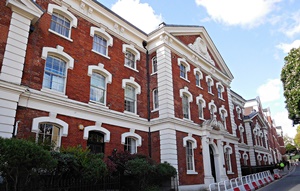
I attended The Hall between 1960 and 1965. The Hall, founded in 1889 (the year the Eiffel Tower was built) was a private school for boys preparing boys for entry into private secondary schools, misleadingly called ‘public schools’.
During my time at the Hall, several bus routes plied between Golders Green and Swiss Cottage: 2, 2a, 2b, and 13. The fare was five pence (less than 2.5p) for children. I used to say to the conductor: “five-penny half, please”.
The bus journey to and from The Hall was tedious and slow. This was because Finchley Road was being widened. The roadworks began before I entered The Hall and continued after I left it five years later. To widen the road, which was lined by houses and shops all the way between Childs Hill and Swiss Cottage, every garden by the roadside had to be cut short. There was a garden centre in a long greenhouse near Finchley Road Underground station opposite the present O2 Centre. More than three quarters of its length was demolished to permit road widening. All in all, the long section of road being ‘improved’ caused the rush hour traffic to move sluggishly. After 5 years of enduring this, I used to be able to recite from memory and in the correct geographical order the names of all the shops along Finchley Road. Today, hardly any of them exist. Even the large, still extant department store John Barnes has changed its name to John Lewis. Gone is the remains of the garden centre and the Edwardian Swiss Cottage public swimming pool. During my time at The Hall, this place closed when the then new Swiss Cottage Library and swimming pools opened close to the swiss style pub. Another of many disappearances is that of Cosmo, a restaurant that used to be popular with refugees from Central Europe and later with my wife, who loved the Hungarian cherry soup served there.
The Camden Arts Centre stands at the corner of Arkwright Road and Finchley Road. The arts centre faces across the main road the start of Lymington Road, which soon runs along the side of a large grassy open space. This is where Hall School boys played football and cricket. We used to walk two by two with one of our teachers from the school to and from the field, a distance of at least a mile.
The Hall School was an ‘elite’ establishment. Almost all the pupils had parents who were listed in “Who’s Who”, or royalty, or were extremely wealthy. Several of my fellow pupils were sons of Greek shipping magnates. One of these used to be driven from the school to Lymington Road in his chauffeur driven Bentley, which he pronounced ‘bantly’. Occasionally, he used to offer teachers a lift in his luxurious vehicle.
The sports field in Lymington Road was opposite a small newsagent-cum-sweetshop. We were not supposed to enter this during school hours, which included time at the sports field. And, because we walked back to school after a sporting session, there was little chance to explore it, but somehow, we managed. The shop was amazingly well-stocked with cheap sweets. I discovered that if I walked from Swiss Cottage to Lymington Road, the fare from there to Golders Green was two pennies (there were 240 old pennies in one Pound) cheaper than from Swiss Cottage. This gave me two pennies on top of what I was given daily to buy snacks (in my case, read ‘sweets’) on the way home.
At Swiss Cottage, there was one sweet shop near my bus stop. It was a branch of Maynard’s inside the subterranean foyer of the Underground station. The sweets it sold were poor value: there was nothing for under three (old) pennies. In contrast, the shop on Lymington Road was full of sweets costing less than one (old) penny. For example, one penny bought four ‘blackjacks’ or a large chewy item called a ‘refresher’. And, for three pence, a ‘Sherbet Fountain’ (still available on the internet for 132 [old] pence or 55p). This used to consist of a paper cylinder containing a fizzy lemon flavoured white powder into which there was a black cylindrical straw made of liquorice (used to suck up the powder). The thing looked just like an unexploded firework. In short, It was worth walking about a mile to save on the bus fare and then to spend it in a place where my money had much better buying power.
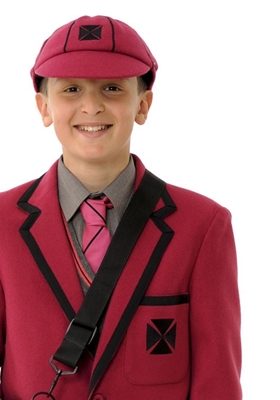
At the end of the day, I disembarked at Golders Green near the Underground Station. There used to be many children from other schools mingling there on their journeys home. One incident at this place remains in my mind, but before relating it, you need to know what we wore at The Hall. The colour that predominated in the school uniform was pink, which was considered rather strange for a boys’ school. Blazers and peaked school caps also contained black trimmings. One of these, which was prominently sewn on to our caps and the outer breast pocket of our pink blazers trimmed with black, was a black Maltese cross. The way that the school’s emblem was drawn was closer to the shape of the German Iron Cross than to the real Maltese cross. By the time I was attending The Hall, I had already become interested in the Holocaust (the Shoah). Golders Green had many Jewish people living there and several shelves of its public library were filled with books about the deeds of Hitler and his followers. I borrowed and read many of them. Therefore, I was horrified when I stepped off the bus at Golders Green one afternoon, and then some schoolboys from another school shouted at my friend and me:
“Look, the Nazis have arrived.”
Is it not strange what one cannot forget?
Picture from https://www.uniform4kids.com/
.



 yamey
yamey 