The watch repairer of West Hampstead and Auroville in India

TODAY, I WAS WALKING ALONG Mill Lane in West Hampstead when I spotted a plaque almost hidden in a doorway. It commemorated a craftsman who used to work in the building. I wondered why anyone had bothered to put up a notice to remember him.

Mill Lane connects West End Green (in West Hampstead) with Shoot Up Hill, which is a stretch of what was once the Roman Watling Street. West End Green was known as ‘Le Rudying’ (a name given to a woodland clearing) in the 14th century. By 1534, the area around the Green was known as ‘West End’. Currently, this green is a part of the district of West Hampstead. Although not so named until later, Mill Lane existed in the Middle Ages. A detailed map published in 1870 reveals that at that time, there were scarcely any buildings along it.  It was not until the late 19th century that Mill Lane began to be lined with houses and shops. A pub on the lane, The Alliance, bears the date 1886, suggesting that before that time there was not sufficient local population to warrant building such a large hostelry.

It was the doorway of number 54 Mill Lane that caught my attention. Number 54 is sandwiched between AK locksmiths Ltd and Computer Clinic. Its shop front has frosted glass. It is the window of an office connected with St Johns Wood Cars, a taxi and private vehicle hire company. The commemorative plaque that I noticed is close to the doorway that gives access to a staircase that leads to the upper floors of the building.

The wording on the commemorative plate reads:

“Clifford Norman Bowler, watchmaker and jeweller, lived & worked here. 1899-1993. A Mill Lane tradesman for over 67 years.”

Well, 67 years is a long time and no doubt Clifford (1899-1993) was a well-known local. Articles published on the Internet (www.watchrepairtalk.com/topic/3184-clifford-norman-bowler-watchmaker and westhampsteadlife.com/2014/01/15/a-moment-in-time-on-mill-lane/9921 ) show that that Clifford was a remarkable member of his profession. Clifford was born in Northumberland in July 1899 and served in the Machine Gun Corps during WW1. By 1926, he was on the Electoral Register, registered as residing at 54 Mill Lane, and in 1929 he married Mabel in nearby Willesden.

He bought the shop on Mill Lane for £100 in about 1926 after leaving the army and having worked for a while with other jewellers and watch-repairers in Manchester. His shop used to be painted red and has been immortalised in a documentary film shot for Channel 4 by a local film-maker, Conrad Blakemore, who currently teaches at the City Lit college in London. His charming short film “The Watchmaker”, a working day in the life of Clifford Bowler,  can be viewed on YouTube (https://youtu.be/BU2nOQwxiWw). In it, Clifford, a charming old man, explains that he left the army in 1919 and began learning watch-repairing in Manchester. Faced with a wage cut, he asked his brother, who was already living in London, to find him some premises. The shop he acquired in Mill Lane was already a watch and clock repairing business. The £100 he paid for it included much equipment required for his trade.

Clifford’s father was a professional banjo and mandolin player. Clifford and Mabel had two children. One of them, Norman Clifford Bowler (born 1932), has followed in his grandfather’s footsteps by having a career in entertainment. Between 1961 and 2012, he appeared in many plays mainly on television.

Although his watch repairer father probably had nothing to do with India, Norman Clifford did forge a connection with the far-off country. In 2011, Norman Clifford recorded “The Rime of the Ancient Mariner” by Samuel Taylor Coleridge (1772-1834) in Bristol. Incidentally, Coleridge’s remains lie in St Michael’s Church in Highgate, where my school used to attend services regularly. The recording was made by Norman Clifford to raise money for a school, The Aikiyam School, in the settlement of Auroville, which is close to the city of Pondicherry, a former French colony, in the south of India. A website (lanternmanproductions.bandcamp.com) that gives access to the recording also notes:

“After falling ill a number of years ago, Norman, as part of his recuperation began to spend time in the warmer climes of Southern India with his wife, Diane. As a result, he became directly involved with The Aikiyam School as a teacher of English and Drama. As the years have gone on, Norman spent more and more time in India, only returning to England to spend time with family and friends, and raise money for the school with poetry readings and personal appearances.”

Clifford is privileged to have met Sri Aurobindo (1872-1950) and The Mother (Mirra Alfassa; 1878-1973), Aurobindo’s spiritual companion/muse, and there exists a recording (www.aurovilleradio.org/satprems-my-burning-heart-a-reading-by-norman/) in which he describes his impressions of her.

When I chanced upon the almost hidden memorial to a watch and clock repairer in Mill Lane, little did I expect to discover a connection between a somewhat non-descript shop in West Hampstead and the south Indian utopian settlement of Auroville, where we have some good friends and have visited a few times. Well, they say that ‘curiosity kills the cat’. Luckily although I am curious about what I see whilst out and about, I am not a cat.

One shirt, two pockets

SOME OF YOU WILL KNOW that I am interested in the mythical birds that have one body and two heads (for example, the Russian, Serbian, and Albanian double-headed eagles). Few will know about my interest in shirts with two pockets. Most people are happy if their shirt has only one pocket, but not me. For, I like to keep my mobile telephone in one shirt pocket and my small point and shoot camera in the other.

About twenty years ago, during one of my frequent visits to Bangalore (the capital of an Indian state whose crest bears a double-headed bird), we found a store in the busy Commercial Street that sold short-sleeved (‘half-sleeve’ in Indian English) shirts with two pockets bearing the brand name ‘Camel Classics’. The store no longer exists but was close to another clothing shop called ‘Favourite Shop’ and not far from a Bata shoe shop.  Year after year, I returned to refresh my stock of double-pocketed Camel shirts. Then, some years ago, the assistants, who by then knew me well, informed me that the manufacture of my favourite Camel shirts was about to be discontinued. Hearing this, I bought all the shirts in my size that were available in the shop.

Nothing lasts forever. This was true of my Camel shirts, which I wore almost everyday both when at work and, also, when not working. The collars tended to fray. This could be remedied during our visits to Bangalore when we found various helpful tailors who were happy to turn the collars. Even with these repairs, some of the shirts became to disreputable to wear in public.

It appeared that two-pocketed shirts had become unfashionable and therefore less easy to obtain. My wife came up with the solution to the problem of replenishing my shirt stock.

We spent a fortnight in Panjim (Goa) in April 2018. While wandering about in the steamy heat, we spotted a tailoring shop. The tailor was asked if he could replicate one of my remaining Camel shirts. He said that he was able to do so, and we were to return after a week. When we went back after seven days, he had produced two perfect replicas. We wished that we had asked him to have made more than two, but our time in Panjim was running out.

The following trip to India, we decided to find tailors in Bangalore, who were willing to replicate my favoured shirts. We found two, both in the Commercial Street district of the city. We got each to make one shirt so that we could assess who did the best job. A tailor on Dispensary Road ‘won the contract’. He made me another five Camel-style shirts. My stock of double-pocketed shirts is currently up to date. Given the present covid-19 pandemic is preventing us from returning to India in the foreseeable future, I am pleased that we had so many of these items manufactured.

Discussing my liking of the double-pocketed Camel shirts with friends and their unavailability, one of them looked at my Camel shirt, and then pointed out that the American Wrangler company makes the same shirts, which are still easily available. So, I could have replenished my stock by buying them on-line, but this would have been far less enjoyable than finding and getting to know tailors in India.

A great discovery

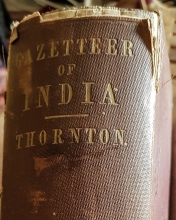
I ENJOY ENTERING CHARITY SHOPS (shops selling used goods to raise money for good causes) to browse the books they have on sale. Even if I do not find anything of interest or buy anything, I find these visits both satisfying and therapeutic. Yesterday, to satisfy my craving for the browsing experience, I stepped into a local charity shop which I have entered many times before,  often with only a day or two’s interval between visits: usually finding that the stock of books has barely changed, and not expecting to find anything worth purchasing. This time, my gaze fell on a large old book on a shelf. What caught my eye was the title on its wide spine: “Gazetteer of India”. Because I have a great interest in India, I always look at books about the country and this was no exception.

The book has 1015 pages of text printed in a tiny font. Eagerly, I looked for its date of publication and to my great delight I discovered that it was published in 1857. For those who are not familiar with it, this is the year when the so-called ‘Indian Mutiny’, or, as it is known nowadays, the ‘First War of Independence’, began on the 10th of May. The book’s full title “A Gazetteer of the Territories Under the Government of the East-India Company and of the Native States on the Continent of India” was soon to become out of date because following the ending of the ‘Mutiny’ in 1858, the British Government took over the ruling of India from the East India Company.

The book by Edward Thornton (Esq.) was published in response to the desire of the General Courts of the East-India Company to have  “… an authentic Gazetteer of India [that] should be offered to the British public in a cheap and convenient form…”. Thornton had already published a four volume “Gazetteer of India” in 1854. The book I found yesterday contains much of the information that was published in the multi-volume edition. The book that I purchased is an original edition, which is rarely offered for sale in the second-hand book market. A facsimile edition was published by the British Library in the 21st century. Fortunately for me, whoever had priced my copy had no idea of its true worth, which is unusual because often those who run charity shops often check the market prices of old books.

Edward Thornton (1799-1875), the author of the gazetteers is, apparently, often confused with the better-known Edward Parry Thornton (1811-1893), who was an administrator in India where he lived on and off between 1830 and 1862. ‘Our’ Edward of the gazetteers worked at East India House (which stood in London where today the towering Lloyds building now stands) between 1814 and 1857, where he was head of its Maritime Department from 1847. The Oxford Dictionary of National Biography includes this information about him:

“Among his publications were gazetteers of the territories held by the East India Company and the ‘countries adjacent to India on the North-West’, and a six-volume History of the British Empire in India (1841–5). He was also responsible for entries in the eighth edition of the Encyclopaedia Britannica on Indian subjects, which have also been attributed to Edward Parry Thornton. This Edward Thornton died at 1 Montpelier Street, Brighton, on 24 December 1875.”

You can rest assured that I will not be reading all 1015 pages of my new ‘treasure’, but I will enjoy dipping into it to read about places I have visited or hope to visit in the future. One of the first places I looked up was Tranquebar in Tamil Nadu, which we visited in February 2020. Formerly, it had been a Danish colony in India. Thornton wrote:

“ … The settlement of Tranquebar was ceded to the British government in 1845 by the King of Denmark, for a pecuniary consideration … the superiority of the British over Danish administration is attested by the growing prosperity of the district, and the large increase in the amount of the government revenue…”

This “government revenue” did not benefit the British in general but rather the coffers of the East India Company.

Of Bangalore, which I have visited more than 50 times in the last 26 years, Thornton wrote a whole page that includes the following:

“… The town is tolerably well built, has a good bazaar, and is inclosed [sic] by a wall, a ditch, and a broad fence of thorns and bamboos…”

Thanks to my friend, an excellent guide to Bangalore, Mansoor Ali, I knew of the existence of the fence (hedge) of vegetation mentioned in the quote but did not realise it was still in existence as late as 1854/7. This hedge is marked on some maps of Bangalore created during the 19th century. According to a map dated 1800, the circular hedge surrounding Bangalore ran through present day Yeshvantpur in the north. Kengery in the west, and almost at Madiwala in the south east. I have no idea when the hedge disappeared, but it was clearly after the time when Thornton knew of its existence. I look forward to much more delving in my latest literary acquisition.

Finally, my copy of Thornton’s book has an ex-libris sticker that bears a coat-of-arms and the name ‘John Harrison’. Harrison is a common family surname. A quick look at Harrison coats-of-arms displayed on Google reveals that the crest in my book is similar but not identical to that of the “Yorkshire Arms” of the ‘James River Harrisons’, which originated in the north of England. They settled on the James River in Virginia in the 1630s. If my book was once owned by a member of that family, I wonder how it ended up on a shelf in a charity shop in West London.

Remembering Madras

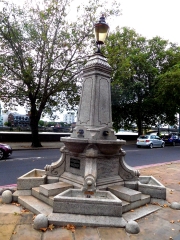
WE PARKED OUR CAR next to Petyt Place close to Chelsea Old Church and the Chelsea Embankment on the River Thames. Our aim was to cross the river to take a stroll in Battersea Park, but before we had gone a few yards, we came across a granite Victorian drinking fountain, which turns out to have connections with India.

BLOG Sparkes

The structure was designed by the architect Charles Barrie (Junior) who lived from 1823 until 1900. He is responsible for many buildings in London and the south-east of England. His father Charles (Senior) was the architect of the Houses of Parliament, which were rebuilt between 1840 and 1876.

The drinking fountain was erected by the widow of George Sparkes of Bromley (Kent), who died in 1878 during his 68th year. Sparkes had been in Madras (now Chennai) in southern India. Seeing this sparked my interest and inspired me to find out more about the man in whose memory it had been constructed.

George Sparkes (1811-1878) was the oldest of the six children of George Sparkes and his wife Ann Alice Wiple.  He was educated at Eton. His great grandfather was John Cator (Senior). George spent his younger years in the Madras Civil Service possibly in association with his relative Peter Cator. The latter, who served as a barrister and Registrar to the Supreme Court in Madras, was involved in education in India and published a book, “Christian Education in India: Why Should English be Excluded?”, in 1858. According to an issue of “Asian Intelligence” dated 1835, Peter donated 10,000 rupees to the Society for Promoting Christian Knowledge in Asia.

Like his relative Peter, George was part of the legal system of the East India Company. He had been a judge.  A book, “The Asiatic Journal and Monthly Register for British India and Its Dependencies, Volume 16”, records that in April 1835, George was appointed ‘assistant judge and joint criminal judge of Malabar’. Malabar, being on the west coast of southern India. Earlier that year he had been appointed ‘registrar of zillah court of Malabar’, a zillah being a subdivision of a British Indian province. The same volume states that George landed in India on the 17th September 1834 having sailed from London on a vessel named ‘Arab’. Just in case you are wondering what the Malabar coast had to do with Madras on the other side of India, let me explain that during the existence of the East India Company, part of the Malabar was under the jurisdiction of Madras.

By 1846, George had returned to his native place, Bromley in Kent. That year, he published “An Easy Introduction to Chemistry”. Its publication was noted in the ‘Books Received’ column of the ‘Provincial Medical and Surgical Journal’ dated 14th of October 1946. Clearly, Sparkes had versatile mind.  Sadly, a review published in “The Chemical Gazette, Or, Journal of Practical Chemistry, in All Its Applications to Pharmacy, Arts and Manufactures” was critical of it, stating that it contained a number of mistakes and had failed to keep up to date with the latest developments in the subject.

By 1851, George, living in Bromley where today stand Bromley’s Central Library and Churchill Theatre, had become Director of the ‘Reversionary Society’. This might have been The Reversionary Interest Society Ltd, which dealt with reversionary interest connected with trust funds.

In the 1850s, George bought number 16 High Street in Bromley. He renamed it ‘Neelgherrries’, his spelling of the Nilgiris, hills in Tamil Nadu to which he would have retreated to escape the heat of Madras in the hot seasons. The author of a website, londongardenstrust.org, wrote:

“Contemporary photographs of Nilgiris in the 19th century show an Indian landscape very similar to the uninterrupted views that Sparkes enjoyed from his house in Bromley.”

Sparkes was a keen gardener and in 1872 he wrote to Charles Darwin, who lived nearby, to discuss the results of his experiments in crossing primula plants. By then, he had been married to his second wife Emily Carpenter (1819-1900), his housekeeper, for seven years. On his death, he left Emily the considerable sum of £140,000 and his house, Neelgherries. She remarried a Mr Dowling, but the union was not a great success. It was Emily who was responsible for commissioning the drinking fountain on Chelsea Embankment. When Emily died in 1900, she:

“… left Neelgherries and grounds to the town of Bromley for ‘education and learning’, in accordance   with George Sparkes’s wishes. In 1906 the Scottish philanthropist Andrew Carnegie donated £7,500 for a new library in Bromley and this was erected on the site of Neelgherries. The gardens became the pleasure grounds, these were the first Bromley Library Gardens…”

Had it not been for Emily’s decision to provide Chelsea with a public drinking fountain, George Sparkes would most likely have been completely forgotten outside Bromley. I suspect that most people walk past this memorial to an erstwhile Civil Servant of India and textbook writer without giving it a thought. I have done so several times in the past but am glad that I stopped to examine it today.


SOURCES INCLUDE:

http://www.beckenhamplaceparkfriends.org.uk/catorsbyPManning.pdf

https://londongardenstrust.org/features/bromleylib.htm

https://www.bblhs.org.uk/east-india-company

Around London’s Euston Station

AFTER EATING DELICIOUS KEBABS and a wonderful mutton biryani at Raavi Kebab, a Pakistani restaurant in Drummond Street close to Euston Station, we took a short post-prandial stroll around the area, a part of London that is home to University College London (‘UCL’), where my wife and I did our first degrees and we first met.

BLOG TAGORE

The west part of Drummond Street has become a desolate building site because of the works being undertaken to construct the HS2 railway. A building covered in tiles the colour of clotted blood stands in the midst of the building works. It looks like some of the entrances to older London Underground stations. It is located on the corner of Drummond and Melton Streets. It was the original entrance (opened between 1907 and 1914) to Euston station of the Charing Cross, Euston and Hampstead Railway, now part of the Northern Line, which is now accessed from within Euston railway station. The latter was built in the 1960s on the site of the demolished Euston Station (with its impressive Doric arch) built in the 19th century.

When the old Euston Station existed, Drummond Street stretched further east than it does today. It ran past the southern façade of the 19th century station and across the present Eversholt Street, ending at Churchway (not far from the current British Library).

All that remains of what must have been a splendid old station is a statue of the railway engineer Robert Stephenson (1803-1859) and two pavilions on Euston Road. These formed part of the entrance to the old station’s forecourt. Built of Portland stone in about 1870, they were designed by JB Stansby. The corners of these two buildings bear the names of the stations that were served by trains from Euston Station. Interestingly, these include cities such as Cork and Dublin, which are no longer within the United Kingdom. When the pavilions were constructed, the whole of Ireland was under British rule.

Strolling along Gordon Street, we passed the Ingold Chemistry building, part of UCL, where my wife and I spent many happy hours trying to synthesize various organic compounds, often ending up with tiny granules of non-descript materials, which might have been bits of broken glass rather than the desired product. Across the street, where there had once been an open-air entrance to the main campus of UCL there is a new building, glass-fronted at street level. Through the glass, we could see the mummified, clothed remains of the philosopher Jeremy Bentham (1748-1832) in a glass container, instead of the old wooden one in which he used to be housed. Bentham was strongly associated with the foundation of UCL in 1826.

As I stared at Bentham, an opponent of slavery, through the windows of the new building, I wondered what his views were, if any, on colonialism in India. Some of Bentham’s followers, such as John Stuart Mill, had been employees of the East India Company. Mill and Bentham, were not opponents of British colonialism, but did criticise it.

It was almost dark when we walked into the garden of Gordon Square, a place overlooked by the homes of some members of the famous Bloomsbury Group, a set of British intellectuals and artists, which thrived during the first half of the 20th century. We discovered something that had not been present when we last visited the square some years ago. This is a bust of the Bengali genius Rabindranath Tagore (1861-1941). Created by Shenda Amery, it was unveiled by the Prince of Wales in July 2011, seventy years after Tagore’s death and one hundred and fifty years after his birth.

Tagore coined the name ‘Mahatma’ for the Indian Nationalist and freedom fighter MK Gandhi and also composed (in 1911) both the words and music of the Indian national anthem, “Jana Gana Mana”. The eminent historian Ramchandra Guha explains in his “Makers of Modern India” that:

“Tagore was a patriot without quite being a nationalist. He was no apologist for colonial rule… he was dismayed by the xenophobic tendencies of the populist edge of the Indian nationalist movement. He thought that India had much to learn from other cultures, including (but not restricted to) the West.”

Following the horrendous massacre of innocent Indians by soldiers under the command of the British at Jallianwala Bagh in 1919, he returned his knighthood to King George V.

Tagore was sceptical about ‘non-cooperation’ as advocated, for example by Gandhi. He was also worried about the concept of nationalism as applied to India. In his book “Nationalism”, published in 1917, he wrote:

“When our nationalists talk about ideals they forget that the basis of nationalism is wanting. The very people who are upholding these ideals are themselves the most conservative in their social practice. Nationalists say, for example, look at Switzerland where, in spite of race differences, the peoples have solidified into a nation. Yet, remember that in Switzerland the races can mingle, they can intermarry, because they are of the same blood. In India there is no common birthright. And when we talk of Western Nationality we forget that the nations there do not have that physical repulsion, one for the other, that we have between different castes. Have we an instance in the whole world where a people who are not allowed to mingle their blood shed their blood for one another except by coercion or for mercenary purposes? And can we ever hope that these moral barriers against our race amalgamation will not stand in the way of our political unity?”

Tagore’s views on Indian independence were not as clear cut as many of the other advocates of freeing India from British rule, such as Gandhi, Jawaharlal Nehru, Subhas Chandra Bose, and Vinayak Savarkar. He was essentially in favour of it but as Radha Chakravarty wrote in “The Essential Tagore”:

“For Tagore, the view of nationalism and patriotism that the movement was taking on was too narrow. He disengaged with the movement but remained expressive on the issue of independence through his art and writings … Fundamental to his belief was that nationalism could not rise above humanity…”

We left Tagore as his bust began to become less visible in the deepening gloaming and walked along Torrington Place past Waterstones bookshop that is housed in the pinnacle-rich building that once housed Dillons, the university bookshop. Almost opposite the north eastern corner of the bookshop, a private roadway leads into the UCL campus and under a circular archway. This was a familiar landmark for us when we were undergraduate students because it allows the roadway to pass beneath the building that housed ‘our’ Department of Physiology. Being August and in the midst of both the university holidays and the coronavirus pandemic, this normally busy roadway was empty.

We walked north along the east side of Gower Street passing a door marked ‘Anatomy’. This used to be an entrance to the Physiology Department, where I spent six years studying. During the last three of these, I used to have a key to the door so that I could let myself in whenever I wanted to do laboratory work on my PhD project. In those far-off days, security was far laxer than it is nowadays.

After passing the main entrance to UCL, we reached the corner of Gower Street and Gower Place. This building, now a part of UCL, used to house the medical bookshop, HK Lewis & Co Ltd. This, according to a plaque on the wall, was founded in 1844 in Gower Street, soon after UCL’s medical school was established in 1834. HK Lewis had a useful second-hand department, where I bought a few of my textbooks at prices not much lower than they would have been if they had been new.

We returned to our car parked in Drummond Street. Our favourite Asian grocery and Ambala’s sweet shop were already closed for the day. Raavi Kebab, a haven for carnivores, and its neighbour, the long-established Diwana Bhel Poori House, a haven for vegetarians, were still serving diners. These restaurants and several others in the street serving foods from the Indian subcontinent are run by folk whose ancestors were subjects of the British Empire prior to 1947. The street is a fine example of the idea suggested by the French colonial writer Frantz Fanon (1925-1961), namely, that eventually the colonial chickens come home to roost. And, thank goodness they have because they help to give London the vibrancy that makes it such a great city.

Umbrella of memory

BUILT BETWEEN 1787 AND 1820, BRIGHTON PAVILION looks less like a hospital than most other buildings. Yet, during the First World War (‘WW1’), this decorative seaside retreat for British royalty was converted into a hospital to treat Indian troops. They had been wounded whilst fighting for the for the British Empire in the battlefields of Flanders. On the 14th of December 1914, the Pavilion was opened as a hospital with 724 beds. According to George Morton-Jack in his book “The Indian Army on the Western Front”, 14,185 wounded Indian troops were brought to Brighton on six “state-of-the-art” hospital ships. They were treated in the Pavilion and other hospitals specially established for the Indian wounded in Brighton and elsewhere. Over 2,300 Indians were treated in the converted Pavilion.

BLOG

The Chattri

A few of the Indians did not survive their injuries. Of those treated at the Pavilion, 18 died, 10 of whom were cremated. Those who died, were given last rites according to their religious beliefs. Moslem corpses were buried in a purpose-built cemetery near the Shah Jehan Mosque at Woking (in Surrey). This mosque was completed in 1889 to the design of Gottlieb William Leitner (1840-1899), an orientalist of Hungarian Jewish heritage. The Hindus and Sikhs who succumbed to their injuries in the hospitals in Brighton were cremated on traditional funeral pyres. Between the 31st of December 1914 and the 30th of December 1915, 53 Sikh and Hindu soldiers were cremated at a specially demarcated spot on Holt Hill (near Patcham) in the South Downs, 500 feet above sea-level and then their ashes were scattered in the sea according to their rites.

Years ago, we used to meet the late General Misra (of the Indian Army) once a year for dinner when he came from India to the UK on his annual visits. He was a jovial gentleman, who seemed to enjoy life. All that we knew about his visits was that during them, he used to make a trip to Sussex to pay his respects to those Indian soldiers who had died during WW1. Apart from knowing him as a pleasant dining companion, we knew nothing else about him apart from the fact that he was related to some close friends of ours. We were not sure exactly why he used to go to Sussex in particular. Also, we were then unaware that our affable old friend had had a formidable military career.

During WW2, the General was attached to the 6th Rajputana Rifle regiment. A report (https://opus.lib.uts.edu.au/bitstream/10453/28086/4/MANIS002.txt) written during the British Indian campaign against the Japanese in Burma noted:

“Expediting the Jap withdrawl from the TENGNOOPAL Ridge and converting his retreat into a rout, the capture of a prominent hill to the east of Sibong, know(n) as Battle Hill, by a battalion of the 6th. Rajputana Rifles enabled us to have a grand-stand view of the retreating Japa on their LOC. The Rajputs singing and shouting made merry here as they sent MAG bursts on the jap LOC. In this battle and from the attack on Lone Tree Hill near Shenam, the Rajrifs [sic] have been commanded by Lt. Col. Dinesh Chandra Misra of Agra and a graduate of the Indian Military Academy.”

On the 5th of October 1944, the London Gazette announced that the then Captain (temporary Major) Misra had been awarded the prestigious Military Cross for his services in Burma. His distinguished military career (with the British before Indian independence) is summarised on the Imperial War Museum website (https://www.iwm.org.uk/collections/item/object/80017253):

“Indian cadet at Indian Military College, Dehra Dum, India, 1933-1935; officer attached to North Staffordshire Regiment in India, 1935-1936; served with 5th Bn Rajputan Rifles in India and Hong Kong, 1937-1941; served with British Army Aid Group Indian Section, China, 1942-1943, served with Rajputan Rifles in India and Burma 1943-1944; student attended Staff College at Camberley, GB, 1944-1945.”

From what my wife and I remember of this affable general, he never mentioned his brave exploits or even hinted at them.

Recently, a friend posted a photograph of a monument that he runs past whilst taking exercise on the South Downs near Hove. This small structure, which looks Indian in design, is what General Misra used to visit on his annual trips to the UK. A few days ago, we visited our friends in Hove and after eating a delicious lunch with them, we drove up on to the Downs near Patcham and walked through a field of well-fed grazing cows to reach a small enclosure containing the Chattri and a monument listing the names of the Hindu and Sikh soldiers who were cremated at this place during WW1.

‘Chattri’ is the Hindustani and Punjabi word for ‘umbrella’. The monument on Holt Hill consists of a small white marble dome supported on eight pillars made of the same material. This stone Chattri stands on a podium with stairs leading up to it from a lower platform on which there are three low granite slabs. The three granite slabs cover the spots where originally there had been three concrete slabs on which the funeral pyres were built and then ignited according to religious tradition. The ‘umbrella’ or ‘chattri’ symbolises, according to a plaque nearby, “the protection offered to the memory of the dead”.

Funded partly by the India Office and Brighton Borough Council, the monument was unveiled by the Prince of Wales in 1921. It was built to the designs of EC Henriques (died 1940, aged 51) a young Indian architect from Bombay. His work was supervised by Sir Samuel Swinton Jacob (1841-1917), an expert in the Indo-Saracenic style of architecture. I have eaten dinner at one of Jacob’s other buildings: Bikaner House, a palace he designed in Mount Abu (Rajasthan), constructed in 1893. Built as a summer palace for a maharajah of Bikaner, it is now a hotel. In January 2020, we ate a poor-quality meal there. We and the other diners sat dressed in padded jackets because the dining room was unheated, and the outside temperature was close to freezing point.

The bases of the eight columns of the Chattri interested me because they bear the same decorative motif seen on the bases of pillars in Hindu temples constructed well before the era of Moslem invasions of India began. The early mosques built in the 15th century in Gujarat (e.g. in Ahmedabad and Champaner), which borrow many structural features of Hindu temples, also contain pillars whose bases are decorated with the same motif seen on the Chattri. The same is true of the capitals of the pillars that support the dome of the Chattri. Also, the domes in those ancient Hindu temples and mediaeval mosques are always supported on eight pillars arranged in an octagon, as is the case at the Chattri.  In brief, the small but elegant Chattri, which looks a little incongruous in West Sussex, would look very much at home in many parts of India.

The Chattri stands high on the South Downs in a pleasingly landscaped garden. It overlooks the surrounding hills and the ribbon of coastal towns including Brighton and Hove, and beyond them the sea. Part of the monument complex is a more recently (2010) erected concrete wall on which are carved the names of the 53 Hindu and Sikh men who were cremated at this spot, as well as their ranks and regiments.

To reach the Chattri, we walked along a path through a field in which cattle were grazing. As I looked at the cows, I thought that most of the Indian men whose lives ended in Brighton and were cremated on the Downs must have often walked amongst cattle in India before they left it to fight in Flanders  for the Empire, which did their fellow countrymen few favours.

During our brief visit to the Chattri, there were a couple of families relaxing around it. Their children were playing cheerfully around the pillars and on its steps, blissfully unaware of what it represented. This did not bother us. We felt that their joy would have been appreciated by the men who sacrificed their lives for the future of families such as these and many others. The wide horizons, the lovely landscape, and the fresh air enveloping the monument, gave the place and its surroundings a special, maybe spiritual, atmosphere, a feeling of the continuum of life and beyond. Who knows, but any of us at the Chattri might possibly be reincarnations of some of the soldiers cremated there.

POSTSCRIPT: INDIAN SOLDIERS ON THE WESTERN FRONT

Many Indian soldiers fought for the British because they believed, or hoped, that by supporting the Empire in its struggle for survival, India would gain at least some autonomy, if not a generous dose of self-rule. In the last years of WW1, even the pacifist Mahatma Gandhi roamed around India encouraging Indians to enrol to fight for the British. Joseph Lelyveld wrote of Gandhi in his book “Great Soul. Mahatma Gandhi and his Struggle with India”:

“He implores wives to send their husbands to sacrifice themselves on behalf of the empire, blithely promising, ‘They will be yours in the next incarnation.’ Fighting for the empire, he now argues, is ‘the straightest way to swaraj’”

The Indian soldiers fought for the empire. Some were killed, others injured, but India did not reach swaraj (i.e. self-government) at the end of WW1. Remember, less than a year after the Great War ended, soldiers commanded by a British general killed at least 379 and wounded over 1000 unarmed Indian civilians in Amritsar in the Punjab, the district of India that supplied many troops to the Western Front and other battlefields. Even Winston Churchill, no lover of India, was genuinely outraged by the horrific nature of this murderous event.

India would have to endure many upheavals and another world war before independence was won.

Clive in India

I AM NOW IN CALCUTTA. Last time I came here, for miles and miles along the railway lines and at stations, there were starving people. Now there is not a sign of famine – it has been organised with the ability of genius…” 

Thus, wrote Clive Branson (1907-1944) from Bengal on the 11th of November 1944. Later in the same letter, this British soldier in India added:

“… it is reported that in the week ending November 5th, 267 deaths occurred in Chandpur town and in the 53 unions (groups of villages), on an average more than 200 in each. The report states ‘Almost all the dead bodies were thrown into the ‘khal’ and paddy fields – to be devoured by dogs, jackals and vultures – as there was no man available to bury or burn those corpses.”

A few lines later, he adds:

The point is that out in the villages people can starve to death without anyone knowing about it, while on the basis of the falling mortality rate in Calcutta Amery will no doubt claim that the famine is over.”

‘Amery’ to whom Branson referred was Leo Amery (1873-1955), who was Secretary of State for India during WW2. The famine was that which decimated many Indians in Bengal and other parts of India.

clive

Writing on the 28th of August 1943, Branson suggested that the famine was to some large extent man-made rather than the result of natural disasters:

But the fact is there is enough food in India now …”

A major cause of the famine he suggested it was:

“… the hoarders, the big grain merchants, the landlords and the bureaucrats who have engineered the famine …”

And, on the 14th September 1943, Branson wrote:

The thing that stands out a mile is that the Government showed no signs of weakness when it came to the arrest of the Congress in glaring contrast  to its utter helplessness (??) (or should we call it co-operation, tie-up) in the face of the grain profiteers (and in a similar situation – the cloth merchants – the coalowners, re employment of women underground).”

These quotes, damning indictments of the situation Clive Branson observed whilst serving in India come from a book, “British Soldier in India”. It contains the letters that Clive wrote from India to his wife in England and was published in 1944 by ‘The Communist Party, London’. The slender volume contains an introduction written by Harry Pollitt (1890-1960), who was General Secretary of The Communist Party of Great Britain from 1941 to 1956. I came across the book while reading an excellent book about the 1943 Bengal famine, “Churchill’s Secret War” by Madhusree Mukherjee, and ordered a copy.

Clive was born in Ahmednagar (India), son of an army officer. Ironically, most of his time in India during WW2 was spent in the town where he was born. He trained to be a painter at The Slade School of Art (part of University College London) and became a prolific and talented artist. Some of his works are housed in London’s Tate Gallery. From the age of 20, Clive became interested in Communism and joined the Communist Party in 1932. Pollitt wrote of him:

He was one of those who endear themselves to all who came in contact with them … he was able to inspire others to hate poverty and fight to remove it, to hate ugliness and see beauty … He was not only a brilliant speaker and organiser, but also did more than his share of what is sometimes called “the donkey work”. Nothing was too much for him …”

During the Spanish Civil War, Clive both recruited for, and from 1938 fought with, The International Brigade. In March 1938, he was taken prisoner by Franco’s Nationalist forces and interned in San Pedro de Cardeña concentration camp, where he painted and sketched the camp and many of its inmates. These artworks are currently stored in the Marx Memorial Library in London’s Clerkenwell Square. Pollitt reports that a fellow prisoner said of Clive:

In any difficult time, Clive was always cheery, putting forward what we should do … He was one of the most popular and most respected among the British prisoners.”

Clive, a true patriot and ardent anti-fascist, joined the Royal Armoured Corps during WW2 and was posted to India where he arrived in May 1942, the month that he sent his first letter published in the book. Pollitt accurately notes that Clive’s letters from India:

“… will make you angry and they will make you sad. They will make you see new colours and shades, an unimaginable suffering and a truly heroic grandeur, extraordinary nobility and equally extraordinary bestiality. It is a vivid and many-sided picture which Clive wanted to record in painting, and which we may be sure he would have executed with feeling and sincerity...”

Reading Clive’s letters today, 76 years after they were composed, still evoked a sense of anger because of the awful things he saw as well as a sense of wonder because of his very evident love and admiration of India and its people.

Whenever he was able, Clive mixed with Indians from all strata of society and delighted in their company.  While in Ahmednagar, Clive was introduced to an Indian artist. At this person’s house, he:

“… did a drawing for 1½ hours of his little niece aged 10. I did it in indelible pencil and ink – this is the medium I shall do most of my work in as it is more lasting – does not smudge – than ordinary pencil. But how difficult are Indian clothes – I shall have to do a lot of careful observation and drawing before I shall know what to do technically’ The Indian just sat and watched me working. He speaks English quite well, and knows a number of famous Indian painters – he himself went to the Bombay School of Art…”

This was noted in a letter dated 13th of April 1943. Several months later, in mid-September, Clive was invited to lunch with his artist friend. I loved his description of the occasion, which was new to him but typically Indian:

We sat on wooden seats about 2 ins. off the ground. The meal was in a room just off the kitchen. Of course we had taken off our boots etc. Each had a large silver plate with the various ingredients put around the edge. A small bowl of what they call butter-milk took the place of water. A pattern, done with vermilion and white powder had been drawn on the ground. In front of me was placed a little silver stand in which a stick of incense burned. Nana’s elder daughter also ate with us. The whole affair was very civilised and friendly.”

In general, Clive was enamoured of all of the Indians he encountered, both those from sophisticated and also humble backgrounds. He was horrified at the way that the British and their government treated them. This is a significant feature of what he conveyed in his letters. Also, the failure and apparent unwillingness of the British to address the terrible famine concerned and upset him greatly. He communicates this eloquently and powerfully in his writing.

One of Clive’s many observations struck a personal chord. It concerns the bookshops that Clive visited in India in search of reading material. In a letter written from Bombay in September 1942, he noted:

I have said a lot about going to bookshops, but I have never mentioned something which hits you in the face about the general trend of literature: 1. Hitler’s ‘Mein Kampf’ is on sale prominently at every bookstall …”

Seeing copies of “Mein Kampf” openly on sale in most bookshops in India is something that has always surprised me since my first visit to India in 1994.

As a Communist, Clive’s political views are not concealed in his letters. He showed little or no sympathy for the policies of Gandhi and the All India Congress. On the 10th of March 1943, he wrote:

How stupid Gandhi’s fast looks compared to the grandeur of a handful of Indian peasants and workers uniting to demand their human rights!  No wonder the Viceroy corresponds with Gandhi and sends the police after the people.”

As for the Muslim League in Bengal:

The net result of the League’s scheme is to launch the peasants against the little men and leave the big bastards to control the famine via the black market – such is the first practical application of the policy of Jinnah.” (letter dated 19th June 1943)

Also, as a staunch anti-fascist, he regarded Subhas Chandra Bose as contemptible because he had chosen to fight alongside the Japanese, who were allies of fascist Germany. During his stay in India, Clive met and discussed matters with members of the Indian Communist Party. This is described in the letters and was not removed by the censors. In addition, his harsh but justifiable criticism of Britain’s mishandling of the famine in India passed the censors’ scrutiny and reached his wife’s letter box intact.

Clive was constantly upset by seeing examples of British racism in India. He mentions this often in his letters. The most eloquent example appears in a letter written on the 29th of November 1943:

I am sitting on the grass outside a long army hut. Not far away is an African negro … reading a book. Five minutes ago a B.O.R. [British other rank] came up, stopped, and said to him, ‘Can you read?’ ‘Yes.’ ‘What’s the book? Miss Blandish?’ ‘No, Pygmalion.’ I had to record this – whole books could not present the present world situation better.”

(I imagine that the B.O.R. was referring to “ No Orchids for Miss Blandish”, a  raunchy thriller by James Hadley Chase)

In the same letter, Clive noted that the British Conservative MP, Ferris:

“… has made a study of Indian affairs, and has delivered himself of the profound judgement that India is not ready for self-government. I wonder how many whiskies and sodas it took to produce such an original conclusion.”

Sadly, Clive did not live long enough to see India becoming independent in 1947. He was killed in action early in 1944 “…commanding an M3 Lee tank of B Squadron, 25th Dragoons. He was hit a glancing but fatal blow on the back of the head by a Japanese anti-tank shell near Point 315 at the end of the Battle of the Admin Box.” (source: Wikipedia).

Clive’s letters provide a moving collection of well-described observations of India, a country in which many of its citizens were enduring a plight at least as bad as that of people suffering in Nazi occupied Europe. They were under the control of the British, who were fighting to defeat Nazi tyranny. The British were under the leadership of Winston Churchill, who is reported (by his close colleague Leo Amery) to have said:

I hate Indians. They are a beastly people with a beastly religion.”

Here are two short videos well worth watching in connection with what I have written:

https://youtu.be/QI6qg1ERmGE

(Pathé Newsreel with scenes of the famine. Commentary in Punjabi, but images are very powerful)

https://youtu.be/fUjtxHFGUrg

(An Indian historian/author/politician gives a fresh view of Churchill)


Hummus in Hampi (south India)

MANY PEOPLE WILL HAVE EATEN HUMMUS, the chickpea-based dip, but far fewer will be familiar with Hampi, which is the location of an extensive archaeological site in the south Indian state of Karnataka. The village of Hampi contains the fantastic ruins of what was once one of the world’s greatest cities, rivalling Ancient Rome and second in size to Beijing, the world’s largest city in the 16th century. The metropolis, known as ‘Vijayanagara’, now in ruins, was the fabulously prosperous capital of the Vijayanagara Empire, which thrived between about 1336 AD and 1565 AD, when it was defeated by a group of Moslem sultanates. After this, the city began to decay, leaving the spectacular ruins that can be explored by visitors today.

BLOG HAMP 1

The ruins of Vijayanagara lie mainly on one side of the River Tungabadra. They are distributed over a large rocky area rich in huge boulders – almost a lunar landscape. We first visited Hampi in about 1997, when there were relatively few tourists clambering amongst the ruins of temples, palaces, stepwells, and miscellaneous other buildings. Since then, we have visited the place another four times. On each successive visit, we have noticed an increase in fellow visitors, both Indians and foreigners. With the increased visitor footfall, there has been ever growing deterioration and damage to the ruins. This is especially noticeable at the Vitthala Temple. It was intact in 1997, but when we last visited a few years ago, it was in a miserable state, with plenty of damaged carvings and being propped up by ugly pillars of grey concrete blocks. Sad as this is, this is not what I want to dwell on in this piece.

India has become a popular destination for Israelis, particularly the younger ones. India is probably a complete contrast to Israel, which I have never visited. In brief, to Israelis India must seem far more ‘laid back’ than their highly organised country. Many Israeli visitors to India visit Hampi to ‘chill out’ and relax.

During one of our stays in Hampi, we took a walk along one bank of the River Tungabadra. We came across a couple of riverside eateries advertising that they served Israeli food. As it was near lunchtime and our daughter and I love hummus, we entered one of these establishments, whose menu included the chickpea paste that we enjoy so much. Also, I was curious to try hummus in India. It was then not a food item I was expecting to see on sale a few years ago. Now, it is becoming available in select food stores such as branches of the upmarket chain Nature’s Basket.

We sat down on a rickety looking terrace overlooking the river and, with mouths watering, and ordered a portion of hummus with pitta bread. It took quite a while to arrive as the hummus was made fresh whilst we waited. When it arrived, the pitta looked remarkably similar to an Indian chapati, rather than an Arabic or Turkish pitta. As for the hummus, this was disappointing to say the least. Its colour was acceptable, but its texture resembled lumpy rice pudding rather than even the coarsest hummus. As for the taste, there was little to report: it was unseasoned and tasteless. I dread to think  what a direct Israeli guest would have made of, or said about, the hummus we were served at Hampi. I had not the heart to send it back to the charming locals who had produced it, but neither was I hungry enough to finish it.

EVERYONE NEEDS GOOD NEIGHBOURS

I HAVE BEEN ASSOCIATED WITH INDIA since my earliest days. This association was unconscious for the first 18 years of my life, that is before I met Indians, including my future wife, at university. During my childhood and until I was 30, I lived in Hampstead Garden Suburb (‘HGS’) in the shadow of the tall conical spire of St Judes Church. This brick edifice that can be seen from all around the HGS and many other places in northwest London was designed by Edwin Lutyens (1869-1944) the husband of Lady Emily Bulwer-Lytton (1874–1964), who was a daughter of the 1st Earl of Lytton, a former Viceroy of India. It was Lutyens who was given the task of designing New Delhi, the new capital of British India, between 1912 and 1930.


H0

St Judes Church by Edwin Lutyens

The construction of St Judes began in 1909, a year after our family home at 36 Hampstead Way was built. The church was consecrated in 1911, but not completed until 1935, after Lutyens had finished working on New Delhi. The north side of the church lines one side of the grassy Central Square, which was also laid out by Lutyens. The north side of the square is lined by the south side of the Free Church, a domed edifice designed by Lutyens. Its construction began in 1911 but was not fully completed until 1960.  As a child and for many years later, I had no idea that Lutyens had an important connection with India. In general,  I do not like the buildings designed by Lutyens in either HGS or in New Delhi. The only one of his buildings that appeals to me is Castle Drogo in Devon.

A recent visit to the HGS brought back several memories that I will share with you. Our house at 36 Hampstead Way looks much as it did when I was a child. In those days, and still today if you look carefully, the name ‘Inverugie’ can be discerned above the front porch beneath layers of whitewash. When my parents bought the house back in the early 1950s, they did not like the name and had it covered with paint. Despite many repaintings, it can still be seen if you know where to look.

When I was a child, our neighbour on Hampstead Way was the elderly spinster Miss Reinecke. Our other immediate neighbours on Hill Close were the very elderly Mr and Mrs Palmer. They sold the house to a young family, Mr and Mrs ‘S’. I used to babysit their children when I was a teenager. It was an easy way to make some pocket money because their children were always asleep when I arrived, and they never woke up while I was on duty. On one occasion, I was baby-sitting long enough to listen to the five long-playing records (LPs) that contained an entire performance of Wagner’s “Mastersingers of Nuremberg”. We rang on the doorbell the other day. Although Mr S could not recognise me at first, once he knew who I am, he remembered all sorts of things. He told me that all of the other houses in Hill Close have changed hands, sometimes several times, since we sold the house in the early 1990s.

A house at the top end of Hill Close used to be occupied by one of my father’s colleagues at the London School of Economics (‘LSE’), Professor Percy Cohen (1928-1999).  He was born in Durban, South Africa, and after obtaining a degree in social anthropology, he moved into the field of sociology. Occasionally, he used to stop his car and pick me up to give me a lift a part of the way to University College London, where I studied for many years.

A few steps lead up from the Cohen’s end of Hill close to a footpath that runs between hedges. When I lived in HGS, there was a tennis court on the south side of the path. All of the houses on Hill Close, including ours, had access to this court. In the second half of the 1960s, I used to play tennis there after school with three of my friends. We used to play in the fading light of the late afternoon. What with poor light and the well-worn markings on the hard court, there were often arguments about whether a ball had landed inside or outside the lines. Today, the court has disappeared and has been replaced by a well-manicured lawn, which is used by residents of a block of flats on South Square.

The footpath that begins at the end of Hill Close disgorges at South Square. A house on the corner of the footpath and South Square was once occupied by the Zacharias family. Mr Zacharias was a US diplomat. My sister and his daughter, Missie, became good friends. I enjoyed spending time with Missie’s brother, and my parents got on well with his. Occasionally, we would be invited to parties at their house. At one of these, we were introduced to Patrick Gordon Walker (1907-1980), who was an important British Labour politician. I remember being impressed at the time. I realised he was a famous person but had no idea why he was. Eventually, the Zacharias family returned to the USA. Just before they left, they came to our house to give us many half empty bottles of liqueurs and spirits.  My parents stored them in a cupboard in my father’s study. They were not keen drinkers. The bottles remained untouched, gathering dust for many years. They were still there when my father sold the house. I hope someone managed to enjoy their contents rather than chucking them away.

Henrietta Barnett School and the HGS Institute line the eastern side of Central Square. Until our recent visit, I had never noticed a stone plaque inserted in the wall of the school building. It reads: “This stone was unveiled by Her Royal Highness The Princess Margaret on 2nd July 1957 to commemorate the jubilee of The Hampstead Garden Suburb, 1907-1957”.

I was 5 years and two months old on the 2nd of July 1957. I remember that day well. I was spending the day at my mother’s sisters house near Wildwood Road in HGS. Sometime that morning, she took me and my young cousin to Wildwood Road and seated me on a piece of street furniture, a metal cupboard fixed to the pavement, which contained equipment needed for telephones. She handed me a Union Jack flag attached to a blue wooden stick. When the fancy car carrying Princess Margaret drove past, I waved the flag. You might wonder how I remember so much about that flag. The reason is that it was stored in my aunt’s downstairs bathroom for many years afterwards and I saw it each time I used the room.

Southway leads east from the south-east corner of Central Square. Harold Wilson (1916-1995), Prime Minister between 1964 and 1970 then again from 1974 to 1976, lived in a semi-detached house on Southway until 1964, when he moved to 10 Downing Street, closer to his workplace. Unlike his minister Gordon Walker, I never met him. The brickwork on the former Prime Minister’s home in Southway includes three bricks inscribed with letters. One reads “HCP”, another “AEP”, and the third “1909”, which might be the year the house was built.

Bigwood Road intersects South Way and leads south to Meadway, crosses it,  and then becomes  Meadway Close. One of my father’s close colleagues at the LSE, Lionel Robbins (1898-1984), lived in a substantial semi-detached house on this cul-de-sac that ends close to the Hampstead Heath Extension. Lord Robbins was an important twentieth century British economist. I cannot tell you about his contributions to economics because I only knew him as a friend of our family.

Lionel was over six feet tall and his wife, Iris, was truly short. He drove a tiny Mini and Iris drove a far larger vehicle. My mother knew that Robbins was fond of spaghetti. My parents were fond of Italians, and often invited my father’s Italian postgraduate students, amongst which was the former Prime Minister of Italy, Romano Prodi, to our home for dinner. Almost always, they invited Lionel Robbins as well. This was because my parents knew that most of my father’s Italian students were in awe of the great Lionel Robbins. At these dinner parties, my mother served spaghetti which Robbins enjoyed, and the young Italian guests sat around the great man enjoying his presence and the opportunity to chat with such a famous economist.

Almost opposite the home of the Robbins was the home of my school friend at Highgate School, Timothy Clarke. Tim is the younger brother of Charles Clarke, who became head boy at Highgate School before studying at Cambridge University. A member of the Labour Party, Charles served as Home Secretary between 2004 and 2006 in Tony Blair’s government. Once a Head Boy, always a Head Boy! I lost contact with Tim after we left Highgate. Whenever I pass his childhood home, I remember that there was a stylised metal sailing ship attached to its front door. When I passed it recently, I noticed that the door was no longer decorated with a ship.

We had parked our car near the intersection of Hampstead Way and Meadway, opposite a house on the north-east corner of the intersection. The building is a kind of terrace containing three or four houses. I never knew anyone who lived there, but I do remember that whenever there was to be a general election, somebody in that group of houses always put up an orange poster promoting the Liberal Party. Despite this and Harold Wilson living in the Suburb, the majority  of voters in the Hendon South Constituency, in which HGS is located, always voted for the Conservatives. When I was young, our MP had a memorable name: Sir Hugh Lucas-Tooth (1903-1985). I wonder whether his name subconsciously inspired me to take up dentistry. He held Hendon South from 1945 until 1970, when he retired from politics.

We drove away from the Suburb, a place that I found dull in my youth, with many memories revived in my head. I hope that you have enjoyed the selection I have shared with you.


Richmond, Russell, and India

DID THE YOUNG BERTRAND RUSSELL ever rush up King Henry’s Mound in Richmond Park and enjoy the famous view of St Pauls Cathedral ten miles away? We might never know the answer to this, but there is a good chance that he did (on days with clear sky) because this small hillock (184 feet above sea level) that might once have been a Neolithic burial ground is only about 330 yards from Pembroke Lodge. This Georgian mansion in Richmond Park was built in the mid-18th century. In between 1788 and 1796, it was extended according to plans by the famous architect Sir John Soane (1753-1837). In 1847, Queen Victoria granted the lodge to her then prime minister, John Russell (1792-1878).


RUS 6

Eric Gill’s cover for the book in which Bertrand Russell wrote the preface

John Russell had a son, John Russell (Viscount Amberley), who was born in 1842. He died in 1876, four years after his son, Bertrand Arthur William Russell, was born (in Monmouthshire, Wales). Bertrand’s mother died in 1874. Bertrand and his brother were placed in the care of their grandparents, who were living at Pembroke Lodge. Had Bertrand’s parents lived longer, they would have been pleased to have learnt that their son was awarded a scholarship to study mathematics at Trinity College Cambridge in 1890.

Bertrand Russell was one of the greatest philosophers of the twentieth century, but I am not qualified to describe his contributions to that field. In his autobiographical book “Unended Quest”, the famous Karl Popper (1902-1994) wrote of Russell that he was:

“… perhaps the greatest philosopher since Kant.”

That was praise indeed.

When I visit places for the first time, they often ignite new interests. Pembroke Lodge was  no exception, and visiting it sparked my interest in its former inhabitant Bertrand Russell. It appears that he was interested in a huge range of things. One of these, which also interests me, was the Indian freedom struggle that culminated in the country becoming independent in August 1947. Wikipedia reveals:

“During the 1930s, Russell became a close friend and collaborator of V. K. Krishna Menon, then President of the India League, the foremost lobby in the United Kingdom for Indian self-rule Russell was Chair of the India League from 1932-1939.”

Krishna Menon (1896-1974), born in Telicherry (now in Kerala, India) came to study at the London School of Economics (‘LSE’) in 1925, then at University College London. He became a keen promoter of the idea of independence for his native land. He was founder and president of the India League from 1928 to 1947.  The League was Britain’s foremost and most influential organisation fighting against the continuation of British imperialism. During the 1930s, Bertrand Russell was one of its its leading supporters and its Chairman for a while.

In 1932, the League decided to send a delegation to India to investigate conditions there. The group, which included Menon, spent 83 days travelling the length and breadth of the country, interviewing people, Indians and Britishers, in all walks of life. After the delegation returned to the UK, they prepared a damning report, “Condition of India”, which was banned by the Government of India but published in England in 1932. Its cover was designed by the artist Eric Gill (1882-1940) and Bertrand Russell wrote its preface. Bertrand Russell began the preface with the following words

“… TO obtain a true picture of the present state of affairs in India is as important as it is difficult. Many English people content themselves with the remark that India does not interest them. If India were independent, they would perhaps be justified in this attitude, but so long as the British insist upon governing India, they have no right to ignore what is done in their name by the Government which they have elected. There has been no lack of interest in the misdeeds of the Nazis in Germany; they have been fully reported in the Press, and have been commented on with self-righteous indignation. Few people in England realise that misdeeds quite as serious are being perpetrated by the British in India. Large numbers of men and women, including many of the highest idealism, have been imprisoned under horrible conditions, often without any charge having been made against them and without any hope of being brought to trial…”

Later in the same piece Russell wrote:

“In India, the peasants are powerless against the landlords and the Government combined, so that no economic lesson is learned from their hardships, and they are expected to ‘Starve quietly without making a fuss’. Only people with political power have a right to make a fuss ; this is one of the great lessons of history, and, lest history should not sufficiently impress the Indians, we are teaching it by the lathi and the gaol. Our ruling classes have lost their former skill, and I fear the ultimate result of their folly In India must be disaster. For in India, also, if the new regime is ushered in by bloodshed the result will not be so good as if it came peacefully. Statesmanship is dead in the post-war world, and India, like other countries, suffers in consequence.”

Like the philosopher Richard Congreve (1818-1899) many years earlier (in 1857), Russell was clearly convinced that the British should leave India. By 1938, Russell, who had dedicated a substantial part of his political activity to matters regarding the future of India, began to concentrate more on philosophy and academia. In the late 1950s, he re-entered political activity, becoming one of the founder members of CND, which opposed the atomic bomb and other nuclear weaponry.

Incidentally, after India became independent, Russell’s former collaborator in Indian affairs, Krishna Menon, then India’s High Commissioner to the UK, and others including Jawaharlal Nehru and Edwina Mountbatten founded the India Club in 1951. In the mid-1950s, its premises shifted to 145 The Strand, near the LSE and India House, where it still stands today. Its shabby looking second floor restaurant preserves its original 1950s look and houses a portrait of Krishna Menon. It has a nice old-fashioned bar on the floor below. A few years ago, before the India Club got a licence to serve alcohol in its restaurant, alcohol could only be served to members of the Club. The only requirement for joining it was to pay an annual subscription of 50 pence.

Returning Pembroke Lodge, we enjoyed hot drinks with our friends in its tranquil garden. It was then that one of our friends pointed out its links with the great philosopher, who spent his childhood there (from 1876 to 1894). After returning home, I looked up Bertrand Russell on the Internet and that is when I found that he had a connection with the history of India. It is wonderful that someone brought up in such fine surroundings as Pembroke Lodge should have felt moved to fight for the people of India, very few of whom would have enjoyed such a luxurious childhood as Russell did.