A beautiful bank

LOVERS OF ARCHITECTURE will find much to enjoy amongst the buildings that fill the historic centre of the university city of Cambridge. Amongst the sea of old colleges, which are rich in fine architectural features, there are some attractive buildings whose existence are not solely due to the requirements of academia. One of these stands at the southern end of Sidney Street. Formerly Foster’s Bank, this picturesque edifice faced with alternating stripes of red and white and topped with a highly decorative clock tower, now houses a branch of Lloyd’s Bank.

Ebenezer Foster (1776-1851) and his brother Richard, both born in Cambridge, founded their bank in 1804. The bank was originally founded for the workers at the three mills that the Fosters owned (www.findagrave.com/memorial/181142444/ebenezer-foster). Because the university would not allow the Fosters to build railway lines to their mills, they constructed another mill close to the existing railway lines. This mill is now called Spillers Mill. The Foster family lived at Anstey Hall in Trumpington (near Cambridge) from 1838 to 1941. Ebenezer died in Trumpington. Ebenezer was Mayor of Cambridge in 1836, and later a county magistrate, then the High Sheriff in 1849. In addition to other public positions, he was a governor of Addenbrooke’s Hospital. Ebenezer’s obituary in “Cambridge Independent Pres” on Saturday the 31st of May 1851 noted:

“Mr. Foster was at the head of the first banking and mercantile establishments in the town. It is unnecessary, therefore, to say that his life was one of great activity and usefulness; and it is not too much to say that in every occupation, whether public or private, his conduct commanded universal respect.”

Before 1891, Fosters Bank was housed on Trinity Street in what was once the Turk’s Head:

“The rather attractive Tudor shop on Trinity Street now occupied by a clothes shop was once the Turk’s Head Coffee House, one of the earliest coffee houses in the country (17th century). It was much frequented by students. The upper floors later became the Turk’s Head Carvery, but it is now entirely given over to floral prints. The building was once the home of Fosters’ Bank, which later moved …” (www.cl.cam.ac.uk/~ckh11/cam.html).

Years ago, in the late 1960s, four of us, three friends and myself, ate a meal at the Turks Head. The bill for the four of us came to 14/6 (72.5pence) and we gave the waiter 15/- (15 shillings: 75 pence). My friends were horrified when I told the waiter:

“Keep the change.”

For, even in those far-off days, sixpence (2.5 pence) was a rather mean tip for a bill of 14/6.

In 1891, the bank building at the south end of Sidney Street, once Foster’s now Lloyd’s, was completed. It was designed by the architects A and P Waterhouse. Alfred Waterhouse (1830-1905) was the eldest of eight children. One of his siblings, Edwin Waterhouse (1841–1917), was one of the founders of the accountancy company Price Waterhouse (now incorporated into PWC). Alfred’s son Paul (1861-1924) joined his father’s architectural practice in 1884, becoming a partner in 1891, the year that the Foster’s Bank building was put up in Sidney Street.

Alfred Waterhouse and his practice were responsible for the design of many impressive buildings in the Victorian era. One of them, which is very well-known, is London’s Natural History Museum. Slightly less famous but equally impressive is the Prudential Assurance Building in London’s Holborn. This building is opposite numbers 337 and 338 High Holborn, which survived the Great Fire of London of 1666, and were restored by Waterhouse.   Apart from the bank in Cambridge and the Cambridge Union building, he also designed buildings associated with the following colleges: Jesus, Gonville and Caius, Pembroke, Girton, and Trinity Hall.  The bank in Cambridge is one of seven designed by Alfred Waterhouse.

I have entered the former Foster’s Bank only once. The glass-ceilinged banking hall is a riot of colour, its surfaces covered by tiles with sculpted surfaces. The octagonal clock tower is topped with a sharply pointed octagonal roof, one of the city’s many spires. The clock faces with their Roman numerals are made with tiling in several colours. Although now a branch of Lloyds, the name Foster can still be seen clearly above the main doorway.

When you next visit Cambridge, by all means admire Kings College Chapel and other architectural gems within the various colleges, but do spare some time to enjoy the former Foster’s Bank building on Sidney Street before visiting the nearby marketplace, which I always enjoy.
Dame Jane lies stone cold in the church

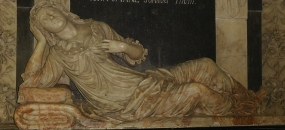
HER HEAD RESTS ON her stone-cold right hand with her elbow on a carved alabaster cushion. Her left hand is held lightly and limply against her left breast. She is a carved alabaster effigy of Dame Jane Cotton (1630-1692), widow of Sir John Cotton of Landwade (1615-1689). This sculpture of Jane Cotton lies against the north wall of the chancel of the Church of St Mary Magdalene in the village of Madingley, close to Cambridge. The church is open until 4pm most days and we got there by 3.45 pm a few days ago in April 2021. So, we were able to have a good look at the interior of this building whose construction commenced in the late 13th century (https://historicengland.org.uk/listing/the-list/list-entry/1127740).

Jane Cotton, who reclines close to the high altar, was the daughter and sole heir of Edward Hinde (c1598-1631) of the Parish of Madingley. Edward lived at Madingley Hall (www.thepeerage.com/p34969.htm#i349687), which is a few yards uphill from the church. Sir John Cotton did well by marrying Jane because by doing so, he acquired the manor of Madingley.

Sir John Hinde (or ‘Hynde’; c1480-1550; see: http://www.geni.com/people/Sir-John-Hynde-MP/6000000090158312935), Serjeant-at-Law and Member of Parliament, had been buying land at Madingley since the 1520s (www.british-history.ac.uk/vch/cambs/vol9/pp166-171). In 1544, the manor of Madingley, which had been held by several trustees for about 100 years, was bestowed on him by law. He commissioned the building of the lovely Madingley Hall, which was constructed between 1543 and 1547. Edward Hinde, Jane Cotton’s father, was a grandson of Sir John Hinde.

Sir John left Madingley to his son Francis, who left it to his son William, who married a widow, Elizabeth. When William died childless in 1606, his widow Elizabeth took over all of the Hinde estates. She remarried and leased Madingley Hall to Edward, who was son of William Hinde’s brother Edward (died 1633).

Jane’s father Edward (died 1633) settled his lands on his eldest son Anthony, who died before him, fighting in Denmark, in 1612, when Denmark was fighting Sweden for control of part of Norway. Anne, Anthony’s widow, ‘sold’ her interests in the lands to her father-in-law Edward (died 1633). Anne and Anthony had a son Edward, to whom Anthony’s father (Edward, died 1633) had left all his lands, but the grandson, Edward, died in an accident in 1631. Jane Hinde then became the heir to her father’s lands. Had Anthony and his son not pre-deceased Jane’s father, she would not have come into possession of the Hinde’s estates, and neither would have they come into the hands of Sir John Cotton. The lands at Madingley remained in the Cotton family until the beginning of the 20th century.

Sir John, husband of Jane, was buried with his ancestors at Landwade in eastern Cambridgeshire. His daughter Jane is interred in the church at Madingley. Her monument stands near the northwest corner of the nave. She is depicted kneeling with a small book in her left hand. Jane was a spinster. She died in 1707. Not far from her monument stands a lovely carved stone font. Covered with geometric decoration, this was made in the 12th century and probably stood in an earlier version of the church. Nearby, the internal walls of the bell tower are decorated with damaged sculptures made of wood. They are:

“… probably the survivors of the cherubim, perhaps on the nave roof, whose removal William Dowsing ordered in 1644.” (www.british-history.ac.uk/vch/cambs/vol9/pp173-176)

Although there is much to enjoy in the church at Madingley, it was Lady Jane Cotton’s reclining effigy that most sparked my curiosity. Looking into what is known of Jane’s heritage has revealed a little bit about the complexities faced by the ‘landed gentry’ when they considered who was to inherit their land.

The families mentioned are what some might describe, often expressing a sense of deference, as ‘old families’. What this means is that the family has sufficient documentary information to trace it back, maybe over many centuries, for many generations.  Well, if you think about it ‘old families’ are no different from other families because all of them must go back an awfully long way in history, even if the documentary evidence no longer exists.

How I avoided an awful fate

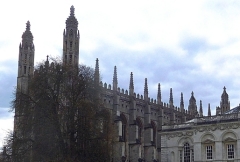
Chapel of Kings College, Cambridge

CAMBRIDGE IS A CITY which I have visited often since I was a child. My first recollection of the place was visiting Gonville and Caius College to meet my father’s long-term collaborator, the Hungarian born economist Peter Bauer (1915-2002). Later, after 1965, during my childhood and adolescence, we used to visit Cambridge to spend time with my father’s friend from his student days in Cape Town (South Africa), the social scientist Cyril Sofer (died 1974) and his wife Elaine. At first, I used to visit them with my family and when I was in my teens, I used to stay with them in their large Victorian house near Selwyn College. It was Elaine, who first introduced me to the joys of the drink known as ‘Bloody Mary’.Further travels to Cambridge followed when a childhood friend of mine attended Clare College to study for his bachelor’s degree. Through him, I met his good friend, now a well-known writer, Matthew Parris.

Many more visits to Cambridge followed my graduation at University College London in 1973. Although I remained in London to study for a higher degree, some of those who had graduated with me moved to Cambridge to pursue further studies. Three out of the nine of us, who graduated in physiology in 1973, embarked on doctoral theses in the city’s university. One of these was Lopa, who is now my wife. While she was at Cambridge, we were still ‘just good friends’, as the saying goes.

On one of my visits to see Lopa, I stayed in a house in Owlstone Road, which is south of the historic centre of Cambridge. A mattress was set up for me in a ground floor room with a street facing window. The room had been recently occupied by a female student, who had moved elsewhere. This sojourn in the city was during the time when the so-called Cambridge Rapist was assaulting young women, always within their homes, at an alarming rate. He carried out his attacks between October 1974 and April the following year.

Apparently, he followed potential victims to their homes and noted down their addresses in a notebook.The rapist carried out his first rape on the 18th of October 1974. Then another on the first of November, and yet again on the 13th of that month (https://en.wikipedia.org/wiki/Peter_Samuel_Cook). The latter was carried out within Homerton College, now a part of Cambridge University. He struck again on the 13th of February 1975, and then, unsuccessfully, on the 5th of May.

I slept soundly at Owlstone Road when I was staying there for a night or two. One morning, I woke up and saw police vehicles out in the road. It was the 8th of December 1974 and the rapist had raped a woman in the house next door to where I was staying, having broken into its ground floor room, which mirrored that in which I was sleeping. What none of us knew until after the perpetrator, Peter Samuel Cook, was eventually caught during his attack on Owlstone Croft’s nurses’ hostel in June 1975, was that the villain had listed the house in which Lopa was living with some other young ladies in his notebook of potential targets. The young lady who had occupied the room where I spent a couple of nights was in the rapist’s list of future victims.

Cook, who had knifed at least one of his victims, was a violent person and might have been awfully annoyed with me had he broken into the room where I was sleeping and found me, a man, instead of one of his intended female targets. Subsequent visits to the wonderful city of Cambridge have not, I am pleased to relate, been so potentially hazardous. Cook was jailed for life and died in Winchester Prison in 2004.

A glimpse of Mersea

SOMETIMES SUBMERGED DURING high tide, a causeway connects mainland Essex with the island of Mersea in the Colne and Blackwater estuaries. Markers with measurements are posted along the causeway so that people wishing to cross it when water covers it can tell how deep the water is. Road signs on both sides of the causeway advise drivers to test their brakes, especially if the road to and from the island is wet.

I first heard of Mersea Island in the mid-1970s when a friend of mine, with whom I have lost contact, married someone who farmed sheep on Mersea Island. However, it was only in 2021 that I first set foot on the island. The largest settlement on Mersea is the small town of West Mersea. We visited on the 12th of April, which was the first day (since the latest ‘lockdown began in December last year) that people were allowed to have drinks at pubs and eat meals at restaurants, but only in the open air. Fortunately, the sun was out and the waterfront mostly south facing.

In 895 AD, the island was known as ‘Meresig’; by 995 as ‘Myresig’; and in the Domesday Book as ‘Meresai’. The Old English word ‘mere’ usually refers to a lake (e.g., Windermere) but in the case of Mersea (and Margate) it refers to the sea. Thus, Mersea comes from words meaning ‘the island in the sea’. During the Celtic era (before the Roman conquest), the island was populated mainly with folk who fished and farmed. After the Romans established their capital at nearby Colchester, they built a causeway to Mersea Island and improved an already existing Celtic track (see: “The Shell Book of the Islands of Britain”, by D Booth and D Perrott). The Romans called the island ‘Maris Insula’ and archaeological remains of their presence there have been discovered and are now in Colchester Museum. There is a museum in West Mersea (www.merseamuseum.org.uk/) but this was closed on account of covid19 regulations. It plans to re-open in June.

The Normans also visited the island. The Domesday book recorded that in about 1086 there about 100 persons living on the island along with 300 sheep. The construction of the Church of St Peter and St Paul, which occupies the highest spot in West Mersea, began in 1046. Some of the original structure forms part of the fabric of the present church, which, sadly, was closed when we visited.

West Mersea is a holiday resort. Many fine homes, mostly modern, line the road that runs parallel to the waterfront, but which is separated from it by mudflats and salt marshes. Twenty or so large houseboats are moored at the water’s edge. Each of them has its own, often rickety-looking, boardwalk leading to it from the road. There are several pubs and eateries from which views of the boats moored by the town may be viewed. The town is famous for its oysters. We watched workmen hosing down crates filled with oysters, which look like large knobbly stones. Apparently, the Mersea oysters are highly prized internationally. Interspersed between boatyards for pleasure craft, there are yards where fishing vessels are maintained. At low tide, which is when we visited, the muddy shore is dotted with small boats of all types, some of them gently rotting away.

As it was late afternoon and we had to drive back to London and we had recently been well-fed, we spent no more than an hour in West Mersea. We hope to return when the weather warms up and then we will sample some of the local refreshment outlets. Although Mersea Island is only about 60 miles (and a lot of heavy traffic) from London’s Hyde Park Corner, it feels as if it is much further away: far away from anywhere.

Trouble in the village

TOLLESBURY IS A TINY village on the estuary of the River Blackwater in the English county of Essex, famed for its oysters, nature reserve, and sailing facilities. It is not far from Colchester and the smaller Tiptree famed for its jam manufacture.  Tiny though it is, Tollesbury appears in the Domesday Book, with the name ‘Tolesberia’ and in 1218 as ‘Tolesbir’. It is possible that the ‘Toll’ part of the name refers to a person who lived many centuries ago. The Church of St Mary the Virgin that stands at one end of the central village square was built in about 1090, possibly incorporating material from an earlier Saxon Church.

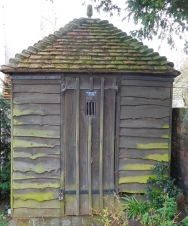
At the southern edge of the square, close to the northern boundary of the churchyard there stands a small wooden hut with a pyramidical tiled roof and one door with a small, barred window. It looks a bit like a garden shed but it was not built for storing tools and so on. For, this was the village lockup or ‘cage’. Built in 1700, it seems in remarkably good condition. The lockup, as its name suggests, was where local miscreants were locked up. It was a tiny prison. The reason that it is in a good state despite its age is that it has:

“…C20 waney weatherboarding, roofed with handmade red clay plain tiles and C20 hip tiles.” (www.prisonhistory.org/lockup/tollesbury-lock-up/)

Essex is home to plenty of village lockups. Apart the lockup from at Tollesbury, you can see village lockups at, for example, Great Bardfield, Thaxted, Canewdon, Great Dunmow, Orsett, Braintree, Roydon, and Steeple Bumpstead (hwww.essex.police.uk/SysSiteAssets/media/downloads/essex/about-us/museum/research/history-notebooks/66.pdf).  

These miniature jails were:

“… used in the eighteenth and nineteenth centuries to house criminals who were apprehended on suspicion of committing petty crime … Lock-ups were only temporary forms of imprisonment, usually for one or two people, before the local authorities of the day decided how to deal with the offender. Criminals could be released or sent to the closest large town for trial.” (www.essexlive.news/news/essex-news/historic-jails-essex-you-can-3227277)

Our friend, who lives in Tollesbury, suggested that probably the lockup was often used to house people who had drunk too much and needed to sober up. This not an unreasonable idea considering that at one time the village had six pubs.

Although there is much more that could be written about Tollesbury, I hope to do this after a future visit to this charming little place.

Gifts from India to an English village

LIFE DEPENDS ON WATER. A few days ago, at the end of March 2021, we drove to a village in Oxfordshire to see two old wells. They are no ordinary wells: they were gifts from India while it was still part of the British Empire.

Maharajah’s Well at Stoke Row

Edward Anderton Reade (1807-1886) was a British civil servant in India between 1826 and 1860. Brother of the novelist Charles Read (author of “The Cloister and the Hearth”), Edward was born in Ipsden, a village in Oxfordshire (www.oxforddnb.com/). He entered the East India Company in 1823. In 1832, he was transferred to Kanpur (Cawnpore), where he introduced opium cultivation to the district. In 1846, he became Commissioner to the Benares Division, a position he held until 1853 when he was moved to Agra.

Edward encouraged genial relations with the local Indian gentry and aristocracy. One of his Indian acquaintances, who became his good friend, was Ishri Prasad Narayan Singh (1822-1889), the Maharajah of Benares, who reigned from 1835 to 1889. During the years before the Indian Rebellion of 1857 (aka ‘First War of Independence’ or ‘The Indian Mutiny’), Reade and the Maharajah discussed much about England including the shortage of water that existed in Ipsden, the part of Oxfordshire where his family lived. Apparently, the villagers in this part of the Chiltern Hills had little or no access to clean drinking water, much as must have been the case for many villagers in India.

During the Rebellion of 1857, the Maharajah remained loyal to the British. In June 1857, the town of Kanpur was besieged by Nana Sahib and his forces. After 3 weeks, the British garrison surrendered under condition that the British inhabitants would be given safe passage out of the town. However, Nana Sahib decided to hold about 120 women and children and kept them housed in a house known as the ‘Bibighar’. This ended badly when some of the hostages were killed. Some of them tried to escape their grizzly end by jumping into a well at the Bibighar. This well became one of the most powerful images of the Rebellion in the minds of those who lived in Britain.

I do not know whether or not it was the tragedy at Bibighar that brought the conversations he had with Reade to the forefront of the mind of the Maharajah of Benares after the Rebellion was over, but in 1862, after his loyalty to the British had been formally recognised, he consulted Reade as to making a charitable gift to the poor people of Ipsden, whose plight he recalled. The Maharajah financed the construction of a well at Stoke Row, not far from Ipsden. It is also possible that the Maharajah remembered the help that Reade had given him when constructing a well in Azamgarh (now in Uttar Pradesh) back in 1831.

Work commenced on the well in March 1863. The well shaft was dug by hand, a perilous job for the labourers as they removed earth from the depths of an unlit and unventilated shaft, bucket by bucket. The shaft, 4 feet in diameter, was 368 feet in depth, greater than the height of St Pauls Cathedral in London, for this is depth of the water table at Stoke Row. Special winding machinery constructed by Wilder, an engineering firm in Wallingford, was installed. It is topped with a model elephant. The mechanism and the well stand beneath an octagonal canopy topped with a magnificent metal dome with circular glazed windows to allow better illumination. It resembles a ‘chhatri’ or architectural umbrella such as can be seen at war memorials on London’s Constitution Hill and on the South Downs near Hove.  The structure, restored in recent times, looks almost new today. Reade, who helped plan the Maharajah’s well, planted a cherry orchard nearby; dug a fish-shaped pond (the fish was part of the Maharajah’s coat-of-arms); and constructed an octagonal well-keeper’s bungalow next to the well. The profits from the cherries harvested from the orchard were supposed to help to finance the well, for whose water the villagers were not charged anything.  The Maharajah’s well at Stoke Row was the first of many such gifts given by wealthy Indians to Britain. Other examples include the Readymoney drinking fountain in Regents Park and a now demolished drinking fountain in Hyde Park, close to Marble Arch. According to the Dictionary of National Biography:

“Reade was wryly amused that an Indian prince should thus give a lesson in charity to the English gentry.”

The well at Stoke Row provided the locals with fresh water until the beginning of WW2, when, eventually, piped water reached the area. It provided 600 to 700 gallons of water every day. The Maharajah’s Well at Stoke Row is relatively well-known compared to another Indian-financed well next to the parish church at Ipsden, where Reade’s grave is located. The well, whose winding mechanism is similar to that installed at Stoke Row, is not covered by a canopy. It stands by a cottage next to the entrance to the churchyard. It was presented to Ipsden in 1865 by ‘Rajah Sir Deon Narayun Singh of Seidpor Bittree’ (I am not sure where this is: these are the words on the well), who had, like the Maharajah of Benares, remained loyal to the British during the 1857 Rebellion.

The Ipsden well is deep but not nearly as deep as that at Stoke Row. A lady, who lives in the cottage beside the well, told us that she had tasted water from the well and it was ice cold, deliciously clean, and tasted pure, having been filtered by many feet of chalk through which it has seeped. She said that once a year, the local water board opens the well and takes a sample of its water to check its purity.

Both wells are worth visiting. We parked in Benares Road in Stoke Row close to the Maharajah’s gift. After viewing the well head and its surroundings, we bought hot drinks at the village’s shop-cum-café, which his run by a couple of friendly people from Zimbabwe. I am grateful to Dr Peter U for bringing the existence of this unusual well to my attention.

A castle, a bridge, and the law

RIVER CROSSINGS HAVE often had great historical significance. The small town of Wallingford in Oxfordshire has been a place for crossing the River Thames since Roman times or maybe even before. According to “The Concise Oxford Dictionary of English Place-names” by someone with an interesting name: Eilert Ekwall, a fascinating book that I picked up for next to nothing at a local charity shop, the town was known as ‘Waelingaford’ in 821 AD, as ‘Welengaford’ in c893 AD, and ‘Walingeford’ in the Domesday Book. The meaning of the name is ‘The ford of Wealh’s people’, clearly referring to a river crossing place. It is said the William the Conqueror used the ford. Today, a fine bridge with many arches crosses the river.

Wallingford Castle

There has been a bridge at Wallingford since 1141, or before. The construction of the first stone bridge was probably constructed for Richard, the first Earl of Cornwall (1209-1272), a son of King John, who became King of Germany (Holy Roman Empire) in 1256, a title he held until his death. Some of the arches of the bridge may contain stonework from the 13th century structure. Much of the present bridge dates from a rebuilding done between 1810 and 1812 to the designs of John Treacher (1760-1836). During the Civil War (1642-1651), four arches were removed and replaced by a drawbridge to help defend the besieged Wallingford Castle.

The huge castle was built on a hill overlooking the town; the river – an artery for water transport in the past; and, more importantly, the bridge, which was an important crossing place on the road leading from London to Oxford via Henley-on-Thames. Between the 11th and the 16th centuries, the castle was used a great deal, being used as a royal residence until Henry VIII abandoned it. During the Civil War, the castle was restored and re-fortified and used as a stronghold by the Royalists. It was of great importance to them as their headquarters were at nearby Oxford. To simplify matters, the Parliamentarians began laying siege to Wallingford Castle in 1645. This initial attempt was unsuccessful because the besiegers had underestimated the strength of the castle’s fortifications. After the Royalists were defeated at the Battle of Naseby (14th June 1645), Wallingford was one of only three strongholds in Berkshire (now in Oxfordshire) still loyal to King Charles I. A second siege of Wallingford commenced on the 14th of May 1646, shortly after the Parliamentarians had laid siege to Oxford. The latter fell on the 24th of June 1646, but Wallingford held out until the 22nd of July 1646 (https://en.wikipedia.org/wiki/Wallingford,_Oxfordshire). The castle was demolished in November 1652.

The castle grounds are open to the public. Here and there, few and far between, there are ruins of what must have once been a spectacular castle. Within the grounds of the former castle, there are several informative notices that give the visitor some idea of which part of the castle used to stand near the signs. From the grassy areas that formed the motte and bailey of the castle, there are fine views of the river below and some of the town.

Although our first visit to Wallingford was brief, I learnt that the judge Sir William Blackstone (1723-1780) had presided as the Recorder at Wallingford from 1749 to 1770. “So, what?”, I hear you asking. At first, I hoped that he was something to do with the road, where we lived in Chicago (Illinois) in 1963: South Blackstone Avenue (number 5608). But I think that thoroughfare was more likely named after the American politician and railway entrepreneur Timothy Blackstone (1829-1900). The Wallingford Blackstone, who lived in the 18th century, was most probably a distant cousin of Timothy’s father (https://en.wikipedia.org/wiki/Timothy_Blackstone). Related or not, Sir William Blackstone had an extremely important influence the legal affairs of the USA.

Having studied at the University of Oxford and the Middle Temple, where he was called to the Bar, Sir William taught law at Oxford for a few years. Just before resigning his prestigious academic position in 1766, he published the first volume of what was to become a best-seller, a real money-spinner, “Commentaries on the Laws of England”. Eventually, this work was completed in four volumes. They contain:

“… first methodical treatise on the common law suitable for a lay readership since at least the Middle Ages. The common law of England has relied on precedent more than statute and codifications and has been far less amenable than the civil law, developed from the Roman law, to the needs of a treatise. The Commentaries were influential largely because they were in fact readable, and because they met a need.” (https://en.wikipedia.org/wiki/Commentaries_on_the_Laws_of_England)

The “Commentaries” are widely regarded as being the definitive sources of common law in America before the American Revolution. Blackstone’s writings were influential in the formulation of the American Constitution. His words embodied his vision of English law as a method of protecting people, their possessions, and their freedom. Blackstone’s ideas are well exemplified by this quotation from the “Commentaries”:

“It is better that ten guilty persons escape than that one innocent suffer.”

This is known as ‘Blackstone’s Ratio’.

Leaders of the American Revolution recycled the idea with words such as:

“It is of more importance to the community that innocence should be protected, than it is, that guilt should be punished; for guilt and crimes are so frequent in this world, that all of them cannot be punished…” (John Adams; 1735-1826), and:

“…it is better 100 guilty Persons should escape than that one innocent Person should suffer…” (Benjamin Franklin; 1706-1790)

As already mentioned, Sir William presided in the court in Wallingford from 1749 onwards, three years after being called to the Bar. During his career, he served as a Tory Member of Parliament a couple of times: for Hindon (1761-68) and for Westbury (1768-70). In the House of Commons, he was:

“…an infrequent and ‘an indifferent speaker’: during the seven years 1761-8 only 14 speeches by him are recorded, mostly on subjects of secondary importance. Very learned and original, over-subtle and ingenious, in major debates he showed a lack of political common sense.” (www.historyofparliamentonline.org/volume/1754-1790/member/blackstone-william-1723-80)

The Blackstone family owned a large estate at Wallingford including 120 acres of land by the River Thames. He died in Wallingford and was buried inside St Peter’s Church, which is close to the bridge over the river.  

What little we saw of Wallingford, its castle, its riverside including the Thames towpath, its attractive market square, and streets rich in historic buildings, during our brief visit recently, we saw enough to whet our appetites for a future and lengthier visit.

Changing travel plans

WE ARRIVED BACK IN LONDON from several months in India on the 27th of February 2020. Since we retired, we have taken to spending a few of the winter months in my wife’s native land, India.

We have often spent Christmas in the south Indian city of Bangalore, where we stay at the long-established ex-colonial Bangalore Club, where the young Winston S Churchill once stayed and then left without settling an outstanding bill. To date, we have settled all our Club bills, you will be pleased to know. However, maybe this is one reason why none of us has ever been elected as Prime Minister of the UK or any other nation.

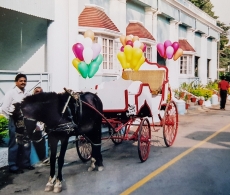
Christmas is celebrated in style at the Club. Strings of tiny lightbulbs are draped all over the establishment’s buildings and the many lovely trees in the Club’s extensive grounds. Shortly before Christmas, there is an outdoor evening carol singing concert that ends with the lighting of a huge bonfire. There is also a lively Christmas party for the members’ children that culminates with the arrival of Father Christmas on a horse-drawn carriage. I always feel a bit sorry for him as he must dress not only in a bushy white beard but also in clothing that is far too warm for the December temperatures in Bangalore, which can be in the high twenties Celsius. On Christmas Day, members and their families, who are not vegetarian as many are in India, queue up for servings of roast Turkey and a wealth of other foods available at a luncheon buffet. There is plenty available for those who prefer not to eat meat. Well, we will be missing all of this in 2020, and a lot more.

Usually, a day or so after we return to London, we visit our travel agent to book tickets for our next ‘Winterreise’ to borrow a title from the composer Franz Peter Schubert. Air tickets become available eleven months before a flight’s departure date. When we were seated at our travel agent’s desk, we told him the dates of our proposed trip. He looked on his system and told us that we could book the outbound flight, but the return flight tickets would not be available for purchase until early April. He advised us to return in April and then book both outward and inbound tickets together. That turned out to be extremely sound advice.

In the middle of March, the UK went into a total ‘lockdown’. It was no longer possible to return to our travel agent or to do much else. In addition, things were deteriorating all over the world as a result of the spreading of covid19 infections. As the weeks went past, it looked increasingly unlikely that we would be making a trip to India at the end of 2020. We were fortunate that we had been advised not to buy our outbound air tickets. Now, having reached December, travel abroad is not advised and currently travel from the UK is being curtailed. Many countries, including India, are banning travel from the UK.

In August, when restrictions on movement were being relaxed, we spent a pleasant week in a rented cottage in Kingsbridge, Devon. We liked the cottage so much that we asked its owner whether we could reserve it over the Christmas/New Year holiday period. She was happy with the idea providing that future ‘lockdown’ rules did not find her trapped there. A couple of months ago, she informed us that the cottage would not be available after all. This was not because of travel restrictions, but because a friend of hers needed temporary accommodation for a few months in winter.

Undismayed, we managed to find another self-catering cottage in the West Country to rent during the Festive Season. Then, London was cast into Tier 3 covid19 preventive measures, which discourage travel outside the Tier 3 restrictions area except between the 23rd and 28th of December. We rang our landlady in the West Country to explain that we would rather not drive so far to spend such a short time and she agreed to rebook us in March 2021.

With the West Country shelved, we decided to stay in a hotel near Cambridge and to spend some ‘socially distanced’ time with one of my cousins, who lives in the area. As the 23rd of December grew nearer, we began planning our festive feasting programme and buying mouth-watering supplies for it. Then, we all learned that the coronavirus had become highly creative and managed to mutate in more ways that most of these bugs can usually manage. This new viral creation is far more efficient at spreading from person to person than its awful ancestors. As a result, and surprisingly sensibly for our strange government, London and much of southeast England was put under stricter restrictions, Tier 4, which include a travel prohibition that forbids travel out of Tier 4 and no relaxation of restrictions during the period that we had planned to spend near Cambridge. So, that was Cambridge ‘out of the window’.

Soon after London was made subject to Tier 4 regulations, we learned that even with the arrival of new vaccines it was likely that the severe restrictions on travel might continue until Easter. So, we reached for the ‘phone and asked our future landlady in the West Country to shift our booking until May 2021. Now, we will make the most of Christmas and New Year without leaving London for any kind of winter journey, let alone India. I hope that all of this does not sound too depressing to you, because we subscribe to the idea that ‘all’s well that ends well’, and we hope that by following the rules, as ad hoc as they might be, we will all keep well.

While we munch our way through all of the festive ‘goodies’ we have accumulated, we will think of you, our friends all over the world, and wish you a prosperous and healthy future.

The birthplace of democracy

IT SEEMED APPROPRIATE to visit Runnymede, the so-called birthplace of democracy on a day (7th November 2020) when  Donald Trump, the current president of the USA, appears to be losing faith in it and might be about to attempt to undermine it.

Runnymede, a water meadow of the Thames close to Windsor, is close to a former Roman river crossing near the town of Staines. The name is probably derived from the Anglo-Saxon words ‘runieg’, meaning ‘meeting place’, and ‘mede’, meaning ‘meadow’. The ‘Witangemot’, a council of Anglo-Saxon kings, used to meet at Runnymede between the 7th and 11th centuries (AD). This pre-Norman Conquest meeting place was used again on the 15th day of June in 1215, when King John reluctantly signed the Magna Carta in the presence of a group of barons who had met a few months earlier in the Suffolk city of Bury St Edmunds (www.visit-burystedmunds.co.uk/blog/2018/discover-bury-st-edmunds-historic-role-in-the-creation-of-the-magna-carta). Runnymede is the most probable location of the signing, as this is what is written at the end of its text (translation from www.bl.uk/magna-carta/articles/magna-carta-english-translation):

“Given by our hand in the meadow that is called Runnymede, between Windsor and Staines, on the fifteenth day of June in the seventeenth year of our reign.”

The Magna Carta, whose evolution is too detailed to be described here, was, and still, is of great importance because it aims to ensure a fair relationship between the rights of ruler and those of his or her then powerful subjects, his barons, but nowadays its principles have extended to cover all subjects of the realm,  It contains chapters such as:

“In future no official shall place a man on trial upon his own unsupported statement, without producing credible witnesses to the truth of it.” (chapt. 38)

“No free man shall be seized or imprisoned, or stripped of his rights or possessions, or outlawed or exiled, or deprived of his standing in any way, nor will we proceed with force against him, or send others to do so, except by the lawful judgment of his equals or by the law of the land.” (chapt. 39)

“In future it shall be lawful for any man to leave and return to our kingdom unharmed and without fear, by land or water, preserving his allegiance to us, except in time of war, for some short period, for the common benefit of the realm. People that have been imprisoned or outlawed in accordance with the law of the land, people from a country that is at war with us, and merchants – who shall be dealt with as stated above – are excepted from this provision.” (chapt. 42)

“We will appoint as justices, constables, sheriffs, or other officials, only men that know the law of the realm and are minded to keep it well.” (chapt. 45)

The Magna Carta includes a number of items that are hardly relevant in the modern world, but those such as I have quoted above are deeply relevant and extremely important. However, the document signed by King John has some elements that illustrate attitudes that we would consider unacceptable today, notably antagonism to Jewish people as can be seen in chapter 10:

“If anyone who has borrowed a sum of money from Jews dies before the debt has been repaid, his heir shall pay no interest on the debt for so long as he remains under age, irrespective of whom he holds his lands …”, and in chapter 11:

“If a man dies owing money to Jews, his wife may have her dower and pay nothing towards the debt from it. If he leaves children that are under age, their needs may also be provided for on a scale appropriate to the size of his holding of lands…”

Seventy-five years after the signing at Runnymede, King Edward I issued an edict expelling all Jews from the Kingdom of England, thus throwing into question whether or not everyone in England was protected by the mostly virtuous intentions of Magna Carta.

In brief, Runnymede was the site of the signing a far-reaching document of great importance to the rights of citizens. Several centuries later, the Magna Carta influenced the formulation of the Constitution of the USA in the late 18th century. The area of Runnymede is now maintained by the National Trust. It contains several monuments and artworks relating to the historic significance of the place.

On arrival at the parking place, we passed a sign that reads:

“Runnymede. A home to politics and picnics for over 1000 years.”

The car park is next to one of a pair of lodges designed by Edwin Lutyens (1869-1944), son-in-law of Edward Robert Lytton Bulwer-Lytton (1831-1891) the Viceroy of India from 1876-1880, and the architect of some of the government buildings in New Delhi. The lodges were built between 1930 and 1932.  They are not the only connection between Runnymede and India as I will explain soon.

During our visit to Runnymede on a crisp sunny morning, we walked across the muddy ground to four features of interest in its meadows dotted with lovely trees, many of them oaks. The first place we reached is a cylindrical stone monument standing within a ring of eight square pillars that support a circular ring whose centre is open to the sky. It is approached via a staircase with names carved in its steps. These are the names of lawyers from the USA. The cylindrical stone bears the words:

“To commemorate Magna Carta, symbol of freedom under law”

This monument was designed by the English architect Sir Edward Maufe (1883-1974) and erected by the American Bar Association in 1957.

The American monument stands a few feet above the base of an oak tree, which is growing beside a square marble stone that bears the words:

“Quercus robur, planted by PV Narasimha Rao, Prime Minister of the Republic of India, as a tribute to the historic Magna Carta, a source of inspiration throughout the world, and as an affirmation of the values of Freedom, Democracy, and the Rule of Law, which the people of India cherish and have enshrined in their constitution. March 16 1994”

‘Quercus robur’ is a type of oak tree and Rao (1921-2004), a member of the Indian National Congress Party, was Prime Minister of India from 1991 to 1996.

Twelve bronze chairs are placed in the midst of the meadow closest to the raised wooded area containing the American and Indian monuments. They are arranged in two rows of five facing each other with another two chairs at the two ends of what is effectively a rectangular dining table with the table removed.  Each chair back’s two surfaces are decorated with bas-reliefs, one facing the chair opposite it and the other away from it. The bas-reliefs depict the various people, events, and ideas resulting from the ideas expressed  in the Magna Carta. One of them depicts Cornelia Sorabji (1866-1954), a Parsi, the first Indian woman to practise law in India. Another depicts Mahatma Gandhi’s portable spinning wheel, his symbol of resistance to the importation of British goods to India. Other motifs are described in an informative website, https://www.nationaltrust.org.uk/runnymede/features/what-does-the-jurors-represent . Seeing the empty chairs set out so formally in the field made me feel as though someone had put them there in readiness for King John’s famous meeting with the barons in June 1215. This effective and moving artwork was created by Hew Locke (born 1959) for the 800th anniversary of the signing of the charter. It is quite likely that the sun would have been shining as brightly on that significant day as it did when we visited Runnymede.

Dramatic as is Locke’s work at Runnymede, it is rivalled, or, better, complemented, by another fantastic creation not far away.  From the outside, it looks like a recently constructed circular military bunker with a tall entrance in its wall. Step inside and you find yourself in a dark passageway that runs parallel with the outer wall and another inner circular wall. Soon, you reach an opening in the inner concentric wall. This leads into a circular chamber lit by daylight coming through a circular orifice in its ceiling. The inner circular chamber contains a circular pool of water surrounded by a metal band in which words are written as a mirror image, just like the way that Leonardo da Vinci used to write. The words are reflected in the water, where they appear the right way round. They spell out the words of chapter 39 of the Magna Carta (translated into English). The effect is both dramatic and very moving. The artwork is called “Writ in Water”, the words coming from the inscription on the gravestone of the poet John Keats, which are:

“Here lies one whose name was writ in water”.

This spectacular piece of art was designed by Mark Wallinger (born 1959) as a place to reflect on the principles of democracy that were born at Runnymede in 1215. It was completed in 2018 and it alone is a good reason to visit Runnymede.

While I was writing this, news began arriving from the USA. It suggested that barring any devious surprises from the current president of the USA, the democratic process in the USA might well have a chance of remaining guided by the noble principles enshrined in Magna Carta under a new president, Mr Joseph Biden.