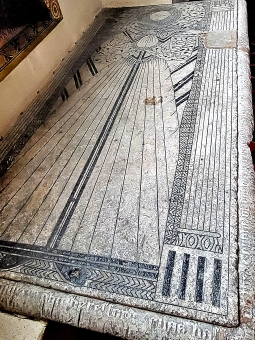
RECENTLY, WE WERE on our way to Hatfield in Hertfordshire when we made a short detour to see the church of St Mary in North Mymms. Which s not far from South Mimms. The church was open, and we entered. Among several items of interest in this edifice, which dates back to the early fourteenth century, we saw a large tomb next to the north wall.
The tomb, which is made from white Derbyshire alabaster – a sort of gypsum resembling marble – is rectangular, box-shaped. Its top or lid is decorated with a portrait of a lady in Elizabethan clothing with her hands held together as if she was praying. The image is in black and was created by inscribing the stone with the design and filling the grooves with black bitumen (see: https://www.northmymmshistory.uk/2018/08/historical-treasures-of-church-of-st.html#tomb). In its simplicity the image on this sixteenth century tomb looks remarkably modern.
The tomb is the final resting place of a member of the Barforde (aka Beresford) family, but it is not known which one. The family lived in North Mymms when two of their daughters, Elizabeth and Mary, died within three months of each other, in about 1584. The image might possibly represent one or both.
As for the name of the village in which the church is located, North Mymms, the etymology of ‘Mymms’ is not known. And like the tomb which might be that of Mary and/or Elizabeth, the spelling of the places’s name has also been uncertain. Over the centuries the village’s second name has been spelled both as ‘Mymms’ and ‘Mimms’. This uncertainty remained until 20 February 1939 when Hertfordshire County Council decided that the spelling be fixed as ‘Mymms’ (see https://en.wikipedia.org/wiki/North_Mymms).
Once again, we have found that by randomly visiting villages and other places in England, it is highly likely that we come across items of historical interest. The alabaster tomb, whose existence had been hitherto unknown to us, is a fine example.
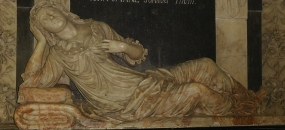
HER HEAD RESTS ON her stone-cold right hand with her elbow on a carved alabaster cushion. Her left hand is held lightly and limply against her left breast. She is a carved alabaster effigy of Dame Jane Cotton (1630-1692), widow of Sir John Cotton of Landwade (1615-1689). This sculpture of Jane Cotton lies against the north wall of the chancel of the Church of St Mary Magdalene in the village of Madingley, close to Cambridge. The church is open until 4pm most days and we got there by 3.45 pm a few days ago in April 2021. So, we were able to have a good look at the interior of this building whose construction commenced in the late 13th century (https://historicengland.org.uk/listing/the-list/list-entry/1127740).
Jane Cotton, who reclines close to the high altar, was the daughter and sole heir of Edward Hinde (c1598-1631) of the Parish of Madingley. Edward lived at Madingley Hall (www.thepeerage.com/p34969.htm#i349687), which is a few yards uphill from the church. Sir John Cotton did well by marrying Jane because by doing so, he acquired the manor of Madingley.
Sir John Hinde (or ‘Hynde’; c1480-1550; see: http://www.geni.com/people/Sir-John-Hynde-MP/6000000090158312935), Serjeant-at-Law and Member of Parliament, had been buying land at Madingley since the 1520s (www.british-history.ac.uk/vch/cambs/vol9/pp166-171). In 1544, the manor of Madingley, which had been held by several trustees for about 100 years, was bestowed on him by law. He commissioned the building of the lovely Madingley Hall, which was constructed between 1543 and 1547. Edward Hinde, Jane Cotton’s father, was a grandson of Sir John Hinde.
Sir John left Madingley to his son Francis, who left it to his son William, who married a widow, Elizabeth. When William died childless in 1606, his widow Elizabeth took over all of the Hinde estates. She remarried and leased Madingley Hall to Edward, who was son of William Hinde’s brother Edward (died 1633).
Jane’s father Edward (died 1633) settled his lands on his eldest son Anthony, who died before him, fighting in Denmark, in 1612, when Denmark was fighting Sweden for control of part of Norway. Anne, Anthony’s widow, ‘sold’ her interests in the lands to her father-in-law Edward (died 1633). Anne and Anthony had a son Edward, to whom Anthony’s father (Edward, died 1633) had left all his lands, but the grandson, Edward, died in an accident in 1631. Jane Hinde then became the heir to her father’s lands. Had Anthony and his son not pre-deceased Jane’s father, she would not have come into possession of the Hinde’s estates, and neither would have they come into the hands of Sir John Cotton. The lands at Madingley remained in the Cotton family until the beginning of the 20th century.
Sir John, husband of Jane, was buried with his ancestors at Landwade in eastern Cambridgeshire. His daughter Jane is interred in the church at Madingley. Her monument stands near the northwest corner of the nave. She is depicted kneeling with a small book in her left hand. Jane was a spinster. She died in 1707. Not far from her monument stands a lovely carved stone font. Covered with geometric decoration, this was made in the 12th century and probably stood in an earlier version of the church. Nearby, the internal walls of the bell tower are decorated with damaged sculptures made of wood. They are:
Although there is much to enjoy in the church at Madingley, it was Lady Jane Cotton’s reclining effigy that most sparked my curiosity. Looking into what is known of Jane’s heritage has revealed a little bit about the complexities faced by the ‘landed gentry’ when they considered who was to inherit their land.
The families mentioned are what some might describe, often expressing a sense of deference, as ‘old families’. What this means is that the family has sufficient documentary information to trace it back, maybe over many centuries, for many generations. Well, if you think about it ‘old families’ are no different from other families because all of them must go back an awfully long way in history, even if the documentary evidence no longer exists.