All that remains is …

OUR GOOD FRIENDS IN HERTFORDSHIRE always take us out into the countryside for a walk with their two friendly dogs. Invariably, we visit countryside that is both beautiful and contains something of interest. This time, we parked in the small hamlet of Thundridge (in Hertfordshire), which is located on what was once the Roman road, Ermine Street (from the Old English ‘Earninga Straete’). This thoroughfare linked London with York. We set off by walking along a small road named Old Church Lane. This soon becomes a footpath that runs alongside the River Rib, a tributary of the River Lea, which in turn is a tributary of the River Thames. The Rib merges with the Lea in the town of Hertford.

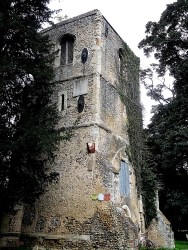
We walked past a vast field in which some grassy crop was growing. Far across the field there was a small wood. A church tower could be seen rising from amongst the trees. We followed another path towards the clump of trees and soon arrived at the tower. This tower and a graveyard is all that remains of the church of St Mary and All Saints (some call it ‘All Hallows and Little St. Mary’ and others ‘Thundridge Old Church’), which was demolished (apart from the tower) in 1853, when a new church was built in Wadesmill. The tower was constructed of flint and mortar in the 15th century. The rest of the church, now demolished, was built in the 11th to 12th centuries. A Romanesque archway now set into the eastern wall of the tower is the only visible remains of that former church.  Although this ruined tower might well appeal to those who find ruins romantic, it is in a bad condition with some of the structure covered with corrugated iron sheeting and other parts with graffiti. There are some plans to conserve it and others to demolish it to make room for new housing.

The reason that the old church was demolished was that the old manor house, which was close to the old church, was demolished in the 19th century. Consequently, the population of Thundridge moved nearer to the new manor house that was built where the church built in 1853 now stands.

Just before we reached the old church tower, we passed a field which had a long grass-covered trench running along it. This is the remains of a moat built long ago when Thundridge village was located near to the the old, now demolished church. The banks of the moat were liberally studded with mole hills. This moat is believed to have been dug in mediaeval times. What remains of it is ‘D’ shaped and encloses an area bounded by sides of approximately 660 feet north to south and by the same east to west. The moat enclosed the site of the former manor house.

Having seen all that remains of Thudridge Old Church, we retraced our steps to Ermine Street, crossed the fast-flowing River Rib, and then ate an enormous roast lunch in the garden of the nearby Feathers pub in Wadesmill, which is about two minutes’ walk from Thundridge.

Jacob’s cross in Lavenham

HAD IT NOT BEEN FILLED WITH parked cars, Market Square in Lavenham (Suffolk in East Anglia) would probably be recognisable to those who lived in the town several hundred years ago. The square is surrounded by old buildings, many of which are half-timbered. The most impressive of these is the Guildhall that was built in 1529. This large building attests the former wealth of the town, when it was an important centre of the wool trade in East Anglia. In its heyday, cloth from Lavenham was sent all over Britain and exported to Holland and Spain via the port of Ipswich. During the reign of Henry VIII (1509-1547), Lavenham was the fourteenth richest town in England.

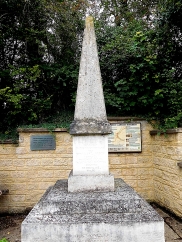
Lavenham boasts a 16th century market cross. Market crosses were erected to indicate that an area had been designated as being a market square by a bishop, or a baron, or the monarch. Lavenham’s market cross is made of stone. A three stepped pyramid supports a slender column surmounted by a stone sphere. A metal plate informs the visitor that:

“The market cross was erected in 1501in accordance with the will of William Jacob”.

So, who was William Jacob?

Jacob was one of Lavenham’s wealthy clothiers, involved in the wool textile trade. Despite his surname, it was highly unlikely that he was Jewish because most Jews had been expelled from England in the 13th century (and it was not until the mid-17th century that Jewish people began returning).  According to text on the website deverehouse.co.uk:

“William Jacob was the tenth wealthiest clothier and businessman in England, making an annual profit of 67 marks and with a gross turnover of 223 whole cloths (a gross turnover of £12m in today’s money, around 400 marks).  On his death he paid for the erection of the market cross that is still there 520 years later.  He did not branch into “straites” or “narrow cloths” and within 25 years of his death the cheaper narrow cloth was dominating the market and Jacob’s family were seeking other work.”

In his will, dated 1500, he wrote:

“I will have a cross made of my perpetual cost that shall be set upon the market hill in the village of Lavenham.”

The cross that was erected in Lavenham in 1501 was a copy of the market cross already present in the city of Cambridge. The Cambridge market cross has long-since disappeared. The stepped base is all that remains of the cross paid for by Jacob’s estate. The slender shaft that now stands on it was put up in 1725. It is interesting to note that far away in Florence (Italy) Michelangelo was beginning work on his famous statue of David in 1501. That sculpture was completed in 1504. Although many visitors come to Lavenham, many more visit Florence.

Suffolk was the most important clothmaking county in 15th/16th century England. William Jacob was one of the county’s 100 clothiers in business between 1480 and 1500. Other counties had far fewer members of this trade. Although William Jacob was the tenth most wealthy, the wealthiest was Thomas Spring III (c1474-1523) of Lavenham. By 1500, Suffolk was the most industrialised and urbanised county in Britain, but by 1700, the county had become a rural backwater. Suffolk and much of the rest of East Anglia might be regarded as a bit of a backwater nowadays, but it is a largely picturesque one with wonderful landscapes and a great architectural legacy due to its past prosperity during the golden age of the wool trade.

French connection

WE HAVE BEEN WARNED repeatedly that during the current covid-19 pandemic that travelling abroad, leaving the UK, is not without the risk that after returning home we might have to go into quarantine for fourteen days. The rules relating to quarantine are strict and include remaining at home twenty-four hours a day. This means, amongst other things, not emerging from home even for exercise, shopping, or going to work. For those who must leave home for work and cannot work from home this quarantine can lead to serious loss of earnings. Currently, the state will not compensate those who have to quarantine because they have returned from a country that the British Government considers having a higher rate of covid-19 virus infections or infection rates. I suppose the argument is that like heat, which flows from a higher to a lower temperature, the virus tends to flow from an area of higher infection to one with a lower one. The quarantining is meant to be part of minimising the risk of importing the virus into the UK from abroad.

Some countries may be visited by people living in the UK without the need for people returning from them to have to stay in quarantine. Until recently, the Government was happy for visitors to France to return to the UK without needing to go into quarantine for a fortnight. Because of this and despite warnings that covid-19 infections were on the increase in France, British holidaymakers were happy to take a risk by travelling to France. From the outset, the Government warned that at any moment there might need to be a change in the situation regarding quarantining after visiting abroad.

On the evening of Thursday 13th August 2020, the British Government announced that anyone who visited France and had not returned to the UK by 4 am on Saturday the 15th of August would need to go into quarantine for 14 days after reaching home in the UK. Between this late evening announcement and early Saturday morning, many British holidaymakers in France were panic stricken and tried to reach British soil before the 4 am deadline because they wanted to avoid being compelled to quarantine. Many of those people shelled out enormous amounts of money to obtain last minute bookings on ‘planes, trains, and ferries, in the hope of beating the deadline.

The panicked return was entirely understandable, and I do not blame anyone for trying to avoid a quarantine period that they could ill afford. What I cannot comprehend was what was magic about 4 am on Saturday the 15th of August. If the risk of importing covid-19 from France (or elsewhere) is so great that it is considered necessary to impose quarantine on returnees, why, for example is someone landing in the UK at, say 3.45 am on the 15th of August, any less likely to pose a danger to public health than someone arriving any time after 4 am on that day? In my opinion, if the chances of bringing in the virus from a certain country are deemed dangerously high and it is determined that quarantine will reduce the chances of imported virus from adding to the already significant local supply, the quarantine requirement should have been imposed immediately, without over a moment’s delay.

As for the effectiveness of the enforced quarantine on reducing imports of infection, that remains to be seen. Recently, the owner of a well-known budget airline poured scorn on the idea of quarantine. He pointed out that many travellers landing in British airports travel to their homes by public transport. During that journey to the places where they plan to quarantine for fourteen days, they have plenty of opportunity to spread the virus to others travelling on the same bus, train, or other public transport. By the time they get home, the damage might well have been done. This airline owner was saying this to help save his business from further destruction caused by ‘lockdown’ conditions, but what he said is true.

Examining the past

ON 13th AUGUST 2020, MANY YOUNGSTERS in England received the results of the state’s university admission examinations. This year of plague and social distancing, 2020, the results have not been determined by the students themselves writing examination papers but by a clumsy, somewhat arbitrary, algorithm that takes various factors other than a student’s own ability into account. Things were quite different last year and back in 1970 when I sat the A-Level examinations required for admission to university.

BLOG EXAM

Back then, as now, universities offered places to potential students subject to achieving or exceeding certain grades at A-Level. The place that was my first choice amongst the six universities I chose was University College London (‘UCL’). In ‘my time’, UCL invited potential students for extensive interviewing. I was invited to spend a whole day at the Physiology Department. During that day, I was interviewed at least three times by different people and met both members of the academic staff as well as students already embarked on their courses of study.

Several days later, I received a letter from UCL offering me a place on the BSc course providing I achieved three E grades at A-Level. The top grade at A-Level was A, the lowest pass grade was E. At first, I was not sure whether to be pleased that all I needed was just to pass my three A-Level examinations. Was that the best that they thought I could manage? No, it was not. In those days, if UCL liked a candidate at interview, they took the strain off the candidate by not expecting high grades. Thee Es was normal for most subjects except medicine and dentistry when 3 Cs were required.  These days, candidates to places like UCL would be expected to get 3 A grades or something awfully close to this. Well, having been offered a place subject to my attaining at least 3 E grades and being neurotic by nature, I began to worry. What if I could not manage the three Es?

I became obsessed by examination papers to such an extent that I used to use my father’s typewriter to compose examination questions that I hoped would never appear in front of me in the examination hall. Whether or not composing these impossible questions was a kind of self-therapy or simply an opportunity to enjoy using the typewriter, I cannot tell, but it did me no harm. At the very least, It gave me short breaks in what for me was long hours trying to understand what I was studying.

My three A-Level subjects were Biology, Physical Science (a mixture of chemistry and physics), and mathematics. I found that all of them were most interesting and not too taxing. When I was at school, it was possible to opt to attempt supplementary papers in the subjects chosen for A-Level. These papers were known as ‘S-Levels’ and were designed to test a candidate’s deeper understanding of a subject. I chose to do S-Level papers in biology and mathematics. The biology S-Level paper was enjoyable. I was able to show off what I had learnt from reading around the subject. One of the questions was something to do with discussing the origins of life on earth. Well, in addition to various then current theories I decided to include what is described in the first chapter of the Old Testament. I passed that S-Level. The mathematics S-Level paper was a quite different ‘cup of tea’. Even though I had attended special classes to learn the mathematics that was required, I was stumped. For the first 30 minutes of the three-hour paper, I just stared at the questions. There was not one that I could even begin to tackle. So, after 20 minutes, I walked out of the examination room, leaving a blank script on my desk.

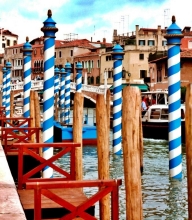
I can remember where I was when I received the A-Level results in August 1970. I was in Italy with my parents and sister on one of our annual visits to that country. We were in Venice, staying, as we always did, at the Pensione La Calcina, where many decades earlier the eminent John Ruskin(1819-1900) used to reside when visiting the island. The establishment’s façade is on the Fondamente Zattere across the water (of the Giudecca Canal) from the famous Santissimo Redentore church (completed 1592) designed by the architect Andrea Palladio.

We had just eaten lunch at the pensione and were taking the air on the waterfront prior to retiring indoors for a siesta when Signorina Steiner, the manageress, came rushing up to us with a telegram. My parents opened it to discover that my aunt in London had sent my A-Level results, which to my great relief were way in excess of the minimum required to gain admission to UCL.

If I had not managed to attain even 3 E grades, I would certainly not have expected to be admitted to any university. I would have had to accept the result and might well have decided to re-sit the examinations a few months later. As far as I am aware, in my day, there was no appealing to have papers re-marked as has become normal in the last twenty or thirty years. During recent times, it is not unusual for someone who is not satisfied with a grade to have his or her examination papers re-marked. Often, the revised grade is higher than the original, but things can go less favourably for the candidate.

This year, when young people have not been able to attend school since March and have not been awarded A-Level grades based on final papers written under strict examination  conditions, they have been awarded grades based largely on statistics (generated by what appears to be a poorly conceived algorithm) rather than individual ability. Many students have been awarded grades well below what they and their teachers expected. Thank heavens that there are appeal procedures in place.

I remember how much of a nail-biting experience it was waiting for my A-Level results back in 1970. This year, it was far worse for candidates. Not only did they not know on what basis their grades would be estimated, but also many of them will have to remain anxious for even longer whilst their appeals are being considered.

Hidden in the rocks

MY FASCINATION WITH MILITARY bunkers began after visiting Albania in 1984, when the country was stilled being ruled by the last regime in Europe that still revered Joseph Stalin. Tiny Albania was surrounded by potential enemies, Greece, Yugoslavia, and Italy across the Adriatic. Having had his country invaded many times in the past, Albania’s dictator, Enver Hoxha (who ruled between 1945 and 1985) was determined to make the country as impregnable as possible. One approach that he adopted was to cover (literally) the entire country (towns and villages included) with small (and large) concrete bunkers, many of them were hemispherical in shape. As Albania was never invaded after 1945, the effectiveness of these concrete structures that looked like a severe rash of pimples was never put to the test.

blog cave

Bunker at Torcross

The same can be said of the numerous concrete bunkers that were constructed in many strategic places all over England before and during WW2. Fortunately, the Germans never managed to invade the UK, with the exception of the Channel Islands. Judging by how useless the Maginot Line proved to be in France, I suspect that the British bunkers would have been fairly useless had the Germans invaded.

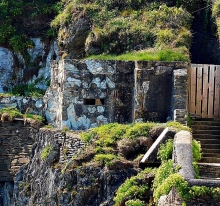
Today, we visited the tiny hamlet of Torcross in south Devon. It lies at the southern end of the long causeway that separates the sea from Slapton Ley, a large freshwater lake. While sitting at an outdoor table on the sea front at Torcross, I was staring at a picturesque rocky outcrop when I noticed what I thought was a rock with a rectangular slit cut in it.

Looking more closely using my camera’s zoom lens, I realised that the slit was really there, but it was cut in something that was not rock, but a thick concrete wall. The wall looked identical in texture to the rocks surrounding it. I realised that what I was looking at is an old bunker that ovelooks the long stretch of Slapton Sands, which is on the sea side of the causeway. It overlooks what would have been a perfect beach for a foreign invasion force to land.

In fact, the stretch of beach known as Slapton Sands was used by an invasion force in 1944. It was not a hostile force belonging to the Axis powers, but a friendly one used by Allied troops. The troops, mostly Americans, were using Slapton Sands to practice or rehearse the planned landings (on D Day) that were about to take place in Normandy as a prelude to recovering Western Europe from German occupation.

As I have described in another post, the rehearsing Allied troops were attacked by German boats, resulting in the tragic deaths of over 700 young Americans. The Germans, based in France, attacked the beach at Slapton Sands because they had picked up very busy radio signal activity in the area. Luckily for the planned invasion of France, the German attackers had no idea of what was being rehearsed at Slapton. Had they known they might well have returned to do even more damage that might have sabotaged the D Day invasion plans.

An amphibious tank, recovered from the sea in 1974, stands at Torcross as a memorial to the men who lost their lives during the German attack of the boats and other military positions at Slapton Sands.

The bunker, which I spotted at Torcross, is known as ‘Pillbox Torcross’. Near to the former Torcross Hotel, this was one of six bunkers at the south end of Slapton Sands. What I thought was concrete is actually local stone (see https://www.heritagegateway.org.uk/Gateway/Results_Single.aspx?uid=MDV39402&resourceID=104).

 Hence, it blends with its surroundings far better than it would have had it been built in concrete. Whether or not this and the other bunkers nearby were of any use when the Germans attacked during the very early hours of the 28th April 1944, I cannot say. However, I feel that given the devastating results of the German attack, this is unlikely.

Today, Torcross is a popular place with visitors. It has several eateries and places to stay. During past visits to this delightful spot, once the scene of a horrible tragedy, we have eaten good seafood at the Start Bay Inn, which is only a few feet away from the tank memorial. The inn was established in the 14th century, when it was known as ‘The Fisherman’s Arms’.

Visiting Torcross provides a good place to reflect on the heroism of those who fought in WW2. Little did those 700 or more men lost in this place in 1944 know that their sacrifice has allowed us to enjoy holidays at this beautiful spot. Whenever I am at Torcross, I have mixed emotions: joy because of the place’s great natural beauty, and sadness when I look at the tank memorial and remember why it is there. Had the D Day landings been thwarted, who knows under what kind of regime we would be living today.

Three towns in Devon

WHEN YOU LEAVE THE A38 road near Buckfastleigh and head southwards, you enter the Devonshire district of South Hams. This picturesque part of southwest England contains three towns that attract many visitors: Dartmouth, Kingsbridge, and Salcombe. Each is located on hilly terrain and has its own distinctive charms. All of them have steep streets that lead to places with great views.

BLOG HAMS 2

Dartmouth, the home of an important large naval college, occupies a position on the estuary of the River Dart. Although it attracts many holidaymakers, it has the feel of a working town. The river is filled with boats, some used by pleasure seekers, and others (including ferry boats and fishing vessels) are working craft.

Salcombe, like Dartmouth, perches on the slopes of the shore of an inlet of the sea. Of the three places mentioned in this essay, it has to win first prize for its setting and attractiveness. I have visited Salcombe both in August (high season) and in May (before the season began). During the high season, the small town is flooded with holidaymakers, day-trippers and those staying in the place (including many owners of second homes). The streets are almost clogged with people. In contrast, when we visited it in May, the tiny town was delightful and relaxing.

We have just returned from staying in Kingsbridge, which is a few miles up the same inlet as Salcombe. This is, at first sight, the least obviously alluring of the three towns. Hence, it attracts fewer visitors than Dartmouth and Salcombe. However, as you wander around the small streets in the historic centre of the town, its charms reveal themselves to the viewer. The town is rich in buildings from the 18th and early 19th centuries. The Quay, where the tidal inlet meets the town is beautifully landscaped. Visitors tend to congregate here to enjoy paddle-boarding, boating (when the tide is high enough), crab fishing, eating ice cream,and just passing the time of day. Also, the town has several excellent restaurants. Of these, I would single out: The Old Bakery (for well-prepared Mediterranean and Middle-Eastern style food), the Dodbrook Arms (with first-class cod and chips as well as other perfectly prepared dishes), and Woodys, which serves very good locally reared beef. Like Dartmouth, but unlike Salcombe, Kingsbridge gives the feeling of being more than a holiday destination; it is a real working town.

In between the three towns, there are many villages and beaches worthy of exploration. Of the three places, Kingsbridge has become my favourite and we hope to return to it soon to use it as a base to get to better acquainted with South Hams.

A bridge and a king


KINGSBRIDGE IS A SMALL town in South Devon. It lies at the head of an inlet of a ria (a completely submerged river valley) upon which the better-known and more popular resort of Salcombe is also located.

BLOG KING 3

 Many histories of Kingsbridge relate that the town resulted from the union of two neighbouring settlements, the neighbouring royal estates of Alvington and Chillington. Kingsbridge was formed around a bridge (possibly, a draw-bridge) that connected the two at the head of the inlet of the ria. The bridge was built by the 10th century. So far, so good, but today there is no bridge in the town of Kingsbridge.

If you drive from Kingsbridge towards Dartmouth via the A379 road, you will soon arrive at the New Bridge west of the town. This not so new bridge with five arches was built in 1845 and restored several times since then. It crosses Bowcombe Creek, another branch of the ria. This bridge is not, and has never, ben inside the town of Kingsbridge; it is well outside it. It is not, as has been suggested to me by several locals, the bridge that gave the town its name. So, where was the bridge?

By chance, I found a book about the history of Kingsbridge on-line. It is “Kingsbridge and its Surroundings” by SP Fox, published in 1874. This is the only source that I have found so far that mentions the site of the bridge in Kingsbridge. On page 10, the author noted:

“Nearly at the lower end, Fore Street is crossed at angles by Mill Street and Duc’c [now called Duke] Street, the former on the west side, leading to West Alvington and Salcombe; the latter on the east, in the direction of Totnes and Dartmouth, and uniting the towns of Kingsbridge and Dodbrooke by a very small bridge.”

The old bridge mentioned by Fox no longer exists, but the two streets mentioned do. Duke Street, which used to run through from Fore Street to Church Street near to the present Duke of Prussia pub (according to a late 19th century map), is now a cul-de-sac on which you can now find the main entrance to a popular fish and chips shop called ‘The Cod Father’. Mill Street is still a road leading towards West Alvington and Salcombe.

Where Fox describes the bridge, there is no sign of a ditch or stream today. Maybe, long ago there might have been a ditch or stream across which the bridge straddled. At the head of the inlet of the ria in Kingsbridge, there is a small arch, which might be the outlet to a formerly visible stream, which has long since been covered.

To add some complexity to the story, a modern source (https://kingsbridge.gov.uk/wp-content/uploads/2020/01/B13-Kingsbridge_Devon-Historic-Market-and-Coastal-Towns-Survey-Report.pdf) suggested that the bridge after which the town was named was not within the town itself but some way outside it:

“The exact site and function of the bridge is of great interest, as clear documentary evidence for an  Anglo-Saxon bridge in Devon is rare (Henderson and Jervoise 1938, 29; Hoskins 1954, 147), and, in the present context, because the development and character of the town, like its name, can be expected to have been fundamentally linked with that of the bridge and its highway. The attraction and shaping of urban growth to main roads and river crossings is a strong pattern across medieval Devon (Slater 1999). The detailed map analysis for the urban survey indicates that the early bridge may have crossed   the River – between routes later altered to become Love or Boon’s Lane on the west side, and Quay Street on the east – downstream from a tidal ford on the Mill Street-Duke Street route and below the extent of the medieval town…”

So, we cannot be certain of the location of the old bridge.

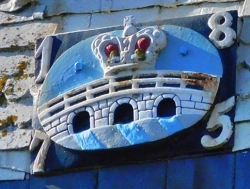
The coat of arms of Kingsbridge consists of a three-arched bridge surmounted by a royal crown. Whether or not the bridge had three arches is not at all certain, but the fact that it linked two royal estates justifies the presence of the crown. If the bridge was located where Fox believed, there was hardly enough width for a bridge with three arches.

But who was the king? It might well have been King Edgar, ‘The Peaceful’, who reigned from 959 to 975 AD. For, it was during his reign that a charter relating to boundaries dated 962 AD mentions the existence of a ‘king’s bridge’. That could also mean that the bridge was in existence before that king’s reign.

So, regardless of the actual position of the bridge after which Kingsbridge is named, we can be certain that the name is justified as there was a bridge somewhere in or near the town and it had royal connections. Whatever the origin of the name, the town of Kingsbridge is well worth a visit.

Richmond, Russell, and India

DID THE YOUNG BERTRAND RUSSELL ever rush up King Henry’s Mound in Richmond Park and enjoy the famous view of St Pauls Cathedral ten miles away? We might never know the answer to this, but there is a good chance that he did (on days with clear sky) because this small hillock (184 feet above sea level) that might once have been a Neolithic burial ground is only about 330 yards from Pembroke Lodge. This Georgian mansion in Richmond Park was built in the mid-18th century. In between 1788 and 1796, it was extended according to plans by the famous architect Sir John Soane (1753-1837). In 1847, Queen Victoria granted the lodge to her then prime minister, John Russell (1792-1878).


RUS 6

Eric Gill’s cover for the book in which Bertrand Russell wrote the preface

John Russell had a son, John Russell (Viscount Amberley), who was born in 1842. He died in 1876, four years after his son, Bertrand Arthur William Russell, was born (in Monmouthshire, Wales). Bertrand’s mother died in 1874. Bertrand and his brother were placed in the care of their grandparents, who were living at Pembroke Lodge. Had Bertrand’s parents lived longer, they would have been pleased to have learnt that their son was awarded a scholarship to study mathematics at Trinity College Cambridge in 1890.

Bertrand Russell was one of the greatest philosophers of the twentieth century, but I am not qualified to describe his contributions to that field. In his autobiographical book “Unended Quest”, the famous Karl Popper (1902-1994) wrote of Russell that he was:

“… perhaps the greatest philosopher since Kant.”

That was praise indeed.

When I visit places for the first time, they often ignite new interests. Pembroke Lodge was  no exception, and visiting it sparked my interest in its former inhabitant Bertrand Russell. It appears that he was interested in a huge range of things. One of these, which also interests me, was the Indian freedom struggle that culminated in the country becoming independent in August 1947. Wikipedia reveals:

“During the 1930s, Russell became a close friend and collaborator of V. K. Krishna Menon, then President of the India League, the foremost lobby in the United Kingdom for Indian self-rule Russell was Chair of the India League from 1932-1939.”

Krishna Menon (1896-1974), born in Telicherry (now in Kerala, India) came to study at the London School of Economics (‘LSE’) in 1925, then at University College London. He became a keen promoter of the idea of independence for his native land. He was founder and president of the India League from 1928 to 1947.  The League was Britain’s foremost and most influential organisation fighting against the continuation of British imperialism. During the 1930s, Bertrand Russell was one of its its leading supporters and its Chairman for a while.

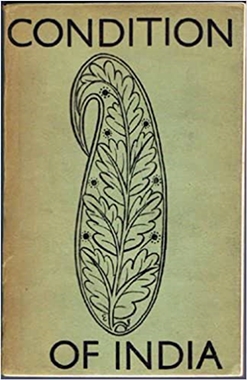
In 1932, the League decided to send a delegation to India to investigate conditions there. The group, which included Menon, spent 83 days travelling the length and breadth of the country, interviewing people, Indians and Britishers, in all walks of life. After the delegation returned to the UK, they prepared a damning report, “Condition of India”, which was banned by the Government of India but published in England in 1932. Its cover was designed by the artist Eric Gill (1882-1940) and Bertrand Russell wrote its preface. Bertrand Russell began the preface with the following words

“… TO obtain a true picture of the present state of affairs in India is as important as it is difficult. Many English people content themselves with the remark that India does not interest them. If India were independent, they would perhaps be justified in this attitude, but so long as the British insist upon governing India, they have no right to ignore what is done in their name by the Government which they have elected. There has been no lack of interest in the misdeeds of the Nazis in Germany; they have been fully reported in the Press, and have been commented on with self-righteous indignation. Few people in England realise that misdeeds quite as serious are being perpetrated by the British in India. Large numbers of men and women, including many of the highest idealism, have been imprisoned under horrible conditions, often without any charge having been made against them and without any hope of being brought to trial…”

Later in the same piece Russell wrote:

“In India, the peasants are powerless against the landlords and the Government combined, so that no economic lesson is learned from their hardships, and they are expected to ‘Starve quietly without making a fuss’. Only people with political power have a right to make a fuss ; this is one of the great lessons of history, and, lest history should not sufficiently impress the Indians, we are teaching it by the lathi and the gaol. Our ruling classes have lost their former skill, and I fear the ultimate result of their folly In India must be disaster. For in India, also, if the new regime is ushered in by bloodshed the result will not be so good as if it came peacefully. Statesmanship is dead in the post-war world, and India, like other countries, suffers in consequence.”

Like the philosopher Richard Congreve (1818-1899) many years earlier (in 1857), Russell was clearly convinced that the British should leave India. By 1938, Russell, who had dedicated a substantial part of his political activity to matters regarding the future of India, began to concentrate more on philosophy and academia. In the late 1950s, he re-entered political activity, becoming one of the founder members of CND, which opposed the atomic bomb and other nuclear weaponry.

Incidentally, after India became independent, Russell’s former collaborator in Indian affairs, Krishna Menon, then India’s High Commissioner to the UK, and others including Jawaharlal Nehru and Edwina Mountbatten founded the India Club in 1951. In the mid-1950s, its premises shifted to 145 The Strand, near the LSE and India House, where it still stands today. Its shabby looking second floor restaurant preserves its original 1950s look and houses a portrait of Krishna Menon. It has a nice old-fashioned bar on the floor below. A few years ago, before the India Club got a licence to serve alcohol in its restaurant, alcohol could only be served to members of the Club. The only requirement for joining it was to pay an annual subscription of 50 pence.

Returning Pembroke Lodge, we enjoyed hot drinks with our friends in its tranquil garden. It was then that one of our friends pointed out its links with the great philosopher, who spent his childhood there (from 1876 to 1894). After returning home, I looked up Bertrand Russell on the Internet and that is when I found that he had a connection with the history of India. It is wonderful that someone brought up in such fine surroundings as Pembroke Lodge should have felt moved to fight for the people of India, very few of whom would have enjoyed such a luxurious childhood as Russell did.

Decorated walls

DURING RECENT TRIPS TO villages and small towns in Essex and Suffolk, we have noticed that some of the plastering on the external walls of buildings is decorated with patterns and illustrations in bas-relief instead of being flat and featureless, as it often is. I first became aware of this decorative plasterwork on a house in the tiny village of Tollesbury in Essex. As we begun to see more examples, my curiosity about it grew. When we visited Saffron Walden, we saw that the outer wall of a bookshop was covered with plasterwork with patterns and symbols. I decided that if anyone would know about this kind of plastering, it would be someone working in what looked like a serious bookshop.

PARG 12 Saf

In Saffron Walden

I entered Harts bookshop and noticed two things. Firstly, the shop was very well stocked. It was a place where one might spend quite a long time browsing. Secondly, the shelving units looked very familiar. I mentioned to the sales assistant that the shelving resembled that used by branches of the excellent Daunt’s bookshop chain. She replied that despite its name, Hart’s is now a branch of Daunt’s. Saffron Walden is lucky to have such a fine bookstore. I asked the assistant about the plasterwork with decorations that was on her shop and other buildings in the area. Another customer overheard me and explained that what I was asking about is called ‘parget(t)ing’. According to Wikipedia:

“Pargeting derives from the word ‘parget’, a Middle English term that is probably derived from the Old French pargeter or parjeter, to throw about, or porgeter, to roughcast a wall.”

However, the frequently fine and intricate patterns and illustrations created on the plaster suggest that creating pargetting involves little if any ‘throwing about’ of plaster but rather much care in its application.

The patterns or drawings were/are often produced by filling moulds with plaster while the wall is being plastered. An important ingredient in the plaster used to create these three-dimensional images and to give them some cohesive strength is fibre. 

The website http://www.buildingconservation.com suggests that:

“English plasterwork became increasingly elaborate in the 16th century and the dramatic external decoration of Henry VIII’s Nonsuch Palace (1538) was contemporary with early plaster friezes in the great houses. Some of the most opulent pargeting was produced over the next 150 years with a high point around 1660 (for example, Ancient House, Ipswich, and the Sun Inn, Saffron Walden), then the technique began to fall out of fashion.”

Later in the 19th century, some architects like Norman Shaw who were involved in the Arts and Crafts Movement revived pargetting, but the effects produced were far less spontaneous looking than those produced by earlier craftsmen. The same website explains:

“The simplest pargeting takes the form of lines scratched with a stick across wet plaster to create, for example, a lattice within a border. More complexity comes from using fingers and combs or moulded templates, incising or impressing chevrons, scallops, herringbones, guilloches, fantails, rope patterns and interchanging squares.”

To create the images that can be seen in pargetting, the plaster used needs to have sufficient cohesive strength. This can be achieved by adding fibre to the plaster mix. According to the http://www.plasterersnews.com website:

“Early pargeting was always worked in lime plaster which had three main ingredients; lime, aggregate and hair … Traditionally it was probably cow or horse hair but BSE stopped them being used and imported goat and yak hair became popular.”

Modern craftsmen conserving pargetting sometimes use synthetic fibres instead of natural hair because some of the modern sources of natural hair have been washed and this removes natural oils, which prevent the hair dissolving in the plaster.

If you, like me, did not know about pargetting before, now you do. When the man in Harts bookshop mentioned ‘pargetting’, “The Archers”, the British radio serial set in a country village, sprung to mind. One of the memorable characters in this series, which was first broadcast in 1950, is a man called Nigel Pargetter. Sadly, his death was recorded in The Guardian newspaper on the 3rd of January 2011. The paper recorded:

“Pargetter, played by Graham Seed for almost 30 years, was felled by the combination of a loose slate, a flapping happy new year banner on the roof of his home, and the need for a rousing climax to the special half-hour 60th anniversary episode, which the producers promised would ‘shake Ambridge to the core’. It had been, the BBC said, ‘a tough decision’”

You will be relieved to learn that Grahame Seed, the actor who played the role of Nigel Pargetter, still thrives.  Nigel might be dead but pargetting still survives and serves to add visual interest to many buildings in East Anglia.


A beautiful bank

FOUR THOUSAND THREE HUNDRED FLOWERS of Crocus sativus needed to be picked in order to produce an ounce (about 28 grams) of saffron in the sixteenth century. I learned this from a magnificent guidebook to East Anglia, written by Peter Sager. The fields surrounding the town of Saffron Walden in Essex used to be filled with the crocuses that were the source of the precious food additive saffron. The saffron industry flourished around the town during the 16th and 17th centuries, but by the 19th century the fields that had once been filled with crocuses became filled with barley. Even though the precious product saffron is hardly produced any more, Saffron Walden is a pleasant small town filled with interesting old buildings. One of these, which is far from being the oldest, now houses the local branch of Barclays Bank.

The centre of the square marketplace in Saffron Walden contains a tall ornate Victorian drinking fountain. This was designed by J F Bentley (1839-1902; architect of London’s Westminster Cathedral) and erected in 1862 to commemorate the marriage of Edward, Prince of Wales. The sides of the marketplace are lined with interesting eye-catching buildings. The Saffron Walden Library on the west side of the square is striking. This building was once the Corn Exchange. It was built in about 1847, possibly designed by R Tress. There is a sculpted ram’s head above the neo-classical pillar-flanked main entrance, which is below an ornate clock tower. I noticed that depictions of animals also adorn the façade of the former Corn Exchange in Bury St Edmunds.  Peter Sager wrote that the ram is placed there in memory of the former, now demolished Woolstaplers Hall that once stood where the library now stands. During the 20th century, the building’s interior was modified to accommodate the town’s library, which was founded in 1832.

SAF 2

The south side of the square has a building with a ground level loggia and elegant half-timbering covering the upper storeys.  It looks mediaeval at first glance. But it is much too well-preserved to be that old.  This Victorian construction, now the Saffron Walden Tourist Information Centre, is also the Town Hall. The structure was built in 1761 and then extensively remodelled and enlarged in 1879 with money donated by George Stacey Gibson (1818-1883), a former Mayor of the town about whom I will soon reveal more.

The Saffron Walden branch of Barclays Bank is on the east side of the square and faces the library. The brick building that houses it, and which was designed by WE Nesfield (1835-1888) and built in 1874, is imposing. It has a large area of windows, each one framed by white masonry. A decorated lead frieze runs above the second floor and below the tiled roof with dormer windows and attractive brick chimney stacks. The main entrance is beneath a gothic arch, which is flanked by bas-relief depictions of birds with long necks and beaks, probably pelicans. Wooden doors near the entrance bear wood carvings that depict the letters “TG” and the date “1874”. Well-worn brass plates on the bank’s inner set of entrance doors read “Gibsons Bank”.

The first room that is reached from the entrance contains its original decorative features. These include a patterned stuccoed ceiling, a stone-framed fireplace with a colourfully tiled interior and fancy brass fire irons. There is wood panelling above the hearth and along the top of the windows in the wall separating this room from others deeper inside the building. The strip of panelling above the internal windows is richly carved with a variety of animals and birds. The rooms further inside the bank have been modernised to serve the requirements of current banking procedures.

Gibsons Bank, or to give it its full name ‘Gibson, Tuke and Gibson’, was also known as ‘Saffron Walden and North Essex Bank’, and ‘Saffron Walden and Bishop’s Stortford Bank’. It was established in 1824 by the Gibsons, a local Quaker brewing family. In 1863, Murray Tuke joined the surviving member of the Gibson family as a partner in the bank, hence the ‘TG’ we noticed on the door. That surviving Gibson was Tuke’s brother-in-law, George Stacey Gibson.

George joined the family bank in 1836 and became a partner in 1840. In addition to attending to the bank and innumerable civic duties, he became a renowned book collector and a serious botanist. In 1862, he published a flora of Essex. “This identified over 1,000 species of flowering plants and ferns, including four that were found only in Essex. “Flora of Essex” sealed Gibson’s reputation as a botanist and for the next century it was regarded as the definitive work on Essex botany” (see: http://www.hundredparishes.org.uk/). He was also the ‘discoverer’ of five flowering plant species that were new to Britain in the early 1840s.  

After his father died in 1862, George had to dedicate most of his time to the bank, his work on the Town Council, and charitable commitments, many of which related to the Society of Friends. He died at the Devonshire House Temperance Hotel in Bishopsgate Street, City of London, from inflammation of the kidneys.

In 1896, the bank, which had been associated with Fordham, Gibson and Co of Royston since 1880, became one of the twenty banks that joined together to form the Barclays Bank consortium. Another bank to join this group in 1896 was Goslings in London’s Fleet Street. Happily, Barclays have managed to preserve some of the original architectural features of both Gosling’s and Gibson’s historic premises. Even if you do not need to cash a cheque or deposit some money, visits to both of these formerly independent banks will provide a feast for the eyes.

PS: I have concentrated on the buildings in the marketplace of Saffron Walden, but must tell you, dear reader, that there is plenty more to see in the town including a fine parish church, many picturesque old buildings,  and the impressive ruins of a mediaeval castle.