DURING RECENT TRIPS TO villages and small towns in Essex and Suffolk, we have noticed that some of the plastering on the external walls of buildings is decorated with patterns and illustrations in bas-relief instead of being flat and featureless, as it often is. I first became aware of this decorative plasterwork on a house in the tiny village of Tollesbury in Essex. As we begun to see more examples, my curiosity about it grew. When we visited Saffron Walden, we saw that the outer wall of a bookshop was covered with plasterwork with patterns and symbols. I decided that if anyone would know about this kind of plastering, it would be someone working in what looked like a serious bookshop.

In Saffron Walden
I entered Harts bookshop and noticed two things. Firstly, the shop was very well stocked. It was a place where one might spend quite a long time browsing. Secondly, the shelving units looked very familiar. I mentioned to the sales assistant that the shelving resembled that used by branches of the excellent Daunt’s bookshop chain. She replied that despite its name, Hart’s is now a branch of Daunt’s. Saffron Walden is lucky to have such a fine bookstore. I asked the assistant about the plasterwork with decorations that was on her shop and other buildings in the area. Another customer overheard me and explained that what I was asking about is called ‘parget(t)ing’. According to Wikipedia:
“Pargeting derives from the word ‘parget’, a Middle English term that is probably derived from the Old French pargeter or parjeter, to throw about, or porgeter, to roughcast a wall.”
However, the frequently fine and intricate patterns and illustrations created on the plaster suggest that creating pargetting involves little if any ‘throwing about’ of plaster but rather much care in its application.
The patterns or drawings were/are often produced by filling moulds with plaster while the wall is being plastered. An important ingredient in the plaster used to create these three-dimensional images and to give them some cohesive strength is fibre.
The website http://www.buildingconservation.com suggests that:
“English plasterwork became increasingly elaborate in the 16th century and the dramatic external decoration of Henry VIII’s Nonsuch Palace (1538) was contemporary with early plaster friezes in the great houses. Some of the most opulent pargeting was produced over the next 150 years with a high point around 1660 (for example, Ancient House, Ipswich, and the Sun Inn, Saffron Walden), then the technique began to fall out of fashion.”
Later in the 19th century, some architects like Norman Shaw who were involved in the Arts and Crafts Movement revived pargetting, but the effects produced were far less spontaneous looking than those produced by earlier craftsmen. The same website explains:
“The simplest pargeting takes the form of lines scratched with a stick across wet plaster to create, for example, a lattice within a border. More complexity comes from using fingers and combs or moulded templates, incising or impressing chevrons, scallops, herringbones, guilloches, fantails, rope patterns and interchanging squares.”
To create the images that can be seen in pargetting, the plaster used needs to have sufficient cohesive strength. This can be achieved by adding fibre to the plaster mix. According to the http://www.plasterersnews.com website:
“Early pargeting was always worked in lime plaster which had three main ingredients; lime, aggregate and hair … Traditionally it was probably cow or horse hair but BSE stopped them being used and imported goat and yak hair became popular.”
Modern craftsmen conserving pargetting sometimes use synthetic fibres instead of natural hair because some of the modern sources of natural hair have been washed and this removes natural oils, which prevent the hair dissolving in the plaster.
If you, like me, did not know about pargetting before, now you do. When the man in Harts bookshop mentioned ‘pargetting’, “The Archers”, the British radio serial set in a country village, sprung to mind. One of the memorable characters in this series, which was first broadcast in 1950, is a man called Nigel Pargetter. Sadly, his death was recorded in The Guardian newspaper on the 3rd of January 2011. The paper recorded:
“Pargetter, played by Graham Seed for almost 30 years, was felled by the combination of a loose slate, a flapping happy new year banner on the roof of his home, and the need for a rousing climax to the special half-hour 60th anniversary episode, which the producers promised would ‘shake Ambridge to the core’. It had been, the BBC said, ‘a tough decision’”
You will be relieved to learn that Grahame Seed, the actor who played the role of Nigel Pargetter, still thrives. Nigel might be dead but pargetting still survives and serves to add visual interest to many buildings in East Anglia.

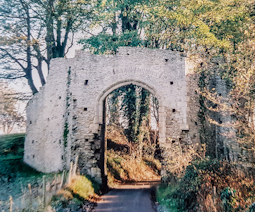 IN DECEMBER 2005, we spent a Saturday night at a bed and breakfast in a remote spot near Winchelsea in East Sussex. In those days we still had our own car and could stop where we wanted on or even off the route.One of our stopping places was Redhill in Surrey. We wanted to visit its contemporary Roman Catholic church of St Joseph and St Paul’s, but not for religious reasons. The architects, who had designed it, knew that my late uncle WS Rindl, an accomplished structural engineer, was a keen amateur sculptor. They asked him to make some decorative features and a crucifix to adorn the exterior of the church. In addition to the concrete crucifix, my uncle designed and constructed concrete gargoyles to run off rainwater from the roof. Each of these gargoyles is decorated in bas-relief with castings of the tools used by builders and engineers. On one of these drainage spouts there is a representation of what looks as if it were an early rather bulky model of a pocket calculator. The church, completed in 1984, is a lovely example of imaginative 20th century architecture, well worth a detour to see.The rurally located bed and breakfast was housed in a building that was at least 300 years old if not older. The accommodation was comfortable but the breakfast was disappointing. The fried eggs served seemed as if they had been made long before breakfast and kept warm; they were not as fresh as the frost that had coated the surrounding countryside overnight. We made a brief visit to Winchelsea, a place that has always fascinated me. Founded as ‘New Winchelsea’ by King Edward the First in the 13th century, the town was a coastal port, complete with city walls. By the 1520s, what had been a thriving centre of trade declined rapidly because of shifting of the coastline resulting from silting up of its harbour. Apart from some of the town’s mediaeval gateways and the large church of St Thomas the Martyr, it is difficult to imagine that Winchelsea was once a bustling metropolis. The decline of Winchelsea is one of many examples all over the world of how environmental changes can affect the ability of civilisations to thrive. In January 2020, we visited Lakhpat in Kutch, a part of Gujarat in western India. This huge walled city, far greater in size than Winchelsea, was a thriving seaport until the early 19th century when an earthquake caused the sea inlet on which it stood to become transformed into a salty desert. Today, the seven kilometres of intact city walls contain not a city but only a few widely separated dwellings and a Sikh Gurdwara. The church, which dates back to the 13th century, looks large. However, what can be seen today is all that is left of what had once been a far larger cathedral-like building.On the Sunday morning when we entered the church, a service was being held. There was the priest and his congregation of less than eight people, looking a little lost in the huge church. Seeing the three of us entering, he welcomed us, and said in a pleading voice: