To Maurice from Bob

THERE WERE AT LEAST 3 JEWISH girls in my wife’s school class in Calcutta during the mid 1960s. Then, the city had a sizeable Jewish community, many of its members and their ancestors having migrated from Iraq, especially Baghdad.

Recently, a friend gave me an old book about the Tollygunge Club in Calcutta. Inside it, there is an undated handwritten inscription: “To Maurice, with love from Bob”.
My friend did not know who Bob is or was, but told me that the book was part of a collection once owned by Dr Maurice Shellim.

Maurice Shellim, a was born in a Baghdadi Jewish family in Shanghai (China) in 1915 and died in London (UK) in 2009 (see: http://www.jewishcalcutta.in/exhibits/show/notable_members/maurice-shellim).

By profession, Maurice was a medical doctor. According to Dalia Ray, writing in her book “The Jews of India”, he was a Member of the Royal College of Surgeons and Physicians (London), having studied medicine at London’s Guys Hospital. Ray also records that he took part in the functioning of a free medical clinic set up by his coreligionist Dr E Musleah.

After buying a painting by Thomas Daniell (19th century painter of Indian scenes), Maurice Shellim became very interested in Daniell and other British painters in India. Eventually, he published a book about Daniell and his nephew William Daniell: “India and the Daniells: Oil Paintings of India and the East”.

Maurice also published a book about the historic Park Street Cemetery in Calcutta. He had devoted much time and energy to conserving this picturesque resting place for the remains of British families.

In his later years, Maurice and his immediate family moved to London, but he often visited Calcutta.

Most of Calcutta’s Jewish people have left the city to settle abroad. Although anti-Semitism has never been a problem in India, many of Calcutta’s Jewish folk chose to leave in the decades following 1947. Probably, many of them left to improve their economic prospects, but Dalia Ray suggests that because most Indian Jews had been pro British they began to feel that they might begin to feel uneasy in independent India. She also wrote that after the establishment of Israel as a sovereign state, many Jews wanted to fulfil their centuries old desire to reach the Promised Land.

Today, there are very few Jewish people left living in Calcutta.

I would not have been likely to have discovered the story of the remarkable, highly cultured Dr Shellim had I not seen that scribbled inscription in an old book.

PS: ‘Bob’ was most probably Bob Wright, a Britisher who lived in Calcutta for over 30 years. He worked for a large company and was involved in the management of the Tolleygunge Club.

From revolutionary to saint

On Sunday morning it was Republic Day, the 26th January 2020. The streets in Baroda were quite. Several of the few vehicles we saw carried Indian national flags that fluttered proudly as they sped past us.

It was also quieter than usual at the Sri Aurobindo Nivas, the home where Sri Aurobindo lived while he was an official in the government of the princely state of Baroda and both professor and vice chancellor of what is now Baroda University. Aurobindo lived with his wife, Mrinalini in this house donated by the Gaekwad. After Baroda, Aurobindo and his wife moved to Calcutta. Later, he moved to the French colony of Pondicherry. After he arrived there, his wife followed him but during the journey to join him, she died suddenly of an infection (https://www.boloji.com/articles/13683/mrinalini-sri-aurobindos-forgotten-wife). I have written a bit about Aurobindo in Baroda in my book “Travels through Gujarat, Daman, and Diu” (published in India by pothi.com as “Gujarat Unwrapped). Here is what I wrote:

“Today, Sri Aurobindo is associated with ‘peace and love’ by many people, especially the crowds of Europeans who seek spiritual solace at his ashram in Pondicherry. While Aurobindo was working as a teacher in Baroda in the early 20th century, he was involved in Indian independence movements. Although he espoused peaceful methods, he was not averse to the use of violence. Jyotirmaya Sharma wrote in his book, Hindutva: Exploring the Idea of Hindu Nationalism, wrote: “It was at Baroda that Aurobindo took the first decisive steps into political life … Aurobindo clearly believed in the efficacy of violent revolution and worked towards organizing secret revolutionary activity as a preparatory stage for open revolt and insurrection…” In a biography, Sri Aurobindo for All Ages, its author Nirodbaran, who worked in close contact with the great man for twelve years, wrote: “When we asked him once how he could even conceive of an armed insurrection against the well-equipped British garrisons, he answered: ‘At that time, warfare and weapons had not become so lethal in their effect. Rifles were the main weapons, machine guns were not so effective. India was disarmed, but with foreign help and proper organisation, the difficulty could be overcome; and in view of the vastness of the country and the smallness of the regular British armies, even guerrilla warfare might be effective…”

After a year’s spell in Alipore prison in connection with his alleged involvement with some politically motivated murders in Bengal, Aurobindo settled in Pondicherry, and from then began espousing a spiritual approach to life. While living in that French colony, he continued to contemplate contemporary Indian issues, including that of the relationship between Hindus and Muslims. In late 1909, Aurobindo wrote: “Our ideal therefore is an Indian Nationalism, largely Hindu in its spirit and traditions, because the Hindu made the land and the people and persists, by the greatness of his past, his civilisation and his culture and his invincible virility, in holding it, but wide enough also to include the Moslem and his culture and traditions and absorb them into itself.” Jyotirmaya Sharma wrote: “Savarkar legitimately claimed paternity for the idea of Hindutva; but Hindutva could lay to an equally formidable patrimony in the thought of Dayananda, Vivekananda, and Aurobindo. What binds these four thinkers together is the systematic marshalling of a Hindu identity in the service of Indian nationalism.” Sharma quotes the following passage, written in 1923, from Aurobindo’s India’s Rebirth (a collection of writings): “It is no use ignoring facts; some day the Hindus may have to fight the Muslims and they must prepare for it. Hindu-Muslim unity should not mean the subjection of the Hindus. Every time the mildness of the Hindus has given way. The best solution would be to allow the Hindus to organize themselves and the Hindu-Muslim unity would take care of itself, it would automatically solve the problem.” And, in 1934, Aurobindo wrote: “As for the Hindu-Muslim affair, I saw no reason why the greatness of India’s past or her spirituality should be thrown into the waste paper basket in order to conciliate the Muslims who would not at all be conciliated by such a stupidity.”

The Sri Aurobindo Nivas, where Aurobindo lived until 1906 while he was an esteemed teacher and state official in Baroda, is a two-storey grand, mainly brick bungalow with European-style wooden window shutters. In 1971, the Government of Gujarat handed it over to Baroda’s Sri Aurobindo Society, which promotes the peaceful aspects of Aurobindo’s teachings and philosophy. The house is surrounded by a well-maintained garden. This contains an outdoor stone shrine, a flat marble table with a bas-relief of a lotus flower in its centre. The lotus was surrounded by a flower arrangement consisting of a circle surrounding a six-pointed star. The star with centrally enclosed lotus is a symbol of Sri Aurobindo, whereas the circle is the symbol of his spiritual partner, the Mother, who settled in Pondicherry in 1920. She was born Mira Alfassa (1878-1973) in Paris, of Turkish and Egyptian Jewish parentage. She became the founder of Aurobindo’s ashram in Pondicherry.

The ground floor of this typical colonial-style bungalow contains offices and a library, which was full of people reading at tables. The upper floor has carpeted rooms decorated with relics and portraits of Sri Aurobindo and the Mother. These two people are often depicted in their old age, but here at Aurobindo Nivas we saw a couple of portraits, hung side-by-side, showing both as young people. The rooms on the upper floor are used for silent meditation. People sit cross-legged on the floor and occasionally prostrate themselves, their foreheads touching the floor. Also, they stand up and touch the paintings and photographs of Aurobindo and the Mother in the same way as Hindu worshippers touch idols in temples.

There is a large well-tended lawn behind the bungalow. About twenty-five people were sitting on the grass on rugs, meditating and doing yoga. They were facing a boundary wall on which there is a large outline map of India as it was before Partition in 1947 (including what is now Pakistan and Bangladesh). In the centre of what is now India, there is the circular symbol of the Mother.”

(end of extract).

After spending a pleasant hour in Aurobindo’s former residence, we took refreshments including south Indian filter coffee and dahi vada in the nearby three storey Canara Coffee House (founded 1950). Then we continued our exploration of the Sursagar Lake and looked for picturesque old buildings in the city. Many of the older structures, mostly residential usage, are rich in finely carved wooden decorative features.

By the time we had seen sufficient, the temperature was approaching 30 degrees Celsius – a contrast to the near zero conditions we had encountered earlier on our trip in places like Darjeeling and Mount Abu.

TRAVELS THROUGH GUJARAT DAMAN AND DIU is available from Amazon, lulu.com, and Bookdepository.com

GUJARAT UNWRAPPED , an Indian edition of the above is available from pothi.com (only in India)

An Indian hero

SUBHAS CHANDRA BOSE (1897-1945) was, along with Gandhi, one of the most important fighters for the independence of India. Without doubt, the activities of Bose and their consequences were one of the main reasons that the British left India in 1947. A one time president of the Indian National Congress, he later parted ways with it.

Before 1940, Bose was placed under house arrest in Calcutta by the British. In 1940, he escaped and made his way to Nazi Germany, where he arrived in 1941. The German authorities were prepared to cooperate with him to bring about the downfall of the British Empire in India.

After the surrender of Singapore to the Japanese, Bose and his colleague Abid Hassan Saffrani (1911-84), who was studying engineeringin Germany and anti-British, were placed on a German submarine in early 1943. It took them to Madagascar, where they boarded a Japanese submarine that took them to Japanese occupied Sumatra. Then, they proceeded to Singapore, where Bose persuaded captured Indian troops to fight the British to gain independence for India. It was during this time that Abid Hassan Saffrani coined the salutation ‘Jai Hind’.

Bose led his Indian National Army on an ill fated military expedition to enter India via Burma. In 1945, Bose was killed in an air accident in Japanese held Taiwan. Abid Hassan Saffrani returned to India and after Independence served his country as a diplomat.

The photograph shows Bose with Abid during their journey on the German submarine in 1943. (Bose is on the left with spectacles)The print I saw is in the possession of a nephew of Abid, who lives in Hyderabad.

Some days before I met Abid’s nephew, we met a lady in Calcutta. After spending an evening with her, I expressed my interest in the anti-British activists, who lived in Calcutta. Hearing this, she revealed that she is related to one of them. We asked which one. She told us that her grandfather was Sarat Chandra Bose, the brother of Subhas Chandra Bose who helped Subhas to escape from Calcutta in 1940. We were amazed to hear this.

CLUBS AND GOLF CLUBS

WHEN THE BRITISH RULED INDIA, they established clubs in India that were based on the sort of clubs frequented by upper class gentlemen in London (e.g. the Reform Club, the Athenaeum, and military sporting clubs). Like their counterparts back in the UK, the clubs in British India were subject to rules and strict dress codes. And, apart from servants, Indians were not admitted. There were a few exceptions. The Bangalore Club allowed some high ranking Indian military men as members, and also the Maharaja of Mysore.

Even after India became independent in August 1947, some of the British colonial clubs in India denied membership to Indians, a few of them until the late 1960s or after.

The Tollygunge Club in south Calcutta, founded in 1895, was one of the institutions that ddidnot admit Indian members until long after 1947. When my late father in law, an Indian and distinguished professional, was offered membership of this club in the 1960s because they needed to replace the dwindling number of ‘white’ members with Indians in order to remain solvent, he turned it down because he felt it wrong that he should join a club that had refused membership to him long after his country became independent.

It may seem surprising that the Indian authorities tolerated the continuation of this racial exclusivity long after independence. It was not only these clubs that denied access to Indians even after 1947, but also some hospitals and schools. This illustrates a certain tolerance amongst Indians to their foreign invaders. Remember, the Taj Mahal and the Victoria Memorial remain unscathed long after their foreign builders left the country.

The Tollygunge Club has its own golf course, a magnificent stretch of parkland where there is much wildlife including jackals, who watch the golfers seemingly unconcerned by them.

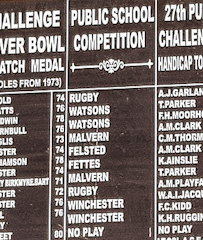
While staying at the Club, we noticed large boards on which the names of high achieving golfers are listed. For example, there is a board listing the Club members who have achieved a ‘hole in one’.

What particularly caught our attention was a board listing winners of The Public School Competition. A public school in the UK is actually a private, somewhat elitist, school. The winners of the Public School Competition on the list are not names of individual players but names of British public schools listed alongside the dates of their achievement for example: Rugby, Fettes, Felsted, Winchester, Eton, Marlborough, and many others. The competition continued until the late 1960s, by which time most of the European members of the Club had returned to the UK or elsewhere.

It would seem, although nobody has confirmed this to me, that during the Public School Competition teams of players who had all attended the same public school would compete against teams of other players each containing men who had attended this or that public school. It was a competition between school alumni teams and the winning school was listed on the board of honour.

The colonial clubs continue to thrive in India, the vast majority of their members being Indian. These pleasant establishments, often housed in colonial era buildings and set in lovely grounds are still elitist and retain some of the rules and traditions that were formulated by their British founders.

Like the gated residential communities that are springing up all over India, the formerly colonial clubs are havens where the better-off can relax, separated from the ‘madding crowds’.

MARBLE PALACE

THINK OF ANY MAJOR CITY and its most famous land mark will spring to mind: Big Ben in London, the Eiffel Tower in Paris, the Coliseum in Rome, the Golden Gate in San Francisco, and so on. Calcutta evokes thoughts of the Victoria Memorial and, maybe, the Howrah Bridge.

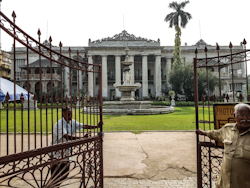
Yet, Calcutta contains something far more remarkable: The Marble Palace. It was built in 1835 in a European neoclassical style to the plans of an architect from Italy for a prosperous Bengali merchant Raja Ragendra Mullick Bahadur. Set in extensive gardens filled with marble statues mostly imported from Europe, the palace alone is remarkable to look at.

However, step inside and a treasure house awaits you. Mullick and his descendants are avid collectors of artworks. Mullick, who had the house constructed, never visited Europe but employed agents to buy precious works of art for him. The collection of paintings in the Marble Palace make it the first ever art gallery in India. Treasures amongst the large numbers of canvases include paintings by Rubens, Murillo, Reynolds, and Ravi Varma.

Rooms on the palace are filled with antique furniture, marble and other statuary, valuable ancient Chinese porcelain, and much else.

The elaborate wooden ceilings differ in design from room to room. Looking downwards, the floors are made of marble of varying colour arranged in patterns typically found in Italian renaissance buildings. They were created by Indian workers using Italian marble and designed by Italian artists.

There is a large open coutyard in the middle of the palace. One end is occupied by a covered stage-like podium, where Hindu ceremonies are performed for the Mullick family, many of whom still live in the palace. The courtyard is filled with interesting bird calls because at one end of it, facing the podium, there are several large cages each containg a large parrot.

There is a small zoo or menagerie on one side of the gardens. Apparently, it is one of the oldest zoos in India. When we visited it, we saw various types of deer and some waterfowl.

If you do no other sight seeing in Calcutta, the Marble Palace, but not the Victoria Memorial, is a ‘must’.

Note: photography is forbidden in the palace but a small book in Bengali is available for 100 Rupees and it contains a few photos.

Page or screen

Many readers are moving from the printed book format to the ebook format, where text is read on a screen instead of on a paper page.

Recently, we visited the small but magnificent book shop, Modern Book Depot, next to New Market in Calcutta. We passed a pleasant hour chatting with its charming and erudite owner, Mr Prakash. One of the topics we discussed was ebooks versus old fashioned paper books. Mr Prakash suggested that ebooks were a useful backup for paper books, but that they were no substitute for the latter. I agree with him.

Paper books engage more of the reader’s senses than ebooks. A ‘real’ book has its own smell. I am not alone in sniffing the books that I read. Each book has its own odour whether its the smell of the paper and printer’s ink or of where it has been stored. Books differ in their tactile properties. Different kinds of paper vary in how they feel. The weight of a book and its degree of flexibility (if it is a paperback) add to the reader’s enjoyment or experience. None of these secondary characteristics associated with paper books can be experienced while reading a text on a screen. Although they do not affect the primary property of the text, its content, they do affect the reader’s whole reading experience, albeit subliminally.

So, give me a paper book any day, rather than an ebook.

Misunderstood

The coffee lounge at Calcutta’s Grand Hotel on Chowringee was closed for cleaning. So, we were advised that we could get coffee at the nearby ‘P.L.S’ café.

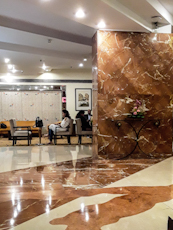
We walked in the direction of P.L.S but could not find it. We asked someone, who pointed at a large hotel called ‘Peerless Inn’. This, the locals pronounce ‘P.L.S’!

Pilots

I associate the word ‘pilot’ mainly with aeroplanes. Also, I think of small boats that help larger ones enter and leave ports. There is also, I believe, a creature called a ‘pilot fish’.

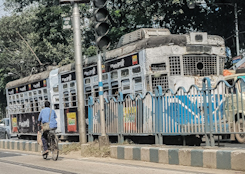
On arrival in Calcutta (now ‘Kolkata’) in West Bengal (India), I noticed that the local city buses have the word ‘pilot’ written on the doors that the bus drivers (i.e. pilots) use to enter their buses.

I am certain that I have never seen the word pilot used to describe a bus driver anywhere else I have visited.