Life cycle

I HAVE OWNED ONLY ONE bicycle. My parents gave it to me as a gift when I was about twelve. My late mother, who was somewhat over-protective of my sister and me, restricted my use of the cycle to our not over large garden in northwest London. Cycling around in this confined face was hardly much fun. The bike fell into disuse.
BIKE 2

In the early 1970s, I met a friend in Luxembourg a few days before he was to be interviewed for a job in the administration of the European Parliament. We spent a night in a youth hostel in Echternach. On the following day, we hired cycles to do some exploring. We cycled over hill and dale, mostly uphill it seemed, through attractive forests until we reached the small town of Vianden about 18 miles away to the north. The bicycle, which I had hired, had a gear change lever attached to its handlebar. I kept fiddling with this as we rode through the summer heat, but it seemed to make no difference to how the vehicle moved.  

When we arrived in Vianden, we headed back on our return journey via a different route. We followed minor roads close to the River Sure, which forms the boundary between Luxembourg and Germany (in those days it was West Germany). There were many small bridges crossing the river and connecting the neighbouring countries. At each bridge, we moved from one country to the other, flitting through short tracts of, say, Germany before the next in Luxembourg. This was long before the Schengen Agreement was signed in 1985, but we were never stopped by border officials on either side of the river. That was lucky because both of us had (maybe unwisely) left our passports with our baggage.

When we got back to Echternach, we were both extremely thirsty and I was exhausted. We found a refreshment place with outdoor seats and tables and ordered chilled beers. I sat down and then promptly stood up again. Having sat on the saddle for so long, my backside had become bruised. It was at least three days after our excursion that sitting became comfortable again. It was only when we returned the cycles to the hire place that I noted that the gear adjuster lever was not connected to anything apart from the handlebar; the bike had no gear mechanism.

A few years later, in the early 1980s, I decided to go to the north of Holland, which was a part of the country I had never visited before. My plan was to cross the sea from Sheerness to Vlissingen on the luxurious Olau Line ferry, and then to travel from nearby Middelburg to various places in the north of Holland. At each place, I had decided to make use of the cycle hire service that was offered at Dutch railway stations. 

My first cycle excursion was around the peninsula on which Middelburg is located. On this first adventure with Dutch Railway cycles, I discovered three important things. First, the bicycles had no gears. This is not in itself a problem because Holland is not a hilly place. Next, the braking system is not operated by leavers on the handlebars. To slow or halt the cycle, the rider must reverse pedal. Thirdly, Holland can be a windy place. Cycling into the wind is as difficult as cycling up a hill. Well, the first outing was a useful learning experience.

Another thing that I learned but did not make use of was the fact that in those days most Dutch people woke up earlier than me. This meant that when I reached the cycle hire offices at railway stations, there were few cycles left for me to select. Most of those available were far too large for me. I was able to ride them, but unable to reach the ground with my feet when I was perched on the saddle. The only way I could cope was to cycle up to a lamp post or telegraph pole, and steady myself by putting one of my hands against it.

I stayed in Leeuwarden in the far north of Holland, a place that I had long wanted to see – why, I cannot recall any longer. I rented a bike to visit the picturesque coastal town of Harlingen. I returned in the early evening and had a brief rest at my hotel. At about 7.30 pm, I decided to look for somewhere to eat. Almost everywhere had stopped serving dinner because people dine early in Leeuwarden. After eating a pizza in a non-descript place, the evening was still young, but the city seemed deserted. Where was everyone, I wondered. Surely, they had not all retired to bed so early. I strolled the empty streets for a while and found a pub that was open. I entered. It was full, but far from lively. People were either chatting quietly or sitting in chairs reading books or newspapers. The pub felt like a rather crowded cosy sitting room.

One highlight of that visit to Holland was cycling along the Afsluitdyk, a man-made causeway constructed between 1927 and 1932. It is over 20 miles long and separates the North Sea from the Ijsselmeer, now an inland lake but once a huge inlet of the sea. The ride, like most others I made in Holland, was windy.

Since my Dutch cycling adventures, I cannot remember pedalling a cycle again until 1993, when I was ‘courting’ my wife. On one occasion when I visited her health club, she encouraged me to try an exercise bike. She sat on the machine next to mine and an athletic fellow sat on one on the other side of mine. My wife pedalled away energetically with the book she was reading balanced on the handlebar. My male neighbour pedalled as furiously as he might have done had he been chased by a cheetah or a jaguar. Meanwhile, yours truly was unable to get the pedals to move at all. Clearly, I had either reached a stage in my life cycle when my strength was ebbing or a previous user of my machine had set the pedal resistance at a very high level (and I had no idea that it was  adjustable).
Me and maps

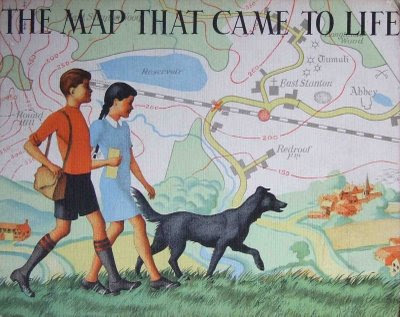
MY LOVE OF MAPS started soon after I was able to read. I was given a book that fascinated me for many years. It was called “The Map that came to Life” by HJ Deverson and R Lampitt. First published in 1948, it follows a couple of children walking through the countryside with their dog, guiding themselves with an Ordinance Survey map. On each page, there is a bit of their map and an illustration showing the terrain which is on that portion of the map. Not only did it teach me something about map reading but it helped me to visualise in three dimensions what is being represented in two dimensions on a map. It was one of my favourite books during my childhood.

MAP 1

From the age of eight years onwards until I was thirteen, I attended the Hall School, which is near to Swiss Cottage (in northwest London). Although there was a lot that I did not like about this academically top-rate establishment, I am grateful for at least one thing. One day when we were learning about Ordinance Survey maps in a geography class, our teacher gave us an exercise that stimulated a hobby that lasted until my late teens. The exercise was to draw an Ordinance Survey map of an imaginary place making correct use of the various symbols that appear on the real maps. Of all the academic tasks I was required to perform at the Hall School, this was the best.

Inadvertently, our geography teacher had sparked off a new craze for me. That was drawing maps of imaginary places. I was inspired not only to emulate Ordinance Survey maps but also to create maps of imaginary places in the styles of the ever-increasing number of maps that I had begun acquiring as a passionate map collector. I drew these maps using pencils, water-colour paints, biros, and fine-tipped Rotring pens (such as are used by architects and technical draftsmen).  Drawing maps occupied much of my precious spare time, time which my friends spent socialising and meeting members of the opposite sex.

After a while, I began drawing maps of an imaginary country, a socialist republic behind the so-called ‘Iron Curtain’. In addition to creating maps of my geographic invention, I produced illustrations, tourist brochures, and so on. Be patient because  I shall say much more about this imagine land in future postings.

When I began studying at university in 1970, my map drawing activities ended. However, my fascination with maps has never diminished. While sorting things at home, I have found the maps and drawings I made during my teenage years. Gradually, I will share some of these with you, dear readers.

I began this piece with a mention of a book that described a map that came to life. It was first published before I was born. Today, the authors’ concept has almost become reality with Google Maps. This useful service provides fairly detailed maps, which at the click of a ‘button’ become aerial views of the area that has been mapped out. At the click of another button, you can travel (virtually) along the streets on the maps and see the buildings and other things along them. While the maps do not really come to life, the Google mapping service has brought us closer to that happening for real. Let us wait and see what the future brings in the way of remote realisation of life in places on the map.

Photographic memories

THERE IS PHOTOGRAPHY IN MY GENES. My great-grandfather, Senator Franz Ginsberg (1862-1936) left his native Prussia to migrate to South Africa in 1880. He arrived in King Williams Town where he and his future bother-in-law Jakob Rindl established a photography studio, one of the first in southern Africa.

HAL 6

I became keen on photography as soon as an uncle, a keen amateur photographer who was closely related to Jakob Rindl and also Franz Ginsberg, had presented me with a simple Kodak Brownie camera when I was about seven years old. It was exciting taking photographs, waiting for the film to be developed at chemist or photography shops, and then opening the packet to discover whether the prints bore any decent looking images. In those early days, there were plenty of dud shots, but also a few decent ones. I graduated from the Brownie to another Kodak model, which had two lens and a viewfinder on top of the device. It was probably a version of the Brownie Reflex camera. It pleased me because it had a few things that could be adjusted whilst taking a picture.

As I got older, maybe over twelve years old, I began buying photography magazines. I soon realised that to achieve interesting results in photography, using a 35mm film camera was essential. I leafed through the issues, reading the reviews of cameras that sounded wonderful but were way beyond my budget. I was so fascinated by these sophisticated devices that I used to draw pictures, fantasising what I would have liked to have owned.

Eventually, there was a review of a camera that almost suited my pocket money budget, and which was likely to satisfy my desire to own a more complicated camera. The camera, which was given an excellent review was made by the Halina company and cost around £12.The Halina models were manufactured in Hong Kong by the Hakin Company. I cannot recall exactly which model was reviewed but it looked similar to the Halina 35x. I do remember that it did not have a built-in exposure meter.

Twelve pounds was a lot of money for me to find in the mid-1960s. I did not expect my parents to donate this sum to me for something they considered unnecessary because they never showed any interest in taking photographs. However, they did offer me a solution: I could earn the money by helping them. The task I was given was to mow the lawn in our garden once a fortnight. Please note that we only possessed a non-motorised human-powered mower. So, the £1 that I received for each quite arduous mowing was not easy money.

Eventually, I amassed the required sum to buy my Halina camera and it leather-like case. Then, I was faced with the problem of determining the appropriate shutter speed and diaphragm settings for my shots. My uncle, the one who had started off my interest in photography, gave me a circular plastic exposure calculator. By twisting the dial to three settings (weather condition, subject matter, film speed), the device produced a recommended combination of exposure time and diaphragm setting (‘f number’). At first, this was quite difficult to use. After a little practice, I became very adept. For example, I could use the calculator to work out the correct exposure settings when taking pictures of landscape from a moving car or bus, and the results were often more than acceptable.

A little more money saving allowed me to have sufficient to buy a highly recommended low-cost electronic exposure meter made by the Boots Company (the famous British pharmaceutical retailer). The meter was far easier to use, and much quicker than, the plastic calculator.

I used the Halina happily for several years until 1967. That year, my parents paid a visit to Japan, where they were hosted by various Japanese people and organizations. Moments before they were about to board the jet that would fly them back to London, their hosts handed them several generous gifts. One of these was a top of the range Canon Rangefinder camera. As mentioned already my parents had no interest in using cameras.

When my parents landed in London, they declared their gifts to a customs officer. Handing the camera to him, my mother said:

“We don’t want this. Take it so that we need not pay duty.”

The officer looked at the fine camera and said:

“The duty is only £3. Anyway, I can’t take it.”

As my parents paid the duty, the officer leant over and whispered to them:

“You’ll get at least £300 for this if you sell it to someone on Oxford Street.”

Fortunately, they did not follow the officer’s advice. Instead, they gave me the superb camera, which I used for many years until I decided to buy a Pentax single lens reflex (‘SLR’) camera. Its excellent lens and accurate built in exposure meter never let me down.

The Pentax was a disaster. I bought it to use during my first visit to what was then Czechoslovakia. A critical part of it broke two or three days into the trip. No one in Prague could fix the thing. So, I purchased another SLR camera. It was an Exacta, which had been made in Eastern Germany shortly before the Berlin Wall was demolished. The Exacta was heavy but solidly built; it was probably indestructible and produced lovely photographs.

That was all long ago. My interest in photography has continued, but it has been several years since I abandoned film cameras for digital devices, both ‘phones and actual cameras. The advent of digital photography and the editing software that can be employed to modify the images captured have eliminated the need for film developing and darkrooms. Modern digital software allows anyone to be able to do what was only possible in darkrooms and much more.

History is bunk

“HISTORY IS BUNK”. So, said Henry Ford in 1916. Although he meant something different to what I understood by those words, I feel that they apply very well to the history lessons that I had to suffer at school until I was about 14 years old. It was not that I had no interest in history when I was a child but the way it was taught at the schools, which I attended, put me off studying the subject any longer than I needed.

bunk 0

Gwyneth K

At the Hall School in Swiss Cottage, which I attended between the ages of 8 and 13, history was one of the subjects that had to be learnt in order to pass the Common Entrance examination that would admit me to a private secondary school. Each school year, we began British history with the arrival of the Romans in Britain and worked through the centuries until we reached the end of the 19th century. The emphasis was on chronology of events rather than what happened, and why it did, and, what were its consequences. We were being trained to answer idiotic examination questions such as:

“Put the following in chronological order: Archbishop Laud, the Corn Laws, Lady Jane Grey, Plassey”

To know their dates was important. To understand their roles in the history of Britain or elsewhere seemed irrelevant. You are probably beginning to get the idea of why history taught like this failed to capture my interest.

Something unpardonable about the teaching of history at the Hall was that although we had to learn the dates of important battles that the British fought overseas, we had no idea of their significance. It was like learning about a series of football or other sporting results. For example, it was long after leaving the school that I began to understand why our ‘team’ was sent abroad to fight Napoleon. It was not simply to notch up yet another British victory at, say, Waterloo, which is what I was led to believe at the Hall, but to combat a force that was invading most of Europe. The same is true of British victories in India and North America. It was vaguely satisfying to know that we had ‘scored’ well at Arcot, Plassey, and Quebec, but I was not aware that the reasons for these battles were ever explained to us.

Well, with the help of my mother, who spent many hours of my spare time cramming the historical facts into my head, I was successful at the Common Entrance examination and gained admission to Highgate School. As far as history was concerned, things did not improve at my new school. Our class was taught by the eminent historian AW Palmer, who eventually gave up teaching to devote his time to writing books on a variety of historical subjects, many of which I now find interesting. However, it was our fate to have to study the history of the USA. We had a textbook with an orange cover, whose title and author I have long forgotten. Neither this nor Mr Palmer managed to excite in me any interest in the undoubtedly exciting history of the USA. So, when we were given the choice of dropping either physics or history, I abandoned the latter. In my time at Highgate, history was alternative to physics, geography to chemistry, and Latin to woodwork. I chose chemistry and Latin in addition to physics.

When I was about 16, I used to walk from our family home to Finchley to visit my father’s colleague Kurt Klappholz and his wife Gwyneth. I was fond of them as well as their two children, one of whom was named after me. Gwyneth taught history at a local school and quickly realised that although I was not taking her subject at school, I was, in fact, quite interested in it. She recommended that I read a series of books written by the historian Alistair Horne. He wrote history in such a way that reading it was as enjoyable as reading a gripping novel. Everything he included in his narratives was reliably sourced. His books are both scholarly and engrossing. Through reading these books and discussions with Gwyneth, my interest in history grew and grew. I am eternally grateful to her for this.

If, God forbid, I should ever decide to study for another degree, I would head for a course in modern history. Far from being ‘bunk’, history is most important. As someone said to me recently:

“The future is a plant that grows in the soil of the past.”

And in the words of the philosopher George Santayana (1863-1952), who influenced Bertrand Russell among others:

“Those who cannot remember the past are condemned to repeat it.”

 I hope that we can learn from the past (by studying history) and avoid repeating the mistakes, which were made then, in the future. But maybe, I am being a little bit over-optimistic.


Umbrella of memory

BUILT BETWEEN 1787 AND 1820, BRIGHTON PAVILION looks less like a hospital than most other buildings. Yet, during the First World War (‘WW1’), this decorative seaside retreat for British royalty was converted into a hospital to treat Indian troops. They had been wounded whilst fighting for the for the British Empire in the battlefields of Flanders. On the 14th of December 1914, the Pavilion was opened as a hospital with 724 beds. According to George Morton-Jack in his book “The Indian Army on the Western Front”, 14,185 wounded Indian troops were brought to Brighton on six “state-of-the-art” hospital ships. They were treated in the Pavilion and other hospitals specially established for the Indian wounded in Brighton and elsewhere. Over 2,300 Indians were treated in the converted Pavilion.

BLOG

The Chattri

A few of the Indians did not survive their injuries. Of those treated at the Pavilion, 18 died, 10 of whom were cremated. Those who died, were given last rites according to their religious beliefs. Moslem corpses were buried in a purpose-built cemetery near the Shah Jehan Mosque at Woking (in Surrey). This mosque was completed in 1889 to the design of Gottlieb William Leitner (1840-1899), an orientalist of Hungarian Jewish heritage. The Hindus and Sikhs who succumbed to their injuries in the hospitals in Brighton were cremated on traditional funeral pyres. Between the 31st of December 1914 and the 30th of December 1915, 53 Sikh and Hindu soldiers were cremated at a specially demarcated spot on Holt Hill (near Patcham) in the South Downs, 500 feet above sea-level and then their ashes were scattered in the sea according to their rites.

Years ago, we used to meet the late General Misra (of the Indian Army) once a year for dinner when he came from India to the UK on his annual visits. He was a jovial gentleman, who seemed to enjoy life. All that we knew about his visits was that during them, he used to make a trip to Sussex to pay his respects to those Indian soldiers who had died during WW1. Apart from knowing him as a pleasant dining companion, we knew nothing else about him apart from the fact that he was related to some close friends of ours. We were not sure exactly why he used to go to Sussex in particular. Also, we were then unaware that our affable old friend had had a formidable military career.

During WW2, the General was attached to the 6th Rajputana Rifle regiment. A report (https://opus.lib.uts.edu.au/bitstream/10453/28086/4/MANIS002.txt) written during the British Indian campaign against the Japanese in Burma noted:

“Expediting the Jap withdrawl from the TENGNOOPAL Ridge and converting his retreat into a rout, the capture of a prominent hill to the east of Sibong, know(n) as Battle Hill, by a battalion of the 6th. Rajputana Rifles enabled us to have a grand-stand view of the retreating Japa on their LOC. The Rajputs singing and shouting made merry here as they sent MAG bursts on the jap LOC. In this battle and from the attack on Lone Tree Hill near Shenam, the Rajrifs [sic] have been commanded by Lt. Col. Dinesh Chandra Misra of Agra and a graduate of the Indian Military Academy.”

On the 5th of October 1944, the London Gazette announced that the then Captain (temporary Major) Misra had been awarded the prestigious Military Cross for his services in Burma. His distinguished military career (with the British before Indian independence) is summarised on the Imperial War Museum website (https://www.iwm.org.uk/collections/item/object/80017253):

“Indian cadet at Indian Military College, Dehra Dum, India, 1933-1935; officer attached to North Staffordshire Regiment in India, 1935-1936; served with 5th Bn Rajputan Rifles in India and Hong Kong, 1937-1941; served with British Army Aid Group Indian Section, China, 1942-1943, served with Rajputan Rifles in India and Burma 1943-1944; student attended Staff College at Camberley, GB, 1944-1945.”

From what my wife and I remember of this affable general, he never mentioned his brave exploits or even hinted at them.

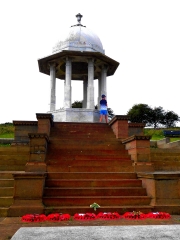
Recently, a friend posted a photograph of a monument that he runs past whilst taking exercise on the South Downs near Hove. This small structure, which looks Indian in design, is what General Misra used to visit on his annual trips to the UK. A few days ago, we visited our friends in Hove and after eating a delicious lunch with them, we drove up on to the Downs near Patcham and walked through a field of well-fed grazing cows to reach a small enclosure containing the Chattri and a monument listing the names of the Hindu and Sikh soldiers who were cremated at this place during WW1.

‘Chattri’ is the Hindustani and Punjabi word for ‘umbrella’. The monument on Holt Hill consists of a small white marble dome supported on eight pillars made of the same material. This stone Chattri stands on a podium with stairs leading up to it from a lower platform on which there are three low granite slabs. The three granite slabs cover the spots where originally there had been three concrete slabs on which the funeral pyres were built and then ignited according to religious tradition. The ‘umbrella’ or ‘chattri’ symbolises, according to a plaque nearby, “the protection offered to the memory of the dead”.

Funded partly by the India Office and Brighton Borough Council, the monument was unveiled by the Prince of Wales in 1921. It was built to the designs of EC Henriques (died 1940, aged 51) a young Indian architect from Bombay. His work was supervised by Sir Samuel Swinton Jacob (1841-1917), an expert in the Indo-Saracenic style of architecture. I have eaten dinner at one of Jacob’s other buildings: Bikaner House, a palace he designed in Mount Abu (Rajasthan), constructed in 1893. Built as a summer palace for a maharajah of Bikaner, it is now a hotel. In January 2020, we ate a poor-quality meal there. We and the other diners sat dressed in padded jackets because the dining room was unheated, and the outside temperature was close to freezing point.

The bases of the eight columns of the Chattri interested me because they bear the same decorative motif seen on the bases of pillars in Hindu temples constructed well before the era of Moslem invasions of India began. The early mosques built in the 15th century in Gujarat (e.g. in Ahmedabad and Champaner), which borrow many structural features of Hindu temples, also contain pillars whose bases are decorated with the same motif seen on the Chattri. The same is true of the capitals of the pillars that support the dome of the Chattri. Also, the domes in those ancient Hindu temples and mediaeval mosques are always supported on eight pillars arranged in an octagon, as is the case at the Chattri.  In brief, the small but elegant Chattri, which looks a little incongruous in West Sussex, would look very much at home in many parts of India.

The Chattri stands high on the South Downs in a pleasingly landscaped garden. It overlooks the surrounding hills and the ribbon of coastal towns including Brighton and Hove, and beyond them the sea. Part of the monument complex is a more recently (2010) erected concrete wall on which are carved the names of the 53 Hindu and Sikh men who were cremated at this spot, as well as their ranks and regiments.

To reach the Chattri, we walked along a path through a field in which cattle were grazing. As I looked at the cows, I thought that most of the Indian men whose lives ended in Brighton and were cremated on the Downs must have often walked amongst cattle in India before they left it to fight in Flanders  for the Empire, which did their fellow countrymen few favours.

During our brief visit to the Chattri, there were a couple of families relaxing around it. Their children were playing cheerfully around the pillars and on its steps, blissfully unaware of what it represented. This did not bother us. We felt that their joy would have been appreciated by the men who sacrificed their lives for the future of families such as these and many others. The wide horizons, the lovely landscape, and the fresh air enveloping the monument, gave the place and its surroundings a special, maybe spiritual, atmosphere, a feeling of the continuum of life and beyond. Who knows, but any of us at the Chattri might possibly be reincarnations of some of the soldiers cremated there.

POSTSCRIPT: INDIAN SOLDIERS ON THE WESTERN FRONT

Many Indian soldiers fought for the British because they believed, or hoped, that by supporting the Empire in its struggle for survival, India would gain at least some autonomy, if not a generous dose of self-rule. In the last years of WW1, even the pacifist Mahatma Gandhi roamed around India encouraging Indians to enrol to fight for the British. Joseph Lelyveld wrote of Gandhi in his book “Great Soul. Mahatma Gandhi and his Struggle with India”:

“He implores wives to send their husbands to sacrifice themselves on behalf of the empire, blithely promising, ‘They will be yours in the next incarnation.’ Fighting for the empire, he now argues, is ‘the straightest way to swaraj’”

The Indian soldiers fought for the empire. Some were killed, others injured, but India did not reach swaraj (i.e. self-government) at the end of WW1. Remember, less than a year after the Great War ended, soldiers commanded by a British general killed at least 379 and wounded over 1000 unarmed Indian civilians in Amritsar in the Punjab, the district of India that supplied many troops to the Western Front and other battlefields. Even Winston Churchill, no lover of India, was genuinely outraged by the horrific nature of this murderous event.

India would have to endure many upheavals and another world war before independence was won.

Start right

MY MOTHER WAS ALWAYS CONCERNED that my sister and I had good shoes when we were children. We used to go to a shoe shop in the Market Place, which is in the heart of Hampstead Garden Suburb, where we lived. It was a store that sold the Start-Rite brand of footwear. What none of us knew in those far-off days was that the company was established in 1792 by James Smith in Norwich. His grandson, James Southall, gave the firm its name.

START RITE

Start-Rite shoes had a good reputation for making sure that shoes it sold fitted the wearers well. I remember having my feet measured both for length and width. The shoes were available in several different widths for each length.  For example, a size four shoe could be obtained in any of five widths, ranging from ‘a’ to e’. Thus, the shop assistant could ‘fine tune’ selecting the correct size shoe to fit a child’s feet. Also, the shoes were durable.

The shop in the Market Place had a machine that I was always dying to try. It was a tall box with two holes at its base and a viewing window at its top. The idea was that a child put on a pair of shoes, and then inserted his or her feet into the two holes. The shop assistant would then push a switch and look into the observation windoe at the top of the box. The machine produced x-rays which passed through the child’s shod feet and onto a fluorescing screen. By observing the image created by the radiation, the assistant could assess how well the shoes fitted. ‘Quel horreur’, you might be thinking if your mind operates in French.

Well, that is what my mother thought. Although not a scientist and having had little education in science, my mother knew very well that radiation was dangerous. After all, she knew all about Hiroshima and Nagasaki. What she might not have known is that the bone marrow cells in children’s skeletons are very sensitive to ionising radiation but being a cautious caring mother, she took no chances. Therefore, I was never able to see the bones of my feet in the device in that or any other shoe shop.

I outgrew Start-Rite shoes long ago. The shoe shop in the Market Place no longer exists, nor are those foot x-ray machines still in use. However, one thing endures. That is my memory of posters advertising Start-Rite shoes, which were pasted on the walls and hoardings of London’s Underground stations. They showed a couple of small children with arms interlinked walking towards infinity along a straight road bordered by fences and rows of trees. I still think that this is one of the most depressing adverts I have ever seen. The captions on the poster are “Children’s shoes have far to go” and “Start-Rite and they’ll walk happily ever after.”

I started ‘rite’ and since then, I  have been walking happily ever after, but cannot erase the depressing image on the poster from my mind.

Water music

I BELIEVE THAT SOUND travels well over water. I do not know if that is scientifically proven, but I like to think that it is the case.

BLOG KENWOOD 2

Yesterday, we visited Kenwood in north London. The neo-classical mansion, remodelled by Robert Adam (1728-1792) and completed in about 1780, contains a superb collection of fine art (the Iveagh Bequest), mostly paintings. Because of the Coronavirus pandemic, Kenwood House was closed, but its extensive grounds were open. Although the official car park was fully occupied, there was no sense of crowding in the grounds.

A wide terrace at the rear of the mansion overlooks a sweeping panorama including a lake at the bottom of the grassy slope that falls away from the terrace. From this vantage point, the viewer can see what looks like a fine bridge with balustrades and three arches at the eastern end of the body of water. However, what meets the eye is not a bridge, but a sham, a trompe-l’oeil, made in wood to produce a picturesque view. It was designed by Robert Adam and constructed in about 1767 and fully restored in the late 20th century.

The bridge has survived the progression of time, but another structure that was a notable feature on the side of the lake furthest from the House has not.  This was an edifice shaped like the quarter of a sphere. Within this shelter, a whole symphony orchestra could be comfortably seated with their instruments. On summer evenings, orchestras used to play music that travelled across the lake to huge audieces seated on the grassy slope leading down to the water.

I used to attend these concerts occasionally during my younger days. They were, as I can recall, often on Saturday evenings. Two kinds of tickets were available. The costlier ones allowed a person to sit on one of the deckchairs arranged in rows on the part of the slope closest to the lake. The cheaper ones permitted holders to sit on the grass above the rows of deckchairs. Many people, who sat on the grass, brought rugs and picnics, which they enjoyed whilst listening to the music. I have never liked sitting on the floor and always preferred to experience the concert in a comfortable deckchair.

It was delightful sitting outside hearing well-performed music whilst the sun set slowly, and the twilight enveloped us all. The acoustics were good, but the first halves of many concerts were subject to the frequent the competition from noisy aeroplanes passing overhead. Usually, by the second half of the performance, there were few interruptions by ‘planes.

When we returned to Kenwood yesterday, the orchestra ‘dome’ was not visible. Where it had been has been replaced by bushes and trees. There is not a trace of it left. It looks as if it had never existed and I worried that maybe my memory had played a trick on me. We stopped a couple of elderly women and asked them about the concerts. They remembered them well and told us that they had been stopped a few years ago because, incredibly, local residents had complained about being disturbed by the noise (and increased traffic) during the few events that occurred each summer.

The lakeside concerts were held every year between 1951 and 2006, the year the English Heritage was forced to put an end to what had been a lovely annual event and an important money-spinner for them. I remember those concerts with fondness and hope that the wealthy inhabitants who live around the area, quite distant from the lake, will one day relent to allow music lovers to enjoy fine music wafting across the water. Well, as often is the case, money has more clout than culture.

Clive in India

I AM NOW IN CALCUTTA. Last time I came here, for miles and miles along the railway lines and at stations, there were starving people. Now there is not a sign of famine – it has been organised with the ability of genius…” 

Thus, wrote Clive Branson (1907-1944) from Bengal on the 11th of November 1944. Later in the same letter, this British soldier in India added:

“… it is reported that in the week ending November 5th, 267 deaths occurred in Chandpur town and in the 53 unions (groups of villages), on an average more than 200 in each. The report states ‘Almost all the dead bodies were thrown into the ‘khal’ and paddy fields – to be devoured by dogs, jackals and vultures – as there was no man available to bury or burn those corpses.”

A few lines later, he adds:

The point is that out in the villages people can starve to death without anyone knowing about it, while on the basis of the falling mortality rate in Calcutta Amery will no doubt claim that the famine is over.”

‘Amery’ to whom Branson referred was Leo Amery (1873-1955), who was Secretary of State for India during WW2. The famine was that which decimated many Indians in Bengal and other parts of India.

clive

Writing on the 28th of August 1943, Branson suggested that the famine was to some large extent man-made rather than the result of natural disasters:

But the fact is there is enough food in India now …”

A major cause of the famine he suggested it was:

“… the hoarders, the big grain merchants, the landlords and the bureaucrats who have engineered the famine …”

And, on the 14th September 1943, Branson wrote:

The thing that stands out a mile is that the Government showed no signs of weakness when it came to the arrest of the Congress in glaring contrast  to its utter helplessness (??) (or should we call it co-operation, tie-up) in the face of the grain profiteers (and in a similar situation – the cloth merchants – the coalowners, re employment of women underground).”

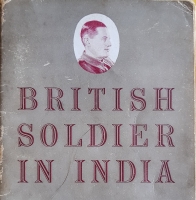
These quotes, damning indictments of the situation Clive Branson observed whilst serving in India come from a book, “British Soldier in India”. It contains the letters that Clive wrote from India to his wife in England and was published in 1944 by ‘The Communist Party, London’. The slender volume contains an introduction written by Harry Pollitt (1890-1960), who was General Secretary of The Communist Party of Great Britain from 1941 to 1956. I came across the book while reading an excellent book about the 1943 Bengal famine, “Churchill’s Secret War” by Madhusree Mukherjee, and ordered a copy.

Clive was born in Ahmednagar (India), son of an army officer. Ironically, most of his time in India during WW2 was spent in the town where he was born. He trained to be a painter at The Slade School of Art (part of University College London) and became a prolific and talented artist. Some of his works are housed in London’s Tate Gallery. From the age of 20, Clive became interested in Communism and joined the Communist Party in 1932. Pollitt wrote of him:

He was one of those who endear themselves to all who came in contact with them … he was able to inspire others to hate poverty and fight to remove it, to hate ugliness and see beauty … He was not only a brilliant speaker and organiser, but also did more than his share of what is sometimes called “the donkey work”. Nothing was too much for him …”

During the Spanish Civil War, Clive both recruited for, and from 1938 fought with, The International Brigade. In March 1938, he was taken prisoner by Franco’s Nationalist forces and interned in San Pedro de Cardeña concentration camp, where he painted and sketched the camp and many of its inmates. These artworks are currently stored in the Marx Memorial Library in London’s Clerkenwell Square. Pollitt reports that a fellow prisoner said of Clive:

In any difficult time, Clive was always cheery, putting forward what we should do … He was one of the most popular and most respected among the British prisoners.”

Clive, a true patriot and ardent anti-fascist, joined the Royal Armoured Corps during WW2 and was posted to India where he arrived in May 1942, the month that he sent his first letter published in the book. Pollitt accurately notes that Clive’s letters from India:

“… will make you angry and they will make you sad. They will make you see new colours and shades, an unimaginable suffering and a truly heroic grandeur, extraordinary nobility and equally extraordinary bestiality. It is a vivid and many-sided picture which Clive wanted to record in painting, and which we may be sure he would have executed with feeling and sincerity...”

Reading Clive’s letters today, 76 years after they were composed, still evoked a sense of anger because of the awful things he saw as well as a sense of wonder because of his very evident love and admiration of India and its people.

Whenever he was able, Clive mixed with Indians from all strata of society and delighted in their company.  While in Ahmednagar, Clive was introduced to an Indian artist. At this person’s house, he:

“… did a drawing for 1½ hours of his little niece aged 10. I did it in indelible pencil and ink – this is the medium I shall do most of my work in as it is more lasting – does not smudge – than ordinary pencil. But how difficult are Indian clothes – I shall have to do a lot of careful observation and drawing before I shall know what to do technically’ The Indian just sat and watched me working. He speaks English quite well, and knows a number of famous Indian painters – he himself went to the Bombay School of Art…”

This was noted in a letter dated 13th of April 1943. Several months later, in mid-September, Clive was invited to lunch with his artist friend. I loved his description of the occasion, which was new to him but typically Indian:

We sat on wooden seats about 2 ins. off the ground. The meal was in a room just off the kitchen. Of course we had taken off our boots etc. Each had a large silver plate with the various ingredients put around the edge. A small bowl of what they call butter-milk took the place of water. A pattern, done with vermilion and white powder had been drawn on the ground. In front of me was placed a little silver stand in which a stick of incense burned. Nana’s elder daughter also ate with us. The whole affair was very civilised and friendly.”

In general, Clive was enamoured of all of the Indians he encountered, both those from sophisticated and also humble backgrounds. He was horrified at the way that the British and their government treated them. This is a significant feature of what he conveyed in his letters. Also, the failure and apparent unwillingness of the British to address the terrible famine concerned and upset him greatly. He communicates this eloquently and powerfully in his writing.

One of Clive’s many observations struck a personal chord. It concerns the bookshops that Clive visited in India in search of reading material. In a letter written from Bombay in September 1942, he noted:

I have said a lot about going to bookshops, but I have never mentioned something which hits you in the face about the general trend of literature: 1. Hitler’s ‘Mein Kampf’ is on sale prominently at every bookstall …”

Seeing copies of “Mein Kampf” openly on sale in most bookshops in India is something that has always surprised me since my first visit to India in 1994.

As a Communist, Clive’s political views are not concealed in his letters. He showed little or no sympathy for the policies of Gandhi and the All India Congress. On the 10th of March 1943, he wrote:

How stupid Gandhi’s fast looks compared to the grandeur of a handful of Indian peasants and workers uniting to demand their human rights!  No wonder the Viceroy corresponds with Gandhi and sends the police after the people.”

As for the Muslim League in Bengal:

The net result of the League’s scheme is to launch the peasants against the little men and leave the big bastards to control the famine via the black market – such is the first practical application of the policy of Jinnah.” (letter dated 19th June 1943)

Also, as a staunch anti-fascist, he regarded Subhas Chandra Bose as contemptible because he had chosen to fight alongside the Japanese, who were allies of fascist Germany. During his stay in India, Clive met and discussed matters with members of the Indian Communist Party. This is described in the letters and was not removed by the censors. In addition, his harsh but justifiable criticism of Britain’s mishandling of the famine in India passed the censors’ scrutiny and reached his wife’s letter box intact.

Clive was constantly upset by seeing examples of British racism in India. He mentions this often in his letters. The most eloquent example appears in a letter written on the 29th of November 1943:

I am sitting on the grass outside a long army hut. Not far away is an African negro … reading a book. Five minutes ago a B.O.R. [British other rank] came up, stopped, and said to him, ‘Can you read?’ ‘Yes.’ ‘What’s the book? Miss Blandish?’ ‘No, Pygmalion.’ I had to record this – whole books could not present the present world situation better.”

(I imagine that the B.O.R. was referring to “ No Orchids for Miss Blandish”, a  raunchy thriller by James Hadley Chase)

In the same letter, Clive noted that the British Conservative MP, Ferris:

“… has made a study of Indian affairs, and has delivered himself of the profound judgement that India is not ready for self-government. I wonder how many whiskies and sodas it took to produce such an original conclusion.”

Sadly, Clive did not live long enough to see India becoming independent in 1947. He was killed in action early in 1944 “…commanding an M3 Lee tank of B Squadron, 25th Dragoons. He was hit a glancing but fatal blow on the back of the head by a Japanese anti-tank shell near Point 315 at the end of the Battle of the Admin Box.” (source: Wikipedia).

Clive’s letters provide a moving collection of well-described observations of India, a country in which many of its citizens were enduring a plight at least as bad as that of people suffering in Nazi occupied Europe. They were under the control of the British, who were fighting to defeat Nazi tyranny. The British were under the leadership of Winston Churchill, who is reported (by his close colleague Leo Amery) to have said:

I hate Indians. They are a beastly people with a beastly religion.”

Here are two short videos well worth watching in connection with what I have written:

https://youtu.be/QI6qg1ERmGE

(Pathé Newsreel with scenes of the famine. Commentary in Punjabi, but images are very powerful)

https://youtu.be/fUjtxHFGUrg

(An Indian historian/author/politician gives a fresh view of Churchill)


Hummus in Hampi (south India)

MANY PEOPLE WILL HAVE EATEN HUMMUS, the chickpea-based dip, but far fewer will be familiar with Hampi, which is the location of an extensive archaeological site in the south Indian state of Karnataka. The village of Hampi contains the fantastic ruins of what was once one of the world’s greatest cities, rivalling Ancient Rome and second in size to Beijing, the world’s largest city in the 16th century. The metropolis, known as ‘Vijayanagara’, now in ruins, was the fabulously prosperous capital of the Vijayanagara Empire, which thrived between about 1336 AD and 1565 AD, when it was defeated by a group of Moslem sultanates. After this, the city began to decay, leaving the spectacular ruins that can be explored by visitors today.

BLOG HAMP 1

The ruins of Vijayanagara lie mainly on one side of the River Tungabadra. They are distributed over a large rocky area rich in huge boulders – almost a lunar landscape. We first visited Hampi in about 1997, when there were relatively few tourists clambering amongst the ruins of temples, palaces, stepwells, and miscellaneous other buildings. Since then, we have visited the place another four times. On each successive visit, we have noticed an increase in fellow visitors, both Indians and foreigners. With the increased visitor footfall, there has been ever growing deterioration and damage to the ruins. This is especially noticeable at the Vitthala Temple. It was intact in 1997, but when we last visited a few years ago, it was in a miserable state, with plenty of damaged carvings and being propped up by ugly pillars of grey concrete blocks. Sad as this is, this is not what I want to dwell on in this piece.

India has become a popular destination for Israelis, particularly the younger ones. India is probably a complete contrast to Israel, which I have never visited. In brief, to Israelis India must seem far more ‘laid back’ than their highly organised country. Many Israeli visitors to India visit Hampi to ‘chill out’ and relax.

During one of our stays in Hampi, we took a walk along one bank of the River Tungabadra. We came across a couple of riverside eateries advertising that they served Israeli food. As it was near lunchtime and our daughter and I love hummus, we entered one of these establishments, whose menu included the chickpea paste that we enjoy so much. Also, I was curious to try hummus in India. It was then not a food item I was expecting to see on sale a few years ago. Now, it is becoming available in select food stores such as branches of the upmarket chain Nature’s Basket.

We sat down on a rickety looking terrace overlooking the river and, with mouths watering, and ordered a portion of hummus with pitta bread. It took quite a while to arrive as the hummus was made fresh whilst we waited. When it arrived, the pitta looked remarkably similar to an Indian chapati, rather than an Arabic or Turkish pitta. As for the hummus, this was disappointing to say the least. Its colour was acceptable, but its texture resembled lumpy rice pudding rather than even the coarsest hummus. As for the taste, there was little to report: it was unseasoned and tasteless. I dread to think  what a direct Israeli guest would have made of, or said about, the hummus we were served at Hampi. I had not the heart to send it back to the charming locals who had produced it, but neither was I hungry enough to finish it.