Examining the past

ON 13th AUGUST 2020, MANY YOUNGSTERS in England received the results of the state’s university admission examinations. This year of plague and social distancing, 2020, the results have not been determined by the students themselves writing examination papers but by a clumsy, somewhat arbitrary, algorithm that takes various factors other than a student’s own ability into account. Things were quite different last year and back in 1970 when I sat the A-Level examinations required for admission to university.

BLOG EXAM

Back then, as now, universities offered places to potential students subject to achieving or exceeding certain grades at A-Level. The place that was my first choice amongst the six universities I chose was University College London (‘UCL’). In ‘my time’, UCL invited potential students for extensive interviewing. I was invited to spend a whole day at the Physiology Department. During that day, I was interviewed at least three times by different people and met both members of the academic staff as well as students already embarked on their courses of study.

Several days later, I received a letter from UCL offering me a place on the BSc course providing I achieved three E grades at A-Level. The top grade at A-Level was A, the lowest pass grade was E. At first, I was not sure whether to be pleased that all I needed was just to pass my three A-Level examinations. Was that the best that they thought I could manage? No, it was not. In those days, if UCL liked a candidate at interview, they took the strain off the candidate by not expecting high grades. Thee Es was normal for most subjects except medicine and dentistry when 3 Cs were required.  These days, candidates to places like UCL would be expected to get 3 A grades or something awfully close to this. Well, having been offered a place subject to my attaining at least 3 E grades and being neurotic by nature, I began to worry. What if I could not manage the three Es?

I became obsessed by examination papers to such an extent that I used to use my father’s typewriter to compose examination questions that I hoped would never appear in front of me in the examination hall. Whether or not composing these impossible questions was a kind of self-therapy or simply an opportunity to enjoy using the typewriter, I cannot tell, but it did me no harm. At the very least, It gave me short breaks in what for me was long hours trying to understand what I was studying.

My three A-Level subjects were Biology, Physical Science (a mixture of chemistry and physics), and mathematics. I found that all of them were most interesting and not too taxing. When I was at school, it was possible to opt to attempt supplementary papers in the subjects chosen for A-Level. These papers were known as ‘S-Levels’ and were designed to test a candidate’s deeper understanding of a subject. I chose to do S-Level papers in biology and mathematics. The biology S-Level paper was enjoyable. I was able to show off what I had learnt from reading around the subject. One of the questions was something to do with discussing the origins of life on earth. Well, in addition to various then current theories I decided to include what is described in the first chapter of the Old Testament. I passed that S-Level. The mathematics S-Level paper was a quite different ‘cup of tea’. Even though I had attended special classes to learn the mathematics that was required, I was stumped. For the first 30 minutes of the three-hour paper, I just stared at the questions. There was not one that I could even begin to tackle. So, after 20 minutes, I walked out of the examination room, leaving a blank script on my desk.

I can remember where I was when I received the A-Level results in August 1970. I was in Italy with my parents and sister on one of our annual visits to that country. We were in Venice, staying, as we always did, at the Pensione La Calcina, where many decades earlier the eminent John Ruskin(1819-1900) used to reside when visiting the island. The establishment’s façade is on the Fondamente Zattere across the water (of the Giudecca Canal) from the famous Santissimo Redentore church (completed 1592) designed by the architect Andrea Palladio.

We had just eaten lunch at the pensione and were taking the air on the waterfront prior to retiring indoors for a siesta when Signorina Steiner, the manageress, came rushing up to us with a telegram. My parents opened it to discover that my aunt in London had sent my A-Level results, which to my great relief were way in excess of the minimum required to gain admission to UCL.

If I had not managed to attain even 3 E grades, I would certainly not have expected to be admitted to any university. I would have had to accept the result and might well have decided to re-sit the examinations a few months later. As far as I am aware, in my day, there was no appealing to have papers re-marked as has become normal in the last twenty or thirty years. During recent times, it is not unusual for someone who is not satisfied with a grade to have his or her examination papers re-marked. Often, the revised grade is higher than the original, but things can go less favourably for the candidate.

This year, when young people have not been able to attend school since March and have not been awarded A-Level grades based on final papers written under strict examination  conditions, they have been awarded grades based largely on statistics (generated by what appears to be a poorly conceived algorithm) rather than individual ability. Many students have been awarded grades well below what they and their teachers expected. Thank heavens that there are appeal procedures in place.

I remember how much of a nail-biting experience it was waiting for my A-Level results back in 1970. This year, it was far worse for candidates. Not only did they not know on what basis their grades would be estimated, but also many of them will have to remain anxious for even longer whilst their appeals are being considered.

A piece of cake

blog cake


EVERYONE HAS WEAKNESSES. One of mine is a liking for coffee and walnut cake. According to Wikipedia, Robert Mullis “stumbled” upon the recipe of this cake whilst studying catering at West Somerset College in 1994. However, I am sure that I first ate this confection long before that date. I remember enjoying slices of this cake while I was working as a dentist in a practice in the small town of Rainham in north Kent.

Just outside Rainham on the road that leads to Sittingbourne (the old A2), there was (and still is) a farm shop called Gore Farm. Its premises included a pleasant dining room where for a modest price you could eat a very fresh tasting ploughman’s lunch that included cheeses made locally. Various cakes were displayed along a shelf in the eating area. These always included a coffee and walnut cake, a slice of which invariably rounded off my luncheons there. As I practised in Rainham between 1982 and 1992, and ate the cake during that period, someone other than Robert Mullis must also have ‘stumbled’ upon its recipe, but before he did. This would not be at all surprising because the cake in question is simply a sponge cake flavoured with coffee and both iced and filled with butter icing and topped with walnut halves.

Does it really matter when the coffee and walnut cake was first created? The answer in ‘no’. The important thing is that it exists to give pleasure to people like me. Today, a friend offered me a slice of it. It was extremely delicious as she had substituted some of the flour with ground almond. It was while savouring this that I wondered about the history of the cake, but so far, I am not entirely satisfied with what little I have discovered. Clearly, the answer might not be a ‘piece of cake’.

What have we come to?

I FIRST MET MY FRIENDS, the brothers, ‘A’ and ‘B’, at the birthday party of another friend ‘C’. This meeting would have been in March 1965. I know this because the celebrations included watching a matinee performance of the film “Goldfinger”, which had been released in the UK a few months before (in September 1964). We saw the film in the now long-since demolished Odeon Cinema in Temple Fortune, which is on the edge of Hampstead Garden Suburb (‘HGS’), where we all lived. Sadly, one of the brothers died a few years ago, but the other two friends are still thriving.

BLOG PUT 3

Mutton Brook

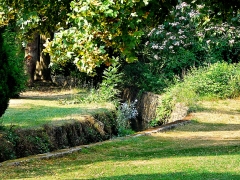
Since the major London ‘lockdown’ ended and we have become more mobile, having acquired a motor car, we have made several visits to HGS to see ‘old haunts’. One of these places is the series of public gardens (Northway Gardens and Littleton Playing Fields) that run along either side of a stream called Mutton Brook (it is a tributary of the River Brent that flows into the Thames at Brentford in Middlesex). The Brook runs parallel to Falloden Way, a stretch of the A1 road. Flanking the road that separates HGS into two sections, there is a shopping area appropriately and unimaginatively called the Market Place. During my childhood, the section of HGS north of Falloden Way was affectionately known as ‘Across the Jordan’ because many Jewish people live(d) there. I suspect that today, there is a fairly equal distribution of Jewish households in both sections of HGS separated by the A1.

My friends, A, B, and C, and I used to visit the gardens alongside Mutton Brook in our spare time. In those days, but not now, the water in Mutton Brook had a rather unpleasant smell (sewage or something rotting). One of the attractions in the gardens was a putting green open to the public. For a small fee it was possible to hire a putting implement (a putter) and a golf ball. The brothers, A and B, were very competitive, and C was less so. The three of them managed to complete the course in a respectably low number of well-aimed shots. By the time I had reached the second hole, the others had putted their balls into all 18 of the holes on the course. What I have never been able to understand is why  when my ball was within inches of a hole, instead of falling into the hole, it spun around the circumference of the mouth of the hole without falling into the target area. Well, I was never skilled at any ball games, but I enjoyed the company of my friends.

Back in the 1960s, I believe that there were no refreshment areas in either Northway Gardens or Littleton Playing Fields. This has changed. There is a charming Café Toulous near one entrance to Northway Gardens and the Café Gaya in Littleton Playing Fields. Today, we sat at a table under trees near the latter and enjoyed drinking coffee in the shade. The ambient temperature was 31 degrees Celsius.  In one direction, we could see the spire of Lutyen’s St Jude on The Hill Church in the heart of HGS and in the other, a nursery school that shares the same building as houses the Gaya.

There were about twenty children’s push chairs (buggies) parked in front of the two-storey nursery. This came as no surprise because the school was in use. What was remarkable was the presence of three hefty looking security men, two in uniform and one in ‘mufti’. Each of these fellows had walkie-talkies and the two in uniform seemed to be wearing protective (bullet-proof?) vests over their jackets. They were keeping a very close watch on the kindergarten and unlocked its front door when ever there was something to be delivered.

After enjoying our drinks, we asked the Eastern-European lady working in the café about the security guards. In not brilliant English with a marked accent, she replied:

“Security”.

Flippantly, I asked:

“Are the kids dangerous?”

Not seeing the joke, she explained:

“Private Jewish school”,

And then added:

“All private Jewish schools have security.”

How sad it is that nowadays, even kindergartens filled with tiny tots are considered to be at risk from attack. This was never the case when my friends and I knocked golf balls around the now non-existent putting green on the bank of Mutton Brook. What have we come to?

Maxim and Ivy: to Russia with love

MEIR HENOCH WALLACH-FINKELSTEIN (1876-1951) is better known as Maxim Maximovich Litvinov. A Bolshevik revolutionary, he became an important Soviet diplomat. In 1930, Stalin appointed him People’s Commissar for Foreign Affairs. Earlier on, shortly after the 1917 Russian Revolution, Maxim was sent to London as the Soviet government’s plenipotentiary representative in Great Britain. While in London, he met and married the writer Ivy (née Low; 1889-1977). I have recently discovered that their lives partially overlapped with mine, not temporally but geographically.

BLOG IVY 5

Ivy was living in London’s Hampstead when she and Maxim were courting. They had met in about 1918 at the home of Dr David Eder (1865-1936), a Zionist socialist and a pioneer of psychoanalysis in Britain. David, whom Ivy regarded as a father figure, and his family lived in Golders Green (actually, in Hampstead Garden Suburb at 103 Hampstead Way, not far from our family home).  According to Ivy’s biographer John Carswell (in his book “The Exile: Ivy Litvinov”):

“Over tea in the Express Dairy in Heath Street where they often met, Ivy helped Maxim to improve his English – throughout her life she adored improving people’s English – and she did more: she guided him in reading English literature.”

Today, the building that used to house the Express Dairy in Heath Street is a branch of the Tesco supermarket empire. However, the building still bears the name ‘Express Dairy’ and the date 1889, the year that Ivy was born.

Ivy’s biographer John Carswell (1918-1997) was the son of one of Ivy’s closest friends, the writer and journalist Catherine Carswell (1879-1946). Ivy met Catherine, a close friend of the writer DH Lawrence who lived in Hampstead, after she had written a favourable review of Ivy’s novel “Growing Pains”, which was published in 1913. Catherine lived in Hampstead at Holly Mount. To be close to her friend, Ivy moved to Hampstead. John, who was born at Hollybush House in Holly Hill, met Ivy several times and has written a good account of her life. It reads well and is extremely informative not only about Ivy but also about her husband.

Ivy and Maxim moved to Russia with their two young children in about 1920 and lived there, with small occasional breaks, until the late 1950s. One of these breaks was when Maxim was appointed Soviet Ambassador to the USA between 1941 and 1943. Her stay in the USSR was also punctuated by short holidays abroad. Living in the USSR, Ivy continued her writing as well as teaching English. Long before he died, Maxim fell out of favour with Stalin and lived in fear of arrest and probable execution. However, he died of natural causes in 1951, just in time to miss Stalin’s last great, but unfulfilled, plan, the anti-Semitic ‘Doctors’ Plot’. On his deathbed, he said to Ivy:

“Englishwoman, go home”.

It was not until 1960 that Ivy did return to England.  But, in 1961, she returned to the USSR, where she remained a pensioned widow until July 1972, when she returned to the UK. She settled in Hove, where she lived the rest of her life. Until her dying day, Ivy wrote, published, and was actively involved with the literary world.

Long before her last visit to England, Ivy had made brief visits. In July 1930, Maxim was appointed People’s Commissar for Foreign Affairs. Soon after his promotion Ivy accompanied him to Geneva. That same winter, the Litvinovs paid a visit to London. John Carswell, then twelve years old, recalled:

“She took me to a Christmas show of which even the name now escapes me; but what is still vivid is the tall, dominating, fur-coated figure sweeping me across the wintry promenade outside the Golders Green Hippodrome, to a torrent of commentary.”

Reading about Carswell’s memory of Ivy taking him to a Christmas show at the Hippodrome reminded me of seeing pantomimes at this same theatre when I was about John’s age or maybe a year or two less. until the mid-1960s, the Hippodrome (built as a 3000-seat music hall in 1913) was a very active repertory theatre, where many plays that would eventually end up in the West End were premiered. In addition to plays, operas and Christmas pantomimes were staged there. In the 1960s, it became a BBC television studio, and lately it has become a venue for Islamic meetings. Like Carswell, I cannot remember what shows I saw there as a child, but I do remember being impressed by the size and fittings (seats arranged in galleries, boxes, and the vast stage) of the Hippodrome. It was as least as impressive as the grandest of West End theatres.

I enjoyed reading Carswell’s biography not only because it provided some insight into what life was like in the Soviet Union during Stalin’s rule but also because it introduced me to the life of an intriguing woman writer whose love for Maxim led her to spend a large part of her life in the USSR. Another thing that appealed to me is that Carswell provided me with new aspects of the history of Hampstead, a part of London which I know well and where I grew up. It is with some reluctance that I will return this enjoyable biography to our local public library.


Hidden in the rocks

MY FASCINATION WITH MILITARY bunkers began after visiting Albania in 1984, when the country was stilled being ruled by the last regime in Europe that still revered Joseph Stalin. Tiny Albania was surrounded by potential enemies, Greece, Yugoslavia, and Italy across the Adriatic. Having had his country invaded many times in the past, Albania’s dictator, Enver Hoxha (who ruled between 1945 and 1985) was determined to make the country as impregnable as possible. One approach that he adopted was to cover (literally) the entire country (towns and villages included) with small (and large) concrete bunkers, many of them were hemispherical in shape. As Albania was never invaded after 1945, the effectiveness of these concrete structures that looked like a severe rash of pimples was never put to the test.

blog cave

Bunker at Torcross

The same can be said of the numerous concrete bunkers that were constructed in many strategic places all over England before and during WW2. Fortunately, the Germans never managed to invade the UK, with the exception of the Channel Islands. Judging by how useless the Maginot Line proved to be in France, I suspect that the British bunkers would have been fairly useless had the Germans invaded.

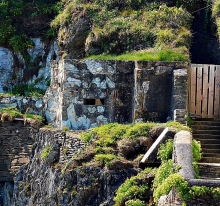
Today, we visited the tiny hamlet of Torcross in south Devon. It lies at the southern end of the long causeway that separates the sea from Slapton Ley, a large freshwater lake. While sitting at an outdoor table on the sea front at Torcross, I was staring at a picturesque rocky outcrop when I noticed what I thought was a rock with a rectangular slit cut in it.

Looking more closely using my camera’s zoom lens, I realised that the slit was really there, but it was cut in something that was not rock, but a thick concrete wall. The wall looked identical in texture to the rocks surrounding it. I realised that what I was looking at is an old bunker that ovelooks the long stretch of Slapton Sands, which is on the sea side of the causeway. It overlooks what would have been a perfect beach for a foreign invasion force to land.

In fact, the stretch of beach known as Slapton Sands was used by an invasion force in 1944. It was not a hostile force belonging to the Axis powers, but a friendly one used by Allied troops. The troops, mostly Americans, were using Slapton Sands to practice or rehearse the planned landings (on D Day) that were about to take place in Normandy as a prelude to recovering Western Europe from German occupation.

As I have described in another post, the rehearsing Allied troops were attacked by German boats, resulting in the tragic deaths of over 700 young Americans. The Germans, based in France, attacked the beach at Slapton Sands because they had picked up very busy radio signal activity in the area. Luckily for the planned invasion of France, the German attackers had no idea of what was being rehearsed at Slapton. Had they known they might well have returned to do even more damage that might have sabotaged the D Day invasion plans.

An amphibious tank, recovered from the sea in 1974, stands at Torcross as a memorial to the men who lost their lives during the German attack of the boats and other military positions at Slapton Sands.

The bunker, which I spotted at Torcross, is known as ‘Pillbox Torcross’. Near to the former Torcross Hotel, this was one of six bunkers at the south end of Slapton Sands. What I thought was concrete is actually local stone (see https://www.heritagegateway.org.uk/Gateway/Results_Single.aspx?uid=MDV39402&resourceID=104).

 Hence, it blends with its surroundings far better than it would have had it been built in concrete. Whether or not this and the other bunkers nearby were of any use when the Germans attacked during the very early hours of the 28th April 1944, I cannot say. However, I feel that given the devastating results of the German attack, this is unlikely.

Today, Torcross is a popular place with visitors. It has several eateries and places to stay. During past visits to this delightful spot, once the scene of a horrible tragedy, we have eaten good seafood at the Start Bay Inn, which is only a few feet away from the tank memorial. The inn was established in the 14th century, when it was known as ‘The Fisherman’s Arms’.

Visiting Torcross provides a good place to reflect on the heroism of those who fought in WW2. Little did those 700 or more men lost in this place in 1944 know that their sacrifice has allowed us to enjoy holidays at this beautiful spot. Whenever I am at Torcross, I have mixed emotions: joy because of the place’s great natural beauty, and sadness when I look at the tank memorial and remember why it is there. Had the D Day landings been thwarted, who knows under what kind of regime we would be living today.

Taking the plunge

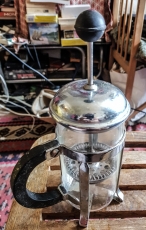
MOST COFFEE DRINKERS will be familiar with the cafetiere or French press (‘caffettiera a stantuffo’ in Italian and ‘Stempelkanne’ in German). The earliest versions of this were patented in the 1920s. For those not familiar with these devices, let me explain how they are used. Coffee grounds and hot water are introduced into an open topped cylindrical vessel, often made in glass but also in metal and plastic. After waiting for the coffee to brew, and people argue how long this should be, a plunger that snugly fits the opening of the vessel is placed on the surface of the hot coffee mixture. The plunger has a metal sieve that does not permit the passage of coffee grounds through it. This plunger is attached to a metal rod, by which pressure can be exerted to drive the sieve through the liquid towards the bottom of the vessel. As it moves downward, the coffee grounds become separated from the liquid (the brewed coffee) above it. Then the coffee, free of grounds, can be served.

BLOG CAF

In the early 1960s, the cafetiere became a fashionable way of preparing and serving coffee. My mother and her sister were quick to buy one for each of their homes. They were elegantly designed with clear glass vessels and shiny steel holders with black handles. And, the coffee they produce is good.

My mother kept using our cafetiere until disaster struck. It did not happen to her but to her brother-in-law. One evening after dinner, my uncle began plunging the filter through the hot coffee when something slipped causing the plunger to descend far too rapidly. As it shot down into the boiling hot coffee, the liquid shot up onto my uncle’s arm and caused him serious burns. Hearing of this unfortunate event, my over-cautious mother decided that far from being useful, the cafetiere was a potentially lethal weapon. So, our cafetiere was decommissioned, never to be used again. My uncle’s family continued to use their cafetiere(s) despite the accident.

Many years later, my wife and I were entertaining guests one evening. My wife had filled a large glass cafetiere with coffee and hot water and told me to plunge the filter whilst she sat down with our friends. Usually when you press the filter plunger into the brew, there is some resistance as the coffee grounds begin the reduce the flow of water through the fine filter mesh. On this occasion, I encountered some resistance as expected but then something unexpected happened. Each time I applied pressure and then released it, the filter disc began rising up towards the opening of the glass vessel. This happened repeatedly and it became increasingly difficult to depress the filter. It seemed as if the coffee was fighting back, pushing the filter plunger upwards.

Eventually, I managed to force the plunger down sufficiently and I served the coffee, somewhat mystified. After the guests had left, I examined our weirdly behaving cafetiere. I removed the plunger and found a deformed stainless-steel spoon amongst the compressed coffee grounds. The formerly straight stem of the spoon had become bent into a ‘U’ shape. I had applied sufficient pressure to the plunger to bend the spoon. I felt as if I had become Uri Geller, famous for his spoon bending tricks. Fortunately, and amazingly, the glass vessel of the cafetiere did not break or even crack.

Breakages are common amongst the glass vessels used in cafetieres. It is not the making of coffee that breaks them but dropping them on hard surfaces does them no good. We now use cafetieres with stainless-steel vessels. Not only do these not break but also many of them have double walls to help keep the coffee warm.

Three towns in Devon

WHEN YOU LEAVE THE A38 road near Buckfastleigh and head southwards, you enter the Devonshire district of South Hams. This picturesque part of southwest England contains three towns that attract many visitors: Dartmouth, Kingsbridge, and Salcombe. Each is located on hilly terrain and has its own distinctive charms. All of them have steep streets that lead to places with great views.

BLOG HAMS 2

Dartmouth, the home of an important large naval college, occupies a position on the estuary of the River Dart. Although it attracts many holidaymakers, it has the feel of a working town. The river is filled with boats, some used by pleasure seekers, and others (including ferry boats and fishing vessels) are working craft.

Salcombe, like Dartmouth, perches on the slopes of the shore of an inlet of the sea. Of the three places mentioned in this essay, it has to win first prize for its setting and attractiveness. I have visited Salcombe both in August (high season) and in May (before the season began). During the high season, the small town is flooded with holidaymakers, day-trippers and those staying in the place (including many owners of second homes). The streets are almost clogged with people. In contrast, when we visited it in May, the tiny town was delightful and relaxing.

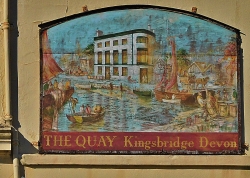
We have just returned from staying in Kingsbridge, which is a few miles up the same inlet as Salcombe. This is, at first sight, the least obviously alluring of the three towns. Hence, it attracts fewer visitors than Dartmouth and Salcombe. However, as you wander around the small streets in the historic centre of the town, its charms reveal themselves to the viewer. The town is rich in buildings from the 18th and early 19th centuries. The Quay, where the tidal inlet meets the town is beautifully landscaped. Visitors tend to congregate here to enjoy paddle-boarding, boating (when the tide is high enough), crab fishing, eating ice cream,and just passing the time of day. Also, the town has several excellent restaurants. Of these, I would single out: The Old Bakery (for well-prepared Mediterranean and Middle-Eastern style food), the Dodbrook Arms (with first-class cod and chips as well as other perfectly prepared dishes), and Woodys, which serves very good locally reared beef. Like Dartmouth, but unlike Salcombe, Kingsbridge gives the feeling of being more than a holiday destination; it is a real working town.

In between the three towns, there are many villages and beaches worthy of exploration. Of the three places, Kingsbridge has become my favourite and we hope to return to it soon to use it as a base to get to better acquainted with South Hams.

A bridge and a king


KINGSBRIDGE IS A SMALL town in South Devon. It lies at the head of an inlet of a ria (a completely submerged river valley) upon which the better-known and more popular resort of Salcombe is also located.

BLOG KING 3

 Many histories of Kingsbridge relate that the town resulted from the union of two neighbouring settlements, the neighbouring royal estates of Alvington and Chillington. Kingsbridge was formed around a bridge (possibly, a draw-bridge) that connected the two at the head of the inlet of the ria. The bridge was built by the 10th century. So far, so good, but today there is no bridge in the town of Kingsbridge.

If you drive from Kingsbridge towards Dartmouth via the A379 road, you will soon arrive at the New Bridge west of the town. This not so new bridge with five arches was built in 1845 and restored several times since then. It crosses Bowcombe Creek, another branch of the ria. This bridge is not, and has never, ben inside the town of Kingsbridge; it is well outside it. It is not, as has been suggested to me by several locals, the bridge that gave the town its name. So, where was the bridge?

By chance, I found a book about the history of Kingsbridge on-line. It is “Kingsbridge and its Surroundings” by SP Fox, published in 1874. This is the only source that I have found so far that mentions the site of the bridge in Kingsbridge. On page 10, the author noted:

“Nearly at the lower end, Fore Street is crossed at angles by Mill Street and Duc’c [now called Duke] Street, the former on the west side, leading to West Alvington and Salcombe; the latter on the east, in the direction of Totnes and Dartmouth, and uniting the towns of Kingsbridge and Dodbrooke by a very small bridge.”

The old bridge mentioned by Fox no longer exists, but the two streets mentioned do. Duke Street, which used to run through from Fore Street to Church Street near to the present Duke of Prussia pub (according to a late 19th century map), is now a cul-de-sac on which you can now find the main entrance to a popular fish and chips shop called ‘The Cod Father’. Mill Street is still a road leading towards West Alvington and Salcombe.

Where Fox describes the bridge, there is no sign of a ditch or stream today. Maybe, long ago there might have been a ditch or stream across which the bridge straddled. At the head of the inlet of the ria in Kingsbridge, there is a small arch, which might be the outlet to a formerly visible stream, which has long since been covered.

To add some complexity to the story, a modern source (https://kingsbridge.gov.uk/wp-content/uploads/2020/01/B13-Kingsbridge_Devon-Historic-Market-and-Coastal-Towns-Survey-Report.pdf) suggested that the bridge after which the town was named was not within the town itself but some way outside it:

“The exact site and function of the bridge is of great interest, as clear documentary evidence for an  Anglo-Saxon bridge in Devon is rare (Henderson and Jervoise 1938, 29; Hoskins 1954, 147), and, in the present context, because the development and character of the town, like its name, can be expected to have been fundamentally linked with that of the bridge and its highway. The attraction and shaping of urban growth to main roads and river crossings is a strong pattern across medieval Devon (Slater 1999). The detailed map analysis for the urban survey indicates that the early bridge may have crossed   the River – between routes later altered to become Love or Boon’s Lane on the west side, and Quay Street on the east – downstream from a tidal ford on the Mill Street-Duke Street route and below the extent of the medieval town…”

So, we cannot be certain of the location of the old bridge.

The coat of arms of Kingsbridge consists of a three-arched bridge surmounted by a royal crown. Whether or not the bridge had three arches is not at all certain, but the fact that it linked two royal estates justifies the presence of the crown. If the bridge was located where Fox believed, there was hardly enough width for a bridge with three arches.

But who was the king? It might well have been King Edgar, ‘The Peaceful’, who reigned from 959 to 975 AD. For, it was during his reign that a charter relating to boundaries dated 962 AD mentions the existence of a ‘king’s bridge’. That could also mean that the bridge was in existence before that king’s reign.

So, regardless of the actual position of the bridge after which Kingsbridge is named, we can be certain that the name is justified as there was a bridge somewhere in or near the town and it had royal connections. Whatever the origin of the name, the town of Kingsbridge is well worth a visit.

A familiar face

THE SCULPTOR ELIZABETH FRINK (1930-1993) was a close friend of my late mother, who was also a sculptor. I do not know how they met at first, but they remained close friends. ‘Liz’ Frink, as I knew her when I was a child, was a regular visitor to our family home in northwest London. After my mother died in 1980, I never saw Liz again. She was born in Suffolk (where one of her pieces stands in the garden of the cathedral of Bury St Edmunds), studied at both Guildford and Chelsea schools of art, and died in Dorset (at Blandford Forum, which is a few miles southwest of Salisbury).

FR 1 BLOG

Walking Madonna

Early in August (2020), we drove from London to Devon via Salisbury. There were two reasons that we chose the less direct route through the city of Salisbury. One was to avoid the motorway system as much as possible and to travel along roads that pass through lovely countryside. The other was to visit Salisbury, especially its cathedral and enclosed environs (the ‘Cathedral Close’). The cathedral, a masterpiece of Gothic architecture built mainly between 1220 and 1320, is worthy of a visit, or as the Michelin “Guides Vert” say in French, ‘vaut le détour’. The splendid architecture was one reason for our latest visit but not the main one. We had come to see an exhibition called “Celebrating 800 Years of Spirit and Endeavour”.

The exhibition consists of 20 works of art, mainly sculptural, displayed within the cathedral and outside it in the Cathedral Close. These works are in addition to the cathedral’s permanent collection of 9 sculptures. My favourites amongst the temporary works were pieces created by: Conrad Shawcross, Danny Lane, Subodh Gupta, Antony Gormley, Tony Cragg, Lynn Chadwick, Daniel Chadwick, and Grayson Perry.

I was intrigued by an electronic sculpture, ‘The Reader’. made in 2015 by an artist named Stanza (born 1962). It depicts a standing man reading a book. The book glows regularly and as it does, LED bulbs in different parts of his body glow for a few moments. The artwork attempts to show, quite successfully, how reading can affect the body and feelings of the reader.

Several of the artworks in the cathedral’s permanent collection particularly impressed me. One of these is a small stone carving by Emily Young, which stands in the cloisters. Also, in the cloisters, there is a large coloured sculpture by Barbara Hepworth, which recalled the works of the Dutch artist Piet Mondrian, a good friend of hers. It is called ‘Construction (Crucifixion’). Generally, I am not enthusiastic about her works, but this one, which is so different from most of her other creations, pleased me greatly.

There is another wonderful part of the permanent collection within the nave of the cathedral. This is a large baptismal font by William Pye. Installed in 2008, this huge vessel is filled to the brim with water which flows from it via four spouts. The surface of the water is perfectly smooth and acts as a mirror in which the architecture of the cathedral is reflected beautifully. It is truly a reflective piece in more than one sense of the adjective.

Outside the cathedral, there is a fine stone carving in white marble, ‘Angels Harmony’, by Helaine Blumenfeld. To me, it seemed to depict drapes being blown around in the wind. I liked this, but what really caught my eye was a rather dreary looking cast bronze sculpture, ‘Walking Madonna’. This life-size piece was made in 1981 by ‘our’ former family friend Liz Frink. At first, I glanced at it quickly, and then, for no special reason, I took a closer look. I experienced a strange feeling of ‘déja vu’ when I looked at the Madonna’s face. For a moment, I felt as if I was looking at Liz Frink’s face. As mentioned already, it is over 40 years since I last saw her. Yet, I had the feeling that I recognised her face. I have since learned that Frink often included her long jawline in the faces she sculpted, but it was not that which gave me the fleeting feeling of recognition. Instead, it was the nose and mouth on the depiction of the Madonna that sparked that momentary sensation that I was looking into Frink’s face. I have since compared photographs of the sculptor with those I took of the work on the lawns outside the cathedral. Comparing them, one cannot entirely rule out the possibility that Liz Frink was influenced by her own face when creating the ‘Walking Madonna’.

Whether or not Frink intended her sculpture to include her own face is up to the viewer, but in any case, I can strongly recommend a visit to Salisbury Cathedral before the enjoyable sculpture exhibition is dismantled.

Career tracking

LIKE MANY OTHER YOUNG BOYS, the idea of being a train driver appealed to me. I am pretty certain that my parents would not have been ecstatic had I ended up in the driving cab of a railway train. Once my father told me that he did not mind what I studied or what profession I took up eventually, so long as it was not economics (he was a professor of economics). He had no need to be concerned about that, as what I could gather about economics made it sound unappealing to me. So, what did I consider after my urge to drive trains diminished?

tracks

From an early age, I used to spend much of my spare time drawing and painting, pursuits encouraged by my mother, who was an accomplished, but lesser known (and not self-promoting) painter and sculptress. In addition, in my early teens, I began to develop an interest in ‘modern’ architects including Le Corbusier, Mies Van der Rohe, and Frank Lloyd Wright. I read books about them and the idea of studying architecture, to become an architect, entered my head. My hope was to create structures as beautiful and innovative as those, which I had read about. After a year or so, I was walking back to school from our dining hall when I was struck by a depressing thought. If I studied architecture for the required seven or so years, there was a good chance that I would not be undertaking major, exciting projects like those which had made my architectural heroes famous. Instead, I might very well have ended up designing loft rooms, domestic garages, garden room extensions, and similar important but mundane structures. This thought dampened my enthusiasm to pursue architecture as a profession.

My next idea was to become a schoolteacher like those who taught me at my secondary school. I am incredibly pleased that this idea was short-lived because over the years the conditions that many schoolteachers have had to endure have deteriorated continuously.

My father, now long retired, was a university teacher (he became a senior professor at the London School of Economics). From my young vantage point, his lifestyle looked good. Despite working hard, which he did, he had lovely colleagues and many pleasant students as well as long holidays. His profession appealed to me and set me on the path of pursuing studies which I hoped would lead to an academic career. After completing my BSc, I worked on a research topic that led to me being awarded a PhD.

As I reached the completion of my doctoral work, two things began to worry me. One was that none the other British-based workers in the field that I was working (connective tissue physiology), whom I met at conferences and seminars, seemed like people with whom I would enjoy working. The prospects for obtaining post-doctoral work abroad were not good, and at that time I had no yearning to live outside the UK.  Another thing that worried me, which I only realised after I left research, was that it was a lonely pursuit.

To cut a long story short, I began studying dentistry. I had an idea that with a clinical qualification, a wider range of research possibilities would become available to me. However, I discovered during the clinical dentistry course that I enjoyed working with people, members of the public, who were willing to risk their teeth in the hands of students. So, when I qualified as a dentist, instead of going back into research and academia, I began working as a practising dentist. I did this for 35 years with varying degrees of enjoyment and satisfaction. Overall, it was a valuable life experience for me, as I hope that it was for my patients.

I have been retired for over two years now and love it. Jokingly, I often tell friends that my main reason for going to work was to retire eventually. But there is an element of truth in this.  Even now, so many decades since my childhood, I still enjoy railways and rail travel. I have not yet completely lost that juvenile desire to drive a train. Maybe someday, I might get to ‘have a go’ at the controls of a train. I have heard that these days drivers of London’s Underground trains make quite a good living. The money would be satisfactory but,  more importantly, the thrill of controlling the train would be a fine reward.

Have you, dear readers, been satisfied with the tracks along which your working lives have travelled?