A poet to the rescue

PERCY BYSSHE SHELLEY (1792-1822), the poet, was a friend of the literary critic and essayist James Henry Leigh Hunt (1784-1859), who lived at various times in Hampstead, north London. Shelley’s poetry and other writing attracted the attention of radical thinkers including, for example, Karl Marx, who wrote:

“The real difference between Byron and Shelley is this: those who understand them and love them rejoice that Byron died at 36, because if he had lived he would have become a reactionary bourgeois. They grieve that Shelley died at 29, because he was essentially a revolutionist and he would always have been one of the advanced guard of socialism.” (https://www.marxists.org/archive/eleanor-marx/1888/04/shelley-socialism.htm)

Hunt, who knew him well, wrote of the poet:

“Shelley was not only anxious for the good of mankind in general. We have seen what he proposed on the subject of Reform in Parliament, and he was always very desirous of the national welfare.”

I mention this about Shelley because it chimes with what is to follow.

The Vale of Health, Hampstead, north London

A few months ago, I acquired a copy of Leigh Hunt’s wordy but fascinating autobiography. After being released from a spell in prison in 1815 having libelled the Prince Regent, the future King George IV, Hunt moved to the Vale of Health in Hampstead. Shelley often used to visit Hunt there, sometimes staying at his home for several days. Hunt wrote that Shelley:

“… delighted in the natural broken ground, and in the fresh air of the place … Here also he swam his paper boats on the ponds, and delighted to play with my children…”

Hunt was returning to his home in the Vale of Health one evening after having been to the opera when he heard a woman shrieking and a man’s voice coming from within his house. The woman’s voice was that of a lady, whom Shelley had found lying:

“… near the top of the hill, in fits. It was a fierce winter night, with snow upon the ground; and winter loses nothing of its fierceness in Hampstead. My friend, always the promptest and the most pitying on these occasions, knocked on the first house he could reach, in order to have the woman taken in.”

Shelley’s request was turned down. Hunt continued:

“The poor woman was in convulsions; her son, a young man, lamenting over her. At last my friend sees a carriage driving up to a house at a little distance. The knock is given; the warm door opens; servants and lights pour forth…”

And Shelley asks for help employing the voice:

“… which anybody might recognise for that of the highest gentleman as well as of an interesting individual …”

He relates his story to the elderly gentleman emerging from his carriage and asks whether he will go and see the distressed female. The passenger replies:

“No, sir; there’s no necessity for that sort of thing, depend on it. Impostors swarm everywhere: the thing cannot be done; sir, your conduct is extraordinary.”

To which Shelley replied to the astonishment of the man who refused to provide assistance:

“Sir, I am very sorry to say that your conduct is not extraordinary; and if my own seems to amaze you, I will tell you something that will amaze you a little more, and I hope will frighten you. It is such men as you who madden the spirits and the patience of the poor and wretched; and if ever a convulsion comes in this country (which is very probable), recollect what I tell you: – you will have your house, that you refuse to put the miserable woman into, burnt over your head.”

By ‘convulsion’ Shelley meant revolution, something that England did not suffer as had France or later Russia and elsewhere. Leigh’s reporting of what Shelley said may help to show that whatever Marx saw in his writings was in harmony with his own ideas.

As for the poor woman, she was:

“… brought to our house, which was at some distance, and down a bleak path (it was in the Vale of Health); and Shelley and her son were obliged to hold her till the doctor could arrive.”

In case you are wondering how the woman got into such a sad state, Hunt informs us:

“It appeared that she had been attending this son in London, on a criminal charge made against him, the agitation of which had thrown her into fits on her return. The doctor said that she would have perished, had she laid there a short time longer.”

Now, I am no reader of poetry. I find that I enjoy it more if it is read to me. Further, I must confess that I am unfamiliar with Shelley’s works, but this story related by Hunt, has begun to endear the poet to me. Shelley not only met Hunt in Hampstead but also in Italy on the 1st of July 1822, where they, along with Lord Byron, made plans to start a new journal “The Liberal”. On the 8th of July, Shelley died at sea when the boat he was travelling in sunk.

The writing on the wall

WE USED TO DRIVE to France during the early 1960s when I was a child and before the M2 motorway was in use. The first part of the drive was from London to Dover and prior to the opening of the M2, it was a slow journey because the main road went through numerous small towns in Kent instead of bypassing them, which the M2 does. To break the tedium of the lengthy drive, I used to count how many Esso filling stations we passed as well as the number of Fremlin signs along the road. I liked the name Fremlin, but in my childhood, I was unaware that this was the name of a brewery based in Maidstone (Kent) and founded in 1861. It is a long time since I passed the time on journeys by counting signs such as Esso and Fremlins, whose name appealed to me. Recently, we drove through the centre of Hertford (in Hertfordshire) and I spotted several buildings bearing a name that intrigued me because we have friends with the same name (as surname). The name is McMullen and it, like Fremlins, is the name of a brewery.

Peter McMullen (1791-1881), the son of a Scottish nurseryman, founded his first brewery at Railway Street in Hertford in 1827. It was his wife’s idea. She suggested that it would be better to open a brewery rather than to continue his hitherto rather unsatisfactory life poaching and undertaking failed apprenticeships (www.mcmullens.co.uk/about-us/our-history).  Given that the first railway station opened in Hertford in 1843 (www.hertford.net/history/railway.php), Railway Street must have had another name when the brewery was established. The business was expanded in 1860 by his sons Alexander and Osmond McMullen, when they took over the brewery. They bought some other breweries and opened several pubs run by tenants. By 1910, McMullen was one of 1284 brewing companies that were in business in the UK. By the 21st century, it was one of the 38 of these that remains.  Now in 2021, it is run by the sixth generation of Peter McMullen’s family (https://en.wikipedia.org/wiki/McMullen%27s_Brewery).

One of the first beers brewed by Mcmullen, which has been available since 1833, was Mcmullen AK. This and several other brews are cask ales. The company also produces bottled beers including McMullen Hertford Castle, which is named after Hertford Castle, where Queen Elizabeth I visited frequently during both her childhood and her reign. The castle still exists: the remains of an early motte; Norman encircling walls; the so-called Gatehouse, built by Henry VIII; and other more recent additions. Incidentally, the Castle was the home of The East India Company College between 1805 and 1809, which then moved to Hailey, also in Hertforshire. The college’s presence in Hertford was before McMullen began producing beer in the town.

The company produce an IPA (Indian Pale Ale), suitable for exporting to tropical climes, but I do not know whether this was ever shipped out to India. The company’s history relates:

“The McMullen relationship with IPA can be traced back to the 1800’s when Peter McMullen recorded the brewing of an East India Pale Ale with connotations of the brew being commissioned to quench the thirst of the British Army at the East India Company College originally in Hertford.” (www.mcmullens.co.uk/blog/2019/04/mcmullen-rebranding#.YJKaSrVKhPY)

Well, you do not have to travel as far as India to sample beer brewed by McMullen. It can be drunk in pubs in the English counties of Hertfordshire, Essex, Buckinghamshire, Kent, Middlesex, Berkshire, Bedfordshire, and more (www.mcmullens.co.uk/our-locals).

After seeing the name of our friends prominently displayed on buildings in Hertford, I rang them and asked them whether they are related to the brewing family. As far as they know, they are not, but they did tell me that there used to be a pub near where they live in north London, which did serve McMullen’s beers, but sadly that has now gone out of business.

Next time, we visit the charming town of Hertford, one of the things I plan to do, which I have not yet done, is to sample some of McMullen’s beer or maybe beers.

PS: One building prominently bearing the name McMullen in Hertford was part of a former seed merchants, A McMullen, established by a brother of Peter Mc Mullen.

Adam’s brother and Jane Austen

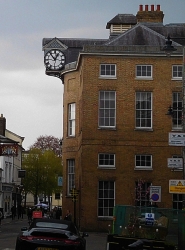
IRRIGATED BY MANY STREAMS, branches of several rivers, notably the Lea and the Beane, the town of Hertford is the county town of Hertfordshire in eastern England. Some parts of this historic place with its numerous water-filled channels recalled distant memories of Brugge (Bruges) in Belgium but the architecture differs considerably from what one sees in the Belgian city. We made our very first visit to Hertford on the 2nd of May 2021 and were surprised by its richness in old buildings and waterside parklands. Amongst the edifices in the historic centre of the town, we came across a well-restored brick building on Fore Street. It, the massive though elegant Shire Hall, now the home of a Crown Court, dwarfs its neighbours. Apart from its size and elegance, its architect attracted my interest.

Shire Hall, Hertford

In 1627, a Sessions House was constructed on the site of the present Shire Hall following the issue of a charter by King Charles I (https://historicengland.org.uk/listing/the-list/list-entry/1268930). By the mid-18th century, it was considered to be too small. An Act of Parliament issued in 1768 during the reign of King George III led to raising money to build a new shire hall. The specifications were sent out to various architects, and amongst the six short-listed were the now very famous Robert Adam (1728-1792) and his far less well-known younger brother James Adam (1732-1794). The new structure was to incorporate:

“…2 courts, a room for the Corporation of Hertford, and both with and without a County Room.”

 The Adam’s brothers won the contract to carry out the above along with the addition of a previously unspecified Assembly Room.

James Adams took charge of the project, which commenced in April 1769 and was completed in April 1771. The arcaded ground floor was used by the Corn Exchange until 1849, after which date a separate edifice for the Corn Exchange was built in 1857-58 on Fore Street. James Adam built far fewer buildings than his better-known brother Robert. James and Robert, both born in Kircaldy (Scotland), started their architectural practice in London in 1758. Not only did they design buildings but also, they provided detailed designs for their interior decoration and furnishings; they provided what could be described as a ‘holistic’ design service. James collaborated with Robert on several other projects apart from the Shire Hall in Hertford. These include the now mostly demolished Adelphi buildings near London’s Strand and Wedderburn Castle in Berwickshire.

The Assembly Room in the Shire Hall, which was used for concerts and theatrical performances, is supposed to have inspired Jane Austen (1775-1817) when she was writing her novel “Pride and Prejudice”, part of which is set in the fictional ‘Merytown’, which she might have based on Hertford. The Assembly Room featured as the ballroom in Austen’s novel (http://wardtimes.info/hertfordshire/east-herts/hertford/news/what-now-shire-hall-hertford). Here is a little extract from Chapter 3 of the book:

“An invitation to dinner was soon afterwards dispatched; and already had Mrs. Bennet planned the courses that were to do credit to her housekeeping, when an answer arrived which deferred it all. Mr. Bingley was obliged to be in town the following day, and, consequently, unable to accept the honour of their invitation, etc. Mrs. Bennet was quite disconcerted. She could not imagine what business he could have in town so soon after his arrival in Hertfordshire; and she began to fear that he might be always flying about from one place to another, and never settled at Netherfield as he ought to be. Lady Lucas quieted her fears a little by starting the idea of his being gone to London only to get a large party for the ball; and a report soon followed that Mr. Bingley was to bring twelve ladies and seven gentlemen with him to the assembly. The girls grieved over such a number of ladies, but were comforted the day before the ball by hearing, that instead of twelve he brought only six with him from London—his five sisters and a cousin. And when the party entered the assembly room it consisted of only five altogether—Mr. Bingley, his two sisters, the husband of the eldest, and another young man.”

The above-mentioned assembly room was that in the Hertfordshire town of Meryton to which the wealthy Mr Bingley had recently arrived from the north of England.  Although the Assembly Room, mentioned in the novel, is thought to be that in the building designed by the Adam brothers in Hertford, at least one authority identifies Meryton not with Hertford but instead with nearby Ware (http://wp.lancs.ac.uk/dighum/2016/12/01/mapping-pride-and-prejudice/). Yet another informant felt:

“Re-reading Pride and Prejudice, I have to say that Meryton bears a strong resemblance to Hertford. But it also feels remarkably like Harpenden. And what about Ware?” (https://www.greatbritishlife.co.uk/people/finding-jane-austen-s-hertfordshire-7217568).

Stepping aside from the identification of the fictional Meryton in “Pride and Prejudice”, I must not forget to mention the large clock attached to the Shire Hall, which projects over Fore Street. Supplied by the Hertford bell founder and clockmaker John Briant (1749-1829), this clock with two faces was erected on the Shire Hall in 1824. It still works and now has a mechanism regulated by a radio signal from Rugby (www.hertford.gov.uk/town-clocks/).

Apart from the Adelphi, which I have seen several times, but until now did not know it was associated with James Adam, the Shire Hall is the first building of which I was aware of James’s hand in its design. I noticed that a plaque attached to this building makes no mention of Robert Adam but only of his brother. It reads:

“Shire Hall. Designed by James Adam. Built 1769-1771”

I do not know whether one can conclude from this that James’s contribution to its design was considerably greater than that of his brother, if he had any involvement at all. In any case, the large structure has a magnificent presence in amongst the smaller and often older buildings amongst which it stands.

Come up and see my etchings

THE TOWER OF BABEL greeted anyone who climbed the staircase at my childhood home in Hampstead Garden Suburb. Well, actually it was a large engraving of the tower as imagined by Dolf Rieser (1898-1983). Dolf, who was born in King Williams Town in South Africa, was related to my mother’s grandmother Hedwig Ginsberg (née Rieser). My mother and Dolf were cousins. Even though they lived not far from us in north London, I saw little of Dolf and his family until about 1976 when I began studying dentistry. It was then that my uncle Sven, married to my mother’s sister, and his daughter told me that they were about to join the printmaking classes that Dolf held in his studio above his home in Sumatra Road, West Hampstead. As I liked drawing and painting, I signed up as well. The three of us attended the weekly evening classes that Dolf held on Tuesdays. Out of a class of on average six to eight students, three of us and the teacher were all closely related.

At the top of the stairs leading to the studio, there was a small colourful image created by the artist who is now very famous. It was a gift to Dolf given by the artist when both were living in Paris in the 1920s and 1930s. Dolf, who had studied biology in Switzerland and was awarded a PhD in 1922 (https://dolfrieser.com/), began studying art in Munich in 1923, and then moved to Paris to study print-making in Atelier 17, the studio of the great surrealist painter and etcher Stanley Hayter (1901-1988) and the engraver Jozef Hecht (1891-1951).

In the compulsory half hour tea breaks during the classes, we used to sit with Dolf whilst he regaled us with tales about his life in Paris during the 1920s and 1930s. Every winter, he used to go to Switzerland to ski. He used to enter the railway station carrying his wooden skis, and Parisians would stop him to ask what they were. For, in those days, it might surprise you to learn, the average Frenchman was unfamiliar with skiing. Dolf used to visit the Café Les Deux Magots in the Saint-Germain-des-Prés district of Paris, where he would enjoy the company of other artists. He told us that he often saw Pablo Picasso there, sitting at one of the tables. Dolf said that being a junior and relatively unknown artist at the time, he had to sit at a table near to Picasso’s, which was reserved for the ‘upper echelon’ of the artists community in the city. I cannot recall all that he told us, but much of it was both informative and highly entertaining, if not always entirely suitable for polite company. One bit of French that I learned from him during these entertaining intervals in the class was ‘poule de luxe’, which you can look up for yourself.

Dolf’s lofty studio had several large tables where we worked on our copper and zinc plates. At one end of the studio there was a raised platform, a gallery, on which there was a couch or bed.  The tables were surrounded with a great assortment of stuff, both works of art by Dolf and the plethora of materials and equipment need to make prints, not only on paper but also on plastic and silk, techniques he developed. There was a table with large shallow trays containing nitric acid in which plates of zinc prepared for etching were bathed. The acid in the trays was of variable concentration, unknown even to Dolf, who used to periodically chuck in unmeasured dollops of concentrated acid from brown glass Winchester bottles whenever he felt (rather than knowing for sure) it might be necessary. Often, he did not tell us when he was about to strengthen the liquid. This could prove difficult if someone were trying to make small delicate adjustments to his or her zinc plate. Occasionally, one or other of us would shout, dismayed:

“Oh, Dolf, you didn’t say you were adding acid. Now, see: the acid has eaten deeper than I was expecting.”

But the ever-ingenious Dolf usually always had a way of remedying what looked to be disastrous at first sight. Today, I doubt that the studio would have passed health and safety rules. There were no extractor fans above the acid baths to remove the toxic fumes emitted when a plate was in the acid. This did not bother any of us.

One end of the studio near the acid baths was dominated by a large, hand operated printing press. The etched or engraved plate was placed on a soft woollen cloth, after having been inked up. A sheet of damp paper was placed over the plate, and this was covered by another cloth. Then, Dolf or one of us turned the large wheel that drove the plate between a pair of metal rollers that applied high pressure to the dampened paper, driving it into the ink-filled grooves on the etched or hand-engraved plates.  When Dolf turned the large wheel, always moving his body rhythmically, he often used to say in Swiss German:

“Aber die Bewegung is immer die glierchen,” meaning ‘but the movement is always the same’.

This referred to a slightly lewd joke he often told us. It went like this. Two Swiss peasants come to Zurich, where they decided to employ the services of a prostitute for the first time in their lives. To save money, they agreed that only one of them should pay for the experience. When the chosen one had finished with the prostitute, he joined his friend, who asked him how it was. The other fellow replied that it was quite pleasant, adding: “Aber die Bewegung is immer die glierchen.”

Printing was always a messy business. To remove the ink from one’s hands, we used a petroleum-based jelly often used by motor mechanics, which Dolf kept in his studio. Removing the ink from one’s hands was easier than removing the lacquer that was painted on to zinc plates to prevent acid from reaching parts that were not to be etched. To explain, a zinc plate is covered with lacquer, which is then removed with tools of varying sharpness to expose parts of the plates which the artist requires to be etched.  This is of course an oversimplification. Dolf who was very inventive showed us many other techniques for producing etched plates. It is likely that his early training in science helped him to develop interesting new ways in printmaking. Dolf maintained an interest in science, as is exemplified by his book “Art and Science”, published in 1972. Its opening words are:

“Art and science are generally considered totally different disciplines. The aim of this book is to draw attention to some of the qualities they share.”

Dolf was a superb teacher. Although the students in our classes were of mixed ability, he brought out the best in each and every one of us. I found that he was particularly good on critiquing composition. The compositions and ideas embodied in his own creations were mostly superb. He used to look at one’s work, immediately understand what we were trying to achieve, and to nudge us gently and constructively in such a way that we ended up with what we were hoping to produce and express.

Once, he held an exhibition of our, his students’, work in his studio and asked us to invite our friends. At the end of the evening, Dolf had sold several of his own prints, but none of us managed to sell any that we had created. Dolf told us off, saying that none of us had worked hard enough, if at all, on getting our friends to buy our works.

After Dolf’s wife died, he continued the classes, but used to be reluctant to see us leave at the end of the evening. I liked Dolf so much that I was always sad when the classes came to an end. However, after he became a widower, we used to follow the classes by walking with him to a Turkish restaurant nearby in Willesden, where we all enjoyed a late supper with him.

The last time I saw Dolf was when he was lying in a hospital bed near the end of his life. Even in hospital, he was in reasonably high spirits, telling his visitors stories and jokes. His house in Sumatra Road still stands. I do not know whether his wonderful studio is still being used to create works of art, but it is with Dolf and his students that I will remember it.

Finally, having read the above, I hope that you will not get the wrong idea when I invite you to “come up and see my etchings”. Many years ago, a young lady did accept this invitation when I made it; she is now my wife.

A bridge across the River Thames and a personal loss

JUST UNDER A YEAR AGO, we visited Cookham in Berkshire, a small town on the River Thames, with our friend ‘H’. I first met H and her widowed mother in about 1975 at the home of some dear friends, my PhD supervisor and his wife. My wife and I used to see H about once a year until about 1999 at the home of our mutual friends. Then, we lost touch. A few years ago, H and I reconnected via social media and we kept promising that we should meet up again. It was only in about July 2020 during a relaxation of the covid19 regulations that we finally met face to face. Our meeting was in Cookham, where we enjoyed an exhibition at the small Stanley Spencer Art Gallery. After having coffee together – it was the first time that H had been to drink coffee outside her home since mid-March, we walked through the rain to Cookham Bridge and crossed it, admiring the lovely views of the Thames.

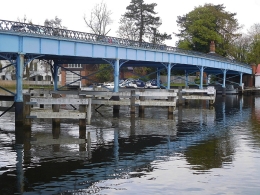
Cookham Bridge

The roadway on Cookham Bridge is so narrow that traffic must be regulated by signals at both ends of the crossing. These signals allow traffic to flow in single file in one direction for a few minutes, and then in the other. While we walked across the bridge, I noted its lovely decorative iron railings, which can be seen in a painting, “Swan Upping at Cookham” (www.tate.org.uk/art/artworks/spencer-swan-upping-at-cookham-t00525), painted in 1915-19 by Cookham’s famous artist Stanley Spencer (1891-1959).

It was not until April 2021 that we revisited Cookham with some friends and walked along the Thames Path, which passes under Cookham Bridge. It was then that I noticed what we had not seen with H: the interesting Victorian ironwork structure supporting the crossing. A sign screwed onto one of the pontic’s metal panels reads: “Pease, Hutchinson, & Co. 1867. Engineers & iron Manufacturers. Skerne Iron Works. Darlington”. The Skerne Iron Works were:

“…run by a Quaker partnership trading as Pease, Hutchinson and Ledward. The Skerne company built its reputation upon plates for ships, boilers, and particularly bridge building, and at its peak employed 1,000 workers.” (www.gracesguide.co.uk/Pease,_Hutchinson_and_Co)

The iron bridge, supported by pairs of slender iron beams (filled with concrete) with cross-bracing rods, was opened in 1867 to replace an earlier wooden bridge that was opened in 1840. The existing bridge was when it was constructed the cheapest bridge across the Thames for its size (https://en.wikipedia.org/wiki/Cookham_Bridge). Until 1947, it was a privately owned bridge for which users needed to pay a toll. It was owned by the Cookham Bridge Company. In 1947, Berkshire County Council bought the bridge, and the toll was abolished. An octagonal house still stands next to the bridge across the river from Cookham. It is the early 19th century toll house built in 1839 by a Mr Freebody (https://heritageportal.buckinghamshire.gov.uk/Monument/MBC19500).

At the Cookham side of the bridge stands The Ferry pub, close to where there used to be a ferry across the river. This old, half-timbered inn, now a mid-priced eatery, has a lovely terrace by the river, from which the bridge can be viewed as well as the waterways leading downstream to Cookham weir and the lock that bypasses it.

Recently, a close relative of H contacted me. He had found my details in the address book in H’s computer. It came as a shock to learn from him that H had passed away suddenly a few weeks ago. When we had last seen her late last year, she was looking hale and hearty. Apparently, one Saturday, she began feeling extremely unwell and on the following day she expired. We were terribly upset because we got on so well with her and were planning outings with her once the covid19 socialising restrictions were eased. They were relaxed but not in time for us to be able to see H again. As we drove through Cookham on our most recent visit, we kept seeing places that reminded us of our meeting with her last summer.

Our friend with whom we crossed Cookham Bridge last year has crossed from this world into another, where I hope that she will be reunited with her parents, our mutual friends, who introduced her to me and then later to my wife, as well as Sir Geoffrey Howe and Elspeth, his wife, with whom she worked happily for many years. H will be sorely missed.

Bacon and a village in eastern England

OUR DETAILED ROAD atlas – yes, we are still using one of these in preference to ‘GPS’ – marks ‘churches of interest’. One of these is at Little Dunmow in Essex and was labelled ‘priory church’. As we were nearby, we made a small detour to the tiny village of Little Dunmow and found the superb gothic structure standing near some small modern dwellings. As is frequently the case, the church was locked up, but someone suggested that if we asked the lady who lived in one of the nearby houses, she would most likely open it for us. We knocked on her front door and a neighbour looked into her back garden, only to discover that she was not at home. Another of her neighbours suggested that she might be out walking her dog. We saw several ladies out walking with their dogs, and the third one we asked happened to be the one with the key to the church. She opened the church for us, and we had a good look around its interior.

The Flitch Chair at Little Dunmow, Essex

The church of St Mary in Little Dunmow is all that remains of what was once a huge priory church. In fact, it is what was once the Lady Chapel on the south side of the chancel. The rest of the church and the Augustinian Priory, to which it was attached, was demolished in the 16th century following the passing of the Suppression of Religious Houses Act 1535 during the reign of King Henry VIII. Some of the great area that was once occupied by the priory and its large church now contains the village’s extensive cemetery.

The Augustinian Priory of St Mary the Virgin was founded by Geoffrey Baynard in 1106 (https://www.british-history.ac.uk/rchme/essex/vol1/pp175-180). In 1086, at the time of the Domesday Book, Geoffrey was “immediate lord over the peasants after the Conquest, who paid tax to the tenant-in-chief” (https://opendomesday.org/name/geoffrey-baynard/) in various parts of East Anglia including Essex. The parish church of Little Dunmow, whose remains we see today, was established by Geoffrey’s mother Lady Juga Baynard (https://www.magnacartabarons.info/index.php/the-towns-and-villages/little-dunmow-essex/), two years before the formation of the priory.

The north wall of the existing church was the south arcade of the chancel of the former priory church. The arches through which one could have passed from the Lady Chapel into the now demolished church have been filled in with masonry, but the original supports of the arches remain intact. The south wall of the current parish church has four large gothic windows and on the eastern wall another, which allow a great deal of light to suffuse the church. Probably, these date from 1360 when the chapel was, according the architectural historian Nikolaus Pevsner writing in his Essex volume of “The Buildings of England”, opulently remodelled. The red brick bell tower at the western end of the edifice was added in 1872 and Pevsner describes it as being “… a silly NW turret.”

The church’s well-lit interior has a wonderfully spacious feel beneath its ceiling lined with simple dark timber beams. Apart from enjoying the place in its entirety, several features attracted my interest. Two alabaster effigies, a man and his wife lying down with carved animals at their feet, commemorate Walter Fitzwalter (died 1432) and his wife Elizabeth (née Chideock, died 1464). Walter was the grandson of Robert Fitzwalter (1247-1346), First Baron Fitzwalter. And, more interestingly, Robert’s father, Robert Fitzwalter (died 1235), feudal baron of Little Dunmow, was one of the barons who opposed King John and made sure that he adhered to what was contained in the Magna Carta, which he signed in 1215. A modern plaque on the eastern wall of the church honours his memory.

The pair of effigies are located next to the north wall of the church, west of an alabaster effigy of a now unknown woman, also located next to the wall.  Information in the church suggests that she might have been the mother of Walter Fitzwalter, or Matilda, the daughter of Robert, the Third Baron, or even Maid Marion of Robin Hood fame.

Another curious feature within the church is a wooden chair with carvings made in the 15th century, using wood with 13th century carvings. This, the Dunmow Flitch Chair, is a unique piece of furniture. Its seat is wide enough to comfortably seat two adults. It was used during the so-called ‘Flitch Trials”, which still take place in Great Dunmow every four years:

“The ancient Flitch of bacon custom rewarded a couple who had been married in church and remained ‘unregreted’ for a year and a day, with a flitch of bacon. The claimants had to swear an oath kneeling on two sharp pointed stones in the churchyard. They were then carried through the village to be acclaimed.” (www.magnacartabarons.info/index.php/the-towns-and-villages/little-dunmow-essex/)

A flitch of bacon is a side of bacon (half a pig cut lengthwise). The trials were held at the priory church in Little Dunmow until 1750, and were later revived in the 19th century following the publishing in 1854 of “The Flitch of Bacon”, a novel written by William Harrison Ainsworth (1805-1882). In the preface to his story, the author hints at the origin of the tradition:

“”Among the jocular tenures of England, none have been more talked of than the Bacon of Dunmow.” So says Grose, and truly. The Dunmow Flitch has passed into a proverb. It is referred to by Chaucer in a manner which proves that allusion to it was as intelligible in his day as it would be in our own. The origin of the memorable Custom, hitherto enveloped in some obscurity, will have found fully explained in the course of this veracious history. Instituted by a Fitzwalter in the early part of the Thirteenth Century, the Custom continued in force till the middle of the Eighteenth—the date of the following Tale.”

According to the novel, the couple attempting to win the flitch of bacon had to came to the priory church at Little Dunmow, where they were subjected to a trial with witnesses, jury, and judges, to assess whether their marriage had been without blemish for a year and a day. On arrival at the priory church, Ainsworth related, the couple:

“… kneel down on the self-same spot, and on the self-same stones, where, more than four centuries ago, Reginald Fitzwalter and his wife knelt when they craved a blessing from the good prior. Benedicite! fond pair! Ye deserve holy priest’s blessing as well as those who have knelt there before you. Bow down your gentle heads as the reverend man bends over you, and murmurs a prayer for your welfare. All who hear him breathe a heartfelt response. Now ye may look up. He is about to recite the Oath, and ye must pronounce it after him. The Oath is uttered.”

Having been awarded the flitch, we learn that:

“All is not over yet. Ye have to be placed in the antique chair, and, according to usage, borne on men’s shoulders round the boundaries of the old Priory, which in the days of your predecessors stood hereabouts. And see! the chair is brought out for you. It is decked with rich though faded tapestry, woven with armorial bearings, which ye must know well, since they are your own, and with a device, which each of you may apply to the other—Toujours Fidèle.”

Well, our road atlas marked the church at Little Dunmow as being “of interest”, and having visited it, we can assure you that it is of very great interest.

An artist, an architect, and a baboon in north London

THE PAINTER GEORGE ROMNEY (1734-1802) moved to Hampstead in north London for health reasons near the end of the 18th century. His home on Holly Hill, originally named ‘Prospect House’ because of the views over London that could be seen from it, still stands today, even thouh it has been altered since Romney occupied it. During 1792, he made frequent visits to Hampstead and the following year he decided to move to the suburbs north of London. In June of that year, he took lodgings at a place he called ‘Pineapple Place’ near Kilburn. Dissatisfied with his Kilburn abode, and having been persuaded that it would be better to buy an existing building rather than to build from scratch, he bought the house on Holly Hill, an old house and its stables, in 1796. It is this building that bears a plaque commemorating his residence there. The Holly Hill house contained his studio, which was completed after the artist had spent £500 on alterations to his new home. While the alterations were being carried out, Romney lived in a building called The Mount on Heath Street, so the informative historian Barratt reveals in Volume 2 of his encyclopaedic history of Hampstead.

Romney’s house in Hampstead, London

The works that Romney had paid for resulted in the creation of:

“…strange new studio and dwelling-house … an odd and whimsical structure in which there was nothing like domestic arrangements. It had a very extensive picture and statue gallery …”

Barratt continues:

“At last Romney got rid of the builders and decorators, and all his town treasures —paintings, casts, statues, canvases, and what not—scores of cart-loads of them—were deposited in the new house and gallery, and the painter began to think that his higher aims were about to be attained.”

But this was not to be. His health failed and in January 1799, he shut up his Hampstead abode and travelled to Kendal. He returned to Holly Hill briefly but returned to Kendal after the 28th of April. He died in Kendal. His house in Hampstead was sold and by 1808, it contained ‘Assembly Rooms’ and three years later it became home to ‘The Constitutional Club’. Barratt revealed that the rooms in Romney’s house were:

“…For sixty years these rooms were practically the Town Hall of Hampstead and the centre of the town’s municipal life. The Hampstead Literary and Scientific Society, formed about 1833, met here, and many learned men at its invitation gave lectures in the rooms …”

In 1807, soon after Romney left Hampstead, the stables attached to his house became part of the nearby Hollybush Pub, after having been used as the catering wing for the Assembly Rooms (https://historicengland.org.uk/listing/the-list/list-entry/1379069).

Lord Ronald Sutherland Gower, author of “George Romney” published in 1904, wrote of FRomney’s Hampstead dwelling:

“…externally the building, which is covered over with a kind of wooden boarding, has the appearance of a large stable; but within are some remains of the great gallery in which the artist placed his collection of casts, and handsome columns decorate this room; it is now a Conservative Club, and appears to be well attended by the residents of that portion of Hampstead. As a living house it must have been supremely uncomfortable; and one no longer has the advantage of the view over London from the upper windows from which Romney loved to look out and watch the distant dome of St. Paul’s lying in the Thames Valley below; the great city has crept up and around Holly Bush Hill, and crowded out the prospect which gave the great painter almost the last solace in his melancholy decline of life.”

Recently, I wrote an essay (see https://adam-yamey-writes.com/2021/04/29/artists-in-hampstead-londons-montmartre/) about some artists who lived in Hampstead and mentioned George Romney. Someone who read it wrote to me and reminded me that Romney’s former home was also the abode of another artist, the Welsh born architect Sir Bertram Clough Williams-Ellis (1883-1978), most famous for his creation of Portmeiron in western Wales. At about the same time as my correspondent mentioned Williams-Ellis, I found a copy of the architect’s autobiography, “The Architect Errant”, in a disused telephone box, now being used as a book exchange, in Madingley, Cambridgeshire. Although I have not yet read the whole book, I have found what he wrote about his time living in Romney’s former home in Holly Hill. He bought this building in 1929 and redesigned it considerably.

Clough left Chelsea for Hampstead.  He wrote of Hampstead and its proximity to the Heath:“It was this love of spaciousness that had propelled me first from South Eaton Place … to Hampstead where the desire for bracing air, a garden, and good schools for the children, were factors determining our choice.

From the edge of a plateau high above the dome of St Pauls we looked southwards from George Romney’s old house across the maze of London …”

The autobiography provided a description of Romney’s house as it was when Clough lived there:

“The fine old house, much altered and adapted to our curious habits, being far too large either for our needs or means, was proportionately delightful to inhabit, and with two ex-billiard rooms (it was once a club) at the disposal of the children, its size had compensations.”

Referring to Romney’s picture gallery, Clough added:

“For myself I had taken the immense old picture gallery as my studio, and I did not hesitate to play up to the magnanimity of its proportions in my embellishments … my wife was surprised and a little shocked at my choosing to work in what she not unjustly called my ‘ballroom’…”

He noted that Romney’s former home was “… splendid for large parties…”, and he held many of them. For example, Clough hosted:

“… dances every so often, a show by Ballet Rambert, David Low drawing large cartoons and selling them for charity. We also gave a party to meet the Russian Ambassador, M Maisky, who made a speech from the gallery balcony …”

The balcony can be seen clearly in a photograph on the RIBA website (www.architecture.com/image-library/RIBApix/image-information/poster/romneys-house-hollybush-hill-hampstead-london-romneys-studio/posterid/RIBA71050.html).

Ivan Mikhailovich Maisky (1884-1975) was the Soviet Ambassador to the Court of St James from 1932 until 1943. Unfortunately, the party referred to above does not get a mention in Maisky’s diary (as edited by Gabriel Gorodetsky), which is perhaps not surprising in view of the huge number of events an ambassador is obliged to attend. A year before Maisky became the ambassador:

“… Clough Williams-Ellis, went to the Soviet Union. His wife, Amabel, a children’s author with strong Communist sympathies, had been an earlier visitor and she contrived an invitation for her husband …” (https://radar.brookes.ac.uk/radar/file/dcce31a4-4cef-4e89-a90c-9dd76c950c42/1/fulltext.pdf).

Rather oddly, Clough does not mention this trip in his autobiography.

Clough wrote that the South African-born scientist Sir Solly Zuckerman (1904-1993), who was studying primate behaviour:

“… wished one of his research baboons on us, as he wanted to study its reactions to ‘bright, intelligent young society’. He was then writing his rather ambiguously entitled book “The Sexual Life of Primates” – so Betsy had quarters on the flat roof at the top of the house for several months.”

The book referred to above was probably “The Social Life of Monkeys and Apes”, published in 1932. Betsy’s stay in Romney’s old house was not entirely successful. It was not:

“… the social success that we had hoped, unresponsive and dirty, we bade our little lodger farewell without regrets. The experience may have been good for Betsy, but I don’t think our children benefitted markedly from the association.”

Clough and his family left Hampstead for Wales at the outset of WW2, keeping a London ‘pied-a-terre’ in Carlton Mews, now demolished. His and Romney’s house in Holly Hill, an edifice altered for Romney by Samuel Bunce (died 1802), has since been used as the studio for an architect’s firm, Hancock Associates, in the 1970s (information from Beth Portwood) and other purposes. In 2012, the architect’s firm ‘6a’ worked on the building to modernise its interior and restore it to a single family dwelling as it had been when Romney acquired it (www.6a.co.uk/projects/more/romneys-house).

The house stands amongst a small cluster of buildings near Fenton House and this charming ensemble makes me think that externally little has changed since these houses were built in the 18th century.