
Being busy as a bee
Is very tiring
But less rewarding


Being busy as a bee
Is very tiring
But less rewarding

Many years ago when we vere on holiday in India, we visited a historic Hindu temple complex in the State of Karnataka.
When we left the enclosure containing the amazing temples with thier intricate stone carvings, we were approached by a little boy, who could have been no more than ten years old. He wanted to sell us some quite attractive miniature elephants carved in stone. Out of politeness, rather than curiosity, we asked the price.
“200 rupees,” he said.
We told him that we did not want the carvings.
“100 rupees,” he said, hopefully.
“We don’t want them, thanks,” we said.
“50 rupees?”
“Really, no thanks”
“25 rupees?”
“Really, no”
“10 rupees?”
We tried to make it clear that we did not want the carvings at any price.
“Have them for nothing,” the little boy offered.
We still did not take them. I often wonder what would have happened next, had we accepted his three elephants as a free gift.

Does it not drive you mad when in the middle of doing something using the Internet, there is an ‘outage’ during which the Internet service signal becomes disconnected and you become unable to access the Internet?
My service provider is BTinternet, which is usually satisfactory for months on end. Then, out of the blue for a few hours or even a few days, there is either no connection with the Internet or irritating short bursts of connectivity punctuated by frustrating breaks in the service.
In the past, I have rung the BTinternet helpline. Their polite operators make all kinds of suggestions about what can be done with my equipment to improve the service. They also test the line carrying the Internet signal. This is always in perfect condition, so they say. However, even after doing what has been suggested (including installing brand-new routers) and sometimes after an engineer has come to look at our connection, the problem persists, only to correct itself after a few hours or days.
It seems to me that BTinternet is trying to shift the blame on breaks in their service onto me and my equipment. They never admit what I suspect to be the case, namely, that there is a failure in their provision of the broadband service. Having looked at postings on Twitter and the interesting downdetector.co.uk website, it seems that when I am having problems, which BTinternet ascribe to my end of the Internet connection, so are many other people! If BTinternet is correct about faulty equipment at the receiving end, it seems a strange coincidence that so many users’ equipment should go faulty at the same moment.

Lying high and dry
The tide is far out
Fishing boats rest on the strand

While I was studying to become a dentist, I took advantage of an optional fortnight shadowing anaesthetists. It was not a hands-on experience, but it was totally fascinating watching anaesthetists keeping patients healthy whilst they were deeply anaesthetised.
One day during a morning coffee break, I was sitting having refreshments with a senior anaesthetist and his team. Suddenly, I heard a shrill prolonged sound coming from a nearby room. I asked a technician what it was. He told me not to worry about it.
A few moments later, the senior anaesthetist asked me:
“What is that high pitched noise?”
“Oh, it’s nothing to worry about, ” I answered confidently.
“Really?” I was asked.
“Oh, yes. there’s absolutely no need to be concerned,” I advised the senior anaesthetist.
If it had been fashionable at that time, I might have told him to ‘chill’, but in those days chilling was reserved for cold weather and refrigeration.
“Hmmmm,” he replied.
After a few moments, he said to me:
“Well, actually that signal is the warning sound made by an oxygen cyinder that is about to become empty. I would really worry about it, young man.”
At that moment, I felt like a complete idiot and hoped that the ground would open up and swallow me.

He stands wash’d by waves,
Surveying horizons:
Lost in the sea of time
Sculpture is “Another Time” at Margate (Kent) by Antony Gormley

Pidgin English is a simplified, often colourful, form of the English language used by some people for whom English is not their mother tongue. The various forms of Pidgin English, and there are many, are typically mixed with the speaker’s native language. Well, for many years, I did not know that. I must admit that this was a symptom of my ignorance. Also, when people referred to ‘Pidgin’ English, I used to think that they were talking about ‘pigeon’ English, which in my ignorance I believed to be English as spoken by someone who knows as little of English as, for example, pigeons. True, people who speak Pidgin probably know less English than fully fluent English speakers, but they know a great deal more about English than pigeons.
I used to visit Italy often during my youth and early adult years. During this period, I picked up a smattering of Italian. I knew enough to have simple conversations with Italians. Although my Italian was mostly ungrammatical, people could make some sense of what I was trying to communicate.
Once, I was travelling through Italy on a train, having a chat with an Italian passenger. He praised my Italian, probably out of politeness and because I was making an effort to speak in his language. Modestly, I told him that I was speaking ‘pigeon’ Italian, when what I really meant, without knowing it, that I wanted to say I was speaking ‘pidgin’ Italian.
I said:
“Parlo italiano come un piccione” (Meaning: ‘I speak Italian like a pigeon’).
The person I was talking to looked at me as if I was mad. And, he was right to do so, because of my ignorance of the difference between ‘pidgin’ and ‘pigeon’.
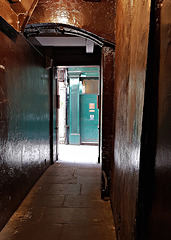
The City of London, the traditional business district of London that stands on the site of the old walled London of Roman and mediaeval times, is full of delightful surprises. Although much of the area was destroyed by the Great Fire in 1666 and the aerial bombing in the 1940s, what has persisted to a remarkable through the ages is the mediaeval street layout.
Another charming feature are the narrow alleyways that pass between or even through buildings. Step through some of these, and suddenly you find yourself stepping back into history.
Recently, we ‘discovered’ Ball Court, which leads south from Cornhill just a few yards west of the Church of St Michaels Cornhill. A narrow alley leads beneath a building to a wider courtyard open to the sky. Two sides of this rectangular space are occupied by Simpsons Tavern, a pub (and chop house) established in 1757. Ball Court itself is even older than the tavern, appearing on a map dated 1746.
I can not tell you why Ball Court has that name, but I feel sure that there must have been a good reason, but it had no name on the 1746 map. In any case, when in London, leave the main streets, explore, and enjoy!
I say serviette
You say napkin
Does it make so much difference ?

I say pavement
You say sidewalk
The mighty Atlantic divides us

There was a young receptionist at one of the dental surgeries where I once worked. Let us call her ‘M’. Engaging her in conversation was not easy, but I tried often and succeeded occasionally.
Once, M announced that she was taking a week’s holiday. When she returned, I asked her:
“How was your holiday?”
“Ok,” M replied vaguely.
“And, where did you go?” I asked.
“I don’t know.”
“Really?” I queried.
“I just got a last minute package trip and got in the ‘plane,” she told me.
“If you don’t know where you went, what was it like?” I asked.
“Not very exciting, really. All of the beaches were covered with black rocks and stones.”
I guessed that M had probably been to one of the volcanic islands in the Atlantic. It surprised me that someone could take a flight somewhere and have no idea where she had landed. What if something awful had happened to her? Who would have known where she was?
 yamey
yamey 