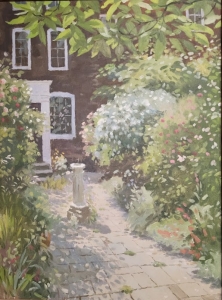
DONALD CHISHOLM TOWNER (1903-1985) was born in Eastbourne, where there is now a gallery named after his great-uncle (John Chisholm Turner), and studied art first at Eastbourne School of Art, and then at London’s Royal College of Art. After graduation, Donald first took a studio at Mornington Crescent. Later, he moved to Hampstead, first residing at Holly Hill, and then in Church Row, where he lived for 50 years.
Currently, Burgh House in Hampstead is hosting an exhibition of Towner’s artworks, which is called “Amongst the Trees and Terraces: Donald Towner (1903-1985) and will continue until 13 December 2026. The exhibition includes one painting of St Pauls Cathedral surrounded by bombed buildings during WW2. Almost all of the other pictures have scenes of Hampstead as their subjects, and were painted in his studio in Church Row. Mostly painted in pale colours, they are all pleasing to the eye. Pleasant as it is, I would not rate Towner’s work nearly as highly as that of his friend (and fellow student), the artist Eric Ravilious (1903-1942). Whereas Ravilious was adventurous in his compositional technique, Towner was more conventional.
Towner was not only a painter, but also a connoisseur and collector of ceramics. He began collecting after the end of WW2, and published several books about ceramics. At the same time, he continued painting until the end of his life.
The exhibition at Burgh House is small but well-laid out in the Marie-Louise von Motesiczky Gallery. One large painting, not in that room, hangs in the reception area, and should not be missed. We saw the exhibition because we were meeting friends in Burgh House’s café. I am not sure that if one does not have an interest in Hampstead, or happen to be visiting the area, that I would make a special journey to see the exhibition.
EVERY TIME I VISIT Hampstead, I feel pleasant twinges of nostalgia not only because I was brought up in the area but also because of my associations with the place after childhood. One place, which still exists, and has done so since it first opened in 1963, is Louis Patisserie on Heath Street. Originally, its shop sign bore the words “Louis Hungarian Patisserie” because it had been established by a Hungarian called Louis Permayer.
Sometime in 1970 or maybe the following year, I took a young lady, who is now my wife, to Hampstead on our ‘first date’. We had a genteel afternoon rendezvous at Louis. My wife remembers that she had coffee, and that it had been served with a separate bowl containing freshly whipped cream. Back in those days and for many years afterwards, Louis, with its wood-panelled walls, seemed to me to have a ‘touch of class’ as well as being evocative of Central Europe. The cakes and other baked items they used to sell were all good quality versions of what you might expect to find in a ‘Konditorei’ in Vienna or a ‘Cukrászda’ in Budapest.
Today (the 26th of February 2024), it was windy and extremely cold when we got off the bus in Hampstead. For old time’s sake, we entered Louis to warm up with hot beverages. Louis has long since changed hands, but the wood-panelling and several other original features still remain. However neither the hot beverages nor the patisserie items were of the same high quality as they used to be long ago. There are now other places in Hampstead where both the coffee and the food are superior to what is available at Louis, but none of these places bring back happy memories.
High on the end wall of the sitting area within Louis, there is a large, framed painting of a pond with buildings along one side of it. These are reflected in the water. In the foreground, three figures are depicted fishing with rods. The picture is painted with muted colours, or, possibly, the colours have faded since it was completed. Despite having visited Louis on numerous occasions, I had never looked at the painting properly until today. At the lower left corner of the painting, there is the artist’s name and a date:
“… Towner was born at Eastbourne and studied at Eastbourne and Brighton schools of art and at the Royal College of Art under William Rothenstein 1923-1927. He moved to Hampstead in 1927 where he lived until his death and produced many paintings of the area and residents. D.C. Towner showed at the RA, Burgh House, NEAC etc.”
William Rothenstein (1872-1945), mentioned above, lived in Hampstead between 1902 and 1912, but by the time he taught Towner he was living elsewhere. It is unlikely that Towner lived in Hampstead because of Rothenstein. It was more likely that he chose the area because it was already favoured by many other artists.
Although DC Towner is not one of the greatest of the artists who lived and worked in Hampstead, his family name has related to the arts in another way – possibly better known than for his paintings. When his father, Alderman John Chisholm Towner of Eastbourne, died in 1920, he left 22 paintings and £6000 for the establishment of a public art gallery. Rehoused in a new gallery opened in 2009, the Towner Gallery still exists in Eastbourne. We visited it in its beautifully designed new home in 2019.
As the picture in Louis was painted in 1972, we would not have seen it on our ‘first date’. I do not know when it was purchased or acquired by the owner of the café. Who knows, but maybe the artist used to enjoy ‘Kaffee und Kuchen’ in the place where I took my future wife out one afternoon long ago.
PS: If you wish to see another of Towner’s paintings in Hampstead, you should visit the Lady Chapel of St John’s Parish Church in Church Row. In it, you can see Towner’s depiction of Church Row, where he lived, and his self-portrait – he used a mirror image of his own face for the Christ in this painting. The picture in the church was created to commemorate the artist’s mother, Grace Towner (1862-1949), who lived in Church Row and was buried nearby in St John’s cemetery.