
Enjoyable and healthy,
Highly satisfactory:
Grill’d veg, of course


Enjoyable and healthy,
Highly satisfactory:
Grill’d veg, of course
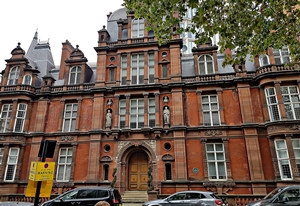
Caxton Hall is close to major London landmarks such as Westminster Abbey, the Houses of Parliament, St James Park, and Buckingham Palace. Yet, it is hidden away in Caxton Street, not only from the casual visitor but also from the attention of contemporary London life. However, this has not always been the case.
Built as Westminster’s Town Hall in 1878-82, it was designed by the architects W Lee and FJ Smith. Its architectural style has been described as an “Ambitious but coarse essay in Francois I style”.[1] It is distinctive looking building that attracts the eye.
The Town Hall contained two large public spaces known as the Great and York Halls[2]. Prior to the 1930s, these halls were used for a variety of gatherings including political meetings. Between 1933 and 1979, Caxton Hall became a registry office where weddings (often of celebrities) were held.
In 1900, the first Pan African Conference was held in Caxton Hall. From February 1906, it was the venue for meetings of The Women’s Social and Political Union, which was founded in 1903 by Emmeline Pankhurst, a fighter for women’s suffrage. Being close to the Houses of Parliament, Caxton Hall was a convenient place for the women to gather before their regular marches to the home of Parliament.
On the 1st of July 1909, Sir William Hutt Curzon Wyllie was shot dead at the Imperial Institute in South Kensington by an Indian nationalist, Madan Lal Dhinghra, from the Punjab. On the 5th of July[3], four days after the assassination, many Indians gathered at Caxton Hall to condemn the actions of Madan Lal Dhingra. Although most of those attending supported the motion “ that those present at the meeting and all the communities of Indians both in India and Great Britain express horror and condemnation of the murders of Curzon Wyllie …”, there was at least one person who opposed it as this extract from my book “Ideas, Bombs, and Bullets” describes:
“When the Chairman announced that the resolution had been passed unanimously, Veer Savarkar, who was in the audience, shouted:
“No, not all!”
Thereupon, mayhem broke out. People were filled with fear as many of them knew Veer’s connections with revolution and bomb-making . Many shouted that he should be thrown out and a few chairs were brandished angrily. A Mr Edward Palmer[4], of mixed British and Indian ancestry, took it upon himself to:
“… plant a truly British blow between the eyes of Savarkar who had raised a chair to fell me… ”
Tirumal Acharya, who helped to defend Veer from further attacks by Palmer, first thrashed Palmer and then began helping his friend get away from the hall . Before this, VVS Aiyar had threatened Palmer with a gun, but Veer winked at him to restrain him . A few days later, Virendranath Chattopadhyaya, who was unable to attend the meeting, wrote to the London Times, saying that if he had been present, he would have supported Veer’s objection even at the risk of being thrown out . He added that although he objected to the resolution and believed in the right to express one’s own opinion, he did not consider that assassination and anarchism was the right way to achieve the independence of his country.”
For those who do not know, Veer Savarkar (VD Savarkar: 1883-1966) has assumed great importance in today’s India. He was a prolific writer, an Indian nationalist and freedom fighter, and helped formulate the concept/philosophy of Hindutva, which is part of the foundation of Hindu Nationalism.
Although Savarkar did not remain in the UK for much longer after this meeting, seeing Caxton House, now converted to luxury dwellings, and knowing its connections with those people I have researched in some detail sends a shiver down my spine.
“IDEAS, BOMBS, and BULLETS”
by Adam YAMEY
is available from:
Amazon, bookdepository.com, lulu.com, and Kindle
Notes to the text of the blog:
[1] https://historicengland.org.uk/listing/the-list/list-entry/1357266
[2] https://en.wikipedia.org/wiki/Caxton_Hall
[3] Much detail from Times (London) 6 July 1909
[4] Edward Palmer was of mixed Indian and British descent. Maybe, it was he who founded Veeraswamy’s Restaurant in London in the 1920s (see: https://erenow.net/biographies/white-mughals-love-and-betrayal-in-eighteenth-century-india/1.php, and https://www.historic-uk.com/CultureUK/The-British-Curry/, both accessed 15 June 2019)

Almost exactly nine years ago our middle-aged Saab automobile developed a fatal error. To repair it, we would have had to pay more than our car was worth. As our vehicle had other problems likely to occur, we sold our Saab to a scrap dealer. Living in the centre of London meant that we used our car usually not more than twice a month. So, we decided to start life without a car of our own. We felt it would be more sensible to use public transport, cabs, and to rent a car when we wanted one for trips away from London.
On one occasion, we were going to make a trip to north Yorkshire. We hired a car from an office based at Heathrow Airport. When I arrived at the office, I expressed a preference for a diesel model. The only diesel-fuelled car available was a large Vauxhall estate car. As it was offered to me at the same price as a smaller petrol-driven car, I hired it.
I crossed the small car park to where ‘my’ vehicle was parked and entered the Vauxhall. By the way, did you know that the Russian word for railway station is вокзал (‘voksal’) and is derived from London’s ‘Vauxhall’ (see: https://londonist.com/2015/10/vokzal). I digress. I sat down in the driver’s seat, and turned the ignition key. A lamp on the dashboard indicated that the handbrake was active. But where was the hand brake? There was no lever to operate as in many other cars. Then I remembered that some Mercedes had a handbrake release near the foot pedals (see: https://adam-yamey-writes.com/2018/11/19/its-enough-to-drive-you-around-the-benz/ ). I looked around the foot pedal area, but saw nothing other than the foot pedals – no handbrake release mechanism. I turned off the car’s engine, and walked back to the car hire office.
Sheepishly, I entered and approached the charming young ladies sitting behind the counter.
“How can I help you sir,” I was asked.
“I know this sounds silly, but I cannot figure out how the handbrake works.”
“Oh that’s simple, sir”, came the reply, “There’s a small button on the armrest close to the gear change stick. By pushing that you can operate the handbrake.”
I returned to the car and found the small button, square and not much larger than a face of a dice.
It is amazing that car hire companies are happy to rent customers almost brand new cars without leaving an instruction manual or providing essential advice. In another article I will describe another incident of renting a car without having been given essential instructions. Watch this space!
Picture source: http://www.daraz.com.bd
A special Indian edition of my book “IDEAS, BOMBS, and BULLETS”, about Indian freedom fighters in London (1905-10) is now available at an economical price for readers wanting ,to buy a copy in India…
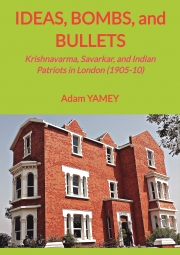
I have already written elsewhere (click HERE ) that I recently published a book about the activities of Indian freedom fighters in London between 1905 and 1910. They were led at first by Shyamji Krishnavarma, who was born in Kutch (now in Gujarat), and then by Vinayak Damodar Savarkar, who later developed the idea of Hindutva.
My book, “IDEAS, BOMBS, and BULLETS” is available on Amazon, bookdepository.com, and lulu.com These online stores are the best way of buying my book IF YOU LIVE OUTSIDE INDIA. Using these stores to order the book in India attracts a huge postal charge. So, I have produced an Indian edition of my book, which IF ORDERED IN INDIA attracts a very modest postal charge. To order the Indian version click: https://pothi.com/pothi/book/adam-yamey-ideas-bombs-and-bullets .
Please note that if you use this link to order my Indian version to be sent outside India, you will…
View original post 29 more words
Eight spindly legs
But oft it inspires fear and angst:
The helpful spider

Now, here is a saying from Madagascar:
“Words are like the spider’s web: a shelter for the clever ones and a trap for the not-so-clever.”
Source: https://bijlmakers.com/spiders/spider-proverbs-and-quotes/

In a previous blog (see: https://adam-yamey-writes.com/2019/01/15/hitler-on-the-shelf/ ), I have written about the prevalence of copies of Hitler’s Mein Kampf in bookshops all over India. Here is an article I wrote a few years ago about a book about Hitler aimed at Indian children.
I was browsing the shelves in Gangaram’s Bookshop in Bangalore (India) when I found a book about Hitler, which was published in 2007 (ISBN: 9788131002520). It is part of a series called “Biographies of Great Personalities”, aimed at younger Indian readers . The garishly covered book caught my eye in that large well-known bookshop in Bangalore. When I flicked through it, I noticed that it was illustrated with line drawings, many of which showed Adolf Hitler in Indian settings with palm trees. At 40 Rupees (less than half a Pound Sterling), I could not resist buying the 93 page book.
The author, Igen B, is a prolific writer. He has published well over 70 short books including biographies of personalities as diverse as Jesus Christ, Bhagat Singh, Mother Teresa, Ashoka the Great, Chhatrapati Shivaji, Shakuntala, and Netaji Chandra Bose. As well as these he has written versions of great Indian classics such as the Vedas, the incarnations of Lord Vishnu, and the Mahabharata. That these books are probably aimed at children is evident from the format and appearance of the books and also the fact that one of his titles is “Illustrated Model Book of School Essay etc.” Therefore, his potential audience is the innocent and impressionable younger mind. This should be remembered whilst paging through his children’s biography of Adolf Hitler.
More than half of the text is dedicated to Hitler’s childhood about which not much is known in detail, his career as an artist, and his rise to power. The author of this book, Igen B, blames a disturbed childhood in a dysfunctional family for much of what Hitler was to become. The future dictator’s disillusionment with the lack of German national pride and his disappointment with the country’s leadership during WW1 were, according to this book, also important formative factors. As, are also the Jews: unquestioningly, Igen B repeats the kind of dangerous nonsense about the Jews that Hitler and many Germans believed.
Having gained power, we learn of Hitler’s campaign to relieve the Jews of any role in public life, and his hatred of the communists. We also learn of his desire to tear up the Treaty of Versailles, and how he went about doing so. So far, the reader is presented with something that faintly resembles what is now common knowledge about the history of Germany just before and during the brief, but long enough, era of Nazi rule. The penultimate 4 pages of the book describe some aspects of WW2. The last page of text is dedicated the last days of Hitler and his new bride Eva Braun.
Nowhere in the book are the mass murders perpetrated by the Nazis even hinted at, let alone mentioned. This worries me greatly considering that the book is sold in bookshops in India, and most of these also sell Hitler’s pernicious ‘autobiography’ “Mein Kampf”.
Igen B’s book is aimed at an Indian audience. It is appropriate in a way that the illustrations are drawn with an Indian ‘flavour’, as many readers are unlikely to have visited Europe or are ever likely to do so. The spelling of many German words and names is peculiar. For example we read of ‘Hebzburg’ (Habsburg), ‘Strum Abtiling’ (Sturmabteilung), ‘fonn’ (von), ‘Versai’ (Versailles), and ‘Hoffbraha’ (Hofbrauhaus). Whilst these original spellings are used more than once and are thus unlikely to be typographic errors, they may also be purposeful. It is possible that the author, realising that most of his readers are likely to be unfamiliar with German pronunciation, has transliterated them so as to make them pronounceable by readers of English.
I picked up this book as a curio, and read it. The author appears to have done some research, but his or her interpretation and presentation of the facts is somewhat unusual. His lack of emphasis of Hitler’s evil influences and deeds in a book aimed at impressionable youngsters is worrying to say the least. The impression I had after reading it was that Hitler was portrayed as an unfortunate child, who grew up with the aim of making Germany a great nation. I was not given the impression that he was even a fraction of the monster that he was in reality. I had rather the same impression after watching the end of the film Downfall made in 2004. Hitler’s final moments during that film were almost heart-rending; the power of film and literature cannot be underrated. This is why Igen B’s book on Hitler might well be considered malevolent, even if the author’s intention was otherwise, to be purely informative.

In the past, I preferred watching films (‘movies’) to attending live drama at the theatre. Now, my preferences have reversed. In live theatre there is an interraction between the actors on stage and the audience. Good actors engage the audience psychologically and almost physically. And, I suspect that the actors are also engaged by the audience – its attentiveness, its reactions (facial and otherwise), and other signs of the audience’s feelings provoked by their actions. So great is that interaction between performers and the audience that often I leave the theatre at the end of a performance feeling physically exhausted. Even with superb cinema productions, I never feel as gripped by the performance as I do whilst watching live theatre.
Having stated the above, I am now going to be a bit critical. I have watched many live performances of drama on stage, much of which was excellent. However, I have noticed that in some plays, the first (opening) act is often very weak compared with what follows later. On several occasions, I have walked out of the theatre because a play’s first act or first half has been unpromising. This is sad because now I know that many plays improve as they progress.
I cannot understand why so many plays have weak opening scenes. If I were reading a book and the first 10 or 20% of its pages did not capture my attention, I would abandon the idea of reading it through to its end. Why do so many people remain in the theatre when the opening act is unpromising? Is it because they have paid so much for the tickets? Or, is it because they, like me, have realised that most plays take time to build up to an engaging/enjoyable momentum?
Recently, I saw a play “Amsterdam” by Mayur Arad Yasur at the Orange Tree Theatre at Richmond (SW London). From its first moment, neither the actors nor the play were able to engage me. The same seemed to be the case for several other members of the audience, who walked across the stage and out of the auditorium within a few minutes of the play’s beginning.
Mercifully, about half way through the performance, which did nothing to make me forget the discomfort caused by my seat – it did the opposite, there was a technical hitch. The performance was paused, and some member of the theatre staff mumbled something, which I imagine was to notify us of the hitch. After almost 10 minutes during which no further information was given to the by now restive audience, I decided to follow the actors backstage to find out what was going on. Only then, did someone come out on to the stage to give some information. As what we had already seen of the play had been so unbearable and there seemed to be no sign that the performance would be resumed in the near future, we walked out. Had the play been more enjoyable or in some way worthwhile, we would have waited for it to continue.
Well, you cannot win every time. For each disaster such as “Amsterdam”, we have have seen plenty of highly satisfactory plays.

Choosing my veg
In a bustling street market
Is most satisfying
Portobello Road, London

When I first became aware of public telephone boxes – that would have been in the early 1960s – they operated as follows. The caller first inserted a suitable number of coins, and then dialled. If the call was answered, the caller had to press a button marked ‘A’ in order to continue the call. By pressing this button, the inserted coins moved into the cash box. If, on the other hand, the recipient of the call did not answer or was busy on another call, the caller had to press button ‘B’. By doing so, the inserted coins were returned.
The A and B call boxes were later replaced by another system. The caller dialled the number. If it was answered, the caller heard a series of beeps. At this point, the caller had to insert money in order to remain connected. Many years after this newer system was installed, my father used to yell down the ‘phone:
“Press button ‘A'”
He did this despite the fact that button ‘A’ no longer existed.
Today, with the advent of mobile telephones, mastering the intricacies of operating public telephone boxes has become almost unneccessary.

About 28 years ago, I was looking for a new winter coat or outdoor jacket. I knew that it had to be warm and have pockets both inside and outside the garment. One Saturday afternoon, I entered a clothing shop on London’s Oxford Street. A well-dressed male shop assistant politely listened to me explaining what I was seeking. He thought for a moment before saying:
“I know exactly what you need, sir”
“What?” I asked.
“What you need is a Dannimac.”
“I see,” I replied, not knowing what he was talking about.
“But, there’s only one problem, sir.”
“Yes. What?” I enquired.
“Well, sir, they don’t make them any more.”
I left the shop amused but without having purchased a coat.
Some months later, I was in New York City, still not having acquired the coat of my dreams. As prices seemed very reasonable in Manhattan, I decided to search for my coat there. I entered a shop that seemed well-stocked but not at the high end of the market, and then explained my requirements. When I mentioned the inside pockets, the chatty salesman interrupted me, saying:
“Inside pockets? Why do you need those? Are you some kind of private detective or maybe you’re a secret agent.”
I was not sure how to answer that, but I went away having bought a superb jacket that fulfilled all of my criteria. That puffy jacket with its inside and outside pockets and brilliant insulation served me well for over 20 years. It showed little sign of wear and tear despite much use. However global warming, and trips to the tropics during winter have rendered it obsolete. I have given it away.

 yamey
yamey 