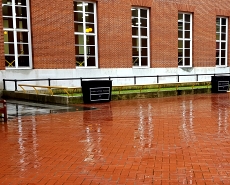
Falling rain drops
Relentlessly wetting the flat
Path beneath my feet


Falling rain drops
Relentlessly wetting the flat
Path beneath my feet
WE LIVE IN A SMALL flat without neither garden nor a balcony, but near the centre of London and two large parks. For several years, we used to drive to France, where we hired country houses in rural locations from an organisation called Gîtes de France. A ‘gîte’ is essentially a furnished house available for rent to holidaymakers.

The organisation used to issue handbooks listing the houses available in various regions. Each home is given a category between the lowest 1 and the highest 3 ‘épi(s)’ (ears of corn). When we planned our trips, we used to choose from the houses on offer in the 3 épis grade. We had several criteria that determined our choice of holiday home. First, it had to have at least 100 square metres of usable space because we wanted to experience living in a spacious place for at least one week per year. Second, it had to be equipped with machines both for both clothes and for dishes. In addition to fulfilling these requirements, there was one more thing we always wanted: a barbecue.
My wife had hired gîtes before we married, which is why we considered doing this for our family holidays. The first one we hired was in a small village, Poilly-sur-Serein near the famous wine-producing town of Chablis in Burgundy. The building was easily large enough to house my wife, her parents, who had flown over from India, our daughter, and me. We used the barbecue almost every evening, preparing vegetarian kebabs for my in-laws and meaty ones for the rest of us. Staying in Poilly-sur-Serein whet my appetite for trying other gîtes.
One April, we hired a lovely house in the south of Provence, not far from Orange. It was next to a cherry orchard and had a large garden. We could not use the garden much during the day because that year there was a heatwave in the south of France. Temperatures were hovering around 37 degrees Celsius and the best place to be was in our air-conditioned car, in which we explored the local and not so local sights.
One of our favourite hires was also in the south of France, in the Aveyron region. The house was located inside the walls of the ruined Templar’s castle at St Jean d’Alcas, which is but a few miles south of Roquefort-sur-Souzon, the centre of Roquefort cheese-making. We visited the small town of blue cheese fame several times and ate some meals in its restaurants. At one of these, a cheese trolley bearing thirteen different types of Roquefort was wheeled to our table. Although they looked alike, our waiter patiently explained the characteristics of each before advising us that it was best not to select more than four of them on a plate at any one meal. At another eatery in the town, I could not resist sampling the ‘Menu Roquefort’, a three-course lunch consisting of dishes that included the town’s famous blue cheese. My starter was an omelette which incorporated the cheese. This was followed by meat in a sauce based on Roquefort. The dessert was a Roquefort soufflé. Although this might sound heavy, it was not because whoever prepared it was a good cook with a light touch.
The gîte at St Jean d’Alcas was so lovely that we hired it a second time, a year after our first visit. During the second stay, there was a grand celebration in the tiny village. It was probably Bastille Day. Long tables were set out in the lane running alongside our house. In the evening, we were invited to feast with the locals, who had flocked in great numbers to the usually deserted village. We joined the friendly crowd seated at the tables and were offered one of two main courses. On offer from huge cooking vessels, there was either tripe in a delicious sauce or grilled local sausages. It was a fine occasion with unlimited wine. The following morning, the tables and benches had disappeared, and the picturesque village had returned to its normal sleepy state.
There was only one shop in St Jean d’Alcas and its merchandise was limited in range but delicious. It sold bottles of a liqueur like ratafia, but with a different name. Apart from that, we had to buy our food supplies elsewhere, mainly in street markets and supermarkets. Shopping for daily needs was one of the many attractions of having our own home away from home.
One curious feature common to all the gîtes that we hired was that each of them had only one toilet/bathroom however large the building. In 2000, we hired a large house in the Haute Loire at a tiny village with a ruined castle, Arlempdes. Its location next to the castle walls was wonderful. It overlooked a sharp curve in the river. This four-storey building had accommodation for eleven people, but only one toilet and shower. Both were inconveniently located in the basement of the gîte. Had there been eleven of us, or even just five of us, having only one toilet would have been extremely inconvenient. As we were looking for extra space to enjoy, this property more than fulfilled our requirements.
We gave up driving through France several years ago. Most of the places we wanted to visit were more than a full day’s tiring drive across France. On the way out, this did not matter as we had an exciting holiday to enjoy. But the return journey was never much fun. There was the long drive through France towards the English Channel, much of which involved driving through the often-dreary areas of the northern part of the country. Then, there was a shorter but much more exhausting ‘schlep’ through Kent and south-east and central London … and the prospect of returning to work. By the time we reached our tiny flat, we were ready for another holiday.

Composing a blog
Once a day or even more
Is so soul soothing
MANY PEOPLE REGRET having to wear spectacles. I am not a part of that crowd.

When I went to school and university, my eyesight was so good that I did not need to consider wearing glasses. However, many of my fellow pupils were not born with such satisfactory vision and were forced to wear spectacles. I felt that those who wore glasses looked far more intelligent than those who did not. I do not know when and from whom I got that rather ridiculous idea. My parents did not wear glasses until they were about 45 years old, by which time I was in my early teenage. Yet, I knew they were both intelligent long before they discovered that they were having to hold their newspapers and books ever increasingly further from their eyes before they finally resorted to wearing spectacles.
I qualified as a dentist in 1982 without needing to wear glasses apart from safety goggles whilst drilling teeth at the dental school. About three years later, I decided it would be a good idea to protect my eyes whilst treating my patients. Instead of goggles such as handymen (and handywomen) use, I decided to ask an optician to make me a pair of ‘specs’ with tough plain lenses. I was extremely pleased with my spectacles. Wearing them, I looked in the mirror and immediately felt more intelligent, however ridiculous this might sound.
As I approached my mid-forties, the plain lenses needed to be replaced with prescription lenses as my eyesight was no longer what it had been. After a year or so, I began noticing two things. First, at night I was seeing three red traffic lights where there was only one. Secondly, when sitting far away from the stage in a theatre, I could hear what was being said or sung but the performers on the stage were barely distinguishable from one another. Watching a play was a bit like watching from afar insects moving about. Enter my new pair of long-distance ‘specs’ and these problems were resolved. But now I had two carry around two pairs of glasses: one for reading and the other for seeing afar. The solution was to try bifocals, which I have grown to like.
My first pair of spectacles was made by an optician’s firm in Kent, near where I worked. Since then, I have had several pairs made extremely competently in Bangalore, India. Most of my Indian ‘specs’ have been made by a company called Lawrence and Mayo (‘L&M’), which has several branches in the city. We favour the branch that used to be on Mahatma Gandhi (‘MG’) Road, but has, since the construction of Bangalore’s metro train system, been located nearby in Barton Tower, which overlooks MG Road. This branch has supplied eye care for several generations of my wife’s family and at least one of the staff has known members of at least four generations.
L & M was founded in Calcutta in 1877 by two Jewish families, the Lawrence’s and the Mayo’s. According to Girish Bhagat (www.scribd.com/document/352875229/1-Case-Study-on-Lawrence-Mayo-2016-Only-Case-Study-Material), the two families:
“…set up optical businesses in two cities simultaneously: London and Kolkata. Later they went on extending their businesses all over the world … After Kolkata, they went ahead in setting up their branches over large cities of India. It soon gained the reputation as being known as authorised opticians to kings and viceroys alike …”
Apart from London and India, the company had branches in Cairo, Spain, Portugal, Colombo, Rangoon, and Singapore.
The families who established L&M were originally named ‘Lazrus’ and ‘Myers’. According to Vivek Mendonca, whose family took over the firm (www.brandyouyear.com/2020/06/dr-vivek-g-mendonsa-group-director-marketing-lawrence-and-mayo.html):
“They were Opticians, Watchmakers and Craftsmen of fine custom made Jewellery, which they used to embellish on customised spectacles for Royal Families, Prince and Princesses based on colour stones based on their coat of arms.”
Of the Lazrus family I found the following information (www.jewishgen.org/jcr-uk/Community/exe/history/lazarus.htm):
“Frank Lazarus (s. of Mathilda Lyon and Lippa Lazarus of Plymouth), who married into a family who were among the founders of the Jewish community of Hartford Conn., USA, and who later returned to England. He was in the optical business and apparently had a business called Lawrence and Mayo, with a branch in India, and which is now one of the biggest and the oldest optical firms in India.”
Of the Myers, I have not yet managed to discover anything about them.
However, I have found that amongst their many customers, the Indian branches have served some well-known people including Mahatma Gandhi, Pandit Nehru, Rabindranath Tagore, and J.R.D. Tata. As if that were not enough, they have supplied eyewear to:
“…queens, viceroys, barons and other people of high repute chose Lawrence & Mayo as their personal optician. During the Wimbledon Finals of 1923, Queen Mary was spotted styling the Amulet inspired glare protectors from Lawrence & Mayo.” (https://youandeyemag.com/optician/lawrence-mayo/)
Although the quality of the work they have done for me is more than satisfactory, learning about some of their former customers is additionally gratifying.
Today, the 5th of January 2021, about two years since I last obtained a new pair of specs from L&M in Bangalore’s Barton Tower, I picked up a new pair from a local optician, owned by an Indian optometrist in London. I am about to give them a ‘test drive’ and hope that they will be as satisfactory as those made by Gandhi’s erstwhile optician. They are certainly better looking than the glasses that appear in many portrayals of the Mahatma.
ELEGANT BELGRAVE SQUARE is but a stone’s throw from Hyde Park Corner. Many of its neo-classical buildings are home to diplomatic missions and their staff. As with many London squares, the centre of Belgrave Square contains a private garden. That at Belgrave Square is adorned with sculptures, mostly statues of eminent people. At each of its four corners, there is one. The people depicted at these four positions are Prince Henry the Navigator (1394-1460); Christopher Columbus (1451-1506); Simon Bolivar (1783-1830), the liberator of Venezuela, Bolivia, Colombia, Ecuador, Peru, and Panama; and José San Martin (1778-1850), liberator of Argentina, Chile, and Peru. Almost facing San Martin on the north east corner of the square is a statue of Sir Robert Grosvenor, First Marquess of Westminster (1767-1845), upon whose estate Belgrave Square was built.

On the eastern side of the square, close to the statue of Simon Bolivar and within the garden, there is a sculpture by Enzo Plazzotta (1921-1981), which was completed after his death by Mark Holloway. It is called “Homage to Leonardo. The Vitruvian Man”.
Interesting as all the above-mentioned are, the sculpture that intrigued me most is a bust of Elias George Basevi (1794-1845), who is described on his plinth as ‘architect’. I guessed that he was likely to have been involved in the design of Belgrave Square, and I was right. According to a plaque on the base of Grosvenor’s statue, he designed the neo-classical terraces surrounding the square for the Haldimand Syndicate, which was under the control of the brothers George (1781-1851) and William (1784-1862) Haldimand, of Swiss origin, sons of a banker born in Switzerland and an English mother. In 1825, William, a Member of Parliament:
“… negotiated successfully with the 2nd Earl Grosvenor, Seth Smith and William Cubitt for a 99-year lease on Belgrave Square, where he had 49 houses built: 16 to be owned by George Haldimand, 14 by himself, eight by Prevost, four by Smith and three by Cubitt…” (www.historyofparliamentonline.org/volume/1820-1832/member/haldimand-william-1784-1862)
The Haldimands were related to Frederick Haldimand (1718-1791), who became Governor of Quebec in 1777. Thomas Cubitt (1788-1855), who was involved in creating the square, was a major Victorian property developer.
As for Basevi, at first, I thought that his surname sounded Italian. His family might have come from that country as its origins were Sephardic Jewish. The Basevi surname is particularly associated with Sephardic Jews in Verona (https://judaism_enc.enacademic.com/2089/BASEVI). His father, Joshua, usually known as ‘George’, was a London City merchant (www.jewishencyclopedia.com/articles/2616-basevi-george-joshua). Elias George’s aunt, George’s sister Maria (née Basevi), was married to Isaac D’Israeli, whose son was Benjamin Disraeli, Earl of Beaconsfield (1804-1881), who was Prime Minister between 1874 and 1880. In 1810, Elias became a pupil of the great architect John Soane (1753-1837), who specialised in creating in the neo-classical style. According to the Dictionary of National Biography (‘DNB’) (https://doi.org/10.1093/ref:odnb/1615), from which I have gleaned much information about Elias, he:
“… also studied at the Royal Academy Schools, where Soane had recently been appointed professor of architecture. In 1815 he visited Paris with his brother, and on completion of his architectural training in 1816 he embarked on a three-year study tour of Italy and Greece, staying the longest in Rome and Athens, but also travelling extensively elsewhere in Italy and even visiting Constantinople.”
Regarding Belgrave Square, the DNB relates:
“Basevi designed and handled the construction of the terraced houses making up the four sides of the square (1825–40), though not the four detached villas at the corners. He treated the stuccoed terraces of eleven or twelve houses on each side as single palatial façades, giving each a central columnar portico and end pavilions in a similar manner to John Nash’s terraces in Regent’s Park … The financial success of this speculative development during an economically depressed period was due in large part to Basevi’s precise and scholarly attention to detail, not just in the design of the individual houses but also in the paving, street furniture, and composition of the square as a whole.”
Elias Basevi’s other projects included, to give just a few examples, St Thomas, Stockport, Cheshire (1822–5); work at several country houses; a building at Balliol College Oxford; Beechwood House and The Elms in Highgate; and the Fitzwilliam Museum in Cambridge, whose construction was completed after his death. Beechwood House was built for the architect’s brother Nathaniel, a barrister, in 1840, who was married to a niece of Sir Robert Peel (1788-1850).
Noticing Basevi’s buildings in Highgate, I looked at John Lloyd’s “History, Topography, and Antiquities of Highgate”, published in 1888, and discovered more about Basevi. He wrote that the Basevi family had been prominent in the Anglo-Jewish community. One member of the family, Napthali, the grandfather of Benjamin Disraeli’s mother, was an early President of The Jewish Board of Deputies, which was involved in the struggle for the emancipation of the Jews. The Basevis moved away from the Jewish faith as did their kinsmen the Disraelis.
Elias Basevi married Frances Agneta Biscoe. They produced eight children, one of whom was given the name James Palladio Basevi (1832-1871), who became an officer in the Royal Engineers.
On a personal note, I attended Highgate School between 1965 and 1970. Some years later, I acquired a copy of the “Highgate School Register 1833-1988”. Today, I looked up ‘Basevi’ in the index of pupils and discovered that in March 1840, James Palladio Basevi joined the school. This son of the architect joined the school two years after the Reverend John Bradley Dyne (1809-1898) had become headmaster. Dyne was to raise the school’s reputation considerably. Other Basevi family members attended the school were William Augustus Basevi (joined January 1841), George Henry Basevi (joined January 1842) Frederick Biscoe Basevi (joined April 1844), Charles Edward Basevi (joined June 1844). All of these fellows were sons of the architect of Belgrave Square. Why they went to Highgate School is a bit of a mystery. Part of the reason might have been that their uncle, Nathaniel, had his home at Beechwood, a short walk from the school. however, their father, the architect lived in central London. The historian Alan Palmer, who used to teach at the school, wrote that out of the 43 graduates of Dyne’s first ten years, only 16 came from homes near the school. His reputation as a headmaster was already excellent by the time that the first of the architect’s sons entered the school, which attracted boarders.
Elias, who became a Member of the Royal Institute of British Architects, and a Fellow of both the Society of Antiquaries and the Royal Society, ended his life in a frightening way. The DNB relates his tragic ending:
“He died on 16 October 1845, aged fifty-one, after falling through an opening in the floor of the old bell chamber of the west tower of Ely Cathedral while inspecting repairs. His remains were buried in Bishop Alcock’s chapel at the east end of the cathedral.”
The bust of Elias George Basevi is smaller than the other commemorative sculpture placed in and around Belgrave Square and easy to miss if you are walking around the square. I only noticed it because I was watching two people walking with their dogs within the square’s private garden. Had I not seen the bust, I might have never explored the life of this man whose family had connections with Highgate, where I attended secondary school.
A WINDING LANE leads from Hampstead’s East Heath Road into the picturesque Vale of Health. I wrote about this isolated, small settlement surrounded by Hampstead Heath in the summer of 2017 (https://hampsteadadam.travellerspoint.com/2/) and have not revisited the place until today, the 2nd of January 2021. Little appears to have changed since then, but I have learnt a little more about the place.
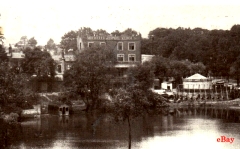
As for its name, the place was not always as healthy as its name suggests. I wrote:
“The land on which the Vale is situated is mentioned in the Domesday Book (1086 AD). It was then owned by the Abbots and monks of Westminster. By the 18th century this swampland in the middle of the part of the Heath, then known as part of ‘Gangmoor’, was inhabited by impoverished people and was malarial. In the 1770s, the area was known as ‘Hatches’ or ‘Hatchett’s’ Bottom, because Samuel Hatch, a harness-maker, had owned a cottage there before 1770. This unsavoury hollow was described in about 1817 as a “stagnate bottom, a pit in the heath” by the sculptor Joseph Nolleken’s wife (see: http://www.british-history.ac.uk/vch/middx/vol9/pp71-73). It was a vale, but not a healthy one.”
However, by 1801 when the land had been drained and property developers began building houses in the area, it gained the salubrious-sounding name by which it is known today.
Apart from the famous Indian artistic genius Rabindranath Tagore (1861-1941), who stayed in the Vale in 1912, the settlement was home to many other well-known people including the author Compton Mackenzie; the barrister Alfred Harmsworth; DH Lawrence; the philosopher Cyril Joad; and Stella Gibbons. Earlier notable residents included the law reformer Sir Samuel Romilly (1757-1818); the poet and essayist James Leigh Hunt (1784-1859), who entertained leading literary figures such as Hazlitt, Keats, Lord Byron and Shelley in his house in the Vale; the publisher Charles Knight (1791-1873); and, also, a Prince Eszterhazy.
During the 19th century, not only were the literati and wealthy attracted to the Vale but also it was a popular place for hoards of trippers, whose names never made it into the annals of history. The author of “The Northern Heights of London” published in 1869, William Howitt (1792-1879), describes these pleasure-seekers and what they did in some detail. He wrote that:
“This Vale of Health used, till of late years, to present a sight at once picturesque and pleasant. In front of a row of cottages, and under the shade of willows, were set out long tables for tea, where many hundreds, at a trifling cost, partook of a homely and exhilarating refreshment. There families could take their own tea and bread and butter, and have water boiled for them, and table accommodation found for them, for a few pence…”
And then, everything changed for the worse according to the puritanical-sounding Howitt:
“Recent times have seen Sunday dissipation reasserting itself, by the erection of a monster public house with a lofty tower and flag, to attract the attention of Sunday strollers on the Heath. Of all places, this raised its Tower of Babel in that formerly quiet and favourite spot, the Vale of Health … that taps and gin palaces on a Titan scale should be licensed, where people resort ostensibly for fresh air, relaxation, and exercise, is the certain mode of turning all such advantages into popular curses and converting the very bosom of nature into a hotbed of demoralisation and crime…”
This demoniacal-sounding establishment is marked as ‘Suburban & Hampstead Heath Hotel’ on a map surveyed a year before Howitt’s book was published. On a map surveyed in 1912, it is marked simply as ‘Hotel’. Just a few houses away southwest of it, another building is marked ‘Hall’, to which I will refer shortly. According to both maps, the hotel stood where today there is a twentieth century block of flats called Spencer House. Opposite this edifice, there is a caravan park, which has been in the possession of the Abbotts family for over 160 years. Since the late 19th century, this patch of land has been fairground land. About ten members of the family live on the site in caravans, and other travelling fair workers can camp there free of charge. In exchange, members of the Abbott family, who operate travelling fairs, are allowed camp for nothing on other fairground owners’ sites when they travel around the country.
Returning to the building that upset Howitt, “A History of the County of Middlesex: Volume 9” (https://www.british-history.ac.uk/vch/middx/vol9/pp71-73) notes:
“… the Suburban hotel (also called the Vale of Health tavern) with towers and battlements and accommodation for 2,000 was built in 1863 …”
This source also notes another establishment, which was being built whilst Howitt was writing or just about to publish. This was the ‘Hampstead Heath Hotel’, which was built in 1868. This stood between two groups of ‘villas’, that is between 1-6 Heath Villas and 7-12 Heath Villas. It was the building marked as ‘Hall’ on the 1912 map. It is now occupied by a mid-twentieth century block of flats, smaller than Spencer House, named ‘Athenaeum’.
The Hampstead Heath Hotel closed in 1877, when it passed into the ownership of Henry Braun. His great grandson, Frances Francis wrote (www.francisfrith.com/uk/hampstead/vale-of-health-hotel_memory-7431):
“My great grandfather Henry Braun owned the Vale of Health Hotel … overlooking the lake, from 1877 until the early 1900’s. The hotel was used as an Anglo German club called the Athenaeum and by 1908 had 1200 members – 500 English, 700 German, including many political radicals. The hotel became a factory during World War I and then remained derelict for some years. The hotel was eventually pulled down in 1958, when I was 15 and I remember with sadness watching ‘luxury’ flats being erected in its place.”
The club closed in 1914 and then became used as a factory until it was demolished and replaced by the present building in 1958.
According to the County History to which I have already referred, The Athenaeum club’s larger neighbour, the hostelry that Howitt detested was:
“The large Vale of Health tavern, originally intended as a hotel and sanatorium, was sold in 1876, became associated with the fair, was let as flats, and c. 1900 became a hotel again on a smaller scale, with the upper rooms let as studios … Spencer House (flats) replaced the Vale of Health hotel in 1964.”
Howitt would have been even more dismayed to have learnt that there was a third hotel built in the Vale of Health in the 1880s. It stood next to the Athenaeum on the site now occupied by Byron Villas. It was at number 1 Byron Villas that the writer DH Lawrence lived in 1915.
Today, Howitt would most probably be happier with the Vale of Health than he was in 1869. The hotels have gone, and there is not even the tiniest of stalls where refreshments may be obtained. He might disapprove of the parked cars and the caravan site opposite Spencer House, but there would be hardly anything that he could find to decry. By the edge of its large pond, one of the sources of the River Fleet, the Vale of Health remains a quiet oasis in the heart of north London.
MUCH OF MOTCOMB Street in London’s Belgravia is now pedestrianised. It is lined with nineteenth century buildings that house shops and food outlets, mostly aimed at wealthy customers. Here, you can find the shops of Christian Loubertin, Ottolenghi, Nicola Donati, Marie Chantal, Maison Corthay, to mention but a few you might know. It is probably safe to say that this is not much of a street for bargain hunters, but to be fair, it does boast a newsagent and a large branch of the Waitrose supermarket chain.

Motcomb Street first appears on a map in 1830, when it was briefly known as ‘Kinnerton Mews’. By 1854, many of the houses along it became shops and places where cows were kept. A publication (http://www.grosvenorlondon.com/GrosvenorLondon/media/GrosvenorLondon/WALKING-IN-BELGRAVIA.pdf) produced by the Grosvenor Estate details the shops:
“… a cow-keeper, a saddler, two tailors, a plumber, a wheelwright, a grocer and two sellers of asses’ milk (thought to be beneficial to health and used in nearby hospitals).”
The ‘Alfred Tennyson’ pub stands on the corner of Motcomb and Kinnerton Streets. It was formerly known as ‘The Pantechnicon’. The reason for its earlier name becomes obvious if you walk away from it westwards along Motcomb Street. Opposite Waitrose and by far the most imposing building in the street is a neo-classical façade supported by ten sturdy pillars with Doric capitals. As impressive as many of the great neoclassical façades in central London, such as that of the National Gallery, these pillars support a slab on which the word ‘PANTECHNICON’ is boldly displayed.
The Pantechnicon was built as commercial premises in about 1830-34 (https://historicengland.org.uk/listing/the-list/list-entry/1223569) for the property developer Seth Smith (1791-1860), most probably designed by the architect and civil engineer Joseph Jopling (1788-1867; http://farnham.attfield.de/fam1012.html). The Pantechnicon was enormous. Covering two acres, it stretched backwards (north) from Motcomb street and was surrounded by the backs of many of the houses lining the east side of Lowndes Square and the west side of Kinnerton Street. When it was completed, it was originally:
“… a bazaar, and was established principally for the sale of carriages and household furniture. There was also a ‘wine department’, consisting of a range of dry vaults for the reception and display of wines; and the bazaar contained likewise a ‘toy department.’” (www.british-history.ac.uk/old-new-london/vol5/pp1-14).
By 1850, when Peter Cunningham published his “Handbook of London”, things had changed. It had become a repository, where you:
“… may send the whole contents of an extensive house – furniture, wine, pictures, even jewellery; and the utmost care will be taken of them, at a comparatively reasonable charge …”
Cunningham lists these charges in detail and later added reassuringly:
“The building is well ventilated, and considered fireproof; but the risk (if any) of accidents by fire, civil commotion, or otherwise, will attach to the owners of the property sent to the Pantechnicon to be warehoused.”
Incidentally, the owners of the Pantechnicon designed a new form of removal van. Its innovation was a movable rear ramp that aided the loading of heavy or bulky objects. Originally, horse-drawn, these became known as ‘Pantechnicons’, a word often applied to motorised removal trucks in use today. And just in case you are wondering, the word ‘pantechnicon’ is derived from two Greek words, ‘pan’ and ‘techne’, meaning ‘all arts’, and was coined to describe wide range of goods that were available to buy in the bazaar in Motcomb Street.
Disaster struck on Friday, the 13th of February 1874 at about 4 pm. The fireproof Pantechnicon burst into flames. By 7 pm, the roof had collapsed. Karen Odden, who has written an interesting article about this conflagration (https://englishhistoryauthors.blogspot.com/2020/01/the-pantechnicon-fire-of-1874.html), noted:
“ …the event was perhaps the single largest episode of destruction of art and furnishings in the Victorian era … It is difficult to assess the value of the objects lost. Because people had such faith in the Pantechnicon, they under-insured their valuables—or found ways to avoid insuring them altogether. For example, one family hid their jewels in their furniture. The cost of insuring a headboard was significantly less than insuring jewels—but jewels hidden inside were (ostensibly) safe all the same. (Tricky!) However, it is known for certain that the fire destroyed the MP Sir Richard Wallace’s painting collection, worth £150,000; and the MP Sir Seymour Fitzgerald’s art collection, worth £200,000, which included many portraits by Sir Joshua Reynolds and paintings by other masters including J.M.W. Turner. Contemporary accounts estimated the total value upon the destroyed items at £2,000,000 (approximately £220,000,000 or $280,000,000 today).”
Luckily for us, many of Wallace’s works were not involved in the fire as can be seen by visiting the Wallace Collection in his former home in Manchester Square.
Today, only the façade of the Pantechnicon remains standing. Located opposite a modern ‘bazaar’, Waitrose, it conceals a lovely public space behind it, which contains benches and a few artworks, and is lined by Halkins Arcade. A modern building attached to the old façade houses restaurants, bars and other businesses, some of which can be entered from the Arcade.
It worth making a visit to Motcomb Street not only to see the impressive remnant of the Pantechnicon but also because the short pedestrian-friendly street has become a particularly pleasant place to linger.
THE EYES OF MOST VISITORS to Kensington Gore are attracted to the spectacular Royal Albert Hall and, opposite it, the monument to Albert, Queen Victoria’s consort. Immediately to the west of the Royal Albert Hall, there stands the comparatively less impressive twentieth century building housing the Royal College of Art (‘RCA’), designed by H T Cadbury Brown and opened in 1962. Next to this geometric structure of concrete and glass and on its south side, there is an edifice whose appearance is a dramatic contrast to it. The walls of the RCA’s southern neighbour are covered with figurative illustrations, created in the ‘sgraffito’ technique. Bands of ‘putti’ carrying musical instruments, scrolls of paper, or singing, appear to be scurrying across the walls of the building. Maybe this is not surprising because once this place housed The Royal College of Organists (‘RCO’).
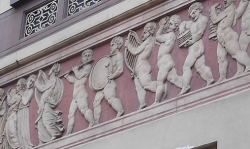
Founded in 1864 by the organist Richard Limpus (1824-1875) to promote advanced organ playing, it received its Royal Charter in 1893. The building next to the present RCA and facing the Royal Albert Hall was designed by Lieutenant Henry Hardy Cole (1843-1916) of the Royal Engineers, and the ‘sgraffiti’ decorating it was created by Francis Wallaston Moody (1824-1886).
Lieutenant Cole was a son of Sir Henry Cole (1808-1882), a civil servant who had an extremely important role in organising the Great Exhibition of 1851. His building, erected 1874-75, was originally constructed to house The National Training School for Music. It was paid for by Sir Henry Cole’s friend, music lover, and a fellow member of the Society of the Arts, the developer Charles James Freake (1818-1884), who lived in Cromwell Road (www.londonremembers.com/memorials/sir-c-j-freake).
The architect, Lieutenant Cole had little practical architectural experience as is revealed in “The Survey of London Vol.38” (www.british-history.ac.uk/survey-london/vol38/pp217-219):
“Lieutenant Cole had returned in 1871 from India, where he had been Superintendent of the Archaeological Survey, North-West Provinces, and his previous architectural work seems to have been confined mainly to publications on ancient Indian architecture and archaeology, and the preparation of casts for the Indian section of the South Kensington Museum, which he catalogued.”
Consequently:
“He was not left to design the school on his own. It was evolved in consultation with his father and was subjected to criticism by members of the Science and Art Department. A committee of management was appointed in July 1873 …”
Moody was a protégé of Sir Henry and a teacher at the National Art Training School, a forerunner of the RCA.
Between 1883 and 1896, the building was used by the newly founded Royal College of Music, which moved into its new premises south of the Royal Albert Hall in about 1896. The large variety of musical instruments that have been depicted on the building’s walls reflect the place’s first occupants. Between 1896 and 1903, it stood empty. Then it was leased to the RCO for 100 years at a ‘peppercorn’ rent. When it was learnt that after expiry of the lease the rent would be increased considerably, the RCO moved into new accommodation in 1991. Currently, at least in 2018, it is owned by an entrepreneur, Robert Tchenguiz.
The Lieutenant, who designed the RCO building, became the Curator of Ancient Monuments in India. His “First Report Of The Curator Of Ancient Monuments In India” was published in 1882 in Simla. This contains some of his views on dealing with archaeological items and sites. For example, he wrote:
“Experience has shown that the keenest investigators have not always had the greatest respect for the maintenance of monuments. Archaeological research has for its object the elucidation of history, and to an enthusiast the temptation to carry off a proof of an unravelled mystery is undoubtedly great. If there were no such things as photographs, casts, and other means of reproducing archaeological evidence, the removal of original stone records might perhaps be justified …”,
and, regarding the now controversial British possession of some famous sculptures in the British Museum:
“Sometimes, indeed, the removal of ancient remains is necessary for safe custody; and in the case of a foreign country, we are not responsible for the preservation in situ of important buildings. We are not answerable for keeping Grecian marbles in Greece; neither were we concerned for the rights of Egypt when Cleopatra’s Needle left Alexandria for the Thames embankment.”
However, regarding India, the Lieutenant wrote:
“In the case, however, of India—a country which is a British possession—the arguments are different. We are, I submit, responsible for Indian monuments, and that they are preserved in situ, when possible. Moreover, as Mr. Eergusson remarks, Indian sculpture is so essentially a part of the architecture with which it is bound, that it is impossible to appreciate it properly without being able to realise correctly the position for which it was originally designed …”
In order to satisfy the needs of museums in Europe, the lieutenant suggested that perfect replicas of artefacts can be made as is well demonstrated by the superb life-like plaster casts that can be seen in the Cast Courts of the Victoria and Albert Museum, which were opened in 1873 and established by Sir Henry Cole and the art collector John Charles Robinson (1824-1913). In general, Sir Henry’s son was against moving historical remains from British possessions. To make his point, he wrote:
“The removal, for instance, of Stonehenge to London would, I imagine, provoke considerable excitement in England, and be condemned by a majority in the scientific and artistic world.”
I am not sure that Lieutenant Cole’s views were shared by the American sculptor and collector of antiques George Grey Barnard (1863-1938), who bought and whole cloisters and other architectural items in France and then had them shipped to New York City. There, they were reassembled and displayed in the superb Cloisters Museum at the northern tip of Manhattan.
Looking at the outside of the former RCO building, I could not detect anything that reflected its architect’s experiences in India except, if I stretch my imagination, for the upper storey windows that faintly recall the projecting windows that can be found on ‘havelis’, for example, in Gujarat and Rajasthan. But maybe I am letting my imagination run a little wild.
ROBERT AND MARGARET, my PhD supervisor, and his wife, became my close friends during the execution of my doctorate and for many years afterwards. I had the feeling that they were not as keen as some about Britain joining what we now call the European Union (‘EU’). Today, the 31st of December 2020 at 11 pm, the UK will leave it. Thinking about this reminded me of my old, now sadly deceased, friends and how joining Europe almost wrecked one of their dietary habits.

Robert was an extremely keen and energetic gardener. His home had extensive grounds. Looking after these kept him blissfully busy. The tennis court was separated from the conservatory by a large lawn surrounded by bushes. This was the ornamental garden. It contained one or two benches and a table where tea could be enjoyed in hot weather. A path led from this into an even larger kitchen garden that was lined on one side by a series of long low huts, known as the ‘goat sheds’. Although they did not contain any goats, they were filled to the brim with … well… maybe many people might have called it ‘junk’. My friends would have disagreed with this assessment.
At one end of these sheds, Robert, who was a first-class handy man as well as a brilliant scientist, kept a wide selection of tools. There were few repairs in and around his home for which Robert lacked the skills to perform competently. Once plastic piping became widely available, he carried out many successful plumbing repairs. More than once he said to me with great seriousness that it was senseless teaching children Latin or Greek; they should be taught something useful like plumbing. Amongst these tools, there was also a hand operated mill that he used to grind flour, which he used to bake his own bread.
Almost whenever I arrived at his home, I would find Robert somewhere in the garden. Often, he was hunched over a bed of seedlings, weeding. Sometimes, he would be looking after his crop of potato plants which grew in a field accessed by way of the path between the goat sheds and the stables. He liked this patch of ground because it bordered the large meadow where his horse, Hobo, grazed. This horse enjoyed company and used to stand by the fence close to where Robert was toiling. Robert valued Hobo’s company as well as that of his Burmese cat, which followed him around the garden.
Beyond the goat sheds and separated from them by a pathway were two adjoining stables. One was occupied occasionally by the family’s pet horse; and the other was filled with the contents of a long-lost friend’s flat. Amongst the various plots for growing fruit and vegetables, there was a spacious elegant Victorian glasshouse. A rusty wide-bore pipe ran around the walls that made up the rectangular base of this. This pipe had once been connected by underground pipes to the house, which was about 70 yards away. In its heyday, the piping in the glasshouse had been part of the house’s central heating system circuit and served to keep the plants warm in winter. By the time that my friends had bought their home, it had been disconnected.
Robert grew a variety of edible plants in the greenhouse. The lettuce he grew there was some of the best that I have ever eaten. Freshly picked, it was so tasty that it required neither salad dressing nor salt nor any other additive. It was grown from seed of a strain of lettuce called ‘Continuity’.
When the UK joined the European Economic Community (‘EEC’) in 1973, something of which I doubt my friends fully approved, the days of Continuity were numbered. Amongst the many regulations that the EEC planned to impose on its members was the banning of the sale of some kinds of seeds including those of Continuity breed of lettuce. This annoyed Robert and Margaret, and it became yet one more reason for them to disapprove of joining the EEC. Not one to be defeated by authority, Robert made sure that he let some of his lettuce plants flower and he collected their seeds in anticipation of the ban. For long after the seeds were no longer on sale, Robert and Margaret and others who ate with them were able to enjoy Continuity lettuce.
Although many people, including my friends Robert and Margaret, benefitted greatly from joining the EEC, later the EU, their disquiet about European judgement about what they could grow in their own gardens was not entirely misplaced. For, over the years, what began as a primarily economic union gradually assumed an overarching political role. We wait with bated breath to see whether leaving the EU will allow Britain to truly ‘regain control’, as Boris Johnson hopes, or, as many people fear, to degenerate into an insignificant archipelago lying off the west coast of Europe.
IT WAS ONE DEGREE Celsius and a bright sunny December day when we made our third visit to Bushy Park. When we arrived at about 9.30 am, the car park near the Pheasantry Café was almost empty. On this trip, we decided to walk along the long waterway that leads from the Diana Statue to the Leg of Mutton Pond. The stream flows through several ponds, which were partly covered with a thin layer of ice. Gulls and other waterfowl stood on the ice, there bodies being reflected in its mirror-like surface.

The watercourse is part of the man-made Longford River, which I described recently (https://adam-yamey-writes.com/2020/09/20/diana-and-the-deer/) as follows:
“… King Charles I (reigned 1625-1649) ordered the building of a canal, the Longford River, which carries water for 12 miles from the River Colne (a tributary of the Thames) to the grounds of Hampton Court Palace. The man-made waterway, designed by Nicholas Lane (1585-1644) and dug by hand in only 9 months in 1638-39, flows through Bushy Park, supplying water to its numerous water features. The water is drawn from the river Colne at a point (Longford near Slough) whose altitude (72 feet above sea level) was great enough to ensure a fast flow to Hampton Court Palace, which is only about 13 feet above sea level.”
On an 1867 map of Bushy Park, the river is named ‘Queen’s or Cardinal’s River’. In the past, the Longford River has been known by these names as well as the ‘New River’ (not to be confused with the canal with the same name that carries river water from Hertfordshire to Islington) and the ‘Hampton Court River’ (https://freejournal.org/4020246/1/longford-river.html). The river enters Bushy Park and divides into two main streams about 1.3 miles west of the Diana Statue that stands in the midst of a circular pond. One of the streams flows south into the grounds of Hampton Court Palace and the other flows east to the pond containing the statue. Some of its water is diverted to flow through the park’s attractive woodland gardens, which are separated from the rest of the park by a fence erected to prevent entry by the deer that roam around Bushy Park. From the statue, it flows eastwards through the Boating Pool, the Heron Pond and then to the Leg of Mutton Pond. From there, it flows under Sandy Lane and enters the Thames east of it, having travelled the last stretch beneath the ground.
The Boating Pool does not appear on the 1867 map. When we saw it today, people were propelling noisy radio-controlled toy boats across it, much to the dismay of the waterfowl bathing in the water. I did not spot a heron at the Heron Pool, but I did see cormorants perching on the Statue of Diana to which some Christmas hats and tinsel had been added. On my first visit to Bushy Park back in about September, I did see a heron on the edge of the round pond in the middle of which the statue stands. Although I saw no herons during my latest visit, there were plenty of gulls, geese, ducks, swans, coots, and moorhen on all three ponds that punctuate the Longford River.
The Leg of Mutton Pond, when seen on a map or from the air resembles the conical lump of meat, which rotates in front of a grill and from which shavings are sliced and put into ‘pita’ bread when ordering a Turkish döner kebab, rather than a leg of mutton. The pond tapers far less than most legs of mutton. Bushy Park is not the only place in London with a Leg of Mutton Pond. Other examples can be found on Hampstead Heath; near the Dollis River in Totteridge; in Barnes; in Richmond Park; and in Wanstead Park, there is even a Shoulder of Mutton pond.
Mutton is not frequently eaten by people of European heritage living in the UK today. It is not so easy as lamb to find in shops. The consumption of mutton in the UK declined many decades ago. Tracy Carrol wrote (https://localfoodbritain.com/surrey/articles/forgotten-mutton-slow-food-worth-the-wait/):
“In Victorian times, mutton was the food of kings and paupers alike, yet things started to change when New Zealand and Australia found themselves with too many sheep as a by-product of the thriving wool industry. Once refrigeration came into being in the late 19th century, the solution was obvious – ship the meat to Britain to feed its hungry and growing population. This was the beginning of the end for British mutton and by 1925 lamb was beginning to appear more and more on our menu. It may not have had the depth of flavour of mutton, but this younger meat was more reliable, even in the hands of the careless cook.”
It is the depth of flavour of mutton that makes it a far better ingredient of curries. Providing one cooks it slowly and for much longer than lamb, it becomes a tender flavoursome meat, and the curry gains a rich flavour, rarely attained by using lamb. Given that mutton prevailed over lamb when long ago ponds were named, it is not surprising to find ponds named after mutton, rather than lamb. In fact, a search of Google or its maps for a ‘Leg of Lamb’ pond or other body of water yielded no results.
Given the ‘way back’ position of regular mutton-eating in the timeline of British food history, seeing the ‘Leg of Mutton Pond’ on the map of Bushy Park made me keen to see this venerable pond. Our walk from the car park to it was truly worthwhile. When we returned to our vehicle, the car park was almost full, as was another one close to the Diana Statue. So, if you wish to enjoy Bushy Park at its best, try to get there early in the morning, well before 10 am.
 yamey
yamey 