Booking a flight
Can be infuriating
Using the internet

IN THE EIGHTEENTH century, travelling by road in England was not without its dangers, One of these was being robbed by highwaymen. Frequently, individual travellers and passengers in horse-drawn coaches were stopped by bandits, who were after money, jewellery, and other valuables.
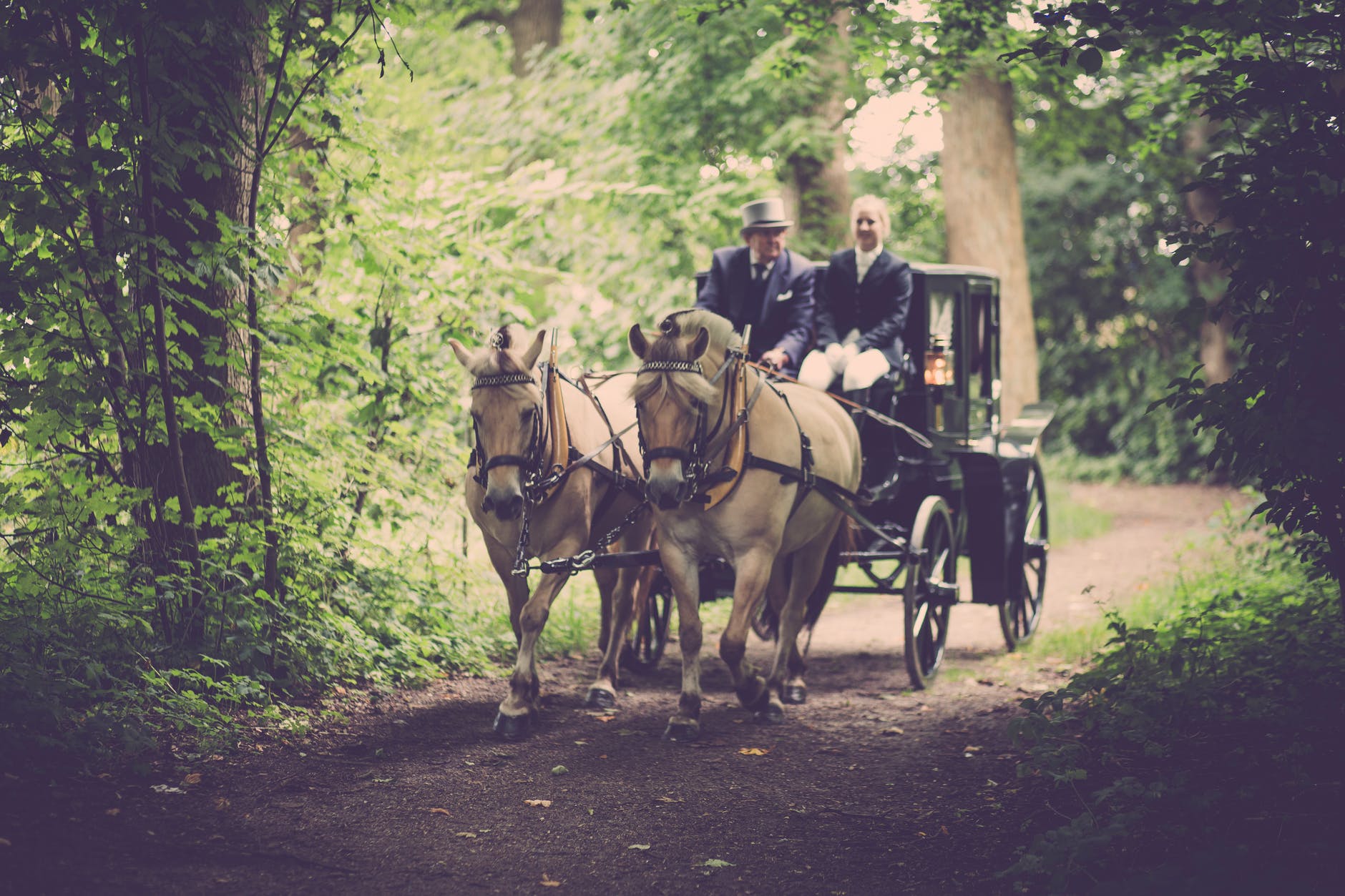
Even close to London, for example between Mayfair and Hammersmith, highwaymen plied their evil trade. As an example, the diarist Samuel Pepys (1633-1703) recorded in his entry for the 19th of May 1669:
“Here news was first talked of Harry Killigrew’s being wounded in nine places last night by footmen in the highway, going from the park in a hackney coach toward Hammersmith to his house at Turnam greene [sic] …”
The punishment for highwaymen, who were captured, was often death by hanging. Many of those convicted of crimes in the countryside around London were hung at Tyburn, close to where London’s Marble Arch stands today. Ending a highwayman’s life at Tyburn was often not the end of the story as is shown in this extract from Select Trials, for Murders, Robberies, Rapes, Sodomy, Coining, Frauds, and Other Offences. At the Sessions-House in the Old-Bailey. …, (published in 1742):
“The same day that Hawkins and Simpson were hanged, their bodies were carried to Hounslow Heath, and there hanged in irons on a gibbet erected for that purpose, not far from that on which Benjamin Child was hanged in the same manner…”
Hounslow Heath was a vast area in Middlesex, now covered mostly by west London and Heathrow Airport. It was crossed by several important roads from London to the west and south west. In between the small villages that were dotted about the Heath, there was no shortage of highwaymen and the potential for stealing much of value was great on these major arteries. The quote above mentioned that the bodies of the two fellows who were hung at Tyburn were taken to Hounslow Heath to be hung in irons. Back in those times, the bodies of executed highwaymen were hung from gibbets alongside the main roads in order to deter others from being tempted to rob travellers. How effective these grim warnings were in preventing highway robberies, I do not know.
You cannot tell
With whom you will be travelling
On a London bus
WE ARRIVED IN ENGLAND from India on the 27th of February 2020. Because of the covid outbreak, we had not left England until today, the 13th of September 2021. Some, especially those who live there, regard Cornwall as being another country, rather than part of England. We have visited that southwest county of what most people regard as England, since we arrived back from England. So, it would be pushing things if we said that we went abroad to Cornwall,
Today, we travelled abroad, leaving England for a few hours. To reach our destination we did not have to take covid tests or show evidence of double doses of vaccine or, even, show our passports. However, leave England we did. We crossed the River Severn to leave England and enter Wales. Crossing the Severn Bridge on the M48 did not require us to pay a toll as used to be the case, as the crossing is now free of charge. A few years ago, a toll was charged for crossing into Wales, but no longer; it has been abolished.
Well, I hear you say, Wales is not exactly ‘abroad’, but when one has not left England for over 18 months, it will do as ‘abroad’. Wales has its own parliament and most signs, be they on the road or elsewhere, are bilingual (English and Welsh) and, if you are lucky, you will meet a speaker of the Welsh language. To us, crossing over into Wales, after so many moths without foreign travel, felt like going abroad.
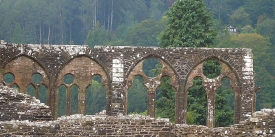
We drove along the beautiful Wye Valley and stopped at the attractive ruins of the former Cistercian Tintern Abbey (Abaty Tyndyrn in Welsh), the first ever Cistercian foundation in Wales. At the ticket office, I expressed my joy at being abroad after so many months, and the cashier said to me in a gently Welsh accent:
“I like your style.”
We have visited Tintern Abbey (founded 1131) many times in the past and each time it has been a wonderful experience. Today was no exception. Set in a wooded valley, the ruins of the gothic buildings look great against the background of trees with dark green foliage. After spending about an hour in Tintern, we drove along roads which were mainly in Wales but occasionally crossed the border into England. When we reached Wrexham (Wrecsam in Welsh), we headed off north and east into England, our trip abroad having been completed.
NO LONGER AVAILABLE !
UGANDA IS ONE OF many countries that I have not yet visited. Yet, I can relate some personal anecdotes related to it.
When we had our Hindu wedding ceremony in Bangalore (India), several of my wife’s aunts, whose families originated in Kutch (now part of Gujarat State in western India) were present and quite concerned that there were elements of Kutchi marriage traditions incorporated into our three-hour long ceremony. I cannot remember what these were. One of the aunts had lived with her family in Uganda until they saw the ‘writing on the wall’ and left for India before Idi Amin forcibly expelled all of the other Asians from his country. Her son, who lives in the UK, introduced me to Uganda’s national alcoholic drink ‘waragi’, brewed from bananas, which did not appeal to me as much as other drinks with 40% alcohol content.
Soon after I went to India for our wedding, I began working in a dental practice near Portobello Road in west London. It was there that I worked with ‘A’, who was the best dental surgery assistant I have ever worked with. She was resourceful, bright, friendly, polite, efficient, and never lost her cool. When equipment went wrong, I used to want to ring Andy, our repairman, but A would say:
“Let me fix it, Mr Yamey, I saw what Andy did last time.”
And usually, she fixed whatever had broken down.
Occasionally, A worked at the reception desk. Patients used to come up to the desk, often impatient and desperate to obtain dental treatment immediately. Instead of getting flustered, as other receptionists might easily have done, she used to say calmly something like:
“Good afternoon, Mr Brown, how are you today? And how is your family?”
When the patient had been calmed down by her questions, she would get down to the business of making arrangements for the patient’s treatment. She had a civilising influence on others.
A was born in Uganda after Idi Amin had given up ruling the country, but she lived through the troubling times that followed his downfall. She told me that she had witnessed a member of her close family being shot while she hid in a bush nearby. On another occasion, she told me:
“I heard some soldiers coming to my home, and, Mr Yamey, I jumped out of a window at the back and ran into the fields. I ran and ran and ran.”
Despite these and other horrific experiences, one would not imagine that A had had such a traumatic childhood.
A was an evangelical Christian. She kept a small edition of the New Testament in one of the drawers in my surgery alongside tubes and bottles of dental materials. It was printed mainly in black but with some words in red. These were, A explained to me, the words that had been uttered by Jesus. Every day, she used to say to me in her gentle voice:
“Mr Yamey, all you need to do to be saved is to accept Jesus into your life.”
This did not bother me, nor did the evangelical Christian radio station that she liked to hear while we were working. However, one day a particularly nervous dental patient, a frequent attender who had been born in the USA, was lying in my treatment chair, when he lifted his hand and said politely:
“There are two things that upset me. One is having dental treatment and the other is having religion thrust down my throat. So, A, will you please turn off the radio now.”
A did as asked, and we never listened to that station again. Often, A encouraged me to try ‘matoke’, a Ugandan dish made from a type of banana. She thought it was delicious, but I have not yet sampled it. I have not seen A for a long time now and hope that she and her husband are thriving and enjoying a life far better than she experienced in Uganda.
Long before I became a dentist, in my teens (in the second half of the 1960s), I loved collecting travel brochures: leaflets, maps, and booklets issued free of charge by travel companies and national tourist offices. My friend ‘F’ shared this passion. One day during the summer holidays, F suggested that we, that is F and his brother, me, and ‘H’, another close friend, should have a brochure collecting competition. F and H formed one team, and F’s brother and I the other. The plan was that we start together at Oxford Circus and then work our way down to Trafalgar Square, collecting as much free travel literature as we could gather. The winning team would be the one which had collected most material, but taking duplicates was not allowed. Speed was also important, so we tried to waste as little time as possible in each place.
My team entered one travel agent or national tourist office after another, taking whatever was on display and asking the people working in them for any material that was available but not on display. We piled our ‘loot’ into the rucksacks we were carrying and moved from one location to the next. Our loads were quite heavy when F’s brother and I arrived at the locked door of Uganda’s tourist office on the south side of Trafalgar Square. We rang the door and were admitted by a man who led us upstairs to his office. There, we were asked to sit in front of his desk. He chatted to us politely, passing the time of day, whilst we sat there anxiously as the minutes, which we could be using more profitably, slipped past. Eventually, we got around to asking him for travel literature. He handed us three thin coloured brochures, which we considered to be a poor haul given how long we had spent with him.
Passing the Ugandan tourist office, which is still where it was during the 1960s, today in January 2021, soon after a recent election in that country, brought back memories of our brochure collecting dash and made me wonder whether at that time I should have been chasing after girls in my spare time, as many of my schoolmates were doing, rather than picking up leaflets about exotic destinations. By the way, F and H won our competition by a narrow margin.
So, finally, this is almost all I have relate about my somewhat tenuous connections with Uganda. All I wish to add relates to my father’s regular purchases of the satirical magazine “Private Eye”, which gave the term ‘Ugandan discussions’ a new meaning in March 1973. If you do not know what I mean, then I will leave you to search for the term on Google.
WE ARRIVED BACK IN LONDON from several months in India on the 27th of February 2020. Since we retired, we have taken to spending a few of the winter months in my wife’s native land, India.
We have often spent Christmas in the south Indian city of Bangalore, where we stay at the long-established ex-colonial Bangalore Club, where the young Winston S Churchill once stayed and then left without settling an outstanding bill. To date, we have settled all our Club bills, you will be pleased to know. However, maybe this is one reason why none of us has ever been elected as Prime Minister of the UK or any other nation.
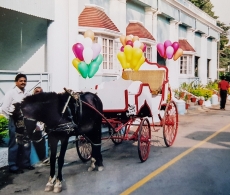
Christmas is celebrated in style at the Club. Strings of tiny lightbulbs are draped all over the establishment’s buildings and the many lovely trees in the Club’s extensive grounds. Shortly before Christmas, there is an outdoor evening carol singing concert that ends with the lighting of a huge bonfire. There is also a lively Christmas party for the members’ children that culminates with the arrival of Father Christmas on a horse-drawn carriage. I always feel a bit sorry for him as he must dress not only in a bushy white beard but also in clothing that is far too warm for the December temperatures in Bangalore, which can be in the high twenties Celsius. On Christmas Day, members and their families, who are not vegetarian as many are in India, queue up for servings of roast Turkey and a wealth of other foods available at a luncheon buffet. There is plenty available for those who prefer not to eat meat. Well, we will be missing all of this in 2020, and a lot more.
Usually, a day or so after we return to London, we visit our travel agent to book tickets for our next ‘Winterreise’ to borrow a title from the composer Franz Peter Schubert. Air tickets become available eleven months before a flight’s departure date. When we were seated at our travel agent’s desk, we told him the dates of our proposed trip. He looked on his system and told us that we could book the outbound flight, but the return flight tickets would not be available for purchase until early April. He advised us to return in April and then book both outward and inbound tickets together. That turned out to be extremely sound advice.
In the middle of March, the UK went into a total ‘lockdown’. It was no longer possible to return to our travel agent or to do much else. In addition, things were deteriorating all over the world as a result of the spreading of covid19 infections. As the weeks went past, it looked increasingly unlikely that we would be making a trip to India at the end of 2020. We were fortunate that we had been advised not to buy our outbound air tickets. Now, having reached December, travel abroad is not advised and currently travel from the UK is being curtailed. Many countries, including India, are banning travel from the UK.
In August, when restrictions on movement were being relaxed, we spent a pleasant week in a rented cottage in Kingsbridge, Devon. We liked the cottage so much that we asked its owner whether we could reserve it over the Christmas/New Year holiday period. She was happy with the idea providing that future ‘lockdown’ rules did not find her trapped there. A couple of months ago, she informed us that the cottage would not be available after all. This was not because of travel restrictions, but because a friend of hers needed temporary accommodation for a few months in winter.
Undismayed, we managed to find another self-catering cottage in the West Country to rent during the Festive Season. Then, London was cast into Tier 3 covid19 preventive measures, which discourage travel outside the Tier 3 restrictions area except between the 23rd and 28th of December. We rang our landlady in the West Country to explain that we would rather not drive so far to spend such a short time and she agreed to rebook us in March 2021.
With the West Country shelved, we decided to stay in a hotel near Cambridge and to spend some ‘socially distanced’ time with one of my cousins, who lives in the area. As the 23rd of December grew nearer, we began planning our festive feasting programme and buying mouth-watering supplies for it. Then, we all learned that the coronavirus had become highly creative and managed to mutate in more ways that most of these bugs can usually manage. This new viral creation is far more efficient at spreading from person to person than its awful ancestors. As a result, and surprisingly sensibly for our strange government, London and much of southeast England was put under stricter restrictions, Tier 4, which include a travel prohibition that forbids travel out of Tier 4 and no relaxation of restrictions during the period that we had planned to spend near Cambridge. So, that was Cambridge ‘out of the window’.
Soon after London was made subject to Tier 4 regulations, we learned that even with the arrival of new vaccines it was likely that the severe restrictions on travel might continue until Easter. So, we reached for the ‘phone and asked our future landlady in the West Country to shift our booking until May 2021. Now, we will make the most of Christmas and New Year without leaving London for any kind of winter journey, let alone India. I hope that all of this does not sound too depressing to you, because we subscribe to the idea that ‘all’s well that ends well’, and we hope that by following the rules, as ad hoc as they might be, we will all keep well.
While we munch our way through all of the festive ‘goodies’ we have accumulated, we will think of you, our friends all over the world, and wish you a prosperous and healthy future.
I HAVE ALWAYS ENJOYED browsing the shelves and piles of books in second-hand/antiquarian bookshops. During my adolescence in the 1960s, I bought many old travel guidebooks, such as were published before WW2 by the likes of Baedeker, Michelin, Murray, and similar. These items were not highly valued by collectors in the ’60s and were very reasonably priced. This was just as well because my spending power was not great at that time. My self-imposed rule was that I would not buy anything priced over £1 (Sterling). One of my prized purchases in that time was a pre-WW1 Baedeker’s guide to Egypt. I paid six shillings (30 pence) for this already rare edition in the second-hand department of Dillon’s university bookshop, which faces the Engineering Department of University College London. This shop is now a branch of the Waterstones chain of booksellers.

Most of the bookshops that I visited regularly were in or near Hampstead, which in the 1960s had at least eight second-hand booksellers. There was one shop that I visited occasionally on the corner of Fleet and Agincourt Roads. Once I entered it and found a copy of Murray’s Handbook to Northern Germany, which was published in the late 1880s. I was fascinated by this book which described Germany long before it was divided into East and West Germany, which is how it was in the 1960s. It also covered parts of the USSR (e.g. Kaliningrad, once ‘Königsberg’) and of Poland (e.g. Danzig, now ‘Gdansk’) that were formerly parts of the German Empire. I looked inside its cover to discover its price. My heart sank. It was priced at one pound and ten shillings (£1.50). It was well beyond my budget. I could not decide whether I should break my £1 rule … only this once, but I did not. Reluctantly, I left the book behind in the shop. I had never seen a copy of this book before, and as I walked away, I wondered whether I would ever see another.
When on foreign travels with my parents, I went into second-hand bookshops and discovered some treasures, which I could afford. For example, in Madrid, I picked up several Michelin guides that had been published before WW1 when motoring was in its infancy. In Italy, which we visited annually during my childhood, I acquired several guides published before WW2 and during Mussolini’s era by the Touring Club Italia (‘TCI’). Some of these covered places that had been parts of Mussolini’s empire, such as Libya and Somalia. One TCI guide covered Friuli-Venezia Giulia, when large parts of what was to become western Slovenia were under Italian rule and the Adriatic coast as far as Rijeka was also part of Italy. This guide also included the Adriatic town of Zadar in Croatia, which was the Italian enclave, called ‘Zara’, before WW2. One treasure, which was subsidised by my parents, was the TCI guide to Greece, which was published just prior to the Italians’ abortive invasion of Greece. My copy includes notes added by its former owner, an Italian soldier. Interestingly, he had traced his route into northern Greece on the book’s map. From this, it was evident that he had travelled through central Albania before entering Greece.
In the 1980s, I was still avidly collecting old books including travel guidebooks. From 1982, when I had passed my driving test and began owning cars, I used to drive to see friends all over the UK and elsewhere. Often, I visited friends in Cornwall. My route, which tended to avoid motorways, took me through many small towns, all of which I explored with a view to discovering second-hand bookshops. Honiton in Devon used to contain several well-stocked antiquarian booksellers. On one trip I entered one of them at the bottom of a hill at the western end of the town and made an exciting discovery. Yes, you have probably guessed it already. In that shop, I found another copy of the old Murray’s guide to Northern Germany. Nervously, I looked for its price. By now, I had abandoned the idea of limiting my spend to £1, which in the 1980s would have been insufficient to buy any of the old guidebooks that attracted my interest. The volume I found was £7, which was remarkably good value in the 1980s. I snapped it up and paid for it with pleasure.
Nowadays, if I see an out-of-print book that interests me, I seize the opportunity to buy it, if, after checking the price on-line, it is not outrageously costly.
Finally, whilst talking about old guidebooks, I must mention an artwork created for me by the lady who would eventually marry me. Long before we were wed, she knew of my collection of guidebooks and was also a keen amateur potter. One day, she presented me with a wonderful gift. It was a box made of fired clay, which was shaped to look like a row of Baedeker guidebooks. This still occupies a prominent position on one of our many overcrowded bookshelves.
WE HAVE BEEN WARNED repeatedly that during the current covid-19 pandemic that travelling abroad, leaving the UK, is not without the risk that after returning home we might have to go into quarantine for fourteen days. The rules relating to quarantine are strict and include remaining at home twenty-four hours a day. This means, amongst other things, not emerging from home even for exercise, shopping, or going to work. For those who must leave home for work and cannot work from home this quarantine can lead to serious loss of earnings. Currently, the state will not compensate those who have to quarantine because they have returned from a country that the British Government considers having a higher rate of covid-19 virus infections or infection rates. I suppose the argument is that like heat, which flows from a higher to a lower temperature, the virus tends to flow from an area of higher infection to one with a lower one. The quarantining is meant to be part of minimising the risk of importing the virus into the UK from abroad.

Some countries may be visited by people living in the UK without the need for people returning from them to have to stay in quarantine. Until recently, the Government was happy for visitors to France to return to the UK without needing to go into quarantine for a fortnight. Because of this and despite warnings that covid-19 infections were on the increase in France, British holidaymakers were happy to take a risk by travelling to France. From the outset, the Government warned that at any moment there might need to be a change in the situation regarding quarantining after visiting abroad.
On the evening of Thursday 13th August 2020, the British Government announced that anyone who visited France and had not returned to the UK by 4 am on Saturday the 15th of August would need to go into quarantine for 14 days after reaching home in the UK. Between this late evening announcement and early Saturday morning, many British holidaymakers in France were panic stricken and tried to reach British soil before the 4 am deadline because they wanted to avoid being compelled to quarantine. Many of those people shelled out enormous amounts of money to obtain last minute bookings on ‘planes, trains, and ferries, in the hope of beating the deadline.
The panicked return was entirely understandable, and I do not blame anyone for trying to avoid a quarantine period that they could ill afford. What I cannot comprehend was what was magic about 4 am on Saturday the 15th of August. If the risk of importing covid-19 from France (or elsewhere) is so great that it is considered necessary to impose quarantine on returnees, why, for example is someone landing in the UK at, say 3.45 am on the 15th of August, any less likely to pose a danger to public health than someone arriving any time after 4 am on that day? In my opinion, if the chances of bringing in the virus from a certain country are deemed dangerously high and it is determined that quarantine will reduce the chances of imported virus from adding to the already significant local supply, the quarantine requirement should have been imposed immediately, without over a moment’s delay.
As for the effectiveness of the enforced quarantine on reducing imports of infection, that remains to be seen. Recently, the owner of a well-known budget airline poured scorn on the idea of quarantine. He pointed out that many travellers landing in British airports travel to their homes by public transport. During that journey to the places where they plan to quarantine for fourteen days, they have plenty of opportunity to spread the virus to others travelling on the same bus, train, or other public transport. By the time they get home, the damage might well have been done. This airline owner was saying this to help save his business from further destruction caused by ‘lockdown’ conditions, but what he said is true.
I DO NOT KNOW ABOUT YOU, but I am finding that time hurtles past during the so-called ‘lockdown’, which severely limits our movements and activities to our local environments. Although I needed little stimulus to do so because I find it enjoyable, it has made me look back into my past more than ever before. This morning (19th of May 2020) on BBC Radio 4, the author Ian McEwan spoke eloquently and with great insight about the perception of time and how it changes during a period of forced inactivity such as long-term prison sentences and our present virus-induced predicament. I was heartened to learn that he and I agree about the effects of ‘lockdown’ on the perception of time’s passage. Having got that ‘off my chest’, I will return to yet more nostalgia. I am going to write about my recollections some of the first ever holidays I enjoyed. These happened when I was well under ten years old. So, my memories may be a little hazy and, also, influenced by what I remember being told about these trips when I was a bit older.
In 1955, when I was three years old, my parents took me to South Africa. We travelled by sea. During the voyage, we crossed the Equator. I have seen photographs taken on board of me dressed in a sheet. When we crossed the Equator, so I was told by my mother, the children on board took part in a fancy-dress party. Unprepared for this, but always resourceful, my mother used a sheet from our cabin to dress me up as a Roman in a toga. Sadly, these photographs have been lost.
On arrival in Cape Town, I faintly recall something that I did on the dockside. There were tracks like tram lines embedded in the ground, along which huge cranes moved. I inserted my tiny foot into the groove of one of these, and then could not remove it. I imagine that my mother, who was excessively anxious about my well-being when I was very young because my birth had been fraught with difficulties, must have been very concerned that her precious child (that is me, folks) would be crushed by a crane on the move. My foot was extracted and with no long-term effects.
Two other recollections of the trip to South Africa relate to our stay in Port Elizabeth, where my father’s mother and sister lived. One faint memory is my concern about the sinister look of the cacti on display in a greenhouse in a park. Another relates to being offered and rejecting smoked salmon – I was an unadventurous eater until my late teens.
I cannot remember visiting King Williams Town (‘King’) in the Eastern Cape in 1955, but about 60 years later I discovered that we did. Several years ago, I was researching at the British Library, leafing through old issues of the “Cape Mercury”, a newspaper published in King. In one of the issues published in 1955, I discovered an article describing our visit to King. The reason we went there was to visit my great grandmother Hedwig Ginsberg, my mother’s grandmother. As she was the widow of a Senator and herself a prominent citizen of King, her social life and that of her son Rudolph, a Mayor of King, was recorded in the paper’s gossip columns. Our visit to King was described. I quote from what I discovered:
“Mrs Yamey … whom many of you will have met in her single days. They now have an adorable little son, Adam, aged three.”
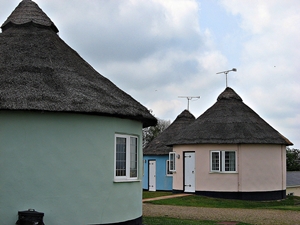
Another trip that I recall vaguely was less exotic. It was to Winterton-on-Sea in Norfolk (UK). I was taken there by my uncle and aunt and their then young daughter. I recall staying in a round hut. Although I did not know it then, the round hut was based on the design of the South African rondavel, a circular hut with a conical roof. Many years later, I re-visited Winterton-on-Sea. The resort colony of rondavel-like dwellings was still being used by holidaymakers. The place, set amongst sloping sandy dunes, had originally been set up by people from South Africa, but had long since changed hands.
My parents were not keen on seaside holidays. However, I can remember two that we made when I was very young. In each case we travelled with friends, who lived in Kent. Arthur Seldon was one of my father’s first friends and collaborators when he came to London from South Africa in the late 1930s. His wife Marjory, who was born on the very same day as my mother, was one of my mother’s closest friends. The Seldons had three sons, one of whom has become quite prominent in public life.
One year, we accompanied the Seldons to the North Sea beach resort, Noordwijk in the Netherlands. This must have been in the second half of the 1950s, just over a decade since the end of WW2. I remember that we kept moving our beach blanket from one patch of sand to another. This was done whenever my mother heard neighbouring holidaymakers speaking in German. During WW2, my mother had worked for the Red Cross in Cape Town. As the war drew to a close, she read Red Cross reports of the atrocities being uncovered in recently defeated Germany. I suppose she thought that there was a good possibility that any adult speaking German in the late 1950s might well have once been at the very least a Nazi sympathiser.
One day when walking back from the beach, I stepped on a nail protruding from some driftwood. I remember an unusual sensation as the nail penetrated the sole of my foot, but it was not pain. My mother, always anxious about me, rushed me to a local doctor, who gave me an injection for tetanus, something I had never heard of at that tender age.
The other holiday with the Seldons was in Bognor Regis on the south coast of England. We had hired a two-storey house for the stay. I remember my mother checking it out before we decided who was going to sleep where. She decided that the Yamey family, mine, was to take the ground floor. The Seldons, she decided, were to occupy the first floor. She had discovered that the windows on the upper floor had low sills, making it easy for people to fall from them. This was not a risk that she was prepared to take. It seemed that it did not bother her to worry about the Seldons risking falling out of these windows. And, as far as I know, it did not worry the Seldons, who survived.
Sometime in the 1950s, we visited Hilversum in Holland. It was the home of one of our live-in helps, Truus Vollmer. She stayed with us for two years and became good friends. Her father worked for Radio Hilversum. Every now and then, he made gramophone records for me. They played at 78 rpm and were unusual because they played from close to the central label outwards towards the edge of the disc. The recordings included sounds of trams, trains, buses, and other forms of transport. One of the records, which I played often, included a recording of the Dutch St Nicholas Day song, with the words:
“Sinterklaas Kapoentje,
Leg wat in mijn schoentje,
Leg wat in mijn laarsje,
Dank je Sinterklaasje!”
During our visit to Hilversum, which I remember dimly, Mr Vollmer tried to record my voice. This was later presented to me on one of his records. I was extremely shy as a small boy. The recording starts with the voices of various adults (some with Dutch accents) and my mother, saying:
“Come on, Adam … Say something … Why not sing something? … Come, say something … Come along … It’s not difficult … Don’t be shy … etc.”
Eventually, my voice can be heard saying sulkily:
“I don’t want to”, and nothing else.
We made several trips to Holland at that time. We always stopped for lunch in Rotterdam, where we ate in the restaurant of a large department store, the Bijenkorf. If I remember correctly, my parents enjoyed eating club sandwiches there. To my knowledge, they never ate them anywhere else.
After 1960, when we stayed close to the sea in Cyprus, our family visited the seaside rarely, and never by design. My mother could not swim, and the sight of water made her uneasy – she was extremely prone to seasickness. My father did enter the sea occasionally, but never for long. The seaside was not my parents’ ‘thing’, nor is it mine.
Well, as I mentioned at the beginning, time feels as if shoots past during the ‘lockdown’. It seems but a few minutes since I woke up in the morning to listen to the latest news of doom and gloom on the radio, but now it is mid-afternoon. Years ago, when I was at school, a 45-minute Latin lesson seemed to last a whole day and I dreaded the occasional double-length Latin lessons we had to endure. Now, it seems that 45 minutes passes in a flash and even a three hour wait in an airport departure lounge seems to shoot past. Yes, our perception of time is a curious thing.
Picture showing rondavels at Winterton -on-Sea

