Seeing India through the eyes of a Londoner

AMONGST THE 101 diverse topics in my book about travelling in India, you will find the following four: observing a padlock made by a company called Hitler; encountering jackals on a golf course; travelling in coracles on crocodile-infested waters; and having spectacles made by Gandhi’s optician. Since getting married in India in early 1994, I have made over fifty visits to the country during which I have spoken to many people and explored a multitude of places – both well-known and hardly known except to locals. My book, “The Hitler Lock & Other Tales of India”, contains a selection of my experiences in the country. The book aims to fulfil the idea of great Jean Molière (1622-1693), namely, “If you want to edify, you have to entertain.” I hope that you will find that I have achieved that.

You can purchase my book from Amazon (either as a paperback or a Kindle e-book) by clicking on the picture below:

DISCOVER THE EXCITING RANGE OF TOPICS IN MY NEW BOOK ABOUT MY TRAVELS IN INDIA DURING THE LAST 30 YEARS

Here is a list of the chapters in Adam Yamey’s anthology of his often entertaining travel experiences in India. The book is both for those who know India and for those who do not.

The book and/or Kindle can be bought by clicking on the picture below.

LIST OF CHAPTERS

Introduction … page 9

Prologue: A book from India … 12

Saved by a nosebleed … 14

You married him? … 16

It began with a bang … 18

Shantiniketan … 20

. Maria and Job … 23

Please use the meter … 27

Mixed couples … 29

Coracles … 31

West End Hotel … 35

Less than one degree … 39

Puncher …42

Dining with the dead … 48

A generous gratuity … 50

Miner’s sauce … 52

From Kutch to Norway … 54

Looking so lovable … 56

Beneath the banyan trees … 58

Meeting Khushwant Singh … 61

A palace by the sea … 64

Monkey business … 67

Chicken 65 … 70

Diplomatic amnesia … 72

Meeting the Mahatma … 74

Feeding the cows … 79

Montecatini Terme … 83

Hummus in Hampi … 86

Clothing can be critical … 89

Traditional but trendy … 94

Facial prejudice … 96

Paradise for bookworms … 99

Wrapped up … 105

The personal touch … 108

He worked with Le Corbusier … 111

My Ferrari … 115

From Gandhi to Hitler … 117

An unusual invitation … 121

Looking for literature … 123

Of dargahs and dyeing … 127

Before my time … 130

Improperly dressed … 132

Dining at Limra … 135

Hitler on the shelf … 139

Beefsteak not biryani … 144

Independence Day … 146

Large snakes … 148

One wife four husbands … 150

One day it might be you … 153

Waterfalls and water closets … 155

Cunning old fox … 158

Kutchi beer … 161

Albanians in India … 163

Bodies in the dark … 167

Don’t let it go viral … 169

Clubbing …171

Lopchu … 175

Threads of faith … 179

Nizam’s … 184

Teapots and politics … 187

A refreshing breeze … 190

Buried not burned … 193

Gandhi’s spectacles … 197

Tea at Lothal … 201

They came from Persia … 207

Don’t take the train … 211

Defying inflation … 215

In your face … 217

Cops and crocs … 219

A curious hotel … 222

Denmark by the sea … 225

No bill food is free … 231

Espresso in Diu … 234

Maurice and Bob … 237

An Indian welcome … 242

The pandit’s wife … 244

Royal encounter … 247

Unlocking a secret … 253

Curious coffee … 255

Do they speak Hindi in Russia? … 257

Dashiki … 260

Field of cars … 263

I love Stalin … 267

Jeremy Bentham and Calcutta …269

India’s first mosque … 273

Eggs excepted … 278

Saving their necks … 280

Reclining on a rug … 283

Bollywood in Bangalore … 285

A coffee house … 289

Bargaining in Mount Abu … 291

Not long in Nepal … 295

An unexpected sight … 299

Four bangles … 303

On the safe side … 306

PHD … 308

In touch with history … 311

James and Adeline … 316

Ladies only … 318

Lost property … 320

Plants from paper … 323

A soaking in Calcutta … 325

Mapusa market … 331

Introducing my NEW BOOK ABOUT MY TRAVELS IN INDIA

SOME SOUVENIRS FROM MY VISITS TO INDIA DURING THE PAST 30 YEARS

 —  A new book with a curious title  —

True love drew me to India. Since my first trip there in late 1993, I have visited the country more than fifty times.

After I married Lopa in London in October 1993, we travelled to her native land, India, a few weeks later. From the moment I first landed on Indian soil, my eyes opened wide with amazement, and ever since then, India has filled me with a delightful sense of wonder. 

You might be curious about the book’s title. This relates to a chance one-off sighting (in the 1990s) of a padlock made by an Indian company with the same name as that of Germany’s former Führer. From that day onward, whenever I have been in India and seen a shop or market stall selling locks, I have always looked to see whether any of this company’s locks are on sale.

To discover some of the many things that endear me to India and whether I ever managed to find one of these curiously named locks, you need to read my new book. Illustrated with my photographs, it contains over one hundred short prose vignettes, which can be enjoyed by both those who are familiar with the country and those who are not.

Paperback: https://www.amazon.co.uk/HITLER-LOCK-OTHER-TALES-INDIA/dp/B0CFM5JNX5/

Kindle: https://www.amazon.co.uk/HITLER-LOCK-OTHER-TALES-INDIA-ebook/dp/B0CG3DX1LP/

Impressions of India in preparation

At the moment, I am preoccupied with carrying out the final editing of my latest book, which I have described briefly below. When I publish it, which I hope will be soon, I will post more about it here in my blog and elsewhere.

A lock made by Hitler; Bollywood encounters; jackals on the golf course; teamakers and politicians; banyans and monkeys; Gandhi’s optician; coracles and crocodiles; and Denmark in India: these are just a few of the topics covered in Adam Yamey’s collection of 101 intriguing vignettes of life in India. This book with illustrations is the author’s love letter to India, a country he has been visiting frequently for almost 30 years.

Welcomed to India with coffee

BECAUSE OF THE COVID19 pandemic, we had not stepped onto Indian soil for two years and nine months. This was unusual for us because after we married in early 1984, we have been visiting India on average twice a year. For family related reasons, we have almost always landed in Bangalore.

When a new international airport was opened near Devanahalli village (at the northern edge of Bangalore) a few years ago, a line of eateries and cafés opened alongside the main landside of the terminal building. Being outside the terminal, which can only be entered by holders of air tickets, these outlets can be used by passengers and those who are not travelling by air.

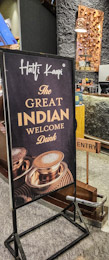
One of these stalls is a grand affair partly decorated with copper sheeting. It is called Hatti Kaapi. The ‘kaapi’ in the name refers to the way local Bangaloreans pronounce ‘coffee’. This particular coffee stand provides excellent quality South Indian filter coffee. It is so wonderful that whenever we visit the airport, either arriving (from the UK or from places elsewhere in India) or departing, we always make time to drink a coffee served by this superb stall.

So, after what was for us an abnormally long absence from India and what has been a disastrous period for everyone, it was wonderful to discover that it was ‘business as usual’ at Hatti Kaapi. And since our last trip 2 ¾ years ago, a new sign has appeared at Hatti Kaapi. It reads:
“HATTI KAAPI The great Indian welcome drink.”


Seeing that sign after 2 ¾ years made us feel much more welcome than its designers could have ever imagined.

Sad to leave, glad to return

AT THE END of a four day stay in Venice, a city, which I have loved ever since my early childhood days, I felt sad at the prospect of departure for home. Wandering about the city brought back happy memories of visits there with my parents as well as giving me the chance to experience familiar sights and to make new discoveries. Although Venice is a little overrun with tourists, its history as a gateway to points further east remains fascinating and evocative. So, the anticipation of leaving filled me with sadness.

We left Venice on a waterbus, which arrived punctually and was not overcrowded. After a lovely 70 minute voyage, which included stops at the Lido, the Fondamente Nove, and a couple of stops on the island of Murano (famous for its glass production), we arrived at Marco Polo Airport. And that is where our journey became wearying.

First, we had to queue to reach the baggage depositing facility for our airline Easyjet. Next, we discovered that our departure would be delayed by about 30 minutes. Then, we sat in a crowded waiting area without knowing from which gate we would be boarding our ‘plane. It was important to know this because there are two sets of passport control points, each leading to a separate set of gates. Once the gate was announced, another queue. This time, we had to wait (not too long) to have stamps placed in our non-EU passports. On arrival at the departure gate, we were told that boarding was beginning. What this meant was that everybody had to stand up, to show our boarding passes, and then to stand in a long sloping corridor for at least 10 minutes before we were invited on-board. The 1 hour 55 minute flight to London’s Gatwick Airport was pleasant, although delayed.

At Gatwick, we disembarked at a point distant from the immigration hall. The latter was reached after a good 15 minute walk. The passport control area was chock-full of people, some of them inebriated. Unlike in the EU, where EU and non-EU passport holders are separated, at Gatwick (and Heathrow), both kinds of passport holders and those from several other countries (e.g., Australia, NZ, and Japan) queue together to use the automated passport checking machines. The process, which might save spending on labour costs, is not user-friendly. Many passengers had difficulty using the machines and had to be helped by other passengers and a few members of airport staff. Fortunately, because it had taken so long to get through the immigration control, our suitcase had arrived in the baggage collection hall.

After one more short, but fast-moving queue, we reclaimed our car keys, and soon began the 1 hour drive home. Although I was so sad leaving Venice, after the many hours spent at airports and the numerous lines in which we waited, I was glad to be home. Years ago, when I was a child, leaving wherever we had spent our holiday was always sad, but even worse was returning to everyday routines of school and life in the staid Hampstead Garden Suburb, where we lived.

Grim warnings along the road

IN THE EIGHTEENTH century, travelling by road in England was not without its dangers, One of these was being robbed by highwaymen. Frequently, individual travellers and passengers in horse-drawn coaches were stopped by bandits, who were after money, jewellery, and other valuables.

Photo by Rene Asmussen on Pexels.com

Even close to London, for example between Mayfair and Hammersmith, highwaymen plied their evil trade. As an example, the diarist Samuel Pepys (1633-1703) recorded in his entry for the 19th of May 1669:

“Here news was first talked of Harry Killigrew’s being wounded in nine places last night by footmen in the highway, going from the park in a hackney coach toward Hammersmith to his house at Turnam greene [sic] …”

The punishment for highwaymen, who were captured, was often death by hanging. Many of those convicted of crimes in the countryside around London were hung at Tyburn, close to where London’s Marble Arch stands today. Ending a highwayman’s life at Tyburn was often not the end of the story as is shown in this extract from Select Trials, for Murders, Robberies, Rapes, Sodomy, Coining, Frauds, and Other Offences. At the Sessions-House in the Old-Bailey. …, (published in 1742):

“The same day that Hawkins and Simpson were hanged, their bodies were carried to Hounslow Heath, and there hanged in irons on a gibbet erected for that purpose, not far from that on which Benjamin Child was hanged in the same manner…”

Hounslow Heath was a vast area in Middlesex, now covered mostly by west London and Heathrow Airport. It was crossed by several important roads from London to the west and south west. In between the small villages that were dotted about the Heath, there was no shortage of highwaymen and the potential for stealing much of value was great on these major arteries. The quote above mentioned that the bodies of the two fellows who were hung at Tyburn were taken to Hounslow Heath to be hung in irons. Back in those times, the bodies of executed highwaymen were hung from gibbets alongside the main roads in order to deter others from being tempted to rob travellers. How effective these grim warnings were in preventing highway robberies, I do not know.

Travelling abroad at last

WE ARRIVED IN ENGLAND from India on the 27th of February 2020. Because of the covid outbreak, we had not left England until today, the 13th of September 2021. Some, especially those who live there, regard Cornwall as being another country, rather than part of England. We have visited that southwest county of what most people regard as England, since we arrived back from England. So, it would be pushing things if we said that we went abroad to Cornwall,

Today, we travelled abroad, leaving England for a few hours. To reach our destination we did not have to take covid tests or show evidence of double doses of vaccine or, even, show our passports. However, leave England we did. We crossed the River Severn to leave England and enter Wales. Crossing the Severn Bridge on the M48 did not require us to pay a toll as used to be the case, as the crossing is now free of charge. A few years ago, a toll was charged for crossing into Wales, but no longer; it has been abolished.

Tintern Abbey

Well, I hear you say, Wales is not exactly ‘abroad’, but when one has not left England for over 18 months, it will do as ‘abroad’. Wales has its own parliament and most signs, be they on the road or elsewhere, are bilingual (English and Welsh) and, if you are lucky, you will meet a speaker of the Welsh language. To us, crossing over into Wales, after so many moths without foreign travel, felt like going abroad.

We drove along the beautiful Wye Valley and stopped at the attractive ruins of the former Cistercian Tintern Abbey (Abaty Tyndyrn in Welsh), the first ever Cistercian foundation in Wales. At the ticket office, I expressed my joy at being abroad after so many months, and the cashier said to me in a gently Welsh accent:

“I like your style.”

We have visited Tintern Abbey (founded 1131) many times in the past and each time it has been a wonderful experience. Today was no exception. Set in a wooded valley, the ruins of the gothic buildings look great against the background of trees with dark green foliage. After spending about an hour in Tintern, we drove along roads which were mainly in Wales but occasionally crossed the border into England. When we reached Wrexham (Wrecsam in Welsh), we headed off north and east into England, our trip abroad having been completed.