Introducing my NEW BOOK ABOUT MY TRAVELS IN INDIA

SOME SOUVENIRS FROM MY VISITS TO INDIA DURING THE PAST 30 YEARS

 —  A new book with a curious title  —

True love drew me to India. Since my first trip there in late 1993, I have visited the country more than fifty times.

After I married Lopa in London in October 1993, we travelled to her native land, India, a few weeks later. From the moment I first landed on Indian soil, my eyes opened wide with amazement, and ever since then, India has filled me with a delightful sense of wonder. 

You might be curious about the book’s title. This relates to a chance one-off sighting (in the 1990s) of a padlock made by an Indian company with the same name as that of Germany’s former Führer. From that day onward, whenever I have been in India and seen a shop or market stall selling locks, I have always looked to see whether any of this company’s locks are on sale.

To discover some of the many things that endear me to India and whether I ever managed to find one of these curiously named locks, you need to read my new book. Illustrated with my photographs, it contains over one hundred short prose vignettes, which can be enjoyed by both those who are familiar with the country and those who are not.

Paperback: https://www.amazon.co.uk/HITLER-LOCK-OTHER-TALES-INDIA/dp/B0CFM5JNX5/

Kindle: https://www.amazon.co.uk/HITLER-LOCK-OTHER-TALES-INDIA-ebook/dp/B0CG3DX1LP/

Impressions of India in preparation

At the moment, I am preoccupied with carrying out the final editing of my latest book, which I have described briefly below. When I publish it, which I hope will be soon, I will post more about it here in my blog and elsewhere.

A lock made by Hitler; Bollywood encounters; jackals on the golf course; teamakers and politicians; banyans and monkeys; Gandhi’s optician; coracles and crocodiles; and Denmark in India: these are just a few of the topics covered in Adam Yamey’s collection of 101 intriguing vignettes of life in India. This book with illustrations is the author’s love letter to India, a country he has been visiting frequently for almost 30 years.

Welcomed to India with coffee

BECAUSE OF THE COVID19 pandemic, we had not stepped onto Indian soil for two years and nine months. This was unusual for us because after we married in early 1984, we have been visiting India on average twice a year. For family related reasons, we have almost always landed in Bangalore.

When a new international airport was opened near Devanahalli village (at the northern edge of Bangalore) a few years ago, a line of eateries and cafés opened alongside the main landside of the terminal building. Being outside the terminal, which can only be entered by holders of air tickets, these outlets can be used by passengers and those who are not travelling by air.

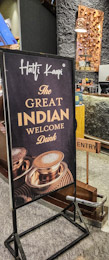
One of these stalls is a grand affair partly decorated with copper sheeting. It is called Hatti Kaapi. The ‘kaapi’ in the name refers to the way local Bangaloreans pronounce ‘coffee’. This particular coffee stand provides excellent quality South Indian filter coffee. It is so wonderful that whenever we visit the airport, either arriving (from the UK or from places elsewhere in India) or departing, we always make time to drink a coffee served by this superb stall.

So, after what was for us an abnormally long absence from India and what has been a disastrous period for everyone, it was wonderful to discover that it was ‘business as usual’ at Hatti Kaapi. And since our last trip 2 ¾ years ago, a new sign has appeared at Hatti Kaapi. It reads:
“HATTI KAAPI The great Indian welcome drink.”


Seeing that sign after 2 ¾ years made us feel much more welcome than its designers could have ever imagined.

Sad to leave, glad to return

AT THE END of a four day stay in Venice, a city, which I have loved ever since my early childhood days, I felt sad at the prospect of departure for home. Wandering about the city brought back happy memories of visits there with my parents as well as giving me the chance to experience familiar sights and to make new discoveries. Although Venice is a little overrun with tourists, its history as a gateway to points further east remains fascinating and evocative. So, the anticipation of leaving filled me with sadness.

We left Venice on a waterbus, which arrived punctually and was not overcrowded. After a lovely 70 minute voyage, which included stops at the Lido, the Fondamente Nove, and a couple of stops on the island of Murano (famous for its glass production), we arrived at Marco Polo Airport. And that is where our journey became wearying.

First, we had to queue to reach the baggage depositing facility for our airline Easyjet. Next, we discovered that our departure would be delayed by about 30 minutes. Then, we sat in a crowded waiting area without knowing from which gate we would be boarding our ‘plane. It was important to know this because there are two sets of passport control points, each leading to a separate set of gates. Once the gate was announced, another queue. This time, we had to wait (not too long) to have stamps placed in our non-EU passports. On arrival at the departure gate, we were told that boarding was beginning. What this meant was that everybody had to stand up, to show our boarding passes, and then to stand in a long sloping corridor for at least 10 minutes before we were invited on-board. The 1 hour 55 minute flight to London’s Gatwick Airport was pleasant, although delayed.

At Gatwick, we disembarked at a point distant from the immigration hall. The latter was reached after a good 15 minute walk. The passport control area was chock-full of people, some of them inebriated. Unlike in the EU, where EU and non-EU passport holders are separated, at Gatwick (and Heathrow), both kinds of passport holders and those from several other countries (e.g., Australia, NZ, and Japan) queue together to use the automated passport checking machines. The process, which might save spending on labour costs, is not user-friendly. Many passengers had difficulty using the machines and had to be helped by other passengers and a few members of airport staff. Fortunately, because it had taken so long to get through the immigration control, our suitcase had arrived in the baggage collection hall.

After one more short, but fast-moving queue, we reclaimed our car keys, and soon began the 1 hour drive home. Although I was so sad leaving Venice, after the many hours spent at airports and the numerous lines in which we waited, I was glad to be home. Years ago, when I was a child, leaving wherever we had spent our holiday was always sad, but even worse was returning to everyday routines of school and life in the staid Hampstead Garden Suburb, where we lived.

Grim warnings along the road

IN THE EIGHTEENTH century, travelling by road in England was not without its dangers, One of these was being robbed by highwaymen. Frequently, individual travellers and passengers in horse-drawn coaches were stopped by bandits, who were after money, jewellery, and other valuables.

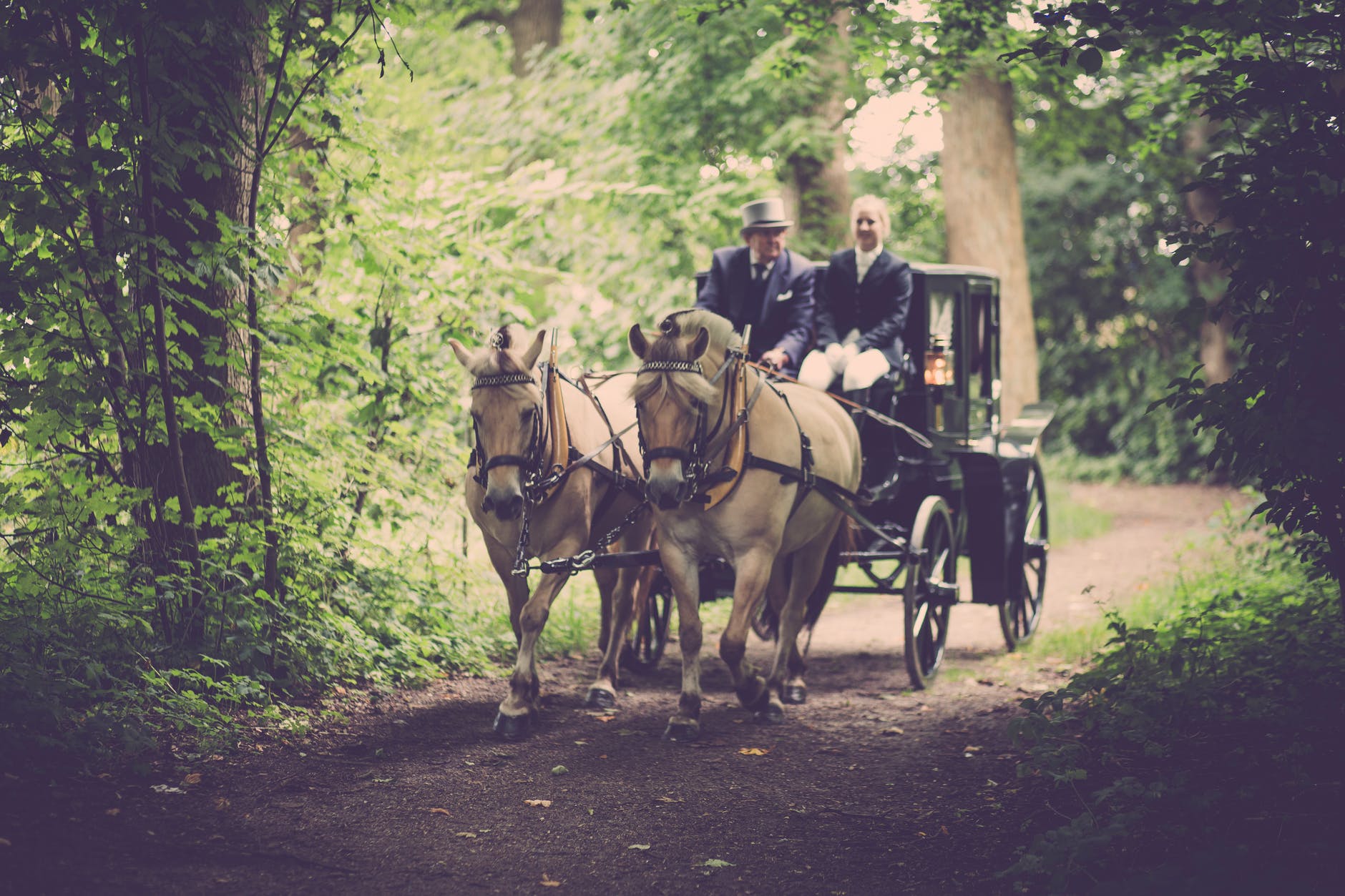
Photo by Rene Asmussen on Pexels.com

Even close to London, for example between Mayfair and Hammersmith, highwaymen plied their evil trade. As an example, the diarist Samuel Pepys (1633-1703) recorded in his entry for the 19th of May 1669:

“Here news was first talked of Harry Killigrew’s being wounded in nine places last night by footmen in the highway, going from the park in a hackney coach toward Hammersmith to his house at Turnam greene [sic] …”

The punishment for highwaymen, who were captured, was often death by hanging. Many of those convicted of crimes in the countryside around London were hung at Tyburn, close to where London’s Marble Arch stands today. Ending a highwayman’s life at Tyburn was often not the end of the story as is shown in this extract from Select Trials, for Murders, Robberies, Rapes, Sodomy, Coining, Frauds, and Other Offences. At the Sessions-House in the Old-Bailey. …, (published in 1742):

“The same day that Hawkins and Simpson were hanged, their bodies were carried to Hounslow Heath, and there hanged in irons on a gibbet erected for that purpose, not far from that on which Benjamin Child was hanged in the same manner…”

Hounslow Heath was a vast area in Middlesex, now covered mostly by west London and Heathrow Airport. It was crossed by several important roads from London to the west and south west. In between the small villages that were dotted about the Heath, there was no shortage of highwaymen and the potential for stealing much of value was great on these major arteries. The quote above mentioned that the bodies of the two fellows who were hung at Tyburn were taken to Hounslow Heath to be hung in irons. Back in those times, the bodies of executed highwaymen were hung from gibbets alongside the main roads in order to deter others from being tempted to rob travellers. How effective these grim warnings were in preventing highway robberies, I do not know.

Travelling abroad at last

WE ARRIVED IN ENGLAND from India on the 27th of February 2020. Because of the covid outbreak, we had not left England until today, the 13th of September 2021. Some, especially those who live there, regard Cornwall as being another country, rather than part of England. We have visited that southwest county of what most people regard as England, since we arrived back from England. So, it would be pushing things if we said that we went abroad to Cornwall,

Today, we travelled abroad, leaving England for a few hours. To reach our destination we did not have to take covid tests or show evidence of double doses of vaccine or, even, show our passports. However, leave England we did. We crossed the River Severn to leave England and enter Wales. Crossing the Severn Bridge on the M48 did not require us to pay a toll as used to be the case, as the crossing is now free of charge. A few years ago, a toll was charged for crossing into Wales, but no longer; it has been abolished.

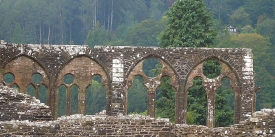
Tintern Abbey

Well, I hear you say, Wales is not exactly ‘abroad’, but when one has not left England for over 18 months, it will do as ‘abroad’. Wales has its own parliament and most signs, be they on the road or elsewhere, are bilingual (English and Welsh) and, if you are lucky, you will meet a speaker of the Welsh language. To us, crossing over into Wales, after so many moths without foreign travel, felt like going abroad.

We drove along the beautiful Wye Valley and stopped at the attractive ruins of the former Cistercian Tintern Abbey (Abaty Tyndyrn in Welsh), the first ever Cistercian foundation in Wales. At the ticket office, I expressed my joy at being abroad after so many months, and the cashier said to me in a gently Welsh accent:

“I like your style.”

We have visited Tintern Abbey (founded 1131) many times in the past and each time it has been a wonderful experience. Today was no exception. Set in a wooded valley, the ruins of the gothic buildings look great against the background of trees with dark green foliage. After spending about an hour in Tintern, we drove along roads which were mainly in Wales but occasionally crossed the border into England. When we reached Wrexham (Wrecsam in Welsh), we headed off north and east into England, our trip abroad having been completed.

Uganda and me

UGANDA IS ONE OF many countries that I have not yet visited. Yet, I can relate some personal anecdotes related to it.

When we had our Hindu wedding ceremony in Bangalore (India), several of my wife’s aunts, whose families originated in Kutch (now part of Gujarat State in western India) were present and quite concerned that there were elements of Kutchi marriage traditions incorporated into our three-hour long ceremony. I cannot remember what these were. One of the aunts had lived with her family in Uganda until they saw the ‘writing on the wall’ and left for India before Idi Amin forcibly expelled all of the other Asians from his country. Her son, who lives in the UK, introduced me to Uganda’s national alcoholic drink ‘waragi’, brewed from bananas, which did not appeal to me as much as other drinks with 40% alcohol content.

Soon after I went to India for our wedding, I began working in a dental practice near Portobello Road in west London. It was there that I worked with ‘A’, who was the best dental surgery assistant I have ever worked with. She was resourceful, bright, friendly, polite, efficient, and never lost her cool. When equipment went wrong, I used to want to ring Andy, our repairman, but A would say:

“Let me fix it, Mr Yamey, I saw what Andy did last time.”

And usually, she fixed whatever had broken down.

Occasionally, A worked at the reception desk. Patients used to come up to the desk, often impatient and desperate to obtain dental treatment immediately. Instead of getting flustered, as other receptionists might easily have done, she used to say calmly something like:

“Good afternoon, Mr Brown, how are you today? And how is your family?”

When the patient had been calmed down by her questions, she would get down to the business of making arrangements for the patient’s treatment. She had a civilising influence on others.

A was born in Uganda after Idi Amin had given up ruling the country, but she lived through the troubling times that followed his downfall. She told me that she had witnessed a member of her close family being shot while she hid in a bush nearby. On another occasion, she told me:

“I heard some soldiers coming to my home, and, Mr Yamey, I jumped out of a window at the back and ran into the fields. I ran and ran and ran.”

Despite these and other horrific experiences, one would not imagine that A had had such a traumatic childhood.

A was an evangelical Christian. She kept a small edition of the New Testament in one of the drawers in my surgery alongside tubes and bottles of dental materials. It was printed mainly in black but with some words in red. These were, A explained to me, the words that had been uttered by Jesus. Every day, she used to say to me in her gentle voice:

“Mr Yamey, all you need to do to be saved is to accept Jesus into your life.”

This did not bother me, nor did the evangelical Christian radio station that she liked to hear while we were working. However, one day a particularly nervous dental patient, a frequent attender who had been born in the USA, was lying in my treatment chair, when he lifted his hand and said politely:

“There are two things that upset me. One is having dental treatment and the other is having religion thrust down my throat. So, A, will you please turn off the radio now.”

A did as asked, and we never listened to that station again. Often, A encouraged me to try ‘matoke’, a Ugandan dish made from a type of banana. She thought it was delicious, but I have not yet sampled it. I have not seen A for a long time now and hope that she and her husband are thriving and enjoying a life far better than she experienced in Uganda.

Long before I became a dentist, in my teens (in the second half of the 1960s), I loved collecting travel brochures: leaflets, maps, and booklets issued free of charge by travel companies and national tourist offices. My friend ‘F’ shared this passion. One day during the summer holidays, F suggested that we, that is F and his brother, me, and ‘H’, another close friend, should have a brochure collecting competition.  F and H formed one team, and F’s brother and I the other. The plan was that we start together at Oxford Circus and then work our way down to Trafalgar Square, collecting as much free travel literature as we could gather. The winning team would be the one which had collected most material, but taking duplicates was not allowed. Speed was also important, so we tried to waste as little time as possible in each place.

My team entered one travel agent or national tourist office after another, taking whatever was on display and asking the people working in them for any material that was available but not on display. We piled our ‘loot’ into the rucksacks we were carrying and moved from one location to the next. Our loads were quite heavy when F’s brother and I arrived at the locked door of Uganda’s tourist office on the south side of Trafalgar Square. We rang the door and were admitted by a man who led us upstairs to his office. There, we were asked to sit in front of his desk. He chatted to us politely, passing the time of day, whilst we sat there anxiously as the minutes, which we could be using more profitably, slipped past. Eventually, we got around to asking him for travel literature. He handed us three thin coloured brochures, which we considered to be a poor haul given how long we had spent with him.

Passing the Ugandan tourist office, which is still where it was during the 1960s, today in January 2021, soon after a recent election in that country, brought back memories of our brochure collecting dash and made me wonder whether at that time I should have been chasing after girls in my spare time, as many of my schoolmates were doing, rather than picking up leaflets about exotic destinations. By the way, F and H won our competition by a narrow margin.

So, finally, this is almost all I have relate about my somewhat tenuous connections with Uganda. All I wish to add relates to my father’s regular purchases of the satirical magazine “Private Eye”, which gave the term ‘Ugandan discussions’ a new meaning in March 1973. If you do not know what I mean, then I will leave you to search for the term on Google.