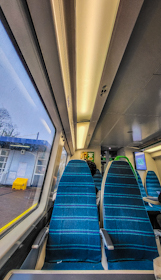
Riding the train
Composing a brand new haiku
Passing time nicely

Riding the train
Composing a brand new haiku
Passing time nicely
WHILE SORTING THROUGH some old photographs, I came across some I had taken during my first visit to Paris. It was 1968 and I was 16. I travelled there with my parents on the overnight Silver Arrow, a train that was put on board a ferry to cross the English Channel. We stayed in a hotel on the Ile St Louis. Everything about the city both enchanted and amazed me.

The photograph included in this post was taken through the window of my compartment in the Silver Arrow as soon as the train pulled into Paris Gare du Nord.
I have visited Paris many times since 1968, but it was during my first visit that the city impressed me most. Although the photographs I found brought back happy memories, I have no great yearning to visit Paris again in the near future.
IT IS NOT UNCOMMON to find that transport vehicles such as trains, boats, and aeroplanes, are given names. They are often named to honour noteworthy people. While strolling along platform 1 at London’s Paddington station today (21st July 2024), I noticed a train bearing the name ‘Megan Lloyd George CH’. You will, I hope, excuse my ignorance when I tell you that although I have heard of David Lloyd George (1863-1945), a former Prime Minister, Megan Lloyd George was not a name with which I am familiar. I wondered why the Great Western Railway (‘GWR’) had chosen to put her name on one of its trains. When I got home, I found out why.

Megan Lloyd George (1902-1966) was the youngest child of the Prime Minister David Lloyd George. She was born in Criccieth, Wales. Until she was four years old, she could only speak in Welsh. Between the ages of 8 and 20, she spent much of her life in the Prime Minister’s residence, 10 Downing Street. It is not surprising that the young lady became interested in politics. With some help from her father, Megan became the Liberal party candidate for the Welsh constituency of Anglesey, and in May 1929, she was elected as its Member of Parliament (‘MP’). She became the first woman MP from Wales. She was re-elected in the general elections of 1931 and 1935.
According to a biography (https://liberalhistory.org.uk/history/lloyd-george-megan/), Megan accompanied her father:
“… on his visit to Hitler in 1936, and opposed the policy of appeasement, urging him to press for Chamberlain’s resignation in May 1940.”
She served in Parliament throughout WW2, and was re-elected in 1945 and 1950, but with greatly reduced majorities. In 1952, she lost her seat.
For various political reasons, Megan and several other members of her party left the Liberal Party and joined the Labour Party in April 1955. In 1957, she became the Labour MP for Carmarthenshire, with a majority of 3000 votes. Always a popular figure, she took Carmarthenshire again in 1966, with a majority of 9000. By then, she was suffering from cancer, and died soon after the election and a few days after having been awarded the Companion of Honour (‘CH’) by Prime Minister Harold Wilson. In 2016, she was nominated as one of the ‘50 Greatest Welsh Men and Women of All Time’ (www.walesonline.co.uk/news/wales-news/50-greatest-welsh-men-women-11431779).
GWR trains run from Paddington to the west of England and parts of Wales including its capital, Cardiff. So, we should not be surprised to find Megan’s name on one of them. Having said that, I am not sure where the train with her name on it was heading as it left platform 1.
OUR JOURNEY FROM Bhuj to Baroda (Vadodara), both in Gujarat, began yesterday at 650 am and ended at our hotel just after 8 pm. The distance we travelled was about 265 miles. There are direct trains between Bhuj and Baroda, but these were fully booked on the day we wanted to travel (i.e., 30th November 2023).
The first ‘leg’ of our journey was on a train that carried us from Bhuj to Sabarmati Junction – one of Ahmedabad’s several railway stations. The other passengers in our compartment were 4 young girls and a couple of young men returning to university after their Diwali break. We noted that the girls talked to each other. So, did the boys. But the girls and boys did not converse with each other and showed no interest in each other. The train rattled at high speed through the flat countryside and arrived at Sabarmati only about 8 minutes late. Unlike many Indian trains I have been on, the Bhuj to Sabarmati Superfast had no vendors wandering up and down the train.
It is a few miles between Sabarmati Junction and Ahmedabad’s centrally located main station. We hired an autorickshaw to take us between Sabarmati Jn and the Moti Mahal restaurant near the main station. Our driver tore through the heavy traffic narrowly missing numerous collisions. The eatery proved to be a scruffy but extremely popular place – noisy and lively. We enjoyed a good light lunch before walking to the station.
Although it was only about 200 yards between the restaurant and the station, it was necessary to cross an incredibly busy road with fast moving vehicles. We asked an autorickshaw driver if he would drive us there. He refused, but kindly offered to help us across the road, which resembled a disorderly road race. Using his arms like a traffic policeman he shepherded us across the thoroughfare. Even with his help it was a hair-raising experience.
We had to wait for our next train for about two hours on platform 6. The train we were about to catch was the Porbandar Shalimar Superfast. This train leaves Porbandar in Saurashtra (part of Gujarat) at 850 am on day 1 and arrives at Shalimar (a station in Calcutta) at 3.35 am on day 3 – having travelled a distance of 2544 km. Our journey on this train lasted just under two hours, arriving in Baroda about 20 minutes late.

Unlike the train from Bhuj, the train to Shalimar was well populated by vendors. The seemingly endless procession of sales people were offering: bottled water; hot tea; snacks including biryani and bhel poori; bags of apples; and mobile phone chargers and cables. One lady in a colourful sari was selling attractive square mats at 10 Rupees each. Every now and then, a deformed invalid literally scuttled along the filthy floor of the corridor. He stopped at each compartment and banged his collecting pot ominously on the ground. Only a few passengers gave him coins.
The sun had set when our train pulled out of Ahmedabad. Through the open window, I saw many small villages, many of them with Hindu temples adorned with coloured lights – many of them flashing decorously. I could also see many brightly lit shops. Within the train, I had an excellent view of the door to one toilet. Even when it was closed it vibrated furiously as the train sped along. Many passengers peered inside the loo, but few dared to enter it.
The train seemed to travel even faster than the one from Bhuj, and it was a relief to disembark in Baroda’s lovely station. After another autorickshaw drive, we arrived at our comfortable hotel. Our reception there was a little reminiscent of an episode from “Fawlty Towers”. Once this was, over, things went smoothly and we enjoyed a good dinner in its dining room.
WE HAD DECIDED TO travel to Mandvi (in Kutch, a part of Gujarat) by taking a train to Gandidham, then going by road the 98 kilometres between there and Mandvi.
The Indore to Gandidham Express arrived 30 minutes late on Ahmedabad Junction’s platform 4. Getting on to our carriage was a veritable scrum. The problem was that people, including us, wanted to board before those alighting at Ahmedabad had reached the carriage entrance. Someone behind us shouted “Hurry up and get inside.” When a passenger who was trying to leave the train replied “We want to get off”, the irritating lout behind us shouted “You should have started getting out quicker.” We struggled along the carriage and found our window seats eventually.
We had reserved seats numbers 73 and 76. A man was sitting in seat 76. When we said it was one of ours, he said that he was occupying his alloted seat, namely seat 77. It took some considerable persuasion before he understood that seat 77 did not have the number ‘76’ above it. This incident reminded me when I used to travel by train in Italy during the 1960s.
Whenever we travelled by intercity trains in Italy long ago, my parents always reserved seats – always in the first class carriages – in advance. Invariably, our reserved seats would be occupied by passengers who should not have been in them. It was o lying after the train conductor had been summoned that the people yielded our seats to us. Moments later, these obstinate people would engage in friendly conversation with us.
Returning to the Indore to Gandidham Express, before it started, vendors selling fruit and bottled water roamed along the platform looking for customers. Meanwhile, a hot tea seller moved along the interior of the train. He and others remained on board during the journey, as did a couple of snack vendors.
Once we got going, the train sped along. There was only one intermediate station where we stopped briefly during the 4 and a 1/2 hour journey. As we traversed the flat plains of Gujarat, we saw many neatly cultivated fields and numerous industrial units of varying sizes. In the area where eastern Kutch begins, we passed vast expanses of land being used as salt pans. Every now and then, we saw conical mounds of grayish white harvested salt.
Many trains passed us, travelling in the opposite direction. Almost all of them were freight trains. The line along which were moving leads to and from the busy port of Kandla on the south coast of Kutch. What little we saw of Gandidham and its outskirts was unattractive.
The air temperature at Gandidham station was well over 30 degrees Celsius and there was little shade. To exit the station, we had to use an escalator. Once again it was a scrum trying board it. Some passengers were too frightened to step on it which made using it even more difficult.
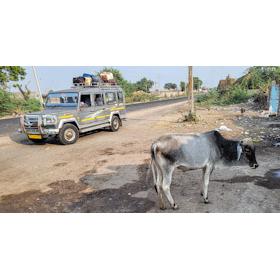
Our host in Mandvi had kindly booked us seats in a shared taxi to travel from Gandidham to Mandvi. This vehicle was like a jeep. It had a front row of seats – sofa like – and behind that there was another similar seating arrangement. Behind that, there was a far less comfortable seating space that accommodated any number of people that could be squeezed in. We were booked into the seating behind the front seats and in front of the rear ‘compartment’.
Although the middle seating had been booked for my wife and me, Lopa invited one of the three passengers who had squeezed in the front seat next to the driver to join us. He turned out to be a friendly chap. He and his friends were returning home from several days of a religious pilgrimage. Our new companion was a trader in rice, sugar, etc. He bought commodities and sold them for export. During our journey, he received a telephone call. He told us that soon after getting home, he had to go to Bombay for some urgent work. He and his business partner would have to drive for 11 hours through the night to reach Bombay from near Mandvi.
Our driver decided not use the 4 lane highway between Gandidham and Mandvi because of heavy traffic. Instead – and it made the journey far more interesting – he took us along a “short cut”, using country roads, some of them minor. This added fascination because we passed through rustic villages. At one of these, we were stopped by an elderly lady standing beside the road. She wanted to go to Mandvi, and was invited on board.
At another place, we stopped and the driver picked up a bundle tied in cloth, which he delivered to someone in another village we passed through later. After about an hour, to my great relief because my mouth was parched, we stopped for about 20 minutes at a stall where snacks and cold drinks were available.
At one point early during our journey, someone in the rear compartment asked our new companion to dial a certain number on his phone. Some conversation in Gujarati ensued. It turned out that there were some labourers travelling in the rear compartment. As they had not yet been paid by their employer, they claimed that they did not have the 300 Rupees needed to pay for the ride. Our friendly sugar trader allowed the employer to electronically transfer the required amount to his account. Our neighbour then suggested that he could electronically transfer that fare money to the driver’s account. However, the driver wanted to be paid in cash, which the trader kindly agreed to do.
Most of the way, the driver used one hand to steer, and the other to hold his mobile phone to his ear. Despite this hazardous practice, there were no scary moments along the way. We arrived at our destination safely, but somewhat cramped.
When we sat inside our host’s air-conditioned large saloon car to drive to his house, it felt as if we had moved from a stone seat into a feather bed. Never before has a modern saloon car felt so comfortable.
Despite moments of discomfort, our rail and road trip was enjoyably interesting. By the end of the journey we felt as if we had been truly travelling – a feeling that air travel often fails to provide.
THE FIRST TIME I visited Southend in Essex was in about 1960. I was invited to go there on a day trip with my best friend, his younger brother, and their father, who was a senior official in London Transport. We went by car, stopping on the way at several London Transport bus garages, where we saw a few vintage busses. I remember two things about Southend on that first visit. First, we ate fish and chips. It was the first time I had sampled this cuisine because my parents were too snobbish about food to have been seen dead in a fish and chip shop. I have enjoyed fish and chips ever since that time in Southend. The other thing that sticks in my mind was travelling along Southend Pier in a special train that carried passengers almost to its furthest point from the seafront. It was not until the 11th of February 2022 that I made my second visit to Southend.
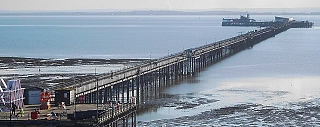
Southend Pier is the longest pleasure pier in the world. It is 1.34 miles (2.16 kilometres) in length. The present pier, which replaced an earlier wooden one built in the early 1830s, was completed in the late 1880s. it was opened to the public in 1889. At about this time, the single-track railway running along it was also ready for use. It was extended by 1898. The trains were then electrically operated. In 1978, the electric railway was closed. By 1986, it had been re-opened using trains that were driven by diesel engines. It was on one of these that we took a return trip this February.
I enjoy piers. They provide a way of going out to sea without leaving land and without risking seasickness. In addition, like the one at Southend, most of the piers in England are visually satisfying when viewed from the shore. At the sea end of Southend Pier, there are various structures ranging from painted wooden shacks to the beautiful contemporary-style Royal Pavilion, opened in 2012. Despite being a complete contrast to the other constructions on the end of the pier, it enhances to visual attractiveness of the area.
Although the pier was not the primary reason for our excursion to Southend, it certainly enhanced our enhancement of the place as did our lunch at a local fish and chips shop.
Train rushing past
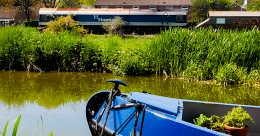
The moor’d disus’d canal narrow boat
Such is progress
The advent of railways in the early 19th century rendered Britain’s canal system largely redundant

IN 1971, I WAS AN UNDERGRADUATE STUDENT. That year, I made my first unaccompanied trip abroad. I was travelling by ferry and rail to Vienna and beyond. My late mother, who was very worried about how I would fare, wanted me to stay in a decent hotel for my first night on the Continent. That was to be in Cologne (Köln) in what was then West Germany. Back in 1971, there was no Internet to look up hotels in Cologne or anywhere else for that matter. The only guidebook to Germany in my possession was a pre-1914 Baedeker guide to The Rhine. Amongst the few hotels listed in the book in the entry for Cologne was a Dom Hotel. I rang the international telephone directory operator and asked if the place still existed. It did, and still does, and she supplied the number. I rang the Dom and booked a room for one night. My mother was happy about this, and said that as soon as I arrived, I was to ring her from the hotel.
I set off from London with my luggage in a metal framed canvas rucksack, kindly lent to me by my uncle Sven. I arrived in Cologne in the early evening and soon arrived at the very grand Dom Hotel, the ‘poshest’ in Cologne, in the late afternoon. It was a short distance from the Hauptbahnhof. I was greeted at the bottom of the steps leading up to its main entrance by a liveried doorman. He asked me for my luggage. So, I handed him my well-used rucksack. He held it gingerly as if it were a rat that had been dead for several days. At great expense, I telephoned my mother to assure her that I had survived the journey so far. From then on, she seemed to lose interest in my well-being during my adventure. I was not required to send progress reports back home.
After Cologne, I spent every night in a youth hostel or similar. From Cologne, I travelled by train to Würzburg, where I was planning to see the brilliant paintings by the Venetian painter Tiepolo inside the city’s Würzburger Residenz. Between Frankfurt and Würzburg, there was a middle-aged lady in my compartment. She wore what looked to me like very old-fashioned traditional German clothes including a hat with a feather stuck in its hat band. As the afternoon light began to fail, we began travelling through hilly country. I had just enough German to understand that the barely visible hills we were passing were the Spessart Hills. She told me that they were very beautiful. I have no idea why I remember her telling me about those hills. The next day, having spent a night in a comfortable youth hostel, I fulfilled my desire to view the Tiepolo wall and ceiling paintings.
At each of the German youth hostels in which I stayed, there was a different method employed to wake the guests in the morning. At Würzburg, A young man playing a flute wandered from dormitory to dormitory. At Munich, where I stayed one night, the morning call was someone shouting “Raus, Raus!”, which immediately conjured up thoughts about POW camps in Germany during WW2.
I decided to attend an opera performance on my first night in Munich. I bought the cheapest ticket for Berg’s “Wozzeck”. I note from the Internet that the opera was performed in Munich on March the 23rd 1971, which helps to date my trip. The ticket I bought allowed me to see the opera from the highest tier of the auditorium. When I arrived in my casual travelling clothes, I was the only man in the audience not dressed in formal evening wear. I enjoyed the opera from my eyrie near the ceiling of the theatre.
The following morning just after I had eaten a very modest breakfast, I met my friend, the late Michael Jacobs, at the famous Hofbrauhaus. We had arranged this sometime earlier when we were both in London. Each of us ordered a large stein of lager, probably a litre each. We chatted and drank in one of the establishment’s large noisy halls. Then, we went our own ways. I walked to the railway station with my rucksack on my back. It seemed to me that the hitherto flat pavements had become wavy. The alcohol had gone to my head.
My uncle Felix had recommended that I should make a stop at Linz in Austria in order to visit an interesting monastery nearby. I enjoyed the trip from Linz to Sankt Florian in what looked like an antique tram. The composer Anton Bruckner was associated musically with Sankt Florian.
From Linz, I travelled eastwards to another town with an important monastery. The monastery at Melk is perched on a hill overlooking the Rhine. I spent a night in the town’s youth hostel before continuing eastwards.
Deliberately, I overshot Vienna and continued from there by bus to the small town of Rust on Lake Neusiedl. The water of this shallow lake is shared between Austria and neighbouring Hungary. I was told that if the wind blows hard, the lake shifts position: more of it moves into Hungary or into Austria depending on the wind direction. From Rust, little could be seen of the lake apart from endless beds of reeds. I was the only guest at the youth hostel because it was so early in the year. At night, I was left alone in the hostel. As I lay waiting to be overcome by sleep, I could hear an incessant croaking of a multitude of frogs coming from the direction of the lake. This strange sound did not help me fall asleep.
The next day, I took a bus to Mörbisch am See, a village on the lake, close to Austria’s border with the then communist Hungary. I asked a village shopkeeper if I could leave my heavy rucksack in his shop so that I could take a stroll. My aim, which was fulfilled, was to see for myself the notorious ‘Iron Curtain’. I walked south of the village and soon spotted the tall watch towers overlooking the no man’s land between the two countries. I only crossed the Iron Curtain for the first time about ten years later. Then, I hurried back to the village because I knew that there was a bus about to leave for Vienna at noon. The bus was waiting. I asked the driver to delay departure while I collected my rucksack. Unfortunately, the shop had closed for its lunch break. The forbearing bus driver helped me find someone to unlock the shop. We set off for Vienna.
My father had an American secretary called Nancy Berg. She and her husband had very kindly torn out and given me the pages about Vienna from their copy of “Europe on Five Dollars a Day”. From this useful source of information, I discovered that there was an extremely cheap, centrally located hostel near Mariahilfer Strasse in Vienna. This was no ordinary hostel. It was subterranean. It had been a bomb-proof underground shelter built by the Nazi Germans. The rooms were somewhat spartan, but each was served by an air-conditioning system that had been installed by the Nazis. The hostel required guest to leave the premises between 8 am and 4 pm. This was not a problem because there was so much for me to explore in and around Vienna. The hostel was good value as was almost everything else in the city. In 1971, £1 Sterling was worth 80 Austrian Schilling. About ten years later, when I next passed through Austria, £1 only bought 20 Austrian Schilling.
I ate most meals at the popular Rathauskeller under the City Hall, which served good food at very reasonable prices. I particularly enjoyed ‘Gulaschsuppe’. One memorably enjoyable meal was at Grinzing at one of its Heurige, or wine taverns. I was not alone there. My friend Michael Jacobs had arrived in Vienna, where he was about to study German for a few months. He joined me and some other people, friends of my Uncle Felix. They were a couple in Vienna, whom my uncle had met. He was very keen that I should meet them. They invited me to afternoon at their residence in the city. It was a fine day and we sat on their terrace. I remember being given a cup of tea and a warm soft-boiled egg in its shell at the same moment. I had never been given this combination before. I hoped that it was not the local habit to break the egg into the tea. Had it been, I am sure that I would have not been able to even sip the strange mixture that would have resulted. Fortunately for me, the egg was designed to be consumed separately. I introduced Michael to this pleasant couple, and they became good friends.
By the time I travelled to Vienna, I had become a fan of the Dreigroschen Oper (Threepenny Opera) by Kurt Weill and Berthold Brecht. I had a gramophone record of the main songs in this work, which I never tired of hearing. Most people will be familiar with one of its opening songs, “Mack the Knife”. Many years later, I discovered a recording one of Ella Fitzgerald’s renderings of this song to a ‘live’ audience, during which she forgets the words following the first half of it. As luck would have it, there was a performance of the opera while I was in Vienna. I sat spellbound, listening to it at the city’s Volksoper.
Amongst Vienna’s many attractions, there were several that I particularly enjoyed. One of these was the magnificent fairground at the Prater. This was on a scale I had never seen before. The Soviet War Memorial also sticks in my mind. I loved walking amongst the stalls in a street market that ran along the banks of a canal. Many of the stalls sold food from a part of Europe that I had not yet visited but wanted to: the Balkans and Communist Eastern Europe. Seeing road signs in Vienna pointing to places such as Bratislava and Budapest, both behind the Iron Curtain, thrilled me. I was also delighted by my visits to the Albertina art museum, Schönbrunn Palace on the edge of the city, and the Belvedere within the city.
It is curious that many details of my first ‘solo’ trip to mainland Europe remain in my mind but the return to London by train has left me no memories at all. I can only suppose that I travelled back without making any intermediate stops before reaching the English Channel. One thing that I regret is that I have mislaid the photographs, which I know that I took on this trip. I have an idea that they might be in a remote storage place that we rent on the outskirts of London. This is not accessible at present and even if it were, it might take hours or days sifting through what is being stored there to find them.
Photo: Melk Abbey from Wikimedia Commons
I USED TO VISIT HUNGARY regularly in the 1980s before the end of Communist rule in that country. Sometimes I drove, other trips I travelled by rail.

In 1985, I boarded a train at London’s Victoria Station. As I was settling down in my seat, a couple accompanying an older man asked me if I could look after on the journey to Hungary. He was their relative and only spoke Hungarian. My knowledge of that language was limited to a vocabulary of less than 100 words including ‘fogkrem’ meaning toothpaste and ‘meleg szendvics’ meaning heated (toasted) sandwich, and ‘menetrend’ meaning timetable and ‘kurva’, which you can look up yourself! I agreed to do my best to look after the gentleman.
After taking the ferry across the English Channel, we boarded an express train bound for Budapest. The gentleman and I were in the same couchette compartment along with some young people.
We stopped in Brussels early in the evening. A late middle-aged Belgian couple entered our compartment, and we set off eastwards. After nightfall, the Belgian couple left us. Several minutes later, they returned. They had changed their clothes. They had dressed in pyjamas and silk dressing gowns. Clearly, they were either unfamiliar with travel in 2nd class couchettes or had formery been used to travel in 1st class Wagon Lits sleeping cars.
We arrived at Hegyeshalom, a Hungarian border town close to Austria. As I was planning to visit southern Hungary, I disembarked there. So did the man who I was ‘looking after’. He was met by some of his family. Although they spoke no English, they expressed their gratitude for me, and kindly offered to drive me to Győr, where I wanted to catch another train.
At Győr, they helped me find my train. I boarded a basic looking local train bound for Keszthely on Lake Balaton. After a while, the train stopped in the middle of the countryside and everyone except me disembarked. I looked out of the train. We were not at a station. Someone saw me and signalked that I should also leave the train. We all boarded buses that had been laid on to substitute for the train that could not proceed further because of track repairs.
After a ride through flat agricultural terrain, we reached a small station, where we boarded another train, which carried us to Kesthely, arriving at about 4 to 5 pm.
I looked around the station at Kesthely and for some unaccountable reason I decided that I did not want to stay in the lakeside resort. I looked at a timetable and discovered that a train would be leaving soon, bound for Kaposvár, which was on the way to the southern city of Pécs.
A Hungarian couple with one child ‘got wind’ of my plan to join the train to Kaposvár, and took me into their care. I boarded the train with them and travelled in their company as the train followed the southern shore of Lake Balaton.
My ‘minders’ left the train at the lakeside station at or near Balatonlelle. Before they disembarked, they asked a man, a stranger to them, in our compartment to look after me. He spoke only Hungarian.
As the train wound its way inland through hills south if Lake Balaton, the sun set and it became too dark to see the countryside through which we were moving slowly. Although there were light fittings with light bulbs in our compartment, they were never turned on. The two of us travelled in total darkness. We tried conversing, but with little meaningful success.
We both left the train at Kaposvár station. Darkness reigned. I had no idea where or even whether there was a hotel (szálloda) in the town. However, my latest ‘minder’ led me to a large state run hotel, the Kapos.
The young receptionist spoke good English. She asked me if I had any books in English. I did. I gave her one that I had already finished. She was very happy.
After a heavy meal in the hotel’s large restaurant (etterem), I retired to my room. The hotel had poor sound insulation. There was a party somewhere in the building and my room seemed to be throbbing with the loud music.
After a while, there was a knock on my door. I opened it and found a waitress holding a plate with an enormous slice of watermelon. She muttered something about ‘recepció’. I realised that the watermelon was a thank you gift from the receptionist.
I took the watermelon into my room and stared at it. Then and still now, I cannot stand eating watermelon. I could not throw it away because it was bound to be discovered and that would have seemed very ungrateful on my part. So, after a bit of thought, I carried the slice of fruit downstairs to the receptionist to whom I had given the book. I thanked her, and then explained, telling a ‘white lie’, that I was allergic to watermelon. She seemed to believe me.
That night, I found it difficult to sleep partly because of trying to digest my heavy dinner and the noise from the party.
On the following day, I took another train to Pécs having stayed in a city I had never heard of before.
Picture of Hotel Kapos in Kaposvar in 1985
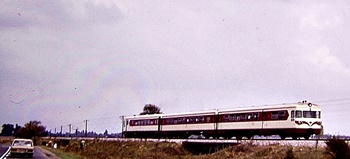
IN THE SUMMER OF 1973, I was on holiday in Greece. Our family and that of ‘K’, a good friend of mine were guests of an extremely wealthy Greek. We had been put up in luxury hotels. We stayed in the George V Hotel in Athens and K’s family were put up by the sea at a luxurious resort at Vouliagmeni. Before leaving England for our Greek holiday, K agreed to accompany me on an excursion north from Greece to a lake in southern Yugoslavia, Lake Ohrid, a body of water now shared by Northern Macedonia and Albania. I was curious to gaze at the then very mysterious Albania across the water from Yugoslavia and K was just being a ‘good sport’ in agreeing to join me.
One day in Athens, K and I left our very comfortable accommodation and arrived at the railway station from which northbound trains departed. The route between Athens and Thessalonika was long and slow, the train having had to wind its way across mountain ranges.
Every twenty minutes, an attendant arrived at our compartment carrying a tray with pork kebabs, lumps of cooked pork on thin wooden skewers. The barely warm meat was delicious. Each skewer seemed better than the previous one. We kept on buying them each time the attendant arrived.
After several hours and many skewers, K said that he had eaten enough of them and he was not feeling too well. My reaction to this was that being an inexperienced traveller compared to me, his stomach was weak compared to mine. I continued munching the delicious kebabs as the journey continued.
At a small place, which was probably Platy, in northern Greece, our train left the main route and headed along a branch line towards Edessa, where we disembarked. Before leaving the station, we had to have our tickets endorsed by a railway official so that we could continue our journey the following day. As soon as we disembarked, K thrust his ticket into my hand and rushed to evacuate his bowels in a field of ripe corn next to the railway.
We booked into a small hotel, the Olympus, in Edessa, where we paid the Drachma equivalent of £1 Sterling for a room with two beds. I gave K some of my anti-diarrhoea tablets, and he ate some plain yoghurt for supper. At this point, I was still thinking how sad it was that my friend’s stomach was so delicate. Surprised to be hungry after having devoured so many pork ‘souvlaki’ on the train, I ate a normal supper.
The beds in the hotel were very short. My feet projected beyond the bed end. I slept well. The next morning, K was feeling much healthier. However, I was not. I had a terrible pain in my stomach which made it difficult for me to stand up straight. I took some of my tablets and tried without much success to enjoy a bowl of plain yoghurt upon which there was a puddle of oil.
We returned to the railway station and boarded the train which took us westwards to the small town of Florina. We had a short stay, a few hours, in Florina, where I recall buying a roll of toilet paper. The daily train, a single motorised carriage, from Florina to the border with Yugoslavia departed in the early afternoon. K and I were the only passengers. At the border, the Greek carriage drew up next to a Yugoslav motorised train with several carriages on the neighbouring track. A Yugoslav soldier instructed us to move from the Greek to the Yugoslav train and then we set off northwards through southern Yugoslavia, crossing a flat plain with well-tended fields.
We disembarked at Bitola, once known as ‘Monastir’, and transferred to a long-distance bus. As the sun set, this carried us north westward over the mountains towards the historic city of Ohrid on Lake Ohrid.
It was dark by the time we arrived at the campsite on the lakeshore about a mile north of Ohrid city. Both of our stomachs had settled down. For the next few days, I explored the beautiful sights along the lake and enjoyed the local food, much of which was in the form of kebabs. K, having been made wary as a result of our experiences with the Greek railway ‘souvlaki’, avoided this kind of food, preferring to feed himself at our campsite.
Picture taken in 1977 shows the train in Yugoslavia between the Greek border and Bitola
 yamey
yamey 