Pasternak, Mandelstam, and Stalin: was the pen mightier than the sword?

LIFE IN STALIN’S Russia was extremely precarious for writers. One small mistake could lead to imprisonment and/or assassination. This was also the case in Enver Hoxha’s Albania, as the country’s famous author Ismail Kadare (1936-2024) knew only too well.

In 1934, the author Boris Pasternak (1890-1960) is widely believed to have received an unexpected telephone call from no lesser person than Russia’s dictator Joseph Stalin. What Stalin said to Pasternak and how Pasternak replied is the subject of a novel, “A Dictator Calls”, published in 2022 and written by Ismail Kadare. The author convincingly demonstrates that nobody can recall what was said during this brief but significant telephone conversation that occurred in 1934. Kadare provides 13 versions of what might have happened during this three-minute telephone call. At one point, he questions whether the call ever happened, but I felt after reading the book that it was likely to have happened.

A common theme amongst the 13 recollections of this telephone call is that Stalin was calling to find out Pasternak’s views on the poet Osip Mandelstam (1891-1938).  At the time of the call, Mandelstam, who had recently written a poem critical of Stalin, was in prison. It seems from what Kadare has written in his novel, which is based on facts (such as they are), that Stalin might have been hoping the Pasternak would say something that might help save his fellow author, the poet Mandelstam. In this fascinating novel, I felt that Kadare was questioning whether omnipotent dictators like Stalin and Hoxha feared, possibly secretly, the power of critics such as the poet Mandelstam, or in the case of Albania, Kadare. As with so many of Kadare’s novels, this relatively new one gives the reader some insight into the nature of secrecy, the contortion of truth, and uncertainty, which prevailed in regimes such as Stalin’s Russia and Hoxha’s Albania. Although difficult to understand in places, “A Dictator Calls” is a fascinating novel, which kept me intrigued all the way through it.

Kadare’s novel has been translated from Albanian into English by John Hodgson. I feel that a good translation should read in such a way that one cannot realise that it is a translation. It should read as if it were originally written in the language into which it was translated. Hodgson has achieved this very successfully.

Hitler, Stalin, Mum and Dad

I have just finished “Hitler, Stalin, Mum and Dad” by Daniel Finkelstein.

Based on the true story of his parents and other family members, this is a page-turner. His mother’s family, German Jews, were caught up in Hitler’s genocidal activities. His father’s family were sucked into Stalin’s notorious Gulag system. Many members of the author’s family lost their lives during WW2. However, some of them survived. Finkelstein guides the reader effortlessly through the history of this horrific period of Europe’s history. Meticulously researched, this is an engaging read and very fascinating.

I can strongly recommend this book.

Mud sweeter than honey: Albania under Enver Hoxha

IN MAY 1984, I visited Albania, which was then still under the rule of its Stalinist dictator Enver Hoxha (1908-1985). The year before, I had spent a fortnight in Bulgaria. My impression was that Bulgaria was much less vibrant than Albania. In Albania, which had to be visited in an organised group tour, we were treated well, shown a great deal, and were fed well. I knew that by 1984, Albania was far more sealed off from the rest of the world than North Korea is today. Several things were curious about our visit. First, we were not allowed to converse with any Albanians apart from our three official guides or ‘minders’, and other Albanians were unable to converse with, or even approach, us. Secondly, we were watched carefully, even followed by plainclothes agents. Thirdly, and most strangely, whenever we ate a meal, we were kept out of sight of Albanian onlookers. Either we dined in a private room, or our tables were surrounded by curtains or screens, which separated us from other diners and staff in hotels or restaurants.

Our Albanian hosts successfully showed us some of their country’s beautiful towns, countryside, and other attractions. Their aim was to show us westerners what an ideal country Enver Hoxha and his regime had created. And to some extent, I was fooled by what I saw. Many years later, I visited the country (in 2016), and met people who told me that what I had seen was carefully stage managed – a sort of Potemkin village on a grand scale. One person told me that three days before visitors (foreign or state officials) visited the village to which he had been exiled, the town would be cleaned up, the usually empty shops would be stocked, and other things would be arranged to give the place the appearance of prosperity. And as soon as the visitors had passed through, everything would be returned to its normal depressing condition.

After returning from my second trip to Albania, I read a biography of Enver Hoxha written by Blendi Fevziu, and published in 2016. In it, I discovered something that really shocked me. He wrote that by 1984, when I was being wined and dined royally by our Albanian hosts, most Albanians were starving because of a man-made famine that had begun a couple of years earlier. It was no wonder that whenever we ate, we and our food was kept out of sight of all but the most trusted waiters and staff.  

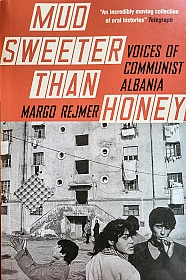
Even when I was in Albania in 1984, I was aware that Hoxha’s regime, like many others run by dictators, was home to prison camps for those who were alleged to have upset the dictator and his paranoid security services. As Margo Rejmer shows in her excellent book “Mud Sweeter Than Honey”, it did not take much to land up in one of Hoxha’s hellish prison camps, and many people suffered this fate.

Rejmer interviewed many people who had lived during Hoxha’s long reign. She successfully demonstrated that every Albanian from the humblest peasant to the highest state official lived in a constant state of fear. Up to one in three people were employed as informers for Hoxha’s secret police – the Sigurimi. It was even dangerous to express one’s thoughts to close members of one’s family. The paranoid dictator ruled, as did Stalin, by endlessly imprisoning or killing anyone that could even slightly be considered a threat to him. Rejmer’s book illustrates this very well and also describes the unbelievable cruelty that prisoners had to suffer in the camps, where they were made to do unpleasant unpaid work, especially in mines.

I am very glad that Rejmer’s book had not yet been written in 1984, because had I read it then, I am certain I would never have set foot in Albania. It is a highly readable, compelling book about the horrific era during which most Albanians had to suffer. My only criticism of it is that she tends to concentrate on people who suffered badly under the regime. However, I suppose it was difficult for her to find anyone who honestly thought that Hoxha had created the paradise, the existence of which our tour guides hoped to persuade us in 1984.

PS My memories of the 1984 visit to Albania are recorded in my book “Albania on My Mind” (https://www.amazon.co.uk/Albania-My-Mind-Adam-Yamey/dp/1291111476/)

Artists and secret agents

A REMARKABLE ENGINEER and furniture entrepreneur Jack Pritchard (1899-1992) and his family lived at 37 Belsize Park Gardens, in London’s Hampstead district. before WW2. Pritchard, who studied engineering and economics at the University of Cambridge, joined Venesta, a company that specialised in plywood goods. It was after this that he began to promote Modernist design. In 1929, he and the Canadian architect Wells Coates (1895-1958) formed the company, Isokon, whose aim was to build Modernist style residential accommodation.

Pritchard and his wife, a psychiatrist, Molly (1900-1985), commissioned Coates to build a block of flats in Lawn Road on a site that they owned. Its design was to be based on the then new ideas for communal housing that had been realised in Germany including the influential Bauhaus in Dessau. The flats are close to Fleet Road and the Mall Studios in Parkhill Road. Completed in 1934, they were, noted the architectural historian Nikolaus Pevsner, “… a milestone in the introduction of the modern idiom to London.” He continued, writing in 1952, clearly critical of the edifice, which:

“…put on a forbidding face towards the street, with large unmitigated concrete surfaces … It is all in the spirit of revolution, unaccommodating and direct to the verge of brutality.”

Well, I quite like the building’s elegant simplicity. In the basement space of the block, there was a refreshment area known as the Isobar. This and its furniture were designed by Marcel Breuer (1902-1981). Regularly, exhibitions were held in the Isobar and, according to an on-line article in The Modern House Journal these were attended by artists including Adrian Stokes, Henry Moore, Barbara Hepworth, Ben Nicholson and Naum Gabo. The article also noted that this refreshment area was frequented by modernist architects such as Erich Mendelsohn, Serge Chermayeff and, Wells Coates, as well as by left-wing politicians. Pritchard occupied the penthouse flat. In 1969, he sold the block, and now it contains accommodation for 25 keyworkers on a shared ownership basis and 11 flats are in private ownership. The block, first known as the Lawn Road Flats, is now called ‘Isokon. Lawn Road Flats’.

T F T Baker, Diane K Bolton and Patricia E C Croot, writing in A History of the County of Middlesex: Volume 9, Hampstead, Paddington, noted that the Lawn Road Flats were built partly to house artistic refugees, who had fled from parts of Europe then oppressed by dictators, notably by Adolf Hitler. Some of them had been associated with the Bauhaus. These included the architect and furniture designer Marcel Breuer, the architect Walter Gropius (1883-1969), and the artist and photographer Laszlo Moholy-Nagy (1895-1946). All three of them are regarded as being masters of 20th century visual arts.

Despite both having come from bourgeois backgrounds, the Pritchards aimed to free themselves from middle-class conventions. The concept and realisation of the Lawn Road Flats, were important landmarks in their quest to achieve a new, alternative way of living. It is accurate to say that the atmosphere that prevailed in the community that either lived in, or frequented, the Lawn Road Flats was predominantly left-wing and extremely welcoming to cultural refugees from Nazi Germany. Probably, it had not been anticipated that the place should become a convenient place for Stalin’s Soviet spies to use as a base. According to a small booklet about the flats Isokon The Story of a New Vision of Urban Living, published in 2016, the flats were home to the following espionage agents, who had been recruited by the NKVD in Central Europe: Arnold Deutsch, Simon Kremer, Jürgen Kuczinski, and Brigitte Kucynski Lewis. Jill Pearlman, one of the book’s several authors, noted that they found the Lawn Road Flats convenient for several reasons:

“Above all, they blended inconspicuously into the sociable community of tenants there. Many tenants too were refugees from Central Europe … Even the Lawn Road Flats building worked well for the spies. One could enter and exit any unit without being seen … no one could see in. At the same time, the cantilevered decks on each floor provided the tenants a perfect vantage point from which to survey the street below.”

Today, there is a small exhibition area in the garage of the flats. This is open on some weekends, but I have yet to visit it.

Russian music with an Albanian conductor in a London church

THE ALBANIAN CONDUCTOR Olsi Qinami, who began studying music in Tirana (Albania), lives in London. He certainly knows how to get the best out of the orchestra he helped to found, the London City Philharmonic. On Saturday the 2nd of October 2021 he conducted the orchestra in a wonderful concert of music by three Russian composers, two of them from the 19th century and the other from the 20th. The musicians performed to a large and enthusiastic audience in the church of St James in Sussex Gardens, Paddington. Many of those present were Albanian speakers and amongst them the Albanian ambassador, Qirjako Qirko.

Olsi Qinami

The church, a fine example of Victorian gothic, was built to satisfy the spiritual requirements of the rapidly growing population of 19th century Paddington. Designed by George Edmund Street (1824-1881), the building was completed in 1882 on the site of an earlier, smaller church that was built in the neo-classical style in about 1841. Apart from being a highly successful example of gothic revival, the church is notable for having been that in which the unjustly vilified writer Oscar Wilde married Constance Lloyd in 1884. Despite being a large, spacious building, the church’s acoustics coped well with the orchestral music.

The concert opened with a spirited rendering of the “Polovtsian Dances from Prince Igor” by Alexander Borodin. This piece holds a special place in my heart, as I will now explain. In the late 1950s, my parents bought or were gifted an LP entitled “Classical Music For People Who Don’t Know Anything About Classical Music”, which I played often in my childhood. Its cover has a sketch of four people in the living room of a very modern looking house, even by today’s standards. A lady, looking pleased with herself or the music or both, stands next to a gramophone player clutching a record cover (sleeve). Behind her, three people are seated in armchairs: one looks puzzled; another looks a bit bored; and the third has fallen asleep with a drinking glass resting on his armrest. One of the tracks on this LP was the “Polovtsian Dances”.

Borodin’s piece was followed by Peter Ilych Tchaikovsky’s “Romeo and Juliet Overture”, with which I am less familiar than the “Polovtsian Dances”. Although this brief piece was nicely performed, it is unlikely to enter my list of favourite works by this composer in the near future.

After the interval, we were treated to an exciting and brilliantly performed rendering of the 5th Symphony by Dmitri Shostakovich. Olsi Qinami and the orchestra handled the constant alternation of the composer’s triumphant sounding sections of the symphony with its comparatively peaceful, lyrical sections with exquisite mastery.

Shostakovitch completed his 5th Symphony in 1937, soon after having been heavily criticised by Stalin for his opera “Lady Macbeth of the Mtsensk District”, first performed in 1934. Had the Fifth Symphony not been so well received and liked by Stalin, the composer’s future might have become exceedingly grim. As Olsi Qinami pointed out in a brief speech before conducting the symphony, the piece, which was praised by the authorities, contains subtle musical messages expressing the composer’s criticism of the ruling regime. Whether or not one was able to detect these messages did not matter because the performance we heard was exciting, uplifting, and invigorating. In the last minutes of the symphony, I noticed one of the violinists breaking into a wonderful smile, no doubt because she and the rest of the orchestra had so successfully mastered this complex and difficult piece of music.

An odd thought occurred to me whilst listening to the Shostakovich piece. It was composed in 1937, when life for ordinary people in the USSR cannot have been at all easy. Although the situation here in the UK in 2021 is hardly comparable to that distant time in Russia, we are also going through times far more difficult than anyone has experienced since WW2, what with the covid 19 pandemic, Brexit-related problems, and shortages in shops and filling stations. It must have been a source of great solace for Soviet citizens to escape from their daily problems, if only for a few hours, by joining an audience at a concert of fine classical music. Well, that is how Olsi’s joyous concert felt for me as soon as he lifted his baton, and the orchestra began to play.

In memoriam: do not pull it down

TEARING DOWN STATUES or defacing them is nothing new, as some might believe after hearing about dunking Edward Colston’s toppled statue into a river in Bristol.

Violette Szabo

When I visited Albania in 1984, I saw statues of Josef Stalin and the Albanian dictator Enver Hoxha prominently placed in public spaces. Neither of these two gentlemen can be seriously considered to be God’s best gifts to humanity. Many of their actions caused great fear and suffering in both the former USSR and in Albania.

In 1991, Albania’s long (1944-1991) Communist regime crumbled ignominiously. In February 1991, citizens of Albania’s capital, Tirana, attached cables to a huge statue of Enver Hoxha, an admirer of Stalin, and pulled it down. Many of the police guarding the huge monument to repression assisted the people to cause this bronze statue to topple to the ground.

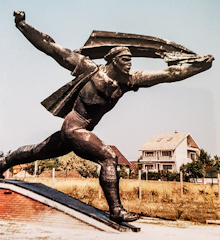
Years later, in 2016, we visited Albania. In the centre of Tirana, there is a national museum of art, which was present when I visited the city in 1984. Back then, and even in 2016, there was a good collection of fine works created in the Social Realism style, so popular amongst Communist regimes. After seeing the gallery in 2016, we happened to bump into one of the museum’s curators. I showed him a picture of a sculpture I had taken in 1984 and asked him if he recognised it. Without answering, he invited us to follow him to a yard at the rear of the gallery.

There, in the yard, stood the sculpture I had photographed in 1984. More interestingly, it was not alone. It stood next to a giant statue of Lenin and another one of Stalin and another large object wrapped in cloth tied down with ropes. The curator explained that these statues, although they depicted people whose ideas and actions had done much harm to the Albanian people, were valuable works of art, not simply because of their great scrap metal value but, more importantly, they helped record the country’s history. In addition, he explained that they were fine examples of their genre. The bundled-up object standing in that yard was, he explained, too sensitive to uncover as it would upset many people viewing it. It was part of an enormous statue of Enver Hoxha, who had not yet been forgiven by many Albanians. Clearly, Lenin and Stalin were thought to be less disturbing as they were not covered up, but sufficiently upsetting to be confined to a relatively unvisited yard behind the gallery open to the public.

Both Trafalgar and Parliament Squares in London contain statues that might cause offense to those whose knowledge of history is more than superficial, yet their actions have not always been 100% reprehensible. Fortunately for these monuments, many of the kind of people who might be inclined to topple statues do not usually read much detailed history.

There are some statues or monuments, which remember people, whose actions cannot rationally be called into question. One of these is that of Edward Jenner (1749-1823), whose work formed the foundation of something on which we are currently becoming extremely dependent: vaccination. Only someone out of his or her mind would consider pulling down or defacing his statue.

Recently, when strolling along an embankment, I spotted a monument close to the River Thames outside Lambeth Palace. Erected in 2009, it commemorates the Special Operations Executive (‘SOE’), whose covert activities in no little way helped to bring about the defeat of Nazi Germany’s forces during WW2. The plinth with metal commemorative plaques is topped with the head of a woman with high cheekbones, a serious, determined face, and luxuriant curly hair, tied back. She stares out across the River Thames toward the Houses of Parliament. The bust depicts Violette Reine Elizabeth Szabo (1921-1945), whose actions behind enemy lines in France were designed to sabotage German military activity. She was one of many women including Noor Inayat Khan (1914-1944), of Indian aristocratic heritage, who risked and lost their lives to assist in the defeat of a repressive regime.

SOE was staffed by both men and women of many nationalities, and their bravery is recorded on this simple memorial outside Lambeth Palace.  Although simple in design, the expression depicted in the face of Violette Szabo gave me a feeling of the great determination of those brave souls who gave up their lives in horrific circumstances. They did so in the hope, fulfilled, that we could enjoy life in Britain and elsewhere without having to bear the burden of inhumane dictatorial rule.  

Unlike Stalin and Hoxha, statues of the purely benevolent such as Jenner and Szabo should be allowed to stand undisturbed for ever, well, at least, so long as they can survive London’s ever-changing weather conditions and pollution.

Maxim and Ivy: to Russia with love

MEIR HENOCH WALLACH-FINKELSTEIN (1876-1951) is better known as Maxim Maximovich Litvinov. A Bolshevik revolutionary, he became an important Soviet diplomat. In 1930, Stalin appointed him People’s Commissar for Foreign Affairs. Earlier on, shortly after the 1917 Russian Revolution, Maxim was sent to London as the Soviet government’s plenipotentiary representative in Great Britain. While in London, he met and married the writer Ivy (née Low; 1889-1977). I have recently discovered that their lives partially overlapped with mine, not temporally but geographically.

BLOG IVY 5

Ivy was living in London’s Hampstead when she and Maxim were courting. They had met in about 1918 at the home of Dr David Eder (1865-1936), a Zionist socialist and a pioneer of psychoanalysis in Britain. David, whom Ivy regarded as a father figure, and his family lived in Golders Green (actually, in Hampstead Garden Suburb at 103 Hampstead Way, not far from our family home).  According to Ivy’s biographer John Carswell (in his book “The Exile: Ivy Litvinov”):

“Over tea in the Express Dairy in Heath Street where they often met, Ivy helped Maxim to improve his English – throughout her life she adored improving people’s English – and she did more: she guided him in reading English literature.”

Today, the building that used to house the Express Dairy in Heath Street is a branch of the Tesco supermarket empire. However, the building still bears the name ‘Express Dairy’ and the date 1889, the year that Ivy was born.

Ivy’s biographer John Carswell (1918-1997) was the son of one of Ivy’s closest friends, the writer and journalist Catherine Carswell (1879-1946). Ivy met Catherine, a close friend of the writer DH Lawrence who lived in Hampstead, after she had written a favourable review of Ivy’s novel “Growing Pains”, which was published in 1913. Catherine lived in Hampstead at Holly Mount. To be close to her friend, Ivy moved to Hampstead. John, who was born at Hollybush House in Holly Hill, met Ivy several times and has written a good account of her life. It reads well and is extremely informative not only about Ivy but also about her husband.

Ivy and Maxim moved to Russia with their two young children in about 1920 and lived there, with small occasional breaks, until the late 1950s. One of these breaks was when Maxim was appointed Soviet Ambassador to the USA between 1941 and 1943. Her stay in the USSR was also punctuated by short holidays abroad. Living in the USSR, Ivy continued her writing as well as teaching English. Long before he died, Maxim fell out of favour with Stalin and lived in fear of arrest and probable execution. However, he died of natural causes in 1951, just in time to miss Stalin’s last great, but unfulfilled, plan, the anti-Semitic ‘Doctors’ Plot’. On his deathbed, he said to Ivy:

“Englishwoman, go home”.

It was not until 1960 that Ivy did return to England.  But, in 1961, she returned to the USSR, where she remained a pensioned widow until July 1972, when she returned to the UK. She settled in Hove, where she lived the rest of her life. Until her dying day, Ivy wrote, published, and was actively involved with the literary world.

Long before her last visit to England, Ivy had made brief visits. In July 1930, Maxim was appointed People’s Commissar for Foreign Affairs. Soon after his promotion Ivy accompanied him to Geneva. That same winter, the Litvinovs paid a visit to London. John Carswell, then twelve years old, recalled:

“She took me to a Christmas show of which even the name now escapes me; but what is still vivid is the tall, dominating, fur-coated figure sweeping me across the wintry promenade outside the Golders Green Hippodrome, to a torrent of commentary.”

Reading about Carswell’s memory of Ivy taking him to a Christmas show at the Hippodrome reminded me of seeing pantomimes at this same theatre when I was about John’s age or maybe a year or two less. until the mid-1960s, the Hippodrome (built as a 3000-seat music hall in 1913) was a very active repertory theatre, where many plays that would eventually end up in the West End were premiered. In addition to plays, operas and Christmas pantomimes were staged there. In the 1960s, it became a BBC television studio, and lately it has become a venue for Islamic meetings. Like Carswell, I cannot remember what shows I saw there as a child, but I do remember being impressed by the size and fittings (seats arranged in galleries, boxes, and the vast stage) of the Hippodrome. It was as least as impressive as the grandest of West End theatres.

I enjoyed reading Carswell’s biography not only because it provided some insight into what life was like in the Soviet Union during Stalin’s rule but also because it introduced me to the life of an intriguing woman writer whose love for Maxim led her to spend a large part of her life in the USSR. Another thing that appealed to me is that Carswell provided me with new aspects of the history of Hampstead, a part of London which I know well and where I grew up. It is with some reluctance that I will return this enjoyable biography to our local public library.



Park of memory

REGIMES RISE AND FALL, as was the case of the Roman, Ottoman, and British empires. Each has left a physical legacy in the form of buildings, works of art, and a plethora of monuments. In India, a part of the both the former Mughal and British Empires, visitors flock to see their tangible remains.

In the late 1980’s, it was turn of the Soviet Empire to decline and fall. In many of its former ‘colonies’, its citizens hastily tried to erase its physical traces. Statues were toppled and monuments destroyed. Some of these artefacts were removed from public view by governmental authorities (maybe because they feared a possible return of Russian domination?)

For good or evil, the Soviet Empire has had a profound influence on what followed in its wake. Whatever one thinks about the Soviet Empire, it has become a significant part of 20th century history and it is a shame to try to erase memory of it. This was also the opinion of the Hungarian architect Ákos Eliőd, who designed the Szoborpark (Memento Park) in the countryside near Budapest.

The Szoborpark opened to the public in 1993. About 6 years later, we drove to Hungary from London. We stayed with a good friend of ours, Ákos, a pioneer of Hungarian rock music, and his family in his home in the outskirts of the hilly Buda section of Budapest. It was Ákos who alerted us to the existence of the Szoborpark.

One sunny day, we drove to the park. It was a wonderful place containing a collection of the Soviet era statues and monuments gathered from all over Hungary. It was/is a treasure trove for those who like or are fascinated by socialist realism art forms, an aesthetic that I like. We spent a couple of enthralling hours in the hot sun, wandering about this open air exhibition.

I took many photographs of the Szoborpark, which I have ‘unearthed’ recently. One of them is of wall plaque celebrating Béla Kun (1886-1938) son of Samu Kohn, a non obervant Jewish lawyer. He was the dictator of a short-lived communist regime that terrorised Hungary for a few months in 1919. With its downfall, Kun fled to the USSR, where he organised the Red Terror campaign in the Crimea in 1921. He was executed in 1938, a victim of Stalin’s anti-Trotskyist purges.

Many years after seeing the Szoborpark, my wife and I visited Albania in 2016, more than 3 decades after the downfall of its highly repressive Marxist-Leninist regime piloted for 40 years by its dictator Enver Hoxha.
Interestingly, all over the country there were still numerous monuments erected during the dictatorial era. Many of them were in need of tidying up or cleaning, but they were still there despite being daily reminders of what was a difficult and fearful time for most Albanian citizens.

We believed that the endurance of these monuments erected during difficult times was due to at least two factors. One of these is that many of them were put up to celebrate heroic feats of Albanians carried out against their German invaders during WW2. The other is that despite Hoxha’s repressive regime, many things were done to move Albania from being a Balkan backwater in the former Ottoman Empire to getting nearer to being a 20th century European state.

This is not to say that statues of Enver Hoxha, Lenin, Marx, and Stalin (the mentor and hero of Enver Hoxha) were not pulled down in Albania. They were, but fortunately a few have been preserved by an art gallery in the country’s capital Tirana.

In countries like Hungary and the former Czechoslovakia, the arrival of the Soviet Army and the Russian domination of their countries was not felt by most citizens to have been even remotely beneficial. Obliteration of memories of this era were not surprising in places like these.

To conclude, I am glad that I have neither lost nor obliterated the photographs I took at the Szoborpark so many years ago.

Gandhi, Lenin, Stalin

gandhi

Non-violent Gandhi 

Beside three leading men

Who faced fate with force


This mantle-piece at Shaw Corner, the home of George Bernard Shaw at Ayot St Lawence in Hertfordshire, bears the portraits of (from left to right) Mahatma Gandhi, Felix Dzerzhinsky, Vladimir Lenin, and Josef Stalin. Shaw met all of these men.


Uncle Joe

STALIN


Standing by Stalin,

albeit in bronze:

odd memories evoked


This statue of Stalin, now in Tirana, was cast during Albania’s Communist era (1944-91). Albania was the only country to continue revering Stalin after his death.