A new sculpture at Wells Cathedral

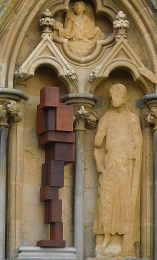
New metal sculpture by Antony Gormley at Wells Cathedral

Among the carvings

At venerable Wells Cathedral

Stands a novice

The sculptor Antony Gornley (born 1950) has added a new artwork (made of metal) to an empty niche on the west facade of Wells Cathedral in Somerset, England

Soho and a straight horizon

WALKING ALONG CHARING CROSS ROAD in central London recently, a memory of my childhood sprung into mind. When I was about eight years old, I was told off by my art teacher at school because the horizon on my painting was not straight enough for her. She told me that I should have used a ruler. When I related this incident to my mother, she was quite annoyed because, in her opinion, it did not matter whether a horizon was drawn ruler straight or not. I hoped that she would not complain to the school about her feelings about the ineptitude of the art teacher. I do not recall that she bothered to do so.

My mother was an artist, whose works became increasingly abstract as she grew older. Before WW2, she trained to become a commercial artist at the Michaelis School of Fine Art in Cape Town (South Africa). Her earliest works, which I have never seen, were hand-painted posters, advertisements for the latest films (movies). In 1948, she followed my father from Cape Town to London, where he had taken up an academic post at the London School of Economics. They married in 1948 and, according to my father, Mom took painting classes with the now famous Stanley Spencer (1891-1959). Interestingly, I never heard my mother mentioning these classes.

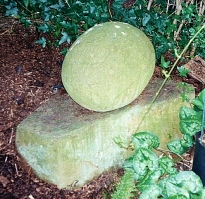
Stone sculpture by Adam Yamey’s mother

I was born in 1952, and it was around then that my mother began creating sculpture. One of her earliest sculptures was in terracotta and its subject matter was a mother, seated, holding a child, maybe me. During the late 1950s and early part of the 1960s, my mother worked in the sculpture workshops at St Martin’s School of Art, which was then located on Charing Cross Road. The Sculpture Department was then under the directorship of Frank Martin (1914-2004), whom my mother referred to as ‘Mr Martin’ when talking to us at home.  It was there that she worked alongside sculptors, who have since become quite famous. These included Menashe Kadishman (1932-2015), Buky Schwarz (1932-2009), Philip King (1934-2021), and Antony Caro (1924-2013). The latter two helped her learn how to weld and create sculptures in metal, a medium she preferred. It was probably at St Martins that my mother met the sculptor Elizabeth Frink (1930-1993), who also taught in the Sculpture Department. She and Mom became close friends. ‘Liz Frink’, as she was known in our family, was a regular visitor to our home in northwest London.

My mother used to work at St Martins several days a week. She used to do a lot of the family’s food shopping nearby in Soho’s Old Compton Street. Vegetables were bought from a French greengrocer, and meat from a Belgian butcher called Benoit Bulcke. This butcher, according to Mom, knew how to cut meat correctly, unlike most English butchers. As a young child, I accepted that this was the case if Mom said so. The butcher and the greengrocer no longer exist. However, three other stores she frequented are still in business: The Algerian Coffee Store; Camisa; and Lina Stores. My mother was an early disciple of the cookery writer, Elizabeth David (1913-1922), and her encouragement of the preparation of French and Mediterranean dishes. The proximity of St Martins to Old Compton Street was convenient for my mother, as the shops along it provided many ingredients, which were hard to find elsewhere in London in the 1950s and early 1960s.

Drums in Afghanistan

RUDYARD KIPLING PUBLISHED his story “Drums of the Fore and Aft” in 1889 (www.kiplingsociety.co.uk/rg_foreandaft1.htm). Based on an incident that occurred in the Second Afghan War (1878-1890), most likely during a battle at Ahmed Khel in 1880, his tale includes the story of two drummer boys, who, fortified with rum and courage, march up and down the battlefield playing the tune of the song, “The British Grenadiers”, which, incidentally, we used to sing at school in the early 1960s. Although the British defeat their enemy, the boys are killed.  Well, I doubt that I would have ever known about this story had we not recently visited Woodbridge on the backwaters of the coast of Suffolk.

Much of Woodbridge is located on the slope of a hill. Its picturesque Market Hill is high up on this incline. It contains many buildings that have been in existence for several centuries. In the centre of the square, stands the Shire Hall, a rectangular brick building with stone trimmings and gables at both ends of its roof. The gables give the building a somewhat Dutch appearance. The edifice is believed to have been built in about 1575 by a local worthy, a politician and member of the court of Queen Elizabeth I, Thomas Seckford (1515-1587). Since then, it has been modified a little, but not to its detriment.

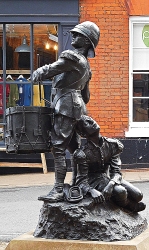
Just outside the eastern end of the Shire Hall, we found a sculpture depicting two young soldiers. One is standing, beating a drum, and the other is sitting on the floor looking upward, a discarded bugle at his feet. A plaque next to the sculpture reads as follows:

“’Drums to the Fore and Aft’. Gifted to the Town by the Duchess of Albermarle following her husband’s wishes in January 1980. Sculpted by Arnold, 8th Earl of Albermarle. Re-sited to this position in March 2018.”

When I saw this, I wondered about the aristocratic creator of this lifelike sculptor.

Arnold was Arnold Allan Cecil Keppel, 8th Earl of Albemarle (1858-1942), soldier, courtier, and Conservative politician (https://en.wikipedia.org/wiki/Arnold_Keppel,_8th_Earl_of_Albemarle). Educated at Eton College, he fought in the 2nd Anglo-Boer War (1899-1902) after having been an MP for Birkenhead between 1892 and 1894. On becoming the 8th Earl, he took his late father’s place in the House of Lords. His wife was born Lady Gertrude Lucia (1861-1943). As she died in 1943 and the town only received the sculpture in 1980, it seems to have taken a long time for her late husband’s wishes to be fulfilled. At least that is what I thought until I looked into the story behind this work of art.

As for the sculpture in Woodbridge, Wikipedia includes the following about Arnold Keppel’s relationship with it:

“He is credited with sculpting the statue of the two drummer boys from Rudyard Kipling’s story ‘The Drums of the Fore and Aft’ that now stands in Woodbridge, Suffolk.”

The Recording Archive for Public Sculpture in Norfolk & Suffolk, a database of sculptural works within the two counties, has the following information about the sculpture (http://racns.co.uk/sculptures.asp?action=getsurvey&id=373):

“8th Earl of Albemarle Sculptor(s). Private commission by 8th Earl of Albemarle. 1901, the cast may be later since the foundry only adopted the name A.B.Burton in 1902, after the death of the other partner, A.J. Hollinshead.”

An illustration in the Archive’s website shows a plaque, which I did not see. This provides the information that the sculpture was given to the town in January 1980 in memory of Walter Keppel, the 9th Earl of Albermarle (1882-1979). Another photograph shows that the sculpture is signed “Albermarle 01”. ‘Albermarle’ was Walter’s father, and ‘01’ refers to 1901. Having learned all of this, I now realise that the sentence I read on the plaque, “Gifted to the Town by the Duchess of Albermarle following her husband’s wishes in January 1980.”, refers not to the 8th Earl’s widow, but to the widow of his son, Walter.

The sculpture is well executed, showing that its maker was a competent artist. A search of the Internet revealed that in addition to the sculpture in Woodbridge, he also drew portraits (e.g. https://auctions.roseberys.co.uk/m/lot-details/index/catalog/299/lot/116339?uact=5&aid=299&lid=116340&current_page=0). Otherwise, I can find hardly anything else about his artistic output. That said, if the sculpture in Woodbridge is the only example of his modelling, it is something that the late 8th Earl must been pleased with.

He paid with spears and swords

MALDON IN ESSEX is best known for the sea salt, prized by cooks and gourmets, which is produced nearby. The town perches on a hill overlooking a marshy inlet of the River Blackwater and the River Chelmer, after which Chelmsford is named, flows through a lower section of the place. We have visited Maldon several times over the last 18 months and always walked along part of its promenade that provides attractive views over the marshes and streams watered by the Chelmer and the Blackwater. However, it was only during our most recent visit (August 2021) that we walked the entire length of the promenade to its end point, which is out of sight of the town. The promenade ends abruptly, a bit like the end of a pier. There at the furthest extremity of the walkway, there is a tall statue. It depicts a man in a helmet, brandishing a sword in his right hand, holding a circular shield in his left, and looking out to sea.

The statue overlooking the sea is a sculpture of Byrhtnoth, Ealdorman of Essex, an Anglo-Saxon aristocrat or high official, who lived during the reign of Ethelred the Unready (c996-1016). Byrthnoth died during the Battle of Maldon on the 11th of August 991. The battle was fought by the Anglo-Saxons against an army of Viking invaders. It is said that before the battle, the Vikings offered to sail away if they were paid with gold and silver. Byrhthnoth was recorded as replying that he would only pay the attackers with the tips of his men’s spears and the blades of their swords.

After the battle, the then reigning Archbishop of Canterbury, Sigeric the Serious, advised Ethelred to pay off the Vikings instead of continuing the fight against them. According to an article on Wikipedia, this payment of 3,300 kilogrammes of silver was the first example of the so-called Danegeld in England. This was a ‘tax’ paid to the Vikings in exchange for them desisting from ravishing the territory which paid it.

So, the statue depicts a participant in a defeat of the English (Anglo-Saxons), and much loss of life amongst the Viking invaders. It was created by John Doubleday (born 1947) and unveiled in 2006. Byrhtnoth stands on a tall cylindrical base decorated with bas-relief depictions of scenes of life in the 10th century and moments during the Battle of Maldon. A plaque embedded into the promenade’s pavement near the statue gives more background to the historical event. It reads:

“Byrthnoth, represented by the figure standing on this monument, was the principal voice in rejecting the policy of appeasement which dominated the court of King Ethelred in the closing years of the 10th century. The leading military figure of his time; he was probably aged 68 when he confronted the Vikings at the battle of Maldon. He surrendered his life in defence of the people, religion and way of life represented in the lower relief panel of the column. Above it you will see aspects of the battle in which he died. Around the base is a quotation from his final prayer as recorded in the surviving fragment of the poem ‘The Battle of Maldon.’”

The poem, mentioned above, was written in Old English. However, much of it has now been lost.

Apart from the statue, Maldon has much to offer the visitor. Along the quayside, there are several old Thames Barges with their maroon/brown sails and a lovely pub, The Queen’s Head Inn. Church Street climbs from the riverside to the High Street which is lined by several old houses; a disused church, now a museum; an attractive parish church; and plenty of decent places to eat and drink. Within easy reach of London, this is a delightful place for a day out or as a base for exploring rural Essex.

The elephant in the …

THE ELEPHANT IN the room is something about which we prefer not to speak. This is not the case for the herd of over one hundred elephants that can be found in London’s Green Park today. This is not a change in the creatures’ habitat caused by global warning, because the elephants are not real. They are life-size models of the creatures, constructed with strips of Lantana camara, an invasive weed that thrives in the tropics. Despite being made of strips of this woody material, each one is a fine representation of an elephant. From afar, the sculptures look quite lifelike. Some of the elephants have models of birds found in the UK perched on their backs.

The elephants, so we were informed by a helpful volunteer from Goa who is working for an organisation called Coexistence, are manufactured by local craftsmen living the district of Gudalur in the Nilgiri Hills of Tamil Nadu state in the south of India. By using the Lantana, the craftsmen not only create the models but also clear deleterious plants from their land.

Apart from looking great, the model pachyderms have arrived with a message. Known as the ‘Coexistence Herd’, the beasts have arrived:

“… at a unique moment in time when a global reduction in human activity has had a positive effect on wildlife. Elephants may be giants but they tread softly. This 100-strong herd reminds us that when we lighten our footprint, wildlife bounces back.” (https://elephant-family.org/coexistence/)⁠⁠

So, it seems that the herd has not arrived merely to enhance our enjoyment of Green Park but also to heighten our awareness of the desirability of humans living in harmony with the rest of the animal kingdom.

Green Park is not the only site in London where these elephants from India can be spotted. There are others currently on display at places such as Berkeley Square and St James Park. The elephants are all for sale. The proceeds of the sales:

“…will be directed to grass-roots organisations across India that allow people and wildlife to live together more peacefully.” (https://coexistence.org/elephant-shop/).

Whether or not you are concerned about the message that is supposed to be conveyed by these superb models of elephants, it unlikely that you will be disappointed by seeing them.

An artist in Germany, Norway, Scotland, Isle of Man, then Somerset

AN UNUSUAL CRUCIFIX hands within the church of St Mary in Bruton, Somerset. It is a sculpture typical of early 20th century German Expressionism, yet it was created in 1969, long after the heyday of this artistic trend. The creator of this religious sculpture was Ernst Blensdorf (1896-1976). He was born Ernst Müller in North Germany, but after his marriage to his first wife, Ilse Blensdorf, in 1923, he changed his surname to ‘Müller-Blensdorf’, then later to ‘Blensdorf’.

At first, Blensdorf became a seaman. After having been interned as an enemy alien by the British during WW1, Ernst travelled to Johannesburg in South Africa with a fellow internee. It was here that he made a table-top wood carving of an African village. On his return to Germany, this fine carving persuaded Ernst’s father that his son had a future as an artist and was willing to support him towards this aim. While in Africa, Ernst had seen African art first-hand and exposure to this certainly helped influenced his future creations.

After a brief spell at an art school in Barmen, he left to become apprenticed to a master joiner. By 1922, he had become a journeyman for a furniture company, which specialised in manufacturing luxury items. During this period, he was influenced by the Bauhaus artist Paul Klee and the sculptor Alexander Archipenko. The skill that Ernest acquired and developed whilst manufacturing wooden objects for the furniture company became useful as he moved from applied craftsmanship to artistic endeavours. In addition to other activities, he taught at the art school in Barmen during the 1920s. By the 1930s, he had become an established sculptor and had exhibited his works at various exhibitions in Germany, where he received both private and public commissions.

When the Nazis took power in Germany, Blensdorf became one of the first artists whose works were categorised as ‘degenerate’ by Hitler and his regime. This led to him losing his teaching post at Barmen and his studio being wrecked by the Nazi’s loutish followers. Ernst, his wife, and children, moved to Norway, where he was planning a giant peace monument to honour the Norwegian statesman and Nobel Peace prize winner Fridjtof Nansen. In Norway, he worked on this project and made a living creating and selling artistic ceramic works, alongside the Norwegian ceramicist Eilif Whist. 

When the Germans invaded Norway in spring 1940, Blensdorf and his children fled to Scotland. His wife, Ilse, remained behind, saying that she was a follower of Adolf Hitler. Following his arrival in the UK, Blensdorf was once again interned as an ‘enemy alien’. Along with many others, including a good number of men with artistic talent and German nationality, he was interned on the Isle of Man (from 1940 to 1941). His children were placed in a couple of orphanages. While interned, he, along with fellow artists, were allowed to satisfy their creative urges and even to sell their creations. Using whatever materials he could find during this period of scarcity, Blensdorf’s creative output was impressively large. For the first time in his life, he had plenty of time to undertake artistic work in the absence of anxieties such as he had experienced before arriving on the Isle of Man.

Blensdorf was released from internment in 1941. He went to live with an Austrian couple, the Schreiners, whom he had met in the internment camp. They lived in Charlton Musgrove in Somerset. With him, the Schreiners planned to set up an art school, but this failed for financial reasons. Ernst remained in Somerset. His first job was teaching pottery at a school in Bratton Seymour. It was here that he met his second wife, Jane Lawson. They married in 1942 and moved into a house near Wincanton, where they were joined by his children. Blensdorf taught in various schools in Somerset including the King’s School in Bruton.

In 1943, Blensdorf and his family bought a run-down 17th century house close to Bruton. Gradually, the house was restored and improved. It remained his home for the rest of his life. Although he exhibited often and in prestigious venues, Blensdorf never realised the great reputations that other artists, such as Henry Moore, Elizabeth Frink, Anthony Caro, and Barbara Hepworth, gained in the UK and beyond. For this reason, seeing his work for the first time during my first visit to the lovely Bruton Museum in July 2021, was a wonderful surprise and an exciting eye-opener.  In one corner of this small museum, there is a large glass cabinet that contains examples of Blensdorf’s sketches, ceramics, and sculptures. When I told the lady, who was looking after the museum, how much I liked what I had seen of his works, she told me about the crucifix in the local church, which fortunately I was able to see. She also sold me a copy of a well-illustrated catalogue of an exhibition of his works that was held some time ago in the Bruton Museum. It is from this publication that I have extracted much of the information above. Bruton is a gem of a town. Visiting its museum is a ‘must’ because not only does it allow you to ‘discover’ the works of Blensdorf but also to see a display of artefacts relating to the author John Steinbeck, who lived close to Bruton between March and September 1959 … but that is another story.

Shifted to Somerset from London

EVERY YEAR SINCE 2000, excepting 2020, The Serpentine Gallery in London’s Kensington Gardens has erected a temporary summer pavilion. Each pavilion is designed by a different architect or group of architects. What they have in common is that their pavilion is the first of their designs to be constructed in London, or maybe the UK. They stand in front of the Serpentine Gallery during the summer months and into early autumn. They are always fascinating visually and always contain a café with seating. Over the years some of them have been used as event spaces.

At the end of the season, the pavilions are dismantled and are never seen again in Kensington Gardens. Some of them might be sold and others re-erected elsewhere, but until recently I have never seen one again.

A few years ago, a contemporary art gallery, Hauser and Wirth, which has a branch in London’s West End, bought a farm on the edge of Bruton in Somerset. They have used some of the farm buildings and constructed some new ones to accommodate another branch of their gallery. In addition to the exhibition spaces, there is a superb restaurant, an up-market farm shop, and a wonderful garden created by the Dutch garden designer Piet Oudolf (born 1944).

The garden slopes upwards from the gallery. At the top of the slope, there is something that at first sight looks like a giant hamburger patty or the profile of an oversized bagel. I recognised it immediately as being one of the former summer pavilions that once stood next to The Serpentine Gallery in Kensington Gardens. It is the 2014 Serpentine pavilion designed by Smiljan Radic (born 1965 in Santiago, Chile).

When I saw it in London in 2014, I was not overly impressed by it. However, seeing it at Hauser and Wirth in Somerset, it looks great. My description of it as an oversized bagel is not too far from the truth. It is, basically, an annular structure like a ring or a bagel, but it is far more interesting than that. Supported on rocks, the ring is not in one plane, but it undulates gradually. Irregularly shaped holes in its translucent skin provide intriguing views of Oudolf’s garden, which looks good in all seasons, and the surrounding hilly Somerset countryside.

A visit to Hauser and Wirth in Somerset makes a fine day out even if you have only a scant interest in contemporary art. The food served in the restaurant is of a high quality and not unreasonably priced. The buildings on the estate are lovely and the garden is hard to beat for its beauty.

Cows on the café

GUILAN IS A NEW cafe on the corner of Moscow Road and St Petersburgh Place in London’s Bayswater. I have walked past the building numerous times over the past more than 25 years, but until today I missed seeing something on the building.

Above the ground floor windows there are a number of sculpted heads of cattle. I had never noticed these before.

On looking at a map produced in the 1950s, I discovered that the building was then a dairy. An older map revealed that it was ‘The Aylesbury Dairy’. A search on the Internet informed me that this building was the head office of the company, which had another branch not far away. So,  the cattle heads are a souvenir of the building’s time as a dairy.

The new café in the former dairy is across the road from Aghia Sofia, a Greek Orthodox church. The cafe is elegant and serves good coffee and tasty pastries including a croissant flavoured with za’atar. I have no idea from which dairy the milk is supplied to Guilan, but you can be sure it is not the Aylesbury Dairy.

Packed with art in St Ives, Cornwall

THE TATE GALLERY has two branches in the picturesque fishing port of St Ives in Cornwall. The artworks displayed at Tate St Ives are contained in a building overlooking Porthmeor Beach, constructed between 1983 and 1993. It replaced a disused gasworks, but I feel that the gallery’s almost fascistic architecture neither does anything to enhance the town or to match the beauty of many of the items displayed within it. The other part of The Tate in St Ives is house and gardens of the sculptor Barbara Hepworth (1903-1975). A visit to her former home and its garden, filled with her sculptures, is a delightful experience.


Barbara Hepworth and her sculpture in the Penwith Gallery

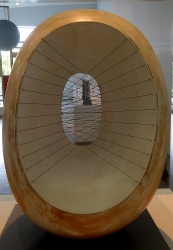
Not far from the Tate St Ives, there is another ‘must-see’ attraction for lovers of modern and contemporary art. This is the Penwith Gallery on Back Road East. Less visited than the two Tate institutions in St Ives, the Penwith is the home of the Penwith Society of Arts, one of whose founders was Barbara Hepworth. The gallery contains one of the loveliest Hepworth sculptures that I have seen to date. Maybe I like it because it recalls the works of the Romanian born sculptor Constantin Brancusi (1876-1957), a sculptor whose works are much to my taste. To be frank, I am not a great lover of Hepworth’s sculpture and this piece in the Penwith is less typical of what I do not like about her work.

Returning to the gallery itself, its website reveals (https://penwithgallery.com/):

“The society was founded in 1949 by Barbara Hepworth,Ben Nicholson, Peter Lanyon, Bernard Leach, Sven Berlin and Wilhelmina Barns– Graham, amongst others. Later members have included Patrick Heron, Terry Frost and Henry Moore (honorary member). This association with so many progressive and influential artists has given the Penwith Society a unique place in British art history.

Today the society continues to play a central role in the thriving and vibrant St. Ives art community, exhibiting contemporary art from Cornwall and beyond.”

The gallery is housed in a former pilchard packing factory. Its ceiling is supported with roughly hewn granite pillars, painted white. Part of the ceiling is glass-covered, allowing natural light into the largest of the three main display areas. The rest of the ceiling does not transmit light.

The gallery displays an ever-changing collection of artworks, which are on sale. Created by members of the Society or artists, who have worked in the Society’s studios, they include sculptures, prints, paintings, and ceramics. Some of the works are figurative and many of them are abstract. Some are halfway between the two extremes. I have enjoyed abstract art since my childhood. This is probably because my mother, who was a sculptor who enjoyed creating abstract pieces. The lovely Hepworth piece that stands next to a fine photograph of its sculptor, and several other works, form part of the Penwith’s permanent collection. A small range of books and cards are available for visitors to purchase.

Every time I visit the Penwith, I enjoy the gallery’s spaces and the works displayed within them.  Instead of being packed with pilchards, as it was in the past, and other tourists, as are the two Tate establishments, the Penwith is comfortably packed with pleasing works of art, which you can take home if you can afford them, and some of them are not excessively costly.

King Alfred gazes over Winchester

KING ALFRED RULED the West Saxons from 871 to c886 and king of the Anglo-Saxons from c886 to 899. He was known as ‘Alfred the Great’. Amongst his many achievements was encouraging education and proposing that primary education was taught in (Old) English, rather than Latin. Winchester was Alfred’s capital and the place where he was buried there for a while. After the Norman Conquest in 1066, his remains were removed to Hyde Abbey near Winchester. This was destroyed in 1538 during the Reformation. Despite this, his grave remained intact until 1788, when the land where he was interred was redeveloped to build a jail. Since then, the whereabouts of his remains is unknown.

Despite, the disappearance of his bones, King Alfred dominates the centre of Winchester in the form of a huge statue near to the city’s cathedral, rich in gothic features, and its Guildhall, which is richly adorned by Victorian gothic features. The statue was erected in 1899. A plaque at its base reads:

“To the founder of the kingdom and nation D. October DCCCI. Winchester and the English name MDCCCI”

DCCCCI, being Roman for 901 and MDCCCCI, being Roman for 1901.

The tall bronze statue was designed by Sir William Hamo Thornycroft (1850-1925), a sculpto who might have been unknown to me had I not become aware of him whilst walking near London’s Holland Park back in 2017. He was an important figure in the New Sculpture movement, whose members’ oeuvres bridged the gap between the neo-classical tradition, popular during the 19th century, and early modernist trends at the end of the 19th century and beginning of the next.

I was roaming around Kensington taking photographs of buildings of interest prior to writing a piece about them when I spotted a plaque on a house in Melbury Road. Number 2a was Thornycroft’s studio, which was designed by his friend, the architect John Belcher (1841-1913).

Although I did not realise that they were created by Thornycroft before I wrote this today, I am familiar with two of his other creations: the statue of Oliver Cromwell outside The Houses of Parliament and “The Sower” at Kew Gardens. His Alfred statue is far larger than the other two.

I wonder what the great king would have thought if he knew that at his feet today, there is a short-term car park and that his capital’s cathedral now charges a fee for visitors to enter within it.