Red rover

MY GRANDMOTHER LIVED a serene life in Port Elizabeth in South Africa. Born in the 1890s, she came with her parents from what is now Lithuania to what was then the Cape Colony. She married my father’s father in Cape Town. She raised four children and also helped her husband run a general store in Tulbagh, a small town, almost a village, near Cape Town. When her husband died young in 1931, she continued running the shop for a few years before marrying a widower who lived Port Elizabeth (‘PE’). Through this  second marriage, she acquired three stepsons and her fifth son. Hers was a tough life to begin with. By the 1960s, when the children had grown up and dispersed, she began living a quieter life in PE.

GRANNY red-rover-ticket john harper

Once every couple of years Granny used to visit her son, my father, and his half-brother in the UK. Although I met her when I was three years old, I only remember her from the time I was about nine. She used to sit in our ‘lounge’ (colonial term for ‘sitting room’) and did little except meet people. Every day in the late afternoon, she enjoyed a glass of whisky before the evening meal. It was in our home that she first ate bacon. My mother, although Jewish, was far from observant and was almost unaware of dietary rules. We ate ham and bacon regularly. She served bacon quite innocently to Granny, who had not encountered it before, enjoyed it, and appeared unperturbed to discover that this delicious food item was derived from pigs.

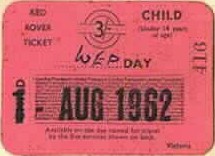
I was about ten when I suggested to Granny that we went on an outing together. It was an outing quite unlike any granny had ever done before or was ever likely to do again. I suggested that we should buy Red Rover tickets and then set off into the unknown. Few readers will be familiar with Red Rovers. So, I will explain. A Red Rover ticket allowed the holder unlimited travel on London Transport’s red buses for a whole day. In the early 1960s, an adult Red Rover ticket cost six shillings (30 pence) and children paid half of that. To my surprise and joy, my not too sprightly seventy-year-old grandmother agreed to the plan.

We set off from the bus station at Golders Green one morning and travelled to Chingford, which at that time was the terminus of the long 102 bus route. Then, another long bus journey through dreary parts of north-east London ended at Ponders End. By this stage, both Granny and I had enough of being jerked around on double-decker buses, but we had to face a couple more tedious bus journeys in order to get us back to Golders Green. For the rest of her life, Granny would recall this trip and the name ‘Ponders End’. When my father’s half-brother moved to a new house to north-east London, we were both amused because it was not far from Ponders End.

Many decades later, about two years ago, I decided walk south along the River Lee Navigation canal, starting near Waltham Abbey. After walking slowly for almost a couple of hours along the canal, which is flanked by large reservoirs, many electric pylons, and occasional industrial buildings, I reached the lock system at … Ponders End. Although I could not remember what Ponders End was like back in the early 1960s except that it was dismal, I found that although there had been much new construction, it had remained dismal.

I am glad that I got the idea of using a Red Rover out of my system. Until the arrival of the Coronavirus pandemic in London, my wife and I loved using London’s superb bus system. Since mid-March, we have not boarded a bus. Now, it is mandatory to wear a face covering on public transport. We see people waiting at bus stops, their noses and mouths covered by everything from a fairly useless single-use paper mask, such as I used when treating dental patients, to colourful home-made fabric coverings. However, things go wrong once these masked passengers enter the bus. We have noticed that many people travelling on buses that pass us have removed their face coverings once they are on board. Also, many bus drivers do not wear them.  So, if you were to gift me a Red Rover, you can be sure that I will not be using it in the foreseeable future.


Photo from john-harper.com

Very late at night

MY PARENTS USED TO go to bed early, usually just after hearing the 10 pm BBC news on the radio. When I was a youngster living at home, this used to upset me because I did not want to go to bed so early or to stay up without company. However, my aunt, my mother’s sister, and her husband were ‘night owls’. They lived a few minutes’ walk away from our family home.

BLOG BED Autumn leaves viewed nocturnally_500

Often, I used to wander over to their house after my parents had gone to bed. I would join them in their comfortable living room, and we would chat. Every now and then, our coffee cups would be refilled. And as the hours ticked by, the empty cafetieres would be replenished with coffee – one with normal coffee and the other with decaffeinated. As night merged into early morning, the three of us would nod off for a few moments and then wake with a jolt.  This would happen several times during the early hours of the morning. I used to love these late-night sessions with my relatives. Frequently, I left my aunt and uncle’s home at about 3 am.

I used to walk home along the tree-lined streets of Hampstead Garden Suburb that were illuminated by the strange orange glow from the bulbs on the concrete streetlamps. The streets were deserted, without cars or other pedestrians. If you were lucky, you might have spotted a fox scuttling past. To be honest, even in daytime, the thoroughfares of the Suburb were almost as dead. Occasionally, I would encounter a policeman on his nocturnal beat. Usually, these encounters led to me being questioned politely. What was I doing out so late? Where was I going? My answers, my innocent mien, and the lack of a sack of swag probably reassured my questioner that I was innocently going about my business.

On weekdays, despite going to bed late, my uncle was ready to drive with his wife to Golders Green station at 8 am. This was the time I headed in the same direction on my way to school. Oddly, although my parents had retired just after 10 pm, they were always still lying in bed when I left the house at 8 am, having prepared my own breakfast.

Something that has only struck me whilst writing this is that my parents did not give any hint that they were concerned at me wandering the streets alone in the early hours of the morning. When our daughter reached the age when she went out with friends at night, often returning at 3 or 4 am, I could not fall asleep until she returned home. These days, so many decades after I was a youngster, the streets are not nearly as safe as they used to be. I am not saying that the streets of London were 100 percent safe when I was old enough to first venture out alone, because there were hazards. However, many new dangers have been added to those that I might have had to face ‘when I was a lad’. ‘That’s progress’, you might say, but, remember that, speaking medically, a disease that progresses is one that is getting worse.

The slave owner who helped abolish slavery

BLOG HOLL LATE 246

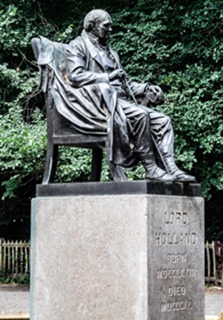
SEATED IN A CHAIR ON A STONE PLINTH, surrounded by a small pond and often with a pigeon on his head or shoulder, Henry Vassall-Fox, 3rd Baron Holland (‘Lord Holland’; 1773-1840) gazes benevolently towards the ruins of his home, which was destroyed by German bombs during WW2. The fine cast metal statue was sculpted by George Frederic Watts (1817-1914) with technical assistance from Joseph Edgar Boehm (1834-1890). I have walked past this statue innumerable times and never given it much of a thought apart from being amused when I have seen pigeons resting on the crown of Holland’s head. A friend of ours pointed out that the sculptor has included, unusually, a depiction of Holland’s wedding ring, a memorial to his marriage which was to prove very interesting with regard to his political activities. Today, the 20th of June, I walked past it yet again, but with the recent interest in statues and their subjects’ relationships with the slave trade, I wondered whether Lord Holland had any connection with it. What I have discovered is somewhat surprising.


Lord Holland was the nephew of the Whig statesman Charles James Fox (1749-1806). According to the British History Online website:
“On the death of his uncle … Lord Holland was introduced into the Cabinet as Lord Privy Seal; but the strength of the Whig portion of the Government had then departed, and the only measure worthy of notice in which his lordship co-operated after his accession to office was the Bill for the Abolition of the Slave Trade.”
This suggests that Holland was an abolitionist.


However, things are never so simple. When visiting Florence (Italy) in 1793, he fell in love with Elizabeth Vassall, wife of Sir Godfrey Webster, 4th Baronet. She and Webster divorced and then Elizabeth married Lord Holland. The “Oxford Dictionary of National Biography” (‘DNB’) records that in 1800
“… Holland assumed the additional name of Vassall to safeguard his children’s right to his wife’s West Indian fortune.”
When her first husband died in 1800, Lord Holland became the owner of the Vassall plantations in Jamaica. By accident, the abolitionist became an owner of slaves.


According to a website published by the Portobello Carnival Film Festival 2008:
“By all accounts, the Hollands were humane and improving proprietors who supported anti-slavery measures against their own financial interests. It can even be argued that he was more use to the abolitionist movement as a slave owner than he would have been as a mere politician. Nevertheless, in perhaps the defining local paradox, the finest hour of Holland House as the international salon of liberal politics was financed by the profits of slave labour.”
The site continues by pointing out that after his uncle died, Lord Holland:
“… was on the committee that framed his uncle’s bill for the abolition of the slave trade. Meanwhile Lady Holland founded the area’s multi-cultural tradition by employing Afro-Caribbean, Spanish and Italian servants – in order to enhance the foreign image of her political salon.”


VE Chancellor wrote in his article “Slave‐owner and anti‐slaver: Henry Richard Vassall Fox, 3rd Lord Holland, 1800–1840” that Holland regarded a slave:
“…not as mere chattel, but as an individual with feelings and abilities no less than those of other men …”.
However:
“… he justified the continuing history of slavery in the British Empire in Whiggish terms of the right to property and the need to obtain the consent of those who owned slaves before Abolition could be achieved…”
So, it seems that Holland, an avowed Abolitionist and ‘accidental’ owner of slaves, was placed in a difficult position. Chancellor records that the great Abolitionist William Wilberforce (1759-1833) regarded Holland as:
“… a ‘most zealous partisan’ of slave trade abolition …”,
And the DNB relates:
“Holland himself was an equally keen supporter of the abolition of slavery in 1833, despite its adverse effect on his West Indian income.”
Holland gave his full support for the Slave Trade Abolition Bill when it passed through the House of Lords. The passing of the Bill was accompanied by sizable tax relief to sugar producers in the West Indies. Lord Holland benefitted from these, as the University College London ‘Legacies of Slave Ownership’ website notes:
“Lord Holland, awarded part of the compensation for under three awards for the enslaved people on his estates in Jamaica…”
Chancellor wrote that Holland, who had benefitted financially from the tax relief concessions:
“… learnt the lesson that those called on to make sacrifices in a good cause do so the more willingly when potential loss is compensated.”


So, now returning to the statue covered with bird droppings in Holland Park, what are we to think? No doubt, Lord Holland became an owner of slaves, but by an accident caused by one of Cupid’s arrows. Had he married someone else, he might not have become the inheritor of Caribbean plantations with slaves. If William Wilberforce was happy to regard him as a bona-fide Abolitionist, that is for me a favourable contemporary character reference for Lord Holland. Some, including me, looking at his statue with hindsight, might ask why he, an avowed Abolitionist, did not emancipate his slaves as soon as they came into his possession. I am willing to believe that the answer to this is far from simple.

[For reference to Chancellor, see: https://www.tandfonline.com/d…/abs/10.1080/01440398008574816]

Wake up call

RETIREMENT OFFERS MANY PLEASURES. One of these is waking up in the morning at whatever time one wishes. I do not want to sound slothful but waking up early rarely appeals to me.

black ring bell alarm clock

Photo by NEOSiAM 2020 on Pexels.com

While I was undertaking research for my PhD in physiology at University College London (‘UCL’), there were no daily time constraints. I could turn up at the laboratory whenever I felt like it and leave whenever I wanted. My timings were entirely up to me. I used to arrive at UCL at about 10 in the morning. At 11 o’clock, I went upstairs for coffee and biscuits in the Starling Room (a departmental meeting place for post-graduates and academic staff; named in honour of the physiologist Ernest Starling). By noon, I had returned to the lab. However, there was not much time to do anything because I liked to have lunch at just before 1 pm. And, after lunch, I often sat in the Ladies Common Room, chatting with Margaret, my supervisor’s wife who also worked in the lab. You can be sure that we never discussed scientific matters over our cups of sub-standard institutional coffee.

By just after 2 pm, I began getting down to work, setting up an experiment. However, everything stopped at 4 pm, when one of us would put the kettle on to boil, the heat being supplied by a gas flame from a Bunsen burner. Tea and biscuits involved me spending another hour chatting, mainly with Margaret. The other PhD students and workers in our lab took tea but were not distracted from their work. At 5 pm Margaret and my PhD supervisor, Robert, set off homewards, followed soon after by the rest of the lab. Between 5 and about 8.30 pm (and on some weekend days) is when I managed to do some ‘solid’ work. Miraculously with this lackadaisical schedule, I managed to do sufficient experimental research to be awarded a doctorate. Then, my life changed dramatically.

Soon after becoming ‘Dr Yamey’, I enrolled in the Dental School of UCL to train to become a dental surgeon (‘dentist’). Compared to my BSc and the PhD studies, this course leading to a Batchelor of Dental Surgery degree was far more demanding of my time. Five days a week, my presence was required at the Dental School at 9 am sharp. The day, which included a lunch break and two brief coffee breaks (if you were lucky), ended at about 5 pm. This seemed to me as bad as being sent back to junior school.

At first, I found this rigorous routine difficult after the relatively laxer times I had enjoyed during my BSc and PhD courses. I remember waking up at 7.00 am on dark autumn mornings and looking out of my bedroom window to see if there were lights on in any of my neighbours’ windows. Often, there were none. To arrive at the hospital by nine in the morning, I had to board the Underground at the peak of the morning rush hour. The tube trains were always crowded, standing room only, at that time. However, in those days in the late 1970s each train had two carriages in which smoking was allowed. Because many people were going off smoking or did not smoke, these carriages always had plenty of empty seats when they pulled into my station, Golders Green. Ignorant of secondary smoking, as I was then, I always travelled comfortably in the smelly, smoke filled carriages. However, by the time I had travelled the thirty minutes to Warren Street, I was always in great need of a quick coffee in the Dental Hospital’s basement canteen before classes began. After qualifying, the early morning routine continued. It lasted for thirty-five years until, at last, I retired.

Waking early in the morning was not confined to dental studies and practice. It is a feature of life that I have got used to in India. Many people in India wake early to take advantage of the cooler early hours of the day. I learned this very soon after arriving in Bangalore during my first visit to India in 1994. For the first few weeks, my wife and I stayed in my in-law’s home. On the second or third morning of our stay, I woke up in darkness. I could hear people rushing about in the house. I woke up my wife and said that I thought that the house was being burgled or attacked. She reassured me that all was okay and told me that the family liked to rise early. It was not quite 5 am. Day after day, my father-in-law tried to encourage me to join him on his early morning walk, to see the sun rise. Eventually, I gave in and we walked around a nearby open space in semi-darkness. It was only when we had returned to the house that we noticed the sun was beginning to rise.

Since those early days in India, I have just about got used to getting up incredibly early if there is a good reason to do so. Driving out of a city as large as Bangalore is one of these reasons. Before 7 am, there is hardly any traffic on the roads, which are usually choc-a-bloc during working hours. Flights to London are another good reason. They often leave India at early hours of the morning so that they can land in Western Europe at an hour that will not disturb those asleep in the UK, where late night/early morning passenger flights are forbidden. Although I can see the benefits of doing things early in the morning in India, I still miss being permitted to sleep until my built-in biological clock gives me its wake-up call. And for those of you who are by now thinking that sleep is all important to me, let me tell you that of late, despite not having any work or travel obligations, that clock of mine is waking me up much earlier than it used to years ago.

Polish or Russian

BLOG HOOP 1l Eagle Lodge


THE DOUBLE-HEADED EAGLE, the symbol of Albania, has fascinated me ever since I first became interested in the country in about 1967. This much-employed imaginary creature, whose origins go back at least 3000 years before the birth of Christ, is not only the national symbol of tiny Albania but also of Imperial, and now modern, Russia. A year or so ago, I was walking along Golders Green Road in northwest London, one of my childhood haunts, when I saw something I had never noticed before. It was a block of flats on which I spotted a large sculpture of a double-headed eagle. The building is appropriately named ‘Eagle Lodge’.

According to Pam Fox, author of “The Jewish Community of Golders Green” a detailed and fascinating book published in 2016, Eagle Lodge was one of a number of mansion blocks built on the sites of former large villas with extensive grounds that used to line Golders Green Road. Next to the mention of ‘Eagle Lodge’, Ms Fox refers to her endnote number 1, which reads:

“It was designed by a Polish architect who carved the Polish eagle onto its façade, giving the block its name.”

Although I doubt that Ms Fox’s book attracts many Polish nationalist readers, this footnote would certainly upset them. The Polish eagle used heraldically or as a symbol has only one head. Having been subjected to domination by the Russians for many years, to confuse the single-headed eagle of Poland with the double headed version used by their Russian neighbours would not go down too well amongst the Polish fraternity.

As for the “Polish architect”, there is another problem. Eagle Lodge was, according to the architectural historian Nikolaus Pevsner, designed by MV Braikevitch and built 1935-37. Mikhail Vasilievich Braikevitch (1874-1940) was a Russian engineer and art collector born in the Ukraine. I found an interesting pamphlet published by the London Borough of Barnet, which contains the district of Golders Green. Titled “The 1917 Revolution & Barnet’s Russian Heritage”, it says:

“Possibly the most interesting Russian resident was Mikhail Vladimirovitch Braikevitch of Woodstock Avenue. He had been an important engineer in the construction of the Trans-Siberian Railway, was the mayor of Odessa before the war, and had been a member of the interim government, who ran Russia between February 1917 and the October Revolution. Remarkable as all these things are, it was his art collection which was most important. Having settled in England, he started to collect works of art smuggled out of Russia from fellow refugees – both in London and Paris – and amassed one of the best collections of Russian art outside of Russia itself. On his death in 1940, he left the collection to the Ashmolean Museum in Oxford, but we can imagine an ordinary house in Golders Green with some of the greatest works of Russian art on the walls.”

It was at Braikevitch’s suggestion and following a visit to his home in Golders Green that the undeservedly lesser known but remarkable Russian composer Nicolas Medtner (1880-1951), a contemporary of Rachmaninoff and Scriabin, shifted from Paris to London in 1935.  The composer and his family settled into a new home on Wentworth Road in Golders Green.

Braikevitch, like Medtner, was buried at Hendon Cemetery and Crematorium, not far from Golders Green.  The architect’s funeral was held at St Philip’s Russian church, Buckingham Palace Road, London. So, all things considered, it is highly likely that the architect of the rather unappealing looking Eagle Lodge with its double-headed eagle was not Polish, and that the bird with two heads has nothing to do with Poland as erroneously suggested by Ms Fox in her end note.  

So long Soho

SOHO BAR ITALIA

IN MANY MINDS ‘SOHO’ conjures up sleazy night spots, strip joints, sex shops, and risqué nightlife. For me, Soho contains many memories of my childhood. And before you wonder about what kind of upbringing I had, let me emphasise that these recollections have nothing to do with the seamier side of this colourful district in London’s West End. If you are hoping for something more ‘exciting’, stop reading now to avoid disappointment.

My mother was an artist. Her preferred metier was sculpture. In the 1960s, she used to work in the sculpture workshops at the St Martin’s School of Art on Charing Cross Road. She welded pieces of metal to create artworks. Her companions in the studio included now famous artists such as Philip King and Anthony Caro.

In addition to being a sculptor my mother was acknowledged by friends and family as being a good cook. She was a disciple of the food writer Elizabeth David, who helped introduce French and Italian cuisines into British kitchens. Ms David’s recipes required ingredients and cuts of meat not readily available to British shoppers in the 1960s. However, St Martin’s was close to Soho, in particular Old Compton Street and Brewer Street, where the ‘exotic’ ingredients needed for Ms David’s recipes were easily accessible. These streets contained a variety of shops that catered to French southern European culinary needs.

We lived in Hampstead Garden Suburb, an attractive but, in my opinion, rather dull place. As a youngster, I loved being taken into central London. My mother often took me to the West End. We used to take the ‘tube’ to Oxford Circus Station. Near there, we always entered Dickins and Jones department store. Why, I cannot say, because my mother rarely bought anything there. The ground floor of the shop was dedicated to perfume and other cosmetic sales. Once, one of the salespeople, called to me. Without prompting, she advised me never to use after shave lotions. I was far too young to have begun shaving, but I have followed her unsolicited advice ever since then. I have not yet been brave enough to experiment with these lotions and to discover why she advised against them.

After leaving the department store, we used to visit the Danish Centre in Conduit Street, where I would be treated to an open sandwich and a kransekage, a Danish confection containing marzipan. From there, we used to head for Soho.

Meat was always bought at Benoit Bulcke, a Belgian butcher shop on the corner of Old Compton Street and a smaller side street. According to my mother, only this place knew how to cut meat properly, and she was not someone to argue with. Their motto was “Meat to Please You, Pleased to Meet You”. They moved from Soho to northwest London some years ago. 

Coffee was always purchased at the still extant Algerian Coffee Stores. The shop’s appearance remains unchanged since I was a child. My mother used to choose Mocha Mysore, a name which meant nothing to me as a child. Decades later, when I began visiting India, I got to visit Mysore and also Indian coffee plantations. One innovation at the Algerian Coffee Stores instituted long after my childhood, and well before the Covid-19 crisis, was the inclusion of a small counter where exquisitely made espresso coffee is served.

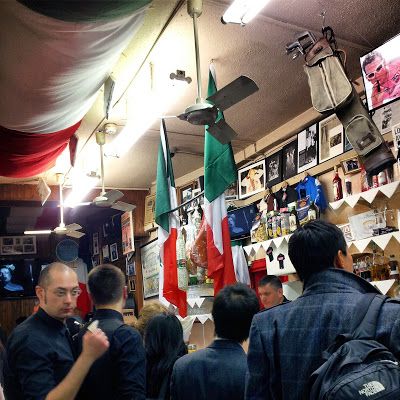
Other groceries were bought at Lina Stores, still in existence, and Camisa, another Italian grocery nearby. Almost every visit to Soho included a stop at Bar Italia. Founded in 1949, this coffee bar still exists. Entering it is like stepping straight from Soho into a typical bar in Italy. Much of its décor remains as I first remember it, but now the far wall of the café is lined with an enormous TV screen on which Italian football matches can be watched. Whenever we visited Bar Italia, my mother would point at a doorway close to it and tell me that it led to Jimmy’s restaurant. Founded in 1948, it was the first Greek restaurant to be opened in Soho.  Although she always mentioned the place, we never ate there. However, close by in a parallel street there was an Italian restaurant, Otello, which my parents visited often, sometimes taking my sister and me.

One shop that no longer exists was on the short stretch of Old Compton Street between Moor Street and Charing Cross Road. It had trays of vegetables and salad greens on stalls on the pavement outside the front of the store. It was a French run greengrocer, whose name I cannot recall. One of the things my mother bought there was something that sounded to my young ears like ‘mush’ (rhyming with ‘slush’). I had no idea what it was or what it was used for, but I know that my mother prized it greatly. Many, many years later, I realised what she was buying was in fact ‘mache’, also known as ‘lambs lettuce’ or ‘corn salad’, and to botanists as Valerianella locusta. In the 1960s when my mother was buying mache in Soho, hardly anyone in the UK would have heard of it, let alone eaten it. Today, it is a common ingredient of packaged salads found in supermarkets. I had no idea that back in the 1960s, my mother had become a foodie trend-setter by serving us mache in our salads.

My mother died forty years ago, and Soho has changed since then, but much remains that she would have recognised. Whenever I sip coffee at Bar Italia, I raise my tiny cup of strong black coffee to her memory. Mache more than that, I cannot do!

A bookshop in my memory

I HAVE LOVED BOOKSHOPS ever since I can remember. In my teenage years, I used to haunt the shelves of Foyles, a multi-storey bookshop in Tottenham Court Road. The store is named after its founders William and Gilbert Foyle, who established their business at Station Road in Peckham in 1903. A year later, they moved it to Cecil Court, an alley near Leicester Square, which still contains several bookshops. By 1906, Foyle’s had a branch on Charing Cross Road, which is where I got familiar with it.

BLOG FOYLES by Tarquin Binary

In the second half of the 1960s, Foyles was a very well-stocked bookstore even if it seemed a bit confusing to its customers. There were separate departments specialising in various topics distributed over at least three floors. I discovered soon enough that behind the bookshelves in some of the departments there were yet more shelves, and these contained second-hand and remaindered books often at reasonable prices. It was amongst these hidden shelves that I found a rather useless but picturesque road atlas to Bulgaria, published in Bulgarian, and a wonderful detailed street map of East Berlin, “Haupstadt der DDR”. This map carefully avoided mapping the city’s contiguous West Berlin. It gave the impression that East Berlin bordered the edge of an area of uninhabited desert.

The language department was very interesting. It stocked books on every language from A to Z. It was there that I discovered a copy of “A Short Albanian Grammar” by SE Mann, published in 1932. This hardback book with dark green board covers was priced at 15 shillings (i.e. 75 pence). I was particularly excited to find this volume as my interest in Albania was already becoming quite well-developed. However, 15 shillings was way beyond my budget in 1968. That year, I began studying biology for the A-Level examinations that had to be passed to enter university. It was then that a chance to obtain this book arose.  

During the first year of the A-Level course, I entered the school’s Bodkin Prize biology essay competition. I wrote a long treatise on the life of the woodlouse. This was my first ever bit of serious research. I visited the Science Library, which was then housed in a part of the then disused Whitely’s department store in Queensway. There, I translated a long article written in French about the reproductive system of the woodlouse. From what I can remember, the woodlouse can reproduce asexually, a process known as parthenogenesis.  I was awarded the second prize. The only other contestant was my classmate Timothy Clarke, whose older brother, Charles, was to become Home Secretary between 2004 and 2006. Tim won the first prize.

Thesecond prize was 15 shillings to be spent on books. I asked the school to spend that money on procuring me the copy of the Albanian grammar book in Foyles. To my great annoyance, my choice was turned down and I was asked to choose again, making sure that at least one book was a hardback, because it was to be embossed with the school’s crest. I chose two books. One was a costly paperback on genetics and the other was the cheapest hardback I could find. To this day, I still do not possess a copy of Mann’s book.

Returning to Foyle’s, let me tell you about its payment system, which resembled, so I was told, the system adopted by shops in the Soviet Union. First, you had to find a book you wished to purchase. Then, you took it to a desk in the department where it was shelved. A shop assistant took the book and wrote out a paper bill. Next, you had to take the bill to one of the few cash desks in the shop. After queuing, you parted with the correct amount of money and then the paper slip was stamped. Following this, you returned to the department where your book was being held and queued up again to exchange your stamped paper slip for the book, which you were then free to take away. This laborious payment system survives today in the government run khadi (home-spun materials) shops in India. These old-fashioned shops, often smelling of moth balls, are picturesque to say the least.

Foyles was bewildering to the newcomer stepping off the street. Like the tiny alleyways in Venice, it was a great place to lose your way. However, if a customer was looking for something specific, this was not helpful. So, quite sensibly, there used to be staff standing near the entrance to help customers find what they were seeking. Some of these no doubt poorly paid staff had poor command of the English language. On one occasion I heard the following:

“May I help, Sir?” asked a young lady with a strong Eastern European accent.

“I am looking for choral music.”

The assistant hesitated and then pointed at the escalator while saying:

“Please try the engineering department.”

That was long ago, back in the late 1960s.

Foyles moved out of its home on Charing Cross Road in 2011 and occupied another building a short way from it on the same street. Its current premises occupy part of the former St Martin School of Art, where my mother used to work in the sculpture studios in the 1960s. I no longer shop at Foyle’s but remember it fondly.


Picture by Tarquin Binary from Wikipedia

Along the canal

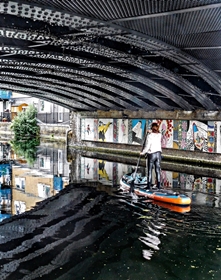
THE PADDINGTON ARM of the Grand Union Canal connects Paddington Basin to Bull’s Bridge at Hayes. It was opened in 1801 and was an important transport route before the growth of railway usage in England. Today, it is used mainly for leisure. People enjoy walking, running, and cycling along its well-maintained towpaths. Others keep long canal boats, known as ‘narrow boats, on the water. Some live in these vessels, others use them to move slowly through Britain’s antique but still usable canal network.


BLOG CANAL


During my teens, I used to explore London with three good friends and an excellent guidebook to London’s quirkier sights, “Nairn’s London” written by Ian Nairn. We walked along the banks of the River Thames, which were undeveloped and somewhat sinister in the late 1960s. In those days, there were stretches of riverside that had barely altered since the era of Charles Dickens.  Nowadays, there are few if any stretches of the Thames in London, which have not been made ‘visitor friendly’.

One day, the four of us decided to walk along the Grand Union Canal, starting our exploration at Camden Lock, now a crowded, popular tourist area. We followed the Regents Canal to the point where it enters the Maida Vale Tunnel, and then re-joined it where it emerged. From Little Venice, we continued westward along the Paddington Arm. For most of the way, we saw nobody else on the towpath. As we headed further west, the canal began running through a dreary semi-industrial neighbourhood. Just before we reached the road bridge that carries Ladbroke Grove over the canal, we saw a gang of young men in leather jackets, who looked at us menacingly. They were busy throwing a motorcycle into the canal. We did not like the look of them and decided that we had seen enough of the canal.

Years later, we joined other friends on a boat trip that began at Camden Lock and continued along the canal to Greenford, a suburb in the far west of London. The trip was very picturesque as far as Ladbroke Grove, but the remaining long stretch was less exciting. West of Ladbroke Grove, the canal winds past industrial buildings and the gardens at the back of residential houses. Later, we accompanied the same friends on a boat trip that took us east from Camden Lock. This was a far more interesting ride as its route includes many fascinating built-up urban areas of east London, which have a richer history than the suburbs of west London. It included a visit to the Olympic Games park that was being constructed at the time.

Today, my wife and I re-visited the Paddington Arm, walking the short stretch between the Harrow Road bridge and the point where, long ago, my friends and I saw the young men throwing a motorbike into the water. We did not see anything like that but had to contend with the almost continuous stream of cyclists sharing the towpath. Most of them were courteous, but a few inconsiderate wildly pedalling folk seemed to think that they were taking part in the Tour de France. Given that it was a Sunday afternoon, it was not too busy to make walking along the towpath anything but enjoyable.

Sun lover

MY MOTHER KEPT A SUN LOUNGER in the garden. It was propped up against a wall of our family home in northwest London. It was made of aluminium tubing and ‘upholstered’ with tautly stretched dark blue canvas. I will tell you why it was there and not in Canada.

Hel

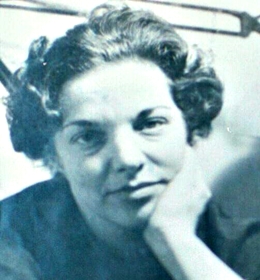
My late mother, Helen (pictured above), was born in South Africa in 1920. Until 1947, I believe that it was quite possible that she might have spent her whole life there.

While living in Cape Town in 1947, she and her sister were invited to a party held by their stepfather’s relatives in the suburb of Parrow. Their hosts, Mr and Mrs Kupfer, had also invited two bachelors, Basil and his brother Ralph, whom they knew from the time when the Kupfers and the two unattached men and their parents lived in the small town of Tulbagh east of Cape Town.

By the end if the evening, Basil and Helen agreed to meet again. Not long after the party, Basil invited Helen to the cinema (bioscope in South African English). They met and talked so much that they never made it to the picture house. Almost immediately after this, they became engaged.

Soon after this, so my mother once told me, Basil informed her that they would not be able to meet again for a few weeks because he was too busy marking university students’ examination scripts. Also, he told her that was about to set sail for England, where he was taking up a teaching post at the London School of Economics (LSE). They agreed that given the imminence of his departure, Helen should follow Basil to London, and they would get married there. Basil departed for London.

Helen, who could not contain her excitement, sailed to Southampton in early 1948. She sat in the boat train to London dismayed by what she saw of England.  It was soon after WW2 had ended. She told me that the sight of rows of small houses all with chimneys emitting filthy smoke and the grey skies made her wonder why she had come to such a dismal place to marry a man she hardly knew. They married in mid-March 1948.

After my parents ‘tied the knot’, Basil chose to leave LSE to take up an academic post at McGill University in Montreal. Helen and Basil ‘upped sticks’ and emigrated to Canada in about 1950. The move was not a great success. The climate in Montreal was harsh. My mother told me that for most of the nine months they remained there, it was bitterly cold. She related that they had a flat that overlooked a cemetery. For a few months, the frozen ground was so hard that graves could not be dug. Coffins had to be stacked up above ground until the ground was soft enough to be dug. Helen bought a fur coat. It was made of soft brown fur that I can still remember. In 1950, stores in Montreal were well heated. Customers left their fur coats near the shops’ entrances whilst they were inside shopping.

It was not only the climate that was difficult in Montreal. My father found the atmosphere in the university was awkward to say the least. There was great antagonism between the francophone and anglophone academics. This created an environment that reminded him of the racially divided one he had happily left behind in his native South Africa.

The adverse conditions in Montreal, both social and meteorological, and the offer of another job at LSE, caused my parents to return to London (UK, not Ontario!). They put down a deposit on a detached house in Hampstead Garden Suburb. It was a part of London where many other LSE academics lived. These included: Sir Lionel Robbins and Sir Arnold Plant, and later Professors J Durbin, I Lakatos, P Cohen, and J Watkins and many others.

My parents’ bedroom in the Suburb contained some very well-made wardrobes, which they had had made for their flat in Montreal and brought to London. That they had gone to the trouble of having bespoke cupboards built in Montreal suggests that they had planned to stay much longer than a few months in Montreal.

My mother could never get used to how little light there was in England compared to what she had been used to in South Africa. Every interior wall in our house was painted white, to reflect as much of the little daylight that there was. In contravention of the strict conservation area planning rules that were, and still are, in place in the Suburb, she made alterations to some of the south facing windows in our house during the 1960s. The original windows consisted of a latticework of small panes. She replaced these with large single panes, which allowed far more daylight to enter the house. Even though our neighbours were always asked to remove unauthorised modifications to their houses, the frowned-upon modified windows were still in place more than three decades later. Now, finally, I see that they have been restored to their original, officially approved design.

My mother died in 1980. Between her arrival in London and her death, there was less sunshine in the city than there is nowadays. Had she lived longer than her six decades, I believe that she would have approved of the warmer, sunnier climate that London enjoys now.  When she was at home and the sun happened to shine through a gap in the clouds, she would stop whatever she was doing and rush outside into our garden. She would lie on the sun lounger and enjoy feeling the sun’s rays on her face even if only for a few minutes. As soon as the sun disappeared behind the clouds, she would leave the lounger and prop it up against the wall of the house ready for the next opportunity to enjoy what she so missed after leaving South Africa. Had my parents remained in Canada, I wonder whether she would have kept a sun lounger at the ready outside her home there. Also, if they had not returned to London, I would have been born a Canadian instead of a ‘Brit’.

Mon oncle – My uncle

UNTIL I BEGAN LEARNING LATIN (at eight years old), I used to think that my mother’s brother’s name, Felix, was strange. Then, I learned that ‘felix’ was the Latin word for ‘happy’ or ‘fortunate’. My Uncle Felix lived up to both meanings of his name.

FELIX BLOG

Felix was born in one of the rooms of his grandparents’ house in Maitland Road, in King Williamstown in South Africa. This house was the home of his grandfather Senator Franz Ginsberg and his wife Hedwig. His three full siblings (and maybe also his half-brother) were born in the same room of this house, which still stands today.

On the 9th of May 1920, Clothilde, Felix’s maternal great-grandmother celebrated her 79th birthday at her home in Munich. That day, she wrote in her diary:

“… Ilse my granddaughter came to Munich with her husband and her indescribably sweet child. It so happened that they could celebrate my birthday with me…”

That child was Felix. That indescribable sweetness remained with him throughout his life.

Felix spent his early years in the tiny town Barkly East in the Eastern Cape, where his father, Iwan, born in Germany, was managing director of the family firm S. Seligmann and Company, which was established in 1885 by his uncle Sigmund Seligmann. In the last few years of his life Felix’s father was the highly respected mayor of this small town in the Eastern Cape. Iwan became very wealthy. The family imported luxury goods from Europe, such as the latest fashions from Paris. Felix told me that they used to buy new American cars (costing £2000) every couple of years. On his deathbed, Felix shared with me some memories of his father, who died in 1931. Iwan used to return home at midday for lunch. He would sit down with his feet up to read his post. Felix told me when he was a little boy, he used to open letters for his father. Many of them came from Germany, where, just after the end of the First World War, there was great inflation. Felix remembered the stamps which bore extremely high denominations (millions, or more) of Reichsmark. He also recalled that his father often took walks on the Common near Barkly East with his friend Mr. Nurse, the proprietor of the local newspaper, “The Barkly East Reporter”.

Even as a child, Felix was an avid reader. It was difficult for his mother to detach him from a book. His love of reading continued throughout his life. He read widely: both fiction and non-fiction. His primary education was in Barkly East. Later, he studied, as a boarder, at Dale College in King Williamstown. After Iwan died, his widow, Ilse, remarried. Her second husband Oscar died soon after the birth of their son John. Shortly afterwards, the family moved to Stellenbosch, where Ilse bought a farm called ‘Bantouzel’ (now re-named ‘Mon Repos’), opposite the Stellenbosch Farmer’s Winery. In 1936, Felix entered the University of Cape Town and enrolled on the BCom course. His future brother-in-law, my father Basil Yamey, who began this course at the same time as Felix, remembers being greeted by him. They had met in Tulbagh some years before at the home of the Kupfers, who were friends of the Yamey family and relatives of Oscar. Felix and his siblings stayed for a while with the Kupfers in about 1935 whilst their mother was undergoing an operation. He never completed this degree.

World War 2 (WW2) was declared in 1939. Felix joined the South African Army.  Because his eyesight was too poor to be a soldier, he served as a medical auxiliary and saw action in many of the major North African campaigns, including Mersah Matruh and Tobruk. My uncle’s wartime experiences were especially important for him.  He used to love to tell stories about them. I feel that he looked back on this tough time, which encouraged warm camaraderie amongst the military at the front, with affection.  As the War ended, Felix went with the army to Palestine.  There, he met Reinhold Seligmann (son of Sigmund) and his daughters. One of the daughters, Felicity (now deceased), showed me pictures of my uncle taken in Jerusalem during that visit. From Palestine he reached Europe, where he ended his tour of duty with some well-earned sightseeing. In Zurich, he visited the ageing Benno Seligmann, who had once lived in Barkly East.

On his return to South Africa, Felix re-entered the University of Cape Town, this time to study engineering. His mother became extremely unwell and died in 1948. After her death, Felix became one of the two joint guardians, with his uncle Rudolf Ginsberg, of his half-brother John. By that time, my mother had settled in London.  He and my mother’s sister Marion helped to look after their younger brother John. They did most of the caring for their far younger half-brother. When John and his wife Mickey came to settle in London in the late 1990s, the two brothers spent much time together. Having John in London gave him much pleasure. Felix became close to John’s sons in London, my cousins Arnold and David, when they came from South Africa to settle in London.

Felix did not complete his engineering degree. Instead, he helped to run the farm at Bantouzel, but its land was poor because it did not have its own well. He bought another farm, called ‘Eureka’, near Stellenbosch.  Next, Felix studied agriculture at Elsenburg College in Stellenbosch. Eureka was not a great success: Felix sold it. For a brief time, he worked in a nursery garden run in King Williams Town, one of Rudolf Ginsberg’s many businesses. Then, Felix joined his sisters Helen and Marion in the UK where they were both living.  He arrived there on the 5th October 1955.

Felix had a varied career in the UK. At an early stage he worked in a photographic shop near Holborn. This must have suited him, as he was a keen photographer.

Just after I began studying at the Hall School (1960), Felix came to our house to take pictures of me in my new uniform. He brought with him various special studio lamps with long cables, which had to be set up. I remember my mother’s dismay when these lights succeeded in blowing the electrical fuses of the house.

At various times, Felix had small businesses. I recall two of these. One was a flock factory: flocking is the addition of a furry surface to objects such as wallpaper. Another was his foam rubber business, which was concerned mainly with cutting foam rubber into various shapes for cushions etc.  While this enterprise struggled along, my sister and I would be presented with pieces of oddly shaped foam rubber whenever Felix came to visit our home.

For a long period, he was technically unemployed, but far from inactive. He was involved in helping charities. He and his friend, Patrick, were the co-founders of a shop (in Hampstead) set up to raise money for the charity Shelter. Felix used his car to ferry around stock collected to sell in the shop. Although this must have helped others, it did not help Felix financially. This did not seem to concern him. He enjoyed a frugally bohemian lifestyle,  financed by the not insubstantial inheritances that his father and grandfather had left him (and his siblings; my mother used her share to lay down a deposit for a house and to pay for private schooling for my sister and me). However, eventually, his bank balance became worryingly low.  

In his early fifties, Felix he joined the General Post Office. He became a postman, based at the sorting office at Rathbone Place. His delivery round was part of Crawford Street. He was much loved by his ‘clients’, who showered him with lavish gifts at Christmas time. As in the army, his time with the post office pleased him greatly. His career as a postman was curtailed by ill health: he took early retirement. The income he gained as a postman allowed Felix to buy a house in Hampstead opposite the Royal Free Hospital. This was divided into three flats. He lived at the top of the house until the last two years of his life, when he moved to the ground floor flat. In the early 1980s, a Nigerian moved in as a lodger: Bayo. This tenant became a good friend of my uncle. In the last years Felix’s life, Bayo and his brother, Folo, looked after Felix as if he was their beloved father.

Felix used to visit us frequently. He always came laden with gifts for us children. This, he continued when we grew up. He never came to see us without a bundle of well-chosen gifts for our daughter, and flowers for my wife.  He loved to entertain children. An annual treat at Christmas time was the sculptures he made by tying together inflated balloons. He would create dog-like balloon creatures for our entertainment. On Christmas Day he would punctuate the meal we used to eat at my aunt’s home with recitations of the story of Chicken-Licken and Turkey-Lurkey, and renditions of a song about Figgy Pudding.

One evening, when our young daughter could barely walk, he came over for dinner. Arriving an hour earlier than expected, as he often did, he sat quietly amusing himself and our tiny daughter. He had brought along the balloons that could be tied together, as described already.  He wanted to create balloon toys for our little one while my wife was busy in the kitchen. Suddenly, my wife rushed into our bathroom. She was bleeding profusely because she was beginning to miscarry. She called to me to bring tissues. As I rushed past my uncle, who was oblivious to the recently developed crisis, he called to me:

“Here, just put your finger on this knot while I tie these balloons together.”

It was like a black comedy or an aeroplane disaster film. He was calling for me to help tie balloons whilst my wife was trying desperately to stem her bleeding. I explained the problem to him and said that my wife needed to go to hospital urgently. Sweetly, he offered to look after our infant, but we declined his kind offer. As far as we knew, he had little or, most probably, no experience of looking after all the needs of a child less than two years old. Fortunately, my wife was rescued by the local hospital.

Felix talked to everybody and anybody. This was a trait he shared with my mother and Bobby, his younger brother. Almost without exception people responded well to Felix’s friendliness. He was genuinely interested in everyone with whom he spoke.

When I bought my house in Gillingham (in Kent), Felix was my first visitor. He arrived before the house was furnished, a few days after I had moved in, and was happy to sleep on a mattress on the floor. I remember that as we sat on the wall at the front of my house awaiting a delivery, he greeted every person who walked past, proudly informing them that I was his nephew, and that I had just moved into the area. Although Felix never married, I do not believe that he was felt alone: the whole world was his family!

Felix was full of enthusiasm for a wide range of things. He pursued his interest in photography until the end, graduating, before many other people did, into using the latest digital technology. He was an active member of the Hampstead Photographic Club and made many friends there. In the early 1970s, he and I used to attend bookbinding classes together at the Hampstead Garden Suburb Institute. Later, Felix became interested in pottery. For many years, he produced ceramic objects at a prolific rate, creating a veritable ocean of objects, some useful, but most of them not.  He was full of ideas, which he tried to express in his ceramic art. Everything inspired him. These objects varied greatly in quality of execution, but never lacked in originality. What many might have expressed in poetry, Felix expressed in glazed pottery.

He had a passion for indoor plants. At one stage, half of his large living room floor was covered in flowerpots filled with a variety of plants and much mud that had spilled from the pots on to the carpet: a chaotic indoor nursery. Added to these interests were history, his lifelong love of reading, cooking, and music. Whenever he could do so, Felix travelled: in the UK, Europe and South Africa, where he spent much time with his brother Bobby and his partner Duffy.

Felix was inventive, as already described above. He loved gadgets and creating them. Once when I went to see Felix in hospital a couple of years before he died, I coincided with the visit of a physiotherapist. She asked Felix whether he could walk, and he answered that he could do so with the help of a stick. She asked Felix to show her his walking stick. This consisted of a piece of metal tubing, which Felix had picked up in the street, and to which he had added a wooden umbrella handle. She looked surprised, said that she had never seen this design before, and Felix answered, “I made it myself”.  More than inventive, he was very intelligent and thoughtful.

To the dismay of some of his close family Felix was untidy. Extremely untidy! His flat had to visited to believed. I am sure that the disorder did not bother him at all. Whenever we visited him, he would sweep things aside, so that there would be somewhere to sit down. He would brew up a hot drink, which he would serve in mugs, which did not bear too close an examination. I believe that he had a confidence in himself that stopped him worrying about what others thought of him.

Felix was born on the 31st of December. Whenever I was near to, or in, London, I used to visit him on that day. One year, he greeted me telling me that he had just treated himself to a video cassette player. He asked me whether I would like to watch a film with him. He told me what he had in his small collection of tapes, and I chose to see Ingmar Bergman’s “Magic Flute”. Felix found the box for it, but the cassette was not the one we needed. He rummaged through the other boxes, all of which contained films that differed from the boxes’ labels. In the end, he found a video of the “Three Tenors” and inserted it into the player. The TV monitor screen was not too clean, so Felix picked up a cloth off the floor and began wiping it across the screen, covering it with grey mud.  In his still strong South African accent, he said:

“Ag, sorry, I forgot that this bleddy cloth is the one I use after I have watered my plants.”

Felix loved exploring, or, what most people would describe as ‘fiddling’. He picked up everything around him wherever he was. We often ate with him at his sister’s home. He would pick up the crockery, turn it over to see its makers label, and flick it with his fingernail to discover whether it was made of fine china. Once, when he was at our flat, he noticed one of our wedding presents displayed on a shelf. It was a valuable, delicate Rosenthal vase. We held our breath as he picked it up, turned it upside down, rotated it, and pinged it with his fingernail … before returning it safely.

If Felix spotted something that needed mending, he was quick to offer to repair it. He knew how to mend things, but his repairs lacked finesse. One day, he spotted one of my saucepans with a loose handle. He just happened to have some glue in his pocket and began mending it. Although the handle stuck well to the pot, so did the glue, which he had spilled accidentally inside the pot. My cousin told me that once he had tried to fix his broken Pentax camera, but unfortunately managed to drop strong adhesive onto its shutter, rendering it quite useless. She also related that when she and her brother were clearing Felix’s flat after he had died, they found a drawer filled with broken radios awaiting repair. His intentions were good, but the results were not always optimal.

In about 2002, Felix began to suffer several ailments, which gradually eroded his quality of life. He was constantly in and out of the wards of Royal Free Hospital, a place where for many years he had worked as a highly valued voluntary helper. Despite these ailments, he remained as cheerful and as caring of his family as ever. In Spring 2004, Felix was admitted to hospital yet again. For over three months he remained there, ill and very slowly losing strength. Until his death, despite becoming increasingly more debilitated Felix retained an interest in the lives of his family and his many friends. His love of life and of Africa continued until the very end. On the day before he died, Felix was chatting with a Zimbabwean nurse who looked after him. She offered him a piece of biltong (dried meat), which he was pleased to eat despite his loss of appetite.  Soon after this last taste of his beloved Africa, he passed away on the afternoon of Saturday 19th June 2004.

Felix was passionately fond of his nieces and nephews, and this was reciprocated. He had no children of his own: we were like his children. He had a great rapport with children. In a way, and I mean this in the best way, he was a child at heart. He was also first and foremost a South African. Although he spent much of his life in the UK, he was at heart was an African.

One of my favourite comedy films is ‘Mon Oncle’ (1958), directed, produced, and starring Jacque Tati (1907-1982). It portrays the unemployed Monsieur Hulot, who lives happily and modestly in a ramshackle Parisian neighbourhood and is loved by everyone. His nephew, Gerard, lives in a sterile, modern house fitted out with the latest gadgets. Gerard’s parents lead almost mechanical, dull lives, with a great emphasis on tidiness and minimalism. There is little scope for Hulot’s nephew to enjoy the normal life of a child. Fortunately for him, his uncle, M. Hulot, visits often. Hulot is both bemused and intrigued by the hi-tech aspects of his relatives’ uncomfortable home. Prone to curiosity, he fiddles with the modern gadgetry sometimes causing unexpected chaos.  After watching this film on YouTube recently, it suddenly struck me that the M. Hulot, portrayed by Tati, and my uncle Felix, although not too similar, did share some very loveable characteristics.