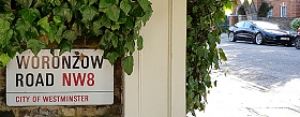
THROUGHOUT MY LIFE, I have been visiting or passing through St Johns Wood in north London. I have often noticed a street called Woronzow Road. It lies between Primrose Hill and St Johns Wood Underground Station. Whenever I have seen this road, I have wondered about the name ‘Woronzow’, but uncharacteristically I have always been too lazy to find out anything about it.
Recently, we visited Wilton House in Wiltshire, not far from the city of Salisbury. Home to the Herberts, the Earls of Pembroke, for many centuries, this is a wonderful place to visit, to see its gardens, the house itself and the outstanding collection of old master paintings within it. The decoration of the rooms that we saw is superb and is kept in good condition by the house’s present occupants, the family of the current, the 17th, Earl of Pembroke. It was whilst visiting this splendid country seat that my ears pricked up hearing the guide mention the name ‘Worontzow’.
In 1808, the widowed George Herbert (born 1759) remarried. His second wife was Catherine Woronzow (1783-1856). Her father was Semyon Romanovich Woronzow (1744-1832), Russian Ambassador to England from 1796-1806, who died in London and was buried in the Pembroke’s family vault. Catharine, who became Countess of Pembroke, did a great deal to improve Wilton House to create much of what we can see today. She is buried in the nearby church of St Mary and St Nicholas, which was built in a neo-Romanesque style between 1841 and 1844. It was built at the instigation of Catharine and her son Sidney Herbert, the 14th Earl of Pembroke (1810-1861).
Between October 1853 and February 1856, the last years of Catharine’s life, Britain was at war with Russia in what is known as The Crimean War. Between June 1859 and July 1861, Sidney Herbert was the Secretary for War in the British government. During the campaign, a supply route called the ‘Woronzow Road’, no doubt named in honour of Catherine’s noble Russian family, ran along the Crimean coast past Sebastopol. Thus, there was once a Woronzow Road in The Crimea. This was an important supply route for the British forces bringing much-needed material south from Alma and Calamita Bay towards Sebastopol. In the winter of 1854, the British lost control of this vital supply route and had to rely on goods reaching them by a far more difficult track,
One of Sidney Herbert’s great contributions to the war effort in the Crimea was his asking Florence Nightingale (1820-1910) to travel to Scutari (now, Üsküdar in Istanbul) with 38 volunteer nurses. She and her team helped to dramatically improve the treatment of the many soldiers who contracted diseases such as cholera and typhus whilst in the Crimea. Incidentally, Florence never visited the Crimea, but remained working in the Turkish city. Herbert and his wife had first met and become friendly with Florence Nightingale in Rome in about 1847.
Now let us return to St Johns Wood in London. Catherine’s father, Semyon Worontzow, lived in the district. The road, where he lived and whose name has intrigued me for decades, is now called ‘Woronzow Road’. It was named after him in 1843. It was not until 2002 that the Russians erected a monument to him on the thoroughfare named after him.
THE ELEPHANT IN the room is something about which we prefer not to speak. This is not the case for the herd of over one hundred elephants that can be found in London’s Green Park today. This is not a change in the creatures’ habitat caused by global warning, because the elephants are not real. They are life-size models of the creatures, constructed with strips of Lantana camara, an invasive weed that thrives in the tropics. Despite being made of strips of this woody material, each one is a fine representation of an elephant. From afar, the sculptures look quite lifelike. Some of the elephants have models of birds found in the UK perched on their backs.
The elephants, so we were informed by a helpful volunteer from Goa who is working for an organisation called Coexistence, are manufactured by local craftsmen living the district of Gudalur in the Nilgiri Hills of Tamil Nadu state in the south of India. By using the Lantana, the craftsmen not only create the models but also clear deleterious plants from their land.
Apart from looking great, the model pachyderms have arrived with a message. Known as the ‘Coexistence Herd’, the beasts have arrived:
“… at a unique moment in time when a global reduction in human activity has had a positive effect on wildlife. Elephants may be giants but they tread softly. This 100-strong herd reminds us that when we lighten our footprint, wildlife bounces back.” (https://elephant-family.org/coexistence/)
So, it seems that the herd has not arrived merely to enhance our enjoyment of Green Park but also to heighten our awareness of the desirability of humans living in harmony with the rest of the animal kingdom.
Green Park is not the only site in London where these elephants from India can be spotted. There are others currently on display at places such as Berkeley Square and St James Park. The elephants are all for sale. The proceeds of the sales:
“…will be directed to grass-roots organisations across India that allow people and wildlife to live together more peacefully.” (https://coexistence.org/elephant-shop/).
Whether or not you are concerned about the message that is supposed to be conveyed by these superb models of elephants, it unlikely that you will be disappointed by seeing them.
THE TATE BRITAIN is currently hosting a wonderful exhibition of the works of Paula Rego, born 1935 in Lisbon, Portugal during the fascist dictatorship of Antonio Salazar (1889-1970), who was in office from 1932 to 1968. Her father was anti-fascist and anglophile. He sent Paula to a finishing school in Kent (UK) when she was 16. Later, she enrolled to study painting at the Slade School of Fine Art, part of London’s University College. While she was studying there (from 1952 until 1956), she met her future husband, the painter Victor Willing (1928-1988). They married in 1959, following Victor’s divorce from his first wife. Paula and Victor lived between Portugal and the UK, finally settling in the latter in 1972.
Distributed within eleven rooms of the Tate Britain, Rego’s works are well displayed, some of them with informative panels placed beside them. Her paintings express her political (anti-fascist) and social consciousness, some of which is concerned with the ill-treatment of, and the indignities inflicted on, women, especially in the country where she was born.
Rego’s paintings are dramatic, colourful, powerful, and not lacking in a sense of humour. They are sometimes almost abstract, but the element of figurativeness is never completely absent. Her paintings often lean towards surrealism. Whether they are expressing subversion, or love, or depression, or pure fantasy, they are visually intriguing and cannot fail to engage the viewer. Throughout her works, which span several decades, the influence of her native land can be discerned, sometimes without difficulty, other times with the assistance of the informative labels by their side.
The exhibition, which opened on the 7th of July 2021, will continue until the 24th of October 2021. So, there is plenty of time for you to enjoy this superb exhibition of the fabulous works of this fascinating artist. It is an exhibition that once again demonstrates that great art is often created as a reaction to an oppressive regime.
GUILAN IS A NEW cafe on the corner of Moscow Road and St Petersburgh Place in London’s Bayswater. I have walked past the building numerous times over the past more than 25 years, but until today I missed seeing something on the building.
Above the ground floor windows there are a number of
sculpted heads of cattle. I had never noticed these before.
On looking at a map produced in the 1950s, I discovered that
the building was then a dairy. An older map revealed that it was ‘The Aylesbury
Dairy’. A search on the Internet informed me that this building was the head
office of the company, which had another branch not far away. So, the cattle heads are a souvenir of the
building’s time as a dairy.
The new café in the former dairy is across the road from
Aghia Sofia, a Greek Orthodox church. The cafe is elegant and serves good
coffee and tasty pastries including a croissant flavoured with za’atar. I have
no idea from which dairy the milk is supplied to Guilan, but you can be sure it
is not the Aylesbury Dairy.
EVERY YEAR SINCE 2000 (except 2020), the Serpentine Gallery in London’s Kensington Gardens has commissioned a temporary pavilion to be constructed next to it. A website (www.inexhibit.com/case-studies/serpentine-galleries-pavilions-history/) explains:
“The pavilions, which last for three months and should be realized with a limited budget, are located in the heart of the Kensington Gardens and are intended to provide a multi-purpose social space where people gather and interact with contemporary art, music, dance and film events.”
The architects chosen to design these temporary structures have not had any of their buildings erected in London prior to their pavilions. Some of the architects involved over the years included Zaha Hadid, Smiljan Radić, Sou Fujimoto, Herzog & de Meuron and Ai Weiwei, Kazuyo Sejima and Ryue Nishizawa, Frank Gehry, Olafur Eliasson & Kjetil Thorsen, Álvaro Siza, and Eduardo Souto de Moura with Cecil Balmond, and Oscar Niemeyer.
With a very few exceptions, I have liked the pavilions and admired their often visually intriguing, original designs. My favourites were the 2007 pavilion by Olafur Eliasson & Kjetil Thorsen; 2009 by Kazuyo Sejima and Ryue Nishizawa; 2013 by Sou Fujimoto; and 2016 by Bjarke Ingels.
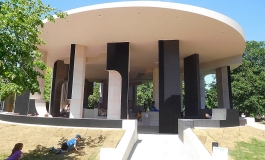
This year, the pavilion was designed by an architectural practice, Counterspace, based in Johannesburg (South Africa) and led by Sumayya Vally, who is the youngest architect to have become involved in the Serpentine pavilion project. According to the Serpentine’s website (www.serpentinegalleries.org/whats-on/serpentine-pavilion-2021-designed-by-counterspace/) the 2021 pavilion is:
“… based on past and present places of meeting, organising and belonging across several London neighbourhoods significant to diasporic and cross-cultural communities, including Brixton, Hoxton, Tower Hamlets, Edgware Road, Barking and Dagenham and Peckham, among others. Responding to the historical erasure and scarcity of informal community spaces across the city, the Pavilion references and pays homage to existing and erased places that have held communities over time and continue to do so today.”
Well, maybe this was the designers’ aim, but it does not convey that concept to me. This circular, building coloured black and white, immediately conjured up in my mind images of often disused municipal structures such as bandstands and public conveniences that might have been constructed on provincial British or even South African seafronts in the 1930s to 1950s. It might have been conceived with high-minded ideas in the architects’ heads, but I felt that the structure is lacking in visual interest both in detail and in its entirety. Compared with many of the previous pavilions erected on its site, this is one of the dullest I have seen. It is a shame that the pavilion’s creators did not put more effort into its appearance than into the message(s) it is supposed to convey. To my taste, it is a disappointment but do not let me put you off: go and see it for yourself.
THE DOMED IONIC temple in the gardens of Chiswick House in west London was built in the early 18th century. It appears in a painting executed in 1729. This circular building is faced by an obelisk that stands in the centre of a circular pool. Today, we walked past these neoclassical garden features when we noticed a lady in a flowing white dress posing on the steps of the temple. Facing her across the circular pond were cameramen and their assistants, some holding large reflector screens. They were either carrying out a photo-shoot or making a film. Every now and then, a man holding a smoke gun ran past the temple creating an illusion that the temple was bathed in mist. Here is a photo I took whilst this activity was in progress.
ACTON IS NOT usually given high priority on the list of places that visitors to London might compile. However, this district in west London, once a borough in its own right between 1865 and 1965, now part of the Borough of Ealing, is not devoid of interest. After a visit to our dentist, whose surgery is close to Acton’s High Street, we took a look around the area. Churchfield Street, filled with small shops and various eateries, leads east to Acton Central Overground Station.
Opened in 1853 as ‘Acton’ station, it was first a stop on the North and South Western Junction Railway. In 1925, it was renamed ‘Acton Central’. The original 19th century railway building built in about 1876, a rather too grand edifice for such a humble station, has now been converted into a pub/restaurant, whose menu looks appetising. Crossing the tracks, we reach Acton Park, about which I will say more later.
The name ‘Acton’ might derive from Old English words meaning ‘oak town’. At the beginning of the 19th century, the parish of Acton was mostly agricultural land with a small population of about 1400 souls. Between 1861 and 1871, the population increased from about 4000 to about 8300, reflecting the urbanisation of the area. By the mid-1880s, it had reached about 12000. No doubt the accessibility of London via the railway helped increase the area’s attractiveness for people wishing to live in leafy suburbs within easy reach of their workplaces in the centre of the metropolis. Many of the streets near the station are lined with substantial, well built houses.
Acton Park is an attractive, municipal recreation area with lawns, trees, bushes, a café, a putting green, and other facilities including a ‘skate park’ and a children’s nursery. At the northern edge of the park opposite Goldsmiths Buildings, there stands a fine stone obelisk. This was moved to its present position in January 1904 from its original sight in the grounds of the now demolished Derwentwater House on Acton’s Horn Lane. It commemorates James Radcliffe, 3rd Earl of Derwentwater (1679-1816). The date of his death is significant, as I will explain.
James was the son of the 2nd Earl (1655-1705) and Lady Mary Tudor (1673-1726), whose parents were King Charles II and one of his mistresses, the actress Mary ‘Moll’ Davis (c1648-1708). James was brought up in France in the court of the exiled James Francis Edward Stuart (1688-1766), ‘The Old Pretender’, son of the Roman Catholic King James II of England, who was forced to leave England by the Protestant William of Orange. James Stuart, encouraged both by a desire to re-establish the line of James II on the English Throne and by the French monarchy, made various attempts to gain the Throne of England. One of these was in 1715, a year after the Protestant Hanoverian King George I had become crowned King of England. In December 1715, The Old Pretender landed in Scotland, having sailed from France.
In 1709, James Radcliffe, whose memorial stands in Acton Park, sailed to England to visit his recently inherited estates in Cumberland and Northumberland. In 1715, he joined the conspiracy to put his companion since childhood, The Old Pretender, on the Throne of England. A warrant for his arrest was issued, but at first he evaded capture by going into hiding. At the Battle of Preston (9th to 14th November 1715), when the Jacobite forces fighting for The Old Pretender were defeated, Radcliffe was arrested and taken to The Tower of London. After various attempts to reprieve him, he was executed in February 1716. His heart was taken to a convent in Paris, where it remains. The monument was erected by Radcliffe’s widow, Lady Derwentwater, who was living in Acton at the time of his execution. Her home, Derwentwater House, which can be seen marked on a detailed map produced in the early 1890s but not on one published in 1914, stood where Churchfield Road East meets Horn Lane, where today the newish shopping centre, ‘The Oaks’, now stands. Edward Walford, writing in 1883, noted in connection with the house:
“It is said that the iron gates at the end of the garden have never been opened since the day her lord last passed through them on his way to the Tower.”
Acton Park was created in 1888, mostly on land that had been owned by The Worshipful Company of Goldsmiths. Across the road from the park and opposite the obelisk, you will see the elegant Goldsmiths Almshouses. This building was erected in 1811 and enlarged in 1838. They were built on land left to the Goldsmiths Company by John Perryn, in whose memory one of Acton’s residential roads is named.
Tree-lined Goldsmiths Avenue is just 360 yards north of Acton Central Station. Number 78 used to be named ‘Tilak House’ in honour of the Indian freedom fighter Bal Gangadhar Tilak (1856-1920). In early May 1907, Vinayak Damodar Savarkar (1883-1966), a freedom fighter and father of the idea of ‘Hindutva’, an expression of Indian nationalism which underlies the political philosophy of India’s currently ruling BJP party, held a celebration of the fiftieth anniversary of the Indian Rebellion of 1857 at this house. The house was then the home of Nitin Sen Dwarkadas, brother-in-law of another Indian patriot who lived in London, Shyamaji Krishnavarma (1850-1930). Today, there is no memorial to this event.
Other attractions that caught my eye in Acton include St Marys Church (established by 1228, but the current building dates from 1865-67) and its nearby peaceful rectangular cemetery on West Churchfield Road. The Old Town Hall with its accompanying municipal offices was built on the site of the former Berrymede Priory. Designed by the architects Raffles and Gridley, the town hall was built in 1908-10, and extended in 1939. Berrymead Priory, a dwelling, is commemorated by a thoroughfare named Berrymead Avenue, where our dentist practises. It was built on the grounds formerly occupied by William Savile, 2nd Marquess of Halifax (1665-1700), who died here. The priory must have been lovely. Walford noted that it was:
“… a picturesque Gothic edifice of the Strawberry Hill type, and occupied the centre of several acres of ground, which are planted with fine trees and evergreens.”
One of the priory’s better-known inhabitants was the novelist and politician Edward Bulmer (1803-1873), Lord Lytton, who lived there between 1835 and 1836. In 1849, the place was purchased by the wealthy cavalry officer George Drafford Heald, who lived here briefly with his wife, the glamorous Irish born actress and courtesan Lola Montez (1821-1861), one time mistress of King Ludwig I of Bavaria and also of the composer Franz Liszt, whom he had married in 1848. The Healds had to flee to France soon after their marriage, which contravened the terms of her divorce with a previous spouse. Lola and George’s marriage did not last long. However, the building named ‘Berrymead Priory’ lasted longer, until 1982 when it was demolished.
Our Lady of Lourdes, a small Roman Catholic Church built in 1902 in the Romanesque style, was designed by Edward Goldie (1856-1921), who built many other Catholic churches. This church is on the High Street close to another decorative public building, The Passmore Edwards Library, built in 1898-99 and designed by Maurice Bingham Adams (1849-1933) in what Nikolaus Pevsner describes as:
“… his typical rather bulging Baroque paraphrase of the accepted Tudor of the late Victorian decades.”
Adams also designed the Passmore Edwards Library in Shepherds Bush. There is more to Acton than I have described, but maybe what I have written might whet your appetite to explore a part of London that is somewhat off the tourist’s beaten track.








 yamey
yamey 