A bridge in London waiting for repairs

In the middle years of the 1720s, Daniel Defoe described Hammersmith as a village that was growing into a small town:

“… and some talk also of building a fine stone bridge over the Thames …”
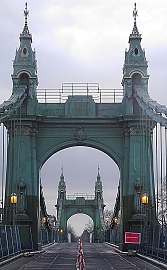
It was almost 100 years after Defoe speculated that a bridge across the Thames would be built at Hammersmith. A suspension bridge was constructed between 1824 and 1827. It was the first of this type of bridge to be constructed anywhere near London and the first to span the Thames. James Thorne, writing in 1876, that in outline and simplicity of style, it:

“… remains the best-looking-bridge of its kind on the Thames …”

The bridge was designed by William Tierney Clark (1783-1852), who had been guided in his development of bridge construction techniques by Thomas Telford and John Rennie, who designed the old London Bridge that now stands in Lake Havasu City in Arizona. Clark also designed the suspension bridge (1832) across the Thames at Marlow and the impressive Széchenyi (Chain) Bridge which crosses the River Danube to link Buda and Pest. The latter resembles Clark’s Hammersmith Bridge as depicted in old engravings.

In 1883-37, Clark’s Hammersmith Bridge was replaced by a newer one designed by Joseph Bazalgette (1819-1891). According to Cherry and Pevsner in The Buildings of England. London 2: South, Bazalgette:

“… re-used the piers and abutments. Iron-framed towers clad in cast iron partly gilt, with Frenchy pavilion tops, and elephantine ornament at the approaches … The deck stiffening girders were replaced in a major overhaul in 1973-6.”

This bridge, which was built for use by horses and carts, pedestrians, and the occasional cyclist, long before the advent of heavy motor vehicles such as busses and lorries. It has been closed for repairs several times, causing much nuisance for those who live on both sides of it. In April 2019, Hammersmith and Fulham Council closed the bridge to all motorised traffic. This was done following the discovery of serious cracks in the pedestals that support the bridge. It remained open for pedestrians and cyclists until August 2020, when a heatwave caused further deterioration. Then, the bridge was closed to all users.  

A variety of schemes have been proposed for repairing the bridge and there was some disagreement as to who would pay for the work. In June 2021, Hammersmith and Fulham Council came to a cost-sharing deal to complete the rehabilitation of the Victorian bridge. In July 2021, the bridge was reopened for use by cyclists and pedestrians until 2027. In February 2022, I stepped on the bridge for the first time since it closed. The view from it is marvellous, especially upstream where one gets a good view of the historic buildings lining the waterfront between Hammersmith and Chiswick.

Eating in The Ark

THE SHED IS aptly named. It is a restaurant in a long lean-to shed amongst the more solidly built edifices on Palace Gardens Terrace in Notting Hill Gate. This ramshackle-looking wooden structure has been home to a restaurant for many decades. For most of that time, it was called ‘The Ark’. It served lovely French-influenced food including my favourite on its menu, rack of lamb. The Ark was a popular local eatery, which attracted some celebrities including Prince Charles and Ingrid Bergman in the 1960s.

On one occasion a friend, let us call him ‘X’, who had eaten at our home many times,offered to treat us at The Ark. We accepted willingly. As soon as we sat down, X ordered the restaurant’s most expensive bottle of red wine. When, during our meal, it came to an end, he ordered another of the same. When the bill arrived at the end of our dinner, X fumbled in his pockets, blushed, and then, stammering, said:

“Oh, I have left my wallet at home.”

His home was a long way from Notting Hill Gate. He continued:

“This is all I have got”,

and placed a £10 note on the table. £10 barely covered half the cost of one of the bottles of wine he had ordered. Naturally, we paid the bill, and he said he would refund us the money, which he must have forgotten to do.

The Ark closed and then re-opened as a branch of the restaurants run by the chef Jean-Christophe Novelli. It served what I considered to be rather over-priced pretentious food. On one occasion, the Novelli restaurant took part in a scheme run by the Evening Standard newspaper. For £15, restaurants in the scheme offered a full meal without drinks – a bargain. My wife rang Novelli at the old Ark and asked whether we could book a table that day and use the voucher in the newspaper for the discounted meal. She was told that the restaurant was fully booked. So, I rang about two minutes later and asked to book a table, but without mentioning the newspaper offer. The lady, who answered the ‘phone at the restaurant, told me:

“Certainly, we have plenty of tables. Come when you like.”

Novelli’s closed, and the old Ark building remained empty for a while.

In 2012, the Gladwin brothers opened The Shed restaurant in the shed that once was home to The Ark. Time Out magazine (www.timeout.com/london/restaurants/the-shed) described it well:

“Tucked away behind a curtain of tousled ivy, The Shed serves up small, resourceful dishes built with foraged and locally-grown ingredients from the countryside. Led by the Gladwin Brother trio, who have their own farm and vineyard in Nutbourne, West Sussex, as well as two additional London restaurants, their flagship Shed was quick to become a local neighbourhood favourite when it first opened in 2012.

Though the menu changes seasonally, the original plates are still the best bet. (Note: everything is served tapas-style and 2-3 dishes per person is the recommendation.)”

I have been there a couple of times and found it to be both pleasant and original from the culinary vantage point. The serving staff, which briefly included our daughter, are obliging and well-trained. When ordering, the waiter or waitress discusses the dish and its ingredients knowledgeably. Pleasant as it is, it is not as enjoyable as The Ark was in its time.

David Hockney painted here

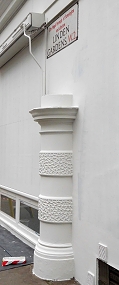
AT THE EASTERN END of Notting Hill Gate, there is a road called Linden Gardens. In the 1860s, only the eastern part of this existed and it was named Linden Grove. To the west of Linden Grove was Linden Lodge, set in extensive grounds with a large pond or lake. It was designed by the engraver, architect, and property developer Thomas Allason (1790-1852) and constructed in 1826. He lived there until about 1838. In the late 1860s, the Lodge was demolished, and houses were built around the edge of, and on, its grounds. This occurred because of the construction of the Metropolitan Railway in the mid-1860s. The gateposts of the lodge still stand, partially embedded in the buildings at the south end of Linden Gardens.

The website british-history.ac.uk noted that it was probably the peacefulness of the Grove:

“… which attracted two other artists, William Mulready, who lived in the southernmost of the eight paired houses (now demolished) from 1828 until his death in 1863, and Thomas Creswick, who lived at the still surviving No. 42 from 1838 until 1866. In the latter year this house was affected by the building of the Metropolitan Railway. Creswick therefore moved to Mulready’s now vacant house, and also, apparently, occupied the adjoining house to the north (with which it formed a pair) until his death in 1869.”

William Mulready (1786-1863) was the designer of the penny postage envelope depicting Britannia. Creswick (1811-1869) was a landscape painter and illustrator. Someone, who lived in Linden Gardens, told me that some of Queen Victoria’s children received art lessons in a studio in Linden Grove, but I have found no evidence to confirm this. However, it is certain that David Hockney painted Mr and Mrs Clark and Percy, a portrait of the dress-designer Ossie Clark (1942-1996) and his wife in their flat in Linden Gardens. The balustrades in the painting are typical of those on most of the first-floor balconies of the houses in the Gardens.

Another artist, Elsa Fraenkel (1892-1975), a German-Jewish born sculptor and Fellow of The Royal Society of Arts, who fled from the Nazis, also lived briefly in Linden Gardens, so I was informed by her daughter, who lives in Bangalore (India), where Elsa died.

Hampstead: a town on a hill

Hampstead High Street

A town on high

Home of famous artists and authors

Hampstead by name

ENJOY my new book which takes a fresh look at north London’s Hampstead: its sites, its personalities, its character, and history. “Beneath a Wide Sky: Hampstead and its Environs” is available from Amazon: https://www.amazon.co.uk/dp/B09R2WRK92

Agatha Christie lived here

HAMPSTEAD’S LAWN ROAD Flats, better known nowadays as the Isokon Flats, was built in the 1930s as an experiment in communal living. This modernistic building was home to artists, writers, architects, and others. Many of its tenants were intellectuals fleeing from Nazi Germany. Amongst its many inhabitants were Henry Moore, Agatha Christie, and Walter Gropius.  Unintentionally, it also became a centre for Soviet Russian espionage activities. You can read about this amazing place and a great deal more about Hampstead in my new book, “Beneath a Wide Sky: Hampstead and its Environs”: https://www.amazon.co.uk/BENEATH-WIDE-SKY-HAMPSTEAD-ENVIRONS/dp/B09R2WRK92/

Out of town

THE GREAT SAMUEL Johnson (1709-1784) is supposed to have said to James Boswell on the 20th of September 1777:

“Why, Sir, you find no man, at all intellectual, who is willing to leave London. No, Sir, when a man is tired of London, he is tired of life; for there is in London all that life can afford.”

Now, 245 years later in 2022, I largely agree with Dr Johnson, but not completely. Every now and then, it is wonderful to leave London in search of the open countryside, fresh air, wide expanses of sky, and a different way of life. Equally, it is satisfying to return to the city feeling refreshed and, sometimes, having been away from it, seeing familiar things in a new light. Our excursions from London have ranged from several months to several hours. The latter, shorter outings, have been invaluable during the recent period when because of covid19 travelling abroad has been difficult, to say the least.

One of our current favourite destinations for brief outings is the tiny village of Abingdon Piggots in southern Cambridgeshire. Although it is only about 90 minutes’ drive from central London, it feels as if it is almost in a different world from the metropolis. Despite being close to Baldock and Royston, the village seems as if it is in the deepest countryside. It has not more than 60 well spread-out houses, a church, and a hostelry called the Pig and Abbott.

The Pig and Abbott is run by Pat and Mick. It is a traditional country inn where one can enjoy a drink as well as eating superbly cooked, tasty food. We have visited the pub at least six times since we first discovered it in July 2020. Each time we go there, we are welcomed like old friends. I suppose we have become regarded as ‘regulars’. Mick told me that most of the regulars come from the area around the village. Of the 60 or so households on the village, only about 10 use his pub. I asked him whether we were amongst his furthest customers. He told me that we were, but one of his regulars, who lives in Alaska, always drops in when he visits Cambridge, where he has work colleagues.

After a hearty meal at the Pig and Abbott, we always take a stroll along Church Lane to see the small church in which there are graves of members of the local Piggott family. The lane is flanked by fields in which one can watch sheep and horses grazing. There is hardly any sound to be heard except birdsong.

Pleasant as is this bucolic scene, it would not suit me to live in it for more than a day or two. I am an urban creature at heart and the humdrum of city life suits me well. My childhood was spent amongst gardens and trees in the Hampstead Garden Suburb in north London, yet I never enjoyed the place as much as central London, which I began visiting with my parents at a young age. I guess that although I enjoy my occasional forays outside London, I cannot disagree with what Johnson said to Boswell all those years ago.

Republic Day

AFTER OUR HONEYMOON in the south of India, we returned to Bangalore, where we disembarked from an overnight bus from Ernakulam (in Kerala) at about 4 am on the 26th of January 1994. Several hours later and incredibly bleary-eyed, we joined many other residents at a gathering in a courtyard of the apartment block in the city’s southern suburb of Koramangala. Mr Zafar Futehally (1920-2013), a noted naturalist and one of the senior tenants, stood by a flagpole and made a brief speech. Then, the flag of India was raised, and everyone dispersed.  It was Republic Day, the significance of which was unknown to me back in 1994, when I made my first visit to India.

Ambedkar in Bangalore

Now, I know that on the 26th of January 1950, two and a half years after India became independent, the Constitution of India came into effect and India became a republic, having briefly been a Dominion since the 15th of August 1947. The Constitution was drafted by a committee that was led by Dr Bhimrao Ramji Ambedkar (1891-1956). After leaving school, he was educated at the University of Bombay, then at Columbia University in NYC, and then at the London School of Economics (‘LSE’). While in London, he qualified as a barrister as a member of Gray’s Inn.

Long after 1994, I learned that Ambedkar had lived in a part of London with which I am familiar. He resided in a house near Primrose Hill and Chalk Farm, where the Roundhouse is located. In my recently published book “Beneath a Wide Sky: Hampstead and its Environs”, I wrote:

“Another reformer and patriot lived near Regents Park Road. He was Dr Bhimrao Ramji Ambedkar (1891-1956), who championed India’s Dalits (‘untouchables’) and formulated the Constitution of India. Between 1920 and 1922 while he was studying at the London School of Economics and for the Bar, Ambedkar lived in a house at 10 King Henrys Road near Regents Park Road. In 2015, the house was bought by the Government of Maharashtra and was then converted into a memorial to Ambedkar. It is open to the public. Visitors can learn about Ambedkar from the well-captioned photographs on the walls of the rooms that they can wander through. The upper floor contains a re-construction of Ambedkar’s bedroom including a four-poster bed, some of the great man’s books, and an old pair of spectacles, which might have belonged to him. Other rooms contain shelves of books and various memorials to Ambedkar. There is also a commemorative plaque to India’s present Prime Minister Narendra Modi, who inaugurated the memorial house in November 2015. The garden contains statue of Ambedkar clutching a book (the Constitution) in his left hand. A few years ago, neighbours of the Ambedkar house complained about it, concerned that it would attract swarms of tourists.”

Although he could never have met him, Ambedkar’s home in King Henry’s Road was not far from the house in which Friedrich Engels (1820-1895) lived for several years.

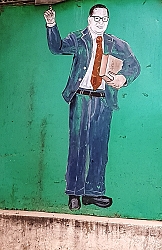
The statue portraying Ambedkar statue in the garden of his former London home is typical of those found all over India. Apart from helping to give birth to India’s Constitution, Ambedkar campaigned for the rights of the Dalits (the ‘Untouchables’), as mentioned in the quote above. The Dalits were excluded from the four caste Varna system of Hinduism and considered by many Hindus as the lowest of the low, fit only for menial tasks that members of other castes would not deign to consider doing. Ambedkar, born into a Dalit caste, campaigned actively for the ending of social discrimination against this class of people. Mochis (cobblers/shoe repairers), who handle leather, are often Dalits. The best place to find a mochi is on the pavement beside a road. Sometimes, they sit on the ground surrounded by their tools and footwear awaiting repair. In other cases, they work from little stalls that can be locked up when they are not at work. These stalls often bear images of Ambedkar in honour of the man who did much to help the Dalits. What with the huge numbers of statues of him and of portraits on the stalls of mochis, Ambedkar must rival Gandhi as being one of the most frequently portrayed politicians of modern India.  

So, every Republic Day, it is appropriate to celebrate the birth of the republic and the adoption of the Constitution, but we should not forget to raise our hats and flags to Ambedkar, the brilliant man who did far more than father the Constitution.

A NEW book about Hampstead in north London

AVAILABLE FROM AMAZON WEBSITES:

e.g.: https://www.amazon.co.uk/dp/B09R2WRK92

Hampstead is one of the highest places in London. There, the heavens are vast
and wide. Beneath this expanse of sky is an area with an eventful past and a
vibrant present. This book takes a fresh look at the locality and shows that
Hampstead is richly imbued with historical memories and has been home to a
multitude of fascinating and noteworthy people. Many books have been written
about Hampstead. Doubtless, there will be more. This one is different. It looks
at Hampstead from unusual as well as familiar viewpoints and gives the reader
a richer appreciation of what makes the place both delightful and intriguing.
This volume explores a wide variety of subjects, familiar and obscure, as well as
some which have never been described in other books about the locality. Here
is a fresh and at times quirky look at this place on a hill, one of London’s
treasures: a district, which is familiar to many people, yet full of surprises.
Although the bulk of this book is about Hampstead, there are also sections
describing some of its environs.

By reading this book, you can find out why John Constable, Samuel Johnson, Boy George, Mohammed Ali Jinnah, Mahatma Gandhi, Peter Sellers, Henry Moore, Maxim Litvinov, General de Gaulle, Stanley Spencer, Thomas Masaryk, Lee Miller, Agatha Christie, Jim Henson, Ian Flemming, Ernő Goldfinger, and many others, both famous and familiar, were all connected with Hampstead.

The book has several sections:
1. a brief survey of Hampstead’s general history and geography.
2. an introduction to Hampstead’s main thoroughfares with some
reminiscences of the area as it was during my youth.
3. the largest section of the book is a collection of chapters about
various aspects of Hampstead’s past and present. Recently, a friend of mine
bemoaned the fact that Hampstead High Street and Heath Street are lined with
branches of shops and cafés that can be found all over London. He is right. So,
if you wish to capture the true character of Hampstead, you need to stray into
the side streets and explore, which is what I hope this book will stimulate you to
do.
4. The last few sections of the book deal with some places of interest near to
Hampstead: Primrose Hill, North End, Go
lders Green, and Highgate.

TABLE OF CONTENTS

PREFACE … 7
INTRODUCTION: OH NO, NOT IN HAMPSTEAD … 7
SOME GEOGRAPHY AND HISTORY … 13
HEATH AND HIGH STREETS WITH SOME MEMORIES … 25
SATURDAY STROLLS … 25
PERRINS LANE, THE EVERYMAN, AND LOUIS … 34
DISCOVERING HAMPSTEAD … 41
A HOUSE ON HEATH STREET AND THE KIT CAT CLUB … 41
A CHURCH ON HEATH STREET … 45
FLASK WALK AND THE HAMPSTEAD SPA … 46
MORE ABOUT THE SPA … 56
THE VALE OF HEALTH … 60
POETS AND THE VALE OF HEALTH … 70
FRENCH CONNECTIONS AND ST MARYS ON HOLLY WALK … 76
ARTISTS IN HAMPSTEAD: ROMNEY, CONSTABLE, AND OTHERS 84
MODERN ARTISTS AND THE ISOKON … 95
BOLSHEVISM AND HEATH STREET … 109
A SINGER AND A PHILOSOPHER ON BRANCH HILL … 114
JUDGES WALK … 118
WHITESTONE POND … 122
EAST HEATH ROAD AND SOUTH END GREEN … 126
SIR HARRY AND ROSSLYN HILL … 137
PILGRIMS LANE AND MORE ON ROSSLYN HILL … 143
NEW END, CHOLERA, AND GROVE PLACE … 150
FITZJOHNS AVENUE AND SWISS COTTAGE … 155
SHEPHERDS WELL … 171
CHURCH ROW … 174
GRACIE FIELDS, FROGNAL WAY, AND FROGNAL … 179
WEST HEATH ROAD AND PLATTS LANE … 187
WEST HAMPSTEAD … 193
SHOOT UP HILL … 198
PRIMROSE HILL … 201
NORTH END AND GOLDERS GREEN … 211
NORTH END AND GOLDERS HILL PARK … 211
POETS AND GOLDERS GREEN … 228
LIFE AND DEATH ON HOOP LANE … 232
HIGHGATE … 241
CODA … 273
SOME BOOKS CONSULTED … 275
ACKNOWLEDGEMENTS … 278
INDEX … 279

Little green huts

SOUTH OF KENSINGTON Gardens, just west of the Royal Garden Hotel, there is a small green hut with a pitched roof beside Kensington Road. It is one of the thirteen remaining cabmen’s shelters dotted around central London, which were established by the Cabmen’s Shelter Fund (‘CSF’) in 1875 and are still maintained by this organisation. Back in those days, cab drivers could not leave a cab stand whilst they were parked there. This made it difficult for cab drivers to obtain food and drink whilst on duty.

The solution to this problem was devised by the newspaper editor George Armstrong (1836–1907) and Anthony Ashley-Cooper, 7th Earl of Shaftesbury (1801-1885). They conceived the idea of the shelters to provide cabdrivers with refreshment. By law, the shelters had to be no larger a horse and cart, which explains their small size. That way, they did not encroach on the carriageway too much. In the past, these shelters confined themselves to serving cabmen. More recently, members of the public can buy snacks and drinks at these huts, whose attendants are supposed to make a living from their shelters.  Cabmen can eat within a shelter, but others can only use them for take-away refreshments.

Recently, when passing the shelter on Kensington Road, I noticed that there were a couple of menus attached to it. Next to them was a small blackboard on which the following was written in chalk:

“Till Rolls 3 for 2.50 Receipt pads 4 for 2£”

This is stationery for the exclusive use of taxicab drivers. I was pleased to see this because it means that although they are open to the public, they are still of special use to cabdrivers.

I have never sampled anything at a cabmen’s shelter, so have no idea of the quality provided. Years ago, when I was practising dentistry, one of my patients was a taxicab driver. He was a ‘foodie’ and  told me that he knew great quality, reasonably-priced eating places all over London. I cannot recall that amongst the many places he told me about that there were any cabmen’s shelters.

Art deco in Kensington

FROM THE LATE 19th century until a few years ago, High Street Kensington was a healthily flourishing retail centre. In its heyday, it boasted of three large department stores, Pontings, Barkers, and Derry & Toms. The impressive buildings that housed the latter two still stand and are fine examples of art deco architecture located close to the Underground station, which has been in service since the late 1860s. In recent years, the advent of on-line shopping, high rents, and the proximity of the Westfield Mall at Shepherds Bush (opened 2008), which has good parking, have conspired together to make High Street Kensington less appealing to shoppers. Consequently, at any one time a large proportion of shops remain empty awaiting new tenants. Sadly, what was once (especially in the 1960s and ‘70s) a bustling high street with trendy shops like Biba and the ‘funky’ Kensington Market, both gone, has become slightly dreary.

Barkers building

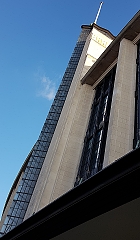
Barker’s former shop, a lovely art deco edifice, which opened in 1933, was designed by Bernard George (1894-1964). Between 1928 and 1962, he was the chief architect for Barker’s of Kensington in-house design group.  It is worth examining this building closely to enjoy is many attractive details.