It began with a bang

First experiences of India

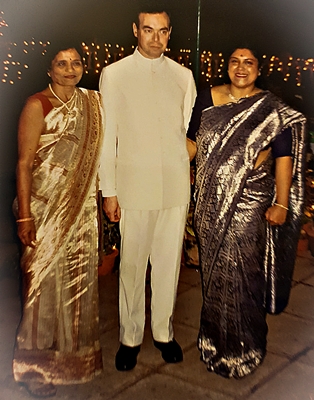
My wife, Lopa, and I flew to Bangalore in India in late December 1993 to celebrate our marriage with a Hindu ceremony. This was the first time that I had ever travelled further east than Cyprus.

COCO 3

We flew from London on a ‘plane operated by the Sri Lankan line, Air Lanka. The flight was memorable because the food served on board was superb. It was not the bland, insufficient fare usually provided when airborne. What we received on our trays in large metal foil containers was delicious Sri Lankan food, which tasted as if it were home-made by a cook who injected his or her love of food into the flavours.

Our first stop was at Colombo, the capital of Sri Lanka. As we descended for landing during the slowly brightening dawn light, I could see acres of palm trees below us.  This was the first time that I had ever seen groves of palms. This exotic sight made me feel that at last I had arrived in Asia.

After disembarking, we had to wait for our next flight for several hours. In those days, we took anti-malaria tablets. That morning, the only liquid we could find to wash them down was tea. Until that moment I had always drunk tea without milk. The tea stall only provided sweetened milky tea. I found it to be sickly and no help for ingesting the evil-tasting tablet. Now, after many visits to India I quite enjoy Indian milky tea.

My wife and I waited in a room along with other passengers, all of them from the sub-continent. Suddenly, one of her eyes began streaming with tears because some foreign body had entered it. Lopa began dabbing her eyes with a tissue. All the people around us glared at me. They thought that I had upset my wife!

On landing in Madras (Chennai) after walking across the tarmac from the ‘plane to the terminal, Lopa became nervous about the Indian customs examination. She told me that the officials could be very awkward. In those days, very little in the way of foreign goods were imported into India. Visitors or returning Indians were often laden with goods that then attracted high import duties at the customs. Smuggling was rife, and the customs’ officials were eagerly on the look-out for hidden treasures such as electronic goods, booze, and so on. We were not carrying anything of dutiable value. Nevertheless, Lopa was anxious.

As we approached the customs’ officials, the gods blessed us in an unusual way. Lopa’s nose suddenly began bleeding profusely. Despite using a handkerchief there was blood all over the place. The custom’s official, whom we were approaching, took one look at the bloodstained woman approaching him, and waved us through the customs barrier without stopping us.

At this point, let me tell you another thing that surprised me during my first visit to India: women police officers dressed in saris, albeit plain khaki saris. Another ‘plane took us from Madras to Bangalore (Bengaluru).

Lopa’s family met us at the airport (this was the old HAL airport east of the city, which has now been replaced by the newer Kempe Gowda Airport north of the city). After fighting our way through a crowd of taxi touts, we scrambled aboard the family’s ageing Maruti van, through its sliding side door.

By now, it was late at night, and dark. When we reached the family’s house, we disembarked, and stood in front of the main entrance. The top of the front door was decorated with leaves attached to a thread, a ‘toran’ (तोरण). Instead of entering, we all stood in front of the door. I wondered whether the front door key had been mislaid.

After a few minutes, there was suddenly a deafening sharp cracking sound, a loud bang. I thought to myself: “Oh no, we’ve been in Bangalore for just over an hour, and someone is shooting at us.” The noise that had startled me was no more than someone cracking open a coconut with an axe. Cracking coconuts is a part of Hindu traditions, especially at weddings. Amongst other things, the coconut is associated with fertility.

COCO 0

Some days later, we began the three-day long series of events connected with our Hindu wedding ceremony.

COCO 1

After the blessings by the priests, Lopa and I, connected together by several flower garlands and scarves, struggled into the back seats of a small Maruti car (not the van!). As soon as we were aboard we were driven a few feet forward. The purpose of this short journey was to drive over and thereby crack a coconut placed beneath one of the car’s front wheels.
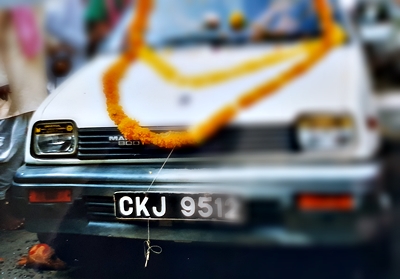
COCO 2

I can truly say that my experience of India began with a bang.

One body, two heads

A short reflection on the use and origin(s) of birds with two heads

DHE 2 Blore

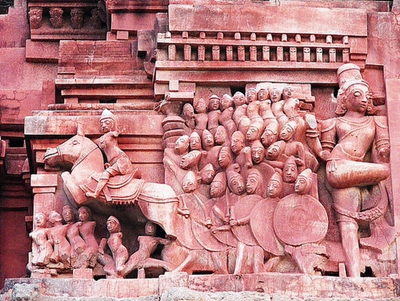
On a Hindu temple in Bangalore, Krnataka, India

The earliest archaelogical evidence of the existence of double-headed eagle (‘DHE’) or any other bird with two heads (each with its own neck) is in Bablylonian remains dating back to 3000-2000 BC.

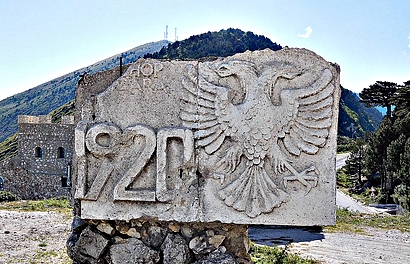
The DHE is and has been used as a heraldic symbol by, for example: the Scythians, the Hittites, the Seljuk Turks, the Kingdom of Mysore (in India), pre-Columbian America, Cormwall (UK), Byzantium, the Holy Roman Empire, the Russian Empire, and several states in the Balkans. The Balkan states that use the DHE include: Albania, Montenegro, and Serbia.

DHE 0

Map showing some of the many places where the double-headed eagle has been employed

I find the DHE to be a fascinating symbol because unlike, forexample,  the cross, Star of David, and swastika, it is not a simple geometric construction, which could be created by random ‘doodling’. Also, it is not naturalistic like the commonly used  such as a lion,  single headed eagle, bear, fish, and hound. 

There is a Hindu mythological creature, a bird with two heads, the Gandaberunda, which has been adopted by the Government of Karnatak (formerly Mysore) as its state emblem. The origins of this creature are obscure, but it has been described in the ancient Hindu texts, the Vedas.

The DHE is an imaginary creature, a product of human thought. The Babylonians not only portrayed the DHE, but also other double-headed creatures.

DHE 1

The Albanian double-headed eagle on the summit of the Llogara Pass in Southern Albania

I would like to SPECULATE that the origin of the DHE was Mesopotamia. From there, I imagine it spread through what is now Turkey to Europe, and across the Indian Ocean to India. If the DHE, or something similar appears in the Vedas, it would be interesting to know if this was by chance or as a result of some forgotten connection between Mesopotamia and the Indian sub-continent.

Arab or Norman, Hindu or Muslim…

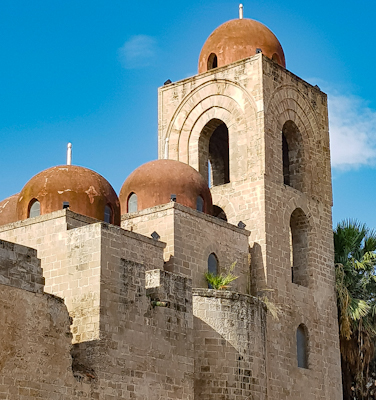
The Normans took over Sicily from its Arab rulers. The early mediaeval church architecture adopted by the Norman builders shows the influence of Arab design.

In Gujarat (India), the Muslim invaders began building mosques in the style of local Hindu temples, just as the Normans built in the way that they found when they arrived in Sicily.

Gift of a Parsi gentleman

FOUNT 1

There is a decorative drinking fountain on the Broadwalk in London’s Regent’s Park. The fountain looks like a typical Victorian gothic structure, which it is. Closer examination reveals bas-relief panels that depict: a bull standing by a palm tree; a lion next to a palm tree; and the head of a man wearing an oriental hat. This fountain would not look out of place in Bombay, which is full of structural souvenirs of the Victorian era. This should not surprise you when you learn that the fountain was a gift of Sir Cowasjee Jehangir Readymoney (1812-78) from Bombay.

FOUNT 3

Cowasjee, who was born in Bombay, received little education before becoming a warehouse clerk in Duncan, Gibb & Co. in that city. In 1837, he moved into a more lucrative job. Nine years later, he opened his own business. In 1866, he became a Commissioner of Income Tax in Bombay. Later he became a Justice of the Peace.

FOUNT 0 352px-Sir_Cowasji_Jehangir_Readymoney_(1812-1878)

Readymoney lived up to his name, becoming very wealthy. He invested huge amounts of money into a wide variety of good causes including social housing (similar to that erected by Peabody in the UK) in Bombay, The University of Bombay and an Indian Institute in London. A year after being made a member of the Order of the Star of India in 1871, he was made a Knight Bachelor of the UK. These honours were awarded to recognise his great philanthropic contributions.

FOUNT 5 Jehangir himself

The fountain in Regent’s Park, which no longer issues water, was erected in 1869, nine years before Readymoney’s death. His main residence was in Bombay’s Malabar Hill district.

FOUNT 4

The pencil and the peas

PENCIL 2

I spent three years working on the experimental aspects of my PhD topic at University College London (‘UCL’) in a laboratory in the Physiology Department. Throughout that time there were always one or two other PhD students working in the same room. ‘Wink’, our supervisor’s wife, was a chemist. She often worked alongside us. Generally, the atmosphere in the laboratory was very congenial.

We were joined by a new PhD student sometime during my second year in the lab. Fortunately, I cannot recall her name, but let’s call her ‘June’.

One morning, June asked me whether she could borrow a pencil from me. As pencils were few and far between in our lab, I said to her: “Make sure you give it back, please.” To which she answered in an unfriendly tone: “Don’t be so Jewish.”

Now, it so happens that I am born Jewish. Although I am the least observant (in religious terms) Jewish person you are ever likely to meet, I am not happy when the word ‘Jewish’ or ‘Jew’ is used pejoratively. Wink must have seen my face flush, because she said to June: “That was unnecessary.”

Although it was almost innocuous, the pencil incident made me wary of June.

Some month’s later, Wink and her husband invited all their PhD students to be their guests at the annual Physiological Society Dinner, which was being held at UCL. I was seated beside Wink and opposite June. When the main course arrived, there were green peas on our plates. I do not like these small round spheres at all.

June noticed me pushing them aside on my plate, and said: “Is your religion also against peas? I must remember that when I invite you around to my place for dinner.” Feeling my face warming, I said to June: “Even if you were to beg me to come to eat at your place, I would have no hesitation in refusing.” Hearing that, June’s face turned bright red. She stood up and without saying anything, left the dining hall. Wink turned to me, and whispered: “Well said, Adam.”

June abandoned her PhD and our lab not long after this dinner.

PENCIL 1

Now, many years later, I am still sensitive about anti-Semitic remarks, but also deeply curious as to why European people make them, often when they have had little or no contact with Jewish people. In India, which I visit often, although there have never been many Jewish people there, there is barely, if any, prejudice against them. Often Indian people extol the virtues of Jewish people.

In Germany, we only eat…

High up in the sky,

a compartmented tray,

consuming airline food 

FLIGHT 1


Since I was a little boy (many decades ago), I have been travelling on aeroplanes, usually to and from holiday destinations. The food served during flights has always intrigued me. As a child, I used to collect the miniature containers of salt and pepper that appeared on the compartmented food trays. I can remember these better than the far from memorable food served with them.

In 1963, we took an overnight flight from New York to London. When the breakfast tray arrived, I remember that there was a hot, foil-wrapped item on the tray. Cautiously, I unwrapped it to reveal a long spindle of something yellow and rubbery. I hit it with a knife. The knife bounced off it. My mother told me that what I had revealed was an omelette. To this day, omelettes on ‘planes have repelled me. I love freshly made omelettes, but one made several hours earlier and reheated has no appeal for me.

The best food I have eaten in the air was on Air Lanka ‘planes in the mid-1990s when we were travelling between London and Colombo. The food was served in large foil containers, rather than in in tiny neat plastic dishes. Delicious Sri Lankan curries were served. They tasted as if they had been lovingly prepared in someone’s home rather than in an industrial kitchen. My wife recalls eating whole steaks and caviar on an Aeroflot flight between Moscow and New Delhi in the late 1980’s. The burly stewardesses served the food on real porcelain plates.

More recently, I have been travelling regularly to India. There is a direct flight between London and Bangalore operated by British Airways (‘BA’), on which we used to travel. The staff on these flights were coolly efficient. The meals were not so good. For some years I had a dental patient, a friendly fellow, who worked for BA as a cabin crew member. When I told him that I was not keen on what was served on BA, he suggested that I pre-order the seafood meals. These turned out to be better than the regular meals, and we ordered these on several successive flights. Then, on one BA flight I was seated next to a very devout Muslim couple, who did a lot of praying during the ten-hour flight. When their meals arrived, a delicious aroma spread from their trays. When they removed the foil from their hot dishes, I saw that they had been served with what looked like really nice curries and biryanis.

After seeing these halal meals, that is what I pre-ordered on all our subsequent bookings with BA. We were not disappointed. BA used a good quality halal caterer. Many people who order halal food are teetotal. The BA crew did not raise an eyebrow when we ordered gin and tonic or bloody Mary cocktails with our so-called ‘Muslim meals’.

FLIGHT 2

Before BA operated the direct flights between London and Bangalore, we had to make the journey with one change of ‘plane. The German airline, Lufthansa, ran a convenient flight from Frankfurt (Main) to Bangalore. On one occasion, we were served two meals on the flight. The first meal included some meat. Several hours later, the second meal arrived. It was a selection of vegetarian food items. Now, I have nothing against vegetarians and vegetarian food, but I like a bit of meat or fish with my veg. I called the stewardess and asked if there was a non-vegetarian option as there had been during the earlier meal.

“No,” she said abruptly.

“Why?” I asked.

“In Germany,” she explained, “we only eat meat once a day.”

What nonsense, I thought. Whenever I have visited Germany, I have seen people eating meat at breakfast, lunch, dinner, and in between these repasts. I was not going to put up with her inaccurate reasoning.

“Well,” I replied, feeling a little bit hypoglycaemic, “I shall be ill if I eat this vegetarian offering. You must find me some meat.”

“One moment, please.”

She disappeared out of our cabin. Maybe, she was worried that I might eat her. After some minutes, she returned with a tray containing some very tasty pieces of fish.

Apparently, Germans who travel business class eat non-vegetarian food more than once a day.

POSTSCRIPT:

I cannot understand why airlines feel that they have to serve hot dishes mid-air. Most of these dishes are shoddy versions of the descriptions given to them on the tiny menus handed out to fool you into thinking that the airline will treat you to ‘fine dining’. I believe that many people would be happy with a selection of tubs of what the Greeks call ‘meze’. These could include things like hummus, taramosalata, tzatziki, olives, cole-slaw, nuts, mutabel, guacamole, salsa, etc. No cooking required, and fun to eat.

Chicken tikka in Tirana

This war written in mid-2016, following Adam Yamey’s visit to Albania

ALB 1

Tirana

Between 1944 and 1990, the tiny Balkan country Albania was governed by a Stalinist dictatorship. During that period, it was more isolated from the outside world than North Korea is today. My Indian wife, Lopa, and I visited the country in June 2016. We were open to surprises, but never imagined that we would discover what I am about to describe, namely some Indian connections.

The small town of Pukë is in the north of the country. Hardly visited by tourists, it is a pleasant place at a high altitude. During our visit there, we entered a small gift shop to buy a notebook. The shop-keeper looked at Lopa, and asked where she was from. When we said India, she pointed at a small television screen beneath the counter. We saw that she was watching something from Bollywood, but with Albanian sub-titles.

ALB 2 Vlora

Vlore museu,

Some days later, we were in the coastal city of Vlorë, visiting the house where on the 28th November 1912, the independence of Albania (after about 500 years of Ottoman domination) was declared. We were shown around the building, which is now a museum, by a lady who spoke only Albanian. An Albanian friend translated. As we moved from room to room, we noticed that the lady was becoming more interested in Lopa than the Independence of Albania. She kept touching Lopa and even hugged her from time to time. At the end of the tour, she asked Lopa why she was not wearing something like a sari as the actors in the Bollywood films do on the television shows that she loved.  A devotee of Bollywood soap operas, she was thrilled to have a real live Indian in her museum. She told us that Lopa was the first Indian women to visit her museum in the 11 years that she had been working there.

Later, we learnt that Bollywood television soap operas are extremely popular in Albania, especially amongst women viewers. The shows are usually broadcast in the afternoon, so a ‘savvy’ person knows better than to ring an Albanian woman during the hour that such shows are on-air.

ALB 3 Korce

Mosque in Korce

Love of Bollywood is not confined to Albanian women. In the southern city of Korçë, we were visiting an old (15th century) mosque, when an elderly man, who was just about to enter to do ‘namaaz’, saw Lopa, and asked if she was Indian. On hearing the answer, he exclaimed: “Rye Kapur”, which was his way of pronouncing Raj Kapoor.

Judging from the excitement that Lopa evoked when meeting Albanians, we guessed that there were probably few or even no Indians in Albania. Our guesswork ended when we met Vijay in the foyer of the National Museum in Albania’s capital Tirana. Vijay, who hails from southern India, lives and works in Albania with his family. He was waiting for his son to return from cricket practice. We were surprised to hear that cricket is being played in a country which has not ‘enjoyed’ the effects of British colonial influence. Vijay told us that not only were ‘ex-pats’ involved in cricket in Tirana, but also Albanians. There is an Englishman who has been training members of Tirana’s rugby club to play cricket. In late June this year, the Albanian team beat the ex-pat’s team by one run.

On the next day, we met Vijay, who teaches computing to Albanians in Albanian, with his family at a café. His wife had specially prepared some Indian snacks for us: chicken tikka and some aloo bhajjis. While we were sitting chatting, another Indian, Vicki, wandered past and joined us. Vicki was working for an Indian mining company, but has recently returned to India having spent a few years in Albania. When we had spent time with our new Indian friends, we got up but before saying farewell, they invited us for lunch the next day.

Apart from having been very fortunate to have ‘bumped’ into Vijay and his family and friends, we were very lucky to have met any Indians at all in Albania. This is because there are currently only about 50 Indians in Albania, and some of them are Mother Teresa nuns.

The following day, we met Vijay and Vicky in the centre of Tirana. A car pulled up, and we all piled in. The car was driven by yet another Indian, Father Oscar who runs Tirana’s large Roman Catholic Don Bosco establishment. He drove us out to Vijay’s flat on the edge of the city. There, we were confronted with a superb warm buffet prepared by Vijay’s wife. As I served myself with chicken biryani, dal, chappatis, channa, and so on, I had to pinch myself to believe that I was not imagining eating home-cooked Indian food in Albania.

PS: Finally, for those with Indian passports who wish to visit Albania, the nearest Albanian embassy to India, we were told by an Albanian diplomat, is in Beijing (China).

Postcards from the past

Sunset and lights_800

Yesterday (30 Aug 2018), I visited an exhibition that fascinated me. Held at the Brunei Gallery on the campus of SOAS in London, it will continue until 23 September 2018.

United services club

The exhibits are replicas of postcards sent from Bangalore and Madras (Chennai) during the early 20th century when India was part of the British Empire. I have visited both Chennai and Bangalore many times, but it is the latter that I know best.

Club panorama_1024

The building that housed United Services Club, which used to be a place that British Officers relaxed in Bangalore, still stands today. It is now the main building of the prestigious Bangalore Club.  Unlike so many old buildings in Bangalore, this one has been well-preserved.

Comm Str

Commercial Street was and still is an important shopping street in Central Bangalore, but it has changed in appearance greatly since this postcard was produced. It has changed yet again since my coloured photograph was taken.

Commercial Sunset_800

Queen Victoria’s statue in Cubbon Park was placed by the British near the end of her reign. It still stands today, but the cannons in the postcard are no longer in place.

Queens statue

That this statue of a former foreign ruler still stands is a tribute to Indian tolerance, as i point out in my latest book, “TRAVELS THROUGH GUJARAT, DAMAN, AND DIU” (see:https://gujarat-travels.com/):

It is a sign of Indian tolerance that a monument celebrating the deeds of invaders has been left intact. I have seen examples of this elsewhere in India. For example, Cubbon Park in Bangalore has two well-maintained British statues, one of Queen Victoria and the other of King Edward VII, and in Calcutta there is the Victoria Memorial.”

The late queen_800

If you can find a short time, I can strongly reccommend visiting this fine temporary exhibition.

exhibition leaflet