Bare your feet

In India, I prefer to wear sandals because in so many places it is necessary to remove footwear, and putting on and off sandals is so much easier than doing the same for lace up shoes.

Just in case you are wondering why there is the requirement to bare one’s feet, the reason is to prevent bringing dirt from outside into the place being entered. It is also a mark of respect when entering a religious place such as a mosque, church, temple, or gurdwara.

In some homes, footwear is left by the entrance. This is also the case for some homes that I have visited in the UK. When I went to a junior school in London’s Belsize Park, The Hall School, we left the shoes we had arrived in at the entrance and then replaced them by another pair reserved for use within the school.

When we visited Gulbarga (in North Karnataka, India) recently, we visited what purported to be an Arabic restaurant, Al Makki by name. Its floor was covered with carpets, and guests had to sit on cushions that surrounded very low tables. The owner took one look at my wife and me, and took pity on us. He provided us with a normal height table and chairs. The food was delicious. We ate a mutton “handi”, which is a pilaff flavoured with dried fruit, fried onions, nuts, and mild spices. By now, if you are still reading this, you might well be thinking that I have strayed from my topic. But, you are mistaken. We were not allowed to enter Al Makki until we had removed our footwear.

To conclude, my advice to people visiting India is: wear footwear that is easy to remove and replace.

Overload

“Incredible India” is a tourist promotion slogan. And, it is totally justifiable.

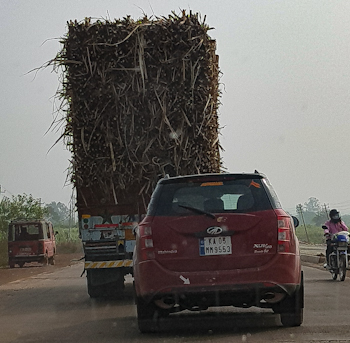
The truck in my picture is not unique. We saw many similarly loaded trucks on a short journey through northern Karnataka, and on many other road trips.

India is not simply incredible because of sights such as overloaded trucks, the wealth of colour, bustle, fantastic food, and the Taj Mahal. It is incredible because of its unending variety and generally very friendly people. Rich in history, the country has a very vibrant present.

Please note that I write this not as a promoter of tourism, but as a lover of a great country that survives despite itself.

On the Indian road

One of the multitude of things that attracts me to India is that often one can see something which remains unchanged over many thousands of years alongside something that has only come into existence very recently.

There is no better place to experience this than on the open road. Bullock carts share the highway with the latest models of automobiles.

In market places, goods are weighed on scales if a design that would not have seemed unfamiliar to people many hundreds of years ago, but the merchant prepares a computerised bill.

You can talk to a scientist who is making ‘cutting edge’ discoveries. During a short conversation, this person will switch with great ease between modern and ancient concepts without any problems.

For me, one of the great joys of India is the seemless coexistence of the past and present in everyday life.

Hindu burials

Death is a morbid but fascinating topic, as is disposal of the dead. Many people living outside India, including myself, believe that the corpses of Hindus are only cremated. At least, I believed this until about 15 years ago, when I visited a Hindu burial ground in Bangalore.

In a Hindu Burial Ground in Bangalore

I have visited two Hindu cemeteries in Bangalore, one of them being next door to a major electric crematorium in the city centre. When I have asked about Hindu burials, I have been told that some sects of Hindus favour burial rather than cremation.

Recently, I read an article about Hindu burials (in Calcutta) by A Acharya and S Sanyal in the “Mint” newspaper (Bangalore), dated 24 Nov 2018. Here is a brief digest of the points contained within it.

1. Certain groups of Hindus are traditionally immersed or buried.

2. These groups include:

A. Saddhus or ascetics who perform their own mortuary rites when they become saddhus, and are considered to be dead to the social world, living ghosts one might say.

B. Some young children, especially those who have not yet developed visible teeth. Also, some parents prefer to bury their dead offspring, rather than watching them being cremated.

C. Lepers. It used to be feared that a leper’s body might release an infectious vapour during cremation.

D. Some members of the following communities prefer to bury their dead to avoid the dominating behaviour of the Hinduism of the Brahmins: dalits, Vaishnav, Hela, and Kaburpanthi.

3. Sometimes, burial is cheaper than cremation. In Calcutta, burial can cost half of the charge of cremation.

4. Burial of Marwaris and Vaishnavites is more costly than for others because these two groups bury their dead with lots of salt, which they believe speeds disolving the flesh off the bones.

This newspaper piece has helped me to understand the existence of cemeteries where Hindus are buried. I assume that at least some of what has been written about Calcutta also applies to Bangalore.

On a parting note, I used to believe that the traditional method of corpse disposal amongst the Parsis was to feed their dead to the vultures. A Parsi friend of ours died in Bangalore, which has Towers of Silence for the corpses of Parsis, was buried in a Parsi cemetery in Bangalore. I have visited that cemetery, which is located in the district if Malleswaram and is for Parsis only.

All of this goes to show that making generalisations about India is inadvisable. So, before you assert that Hindus do not eat beef, hold your tongue! Some sects of Hindus have eaten beef since time immemorial. If the present government in India bans the consumption of beef, it will not be only Christians and Muslims who will be affected, but also several million Hindus.

In the club

The Bangalore United Services Club was established in its present pleasant premises in 1868 by members of the British military, the United Services. It was an officers’ club. With a very few exceptions (some members of Indian royal families), the Club only admitted Europeans (i.e. white people).  One of its best-known members was Winston Churchill, who did not like Bangalore and left the city leaving an unpaid bill at the Club. After WW1, some Indian military officers were admitted as members, but other Indians were excluded. After 1946, the Club was renamed “The Bangalore Club”, and civilians, both ‘white’ and Indian could become members. My late father-in-law became one of the first Indian members in the early 1950s.

CLUB 1

Today, the Bangalore Club is regarded as being one of the top (elite) social clubs in India. To become a member, applications must be made, and a hefty amount of money must be deposited with the Club. Then, the prospective member is put on a waiting list. The average waiting time is currently about a quarter of a century. This slow method of entry can be bypassed if you are the child or the spouse of an existing member. It so happens that I married a member of the Club. I was eligible to become a ‘spouse member’.

Simply being married to a member is not enough to get you into the Club. The spouse candidate needs first to apply, and then to find six sponsors, who are already members of the Club, and then to attend an interview. The interviews are only held a few times a year. Missing the interview might wreck the candidate’s chances of ever becoming a member. So, the candidate, who might be living anywhere in the world, must drop everything and attend when he or she is summoned.

I was lucky. My father-in-law (‘Daddy’), a well-respected and much-loved member of the Club, arranged that I would be called for interview on a date, when he was certain that I would be in India. However, he did not tell us about the interview before we left London. Had I known, I would have packed my only smart suit, but I did not. As soon as we arrived in Bangalore, Daddy told us about the interview, and we told him that we had not brought my suit. Undismayed, he rang around his friends in the neighbourhood, and he and I drove from house to house, trying to find a suit for me to borrow. Eventually, some kind person lent me his incredibly smart double-breasted jacket suit, which fitted me well. Unfortunately, I had to return it after the interview.

For a few days before my interview, Daddy and I visited several venerable members of the Club to get their signatures for my sponsorship. At each of their homes, I was received kindly, offered drinks and snacks while my potential sponsors became acquainted with me. At last, I was ready for the interview.

On the day of the interview, I woke up with an attack of influenza. My temperature was high, but the interview could not be missed. I was dosed up with paracetamol. Just before we left the flat, with me in my smart suit, Daddy sprayed me with some Eau de Cologne, saying it was best that I should smell pleasant when I met the interviewing committee.

I arrived with Daddy at the Club, where we joined about ten other candidates. Each candidate was chaperoned by a member, who would introduce him or her to the interviewers. Daddy was my chaperone. The interview procedure involved introducing me to each of several Club Committee members. Each Committee member asked me questions. Daddy was clearly worried about what I might say in response. So, as soon as I was about to answer any of the questioners, Daddy would interrupt me, saying something like:

“You remember me. I have been a member since 1954. How is your father? He joined at the same time as me, you know.”

I do not recall having answered any of the questions. Being Daddy’s son-in-law was enough to persuade them that I would be an acceptable member of the Club.

As we walked away from the interviewing room, Daddy congratulated me for becoming a member of the esteemed club. He led me to the Men’s Bar (for men only), where we downed draught Kingfisher beer. Oddly, my influenza symptoms were beginning to subside by then.
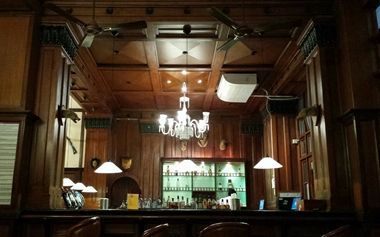
CLUB 2

Sadly, Daddy is no longer around. Today, the Men’s Bar is no longer for men alone. Its name changed in about 2017, by which time both men and women were permitted to use its facilities. Daddy would, I believe, have approved of the liberation of the former Men’s Bar.


Finally, let me emphasise that I do not agree with Groucho Marx, who said:

“Please accept my resignation. I don’t want to belong to any club that will accept people like me as a member”


Delivered to your door

After we married in 1994, we used to visit my in-laws in Bangalore (India) regularly. During the first few visits, we stayed in their home in Koramangala, a suburb to the south of the city’s diffuse central area. Although they lived close to shops, some within easy walking distance, their street was visited by itinerant sellers. For example, there were (and still are) people wheeling barrows from which they sell fruit and vegetables. These sellers announce their arrival with shouts in the Kannada language, which I cannot understand.  Other vendors come to the door selling bags of nuts and deep-fried and other snacks. Every street or street corner has a stall that is visited daily by the dhobi, who collects washed clothes to be ironed from your front door. All of this occurred in 1994 and continues today.

When I was a child during the 1950s and ‘60s, I lived with my family in Hampstead Garden Suburb (‘HGS’) near to Golders Green in north-west London. The HGS is a housing project, which was conceived by the social reformer and general ‘do-gooder’ Henrietta Barnett (1851-1936). The Suburb, whose construction began around 1904, is a mixture of residences of varying sizes built in different styles of architecture. Her idea was to provide homes for all classes of society, so that people from all these social classes could live harmoniously side-by-side. As with all the best-laid plans, this social mixing was never achieved. The very pleasant green suburb became a haven for the middle classes, the bourgeoisie. In his autobiography “A Little Learning”, Evelyn Waugh wrote of HGS (in its early years) that it was inhabited:

“… not exactly by cranks, nor by Bohemians, but mainly by a community of unconventional bourgeois of artistic interests.”

Today, this kind of people cannot afford to live there; it is now a highly desired residential area for the sector of middle class with plenty of money at hand.

Henrietta Barnett included three churches, a community hall (the so-called ‘Tea Room’), a school, an Institute, and two areas of woodland in her utopian suburb, but rejected the idea of including anything so ungodly as shops. So, HGS had, and still has, no shops within its boundaries. The nearest shopping centres are Golders Green, Temple Fortune, and the Market Place that is located on an arterial road that divides HGS into two separate parts. Unless one lived near to any of these shopping areas, the nearest shops could be up to a mile away from your front door. Because of this, HGS used to be visited by various roving services in my day.

The milkman made deliveries of dairy products every day. These were loaded on small electrically powered vehicles (‘milk floats’) that moved almost silently along the streets. The only sound they made was the tinkling of glass milk bottles as they rattled in the wagon. The milkman collected his stock from the Express Dairy Depot at Hoop Lane on the edge of the boundary of HGS. It was at this depot that the electric vehicle’s batteries were charged overnight. Newspapers were delivered to the door by a delivery boy employed by a local newsagent. A man with a French accent wearing a beret used to cycle around HGS selling strings of onions. For some reason unknown to me my mother never bought onions from him, but her sister, who lived close by, always did. Several times a week a tatty lorry used to cruise slowly along our streets. His vehicle contained a vegetable shop.

In summer, vans selling ice-cream would occasionally cruise along our street. When they stopped, they played a pre-recorded musical (well, not very musical) jingle to attract customers’ attention.

Every now and then, a knife grinder would arrive on his bicycle. He had a pedal-operated grinding wheel that spat out a shower of sparks when a knife was being sharpened. My mother never employed the grinder, claiming that he would ruin her kitchen knives. Being a sculptress, she was used to sharpening her chisels on a stone, and probably sharpened her own knives as well. Cries of what sounded to me like “old iron and echo” heralded the arrival of the scrap metal collector. When I was very young, he arrived with a horse-drawn wagon. This was later replaced by a battered motor driven lorry.

Twice a week, a mobile public library visited HGS. I never used it, preferring to walk to the better stocked library in Golders Green. The only commercial establishment, the nearest approximation to a shop, within HGS was Mendels Garage, which sold petrol and repaired cars. This has long since disappeared as did some of the other services mentioned above.

A dhobi ironing in Bangalore

Moving fast forward to today’s world, there is little need to leave your home if you do not feel like doing so. With the advent of the Internet, everything can be brought to your front door: from cooked meals to rare books, clothes, and almost anything you might want to buy. Even fast-food joints like McDonald’s will deliver your favourite snacks. Recently, a friend in Bombay needed a new rubber stamp costing a very few rupees. He rang the manufacturer to order it and was told that it would be delivered to his home within a very short time.

The convenience of home delivery is obvious, but this may jeopardise the future of shops that rely on people entering their stores to buy things.  Such is life, as so many people say, rather irritatingly I feel!