Filter coffee

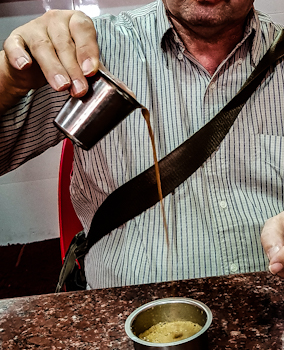
South Indian filter coffee is wonderful. Here is how it is prepared. First coffee powder is placed in the upper chamber of a cylindrical metal vessel with a finely perforated base. Hot water is poured on it. Then, the water slowly filters through the powder to produce an intensely strong, undrinkable filtrate, known as ‘decoction’. This filtration takes many hours.

The coffee-maker ladles some decoction into a vessel, often a stainless steel beaker. Then, he or she fills the rest of the beaker with freshly boiled milk (With or without sugar).

If you want your coffee without sugar, ask for “sugarless”.

The coffee cup comes with a deep saucer. To cool the coffee, you pour the coffee from the beaker to the saucer and vice versa.

Then, ENJOY!

The writing on the wall

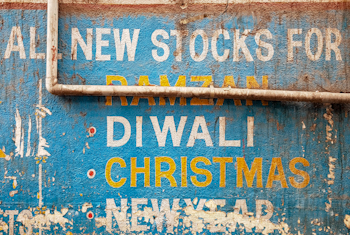
India is a country with many religions. This sign advertises a store that gets in new stock for Ramzan ( Muslim ), Christmas ( Christian ), Diwali ( Hindu ) and New Year ( which one is not specified ).

Sadly, inter-religious tolerance is being challenged in today’s India.

Spelling curios

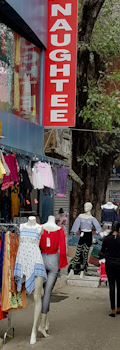
All over India you can see variations in the spelling of English words. Here are some examples I saw today in Bangalore.

Here the word ‘naughty’ has been spelled semi-phonetically.

Here, b and P have been mixed up. The consonants B and P are formed similarly when spoken.

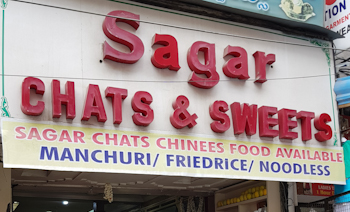
This shop sign demonstrates a variety of different kinds of spelling errors. (By the way, ‘chats’ are slightly cooked vegetables or raw fruits dressed with spicy powders.)

Remember that although English is one of India’s national languages, for many shop owners it is a foreign language. Hence, the diversity of spellings of common English words.

Monkey business

MONKEY


I was reminded of what follows, a true story,  after seeing an excellent photograph (reproduced above). The photographer Ajay Ghatage (from Bangalore) has kindly allowed me to use this photo.

Until I first visited India in 1994, I had never seen a monkey except in a zoo. Even in the hearts of big cities in India, these creatures are as successful as other city fauna such as pigeons, wild dogs, and birds of prey. I never cease to be fascinated by the monkeys’ antics, but I do recognise their nuisance value.

Kitchen windows need to be protected to stop monkeys from entering. At least once I walked into the family kitchen and startled a monkey, which was about to leap out of the window clasping a bunch of bananas.

Once my wife’s family decided that it would be fun to go on an outing to the Big Banyan, a few miles outside Bangalore. The Big Banyan is at least 400 years old and lives up to its name – it is a vast rambling tree that spreads its branches and aerial roots over a huge area. It is a popular picnic place, but, having visited it, I fail to see why. We found a clearing within the area covered by the tree, and then laid out a blanket for a picnic. Before we could sit down, many monkeys appeared. One of them began tugging at the blanket, and others looked greedily at our picnic baskets. The situation became so menacing that we abandoned the idea of a picnic and retired to eat in the car.

Many years later, my wife, our daughter, and I visited Badami in northern Karnataka. This place is famed for its fabulous Hindu, Jain, and Buddhist temples, some of which were carved in the living rock by the Chalukya dynasty in the 5th to 8th centuries AD. The area was infested with monkeys on the look-out for almost anything they could get hold of.

Some of the ancient temples are located next to a ‘tank’ or lake. While we were looking at these, our daughter wanted to take a photo. So, my wife held her bag.  Suddenly, I heard my wife making loud growling sounds. She was tugging our daughter’s bag while a monkey was trying to pull it away from her. The monkey was strong, but my wife’s growls scared it into releasing the bag.

A short while later, we sat down to have soft drinks under some trees. Our daughter ordered a virulently coloured orange carbonated drink. It was not one we would have recommended, but it appealed to our daughter. After the bag incident, we had warned her not to let go of anything, but she forgot momentarily. She put the opened bottle of drink beside her on the bench. Before she could say “monkey”, the bottle had disappeared. We looked up into one of the trees, and saw a monkey putting the bottle to its lips.

A few seconds later the monkey turned the bottle upside down, and then poured its contents down through the branches. Clearly, it was a creature with a discerning palate.  

Bollywood in Albania

Films from India made in Bombay, the so-called Bollywood productions, are popular all over the world. When we visited post-Communist Albania in 2016, 31 years after the death of its long-time dictator Enver Hoxha, we encountered Albanian Bollywood fans in several places. The following three excerpts from my book “Rediscovering Albania” describe some incidences when we met local lovers of Bollywood.

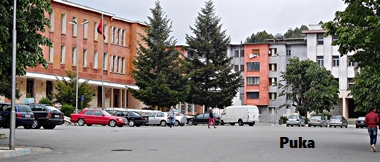
In the northern town of Pukë:
ALBOLLY 3

“Our shopping expedition continued in a tiny stationery/gift shop, where I bought a notebook. The sales lady wanted to know where we came from. When she learnt that Lopa came from India, she pointed at a small television set hidden under her counter. We saw that she was watching a Bollywood movie with Albanian subtitles. Every afternoon on Albanian television, there is an episode of a Bollywood TV soap opera. Those ‘in the know’ never ring ladies between certain hours in the afternoon so as not to disturb their enjoyment of this addictive show. The inter-continental cultural traffic is not one-way: in 2013, the Albanian actress Denisa Gokovi starred in a film (Phir Mulaquat Ho Na Ho) directed by the Indian Bobby Sheik.”

In the southern city of Korçë:

ALBOLLY 2

“Weary and hot, we tried to retrace our steps back into the centre. Quite by chance, we began walking along a road that led straight to the Mirahorit mosque, which was closed when we arrived. However, some men were gathering outside it, and soon the imam arrived to unlock it for afternoon namaaz (prayers). They were all friendly and welcoming. While we were waiting, we were joined by a German lady, who was keen to see this mosque that dates back to 1496. Restored by a Turkish organisation in 2014, it was worth waiting to enter it. The interior was decorated with attractive frescoes depicting various mosques and Muslim pilgrimage places including the Kaaba.  One of the men who was waiting with us to enter the mosque asked Lopa where she was from. When she said India, he exclaimed “Rye Kapur”, that being his pronunciation of Raj Kapoor, a well-known Bollywood film star. As we had already discovered in Pukë, Bollywood is popular in Albania.”

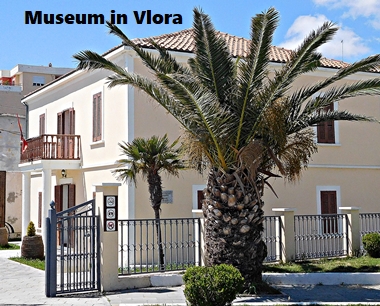
In the large seaport of Vlorë:
ALBOLLY 1

“This small building of great historic importance was dwarfed by huge cranes and ocean-going freighters in the nearby port area. Its windows had slatted wooden shutters, and there was a balcony projecting over its main entrance. It was from this balcony that Ismail Qemal read the declaration of Albania’s independence in 1912. Vlorë, which was invaded by the Italians in 1914, was the country’s first capital. In 1920, Tirana assumed this role.

We were guided around the museum, and shown photos, documents, and furniture, connected with the historic events that occurred around 1912. Driton kindly translated our lady guide’s interesting commentary into English. Sadly, we were not permitted to stand on the historic balcony because it has become too fragile. As we moved from room to room, I noticed that our guide was becoming more and more interested in Lopa, touching her occasionally. At the end of the tour, she told us that she loves watching the Bollywood films and soap-operas broadcast on Albanian television. It was a pity, she said, that Lopa had not been dressed in a sari. Lopa’s arrival in the museum had meant a great deal to her. It was as if one of the characters in the films, which she enjoyed watching, had stepped out of her television and into her museum. She said that Lopa was the first female Indian visitor to the museum since she began working there eleven years earlier.”  

Prior to 1991, Albanians would not have been able to watch Bollywood or even Hollywood productions. Under the dictatorship created by Enver Hoxha, which lasted from 1944 until late1990, the Albanian population was almost completely isolated from external influences. A few people watched Italian TV at their peril. If discovered, they would have risked dire punishment. Today, everything has changed; Albania is wide open to foreign culture.
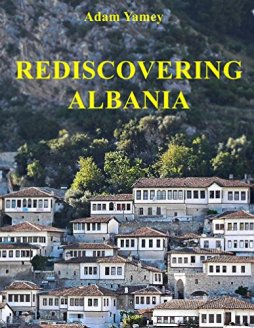
 

REDISC ALB cover

REDISCOVERING ALBANIA by Adam Yamey is available from:

Amazon, Bookdepository.com, lulu.com, Kindle,

and your local bookshop (will need to be ordered)