Temples and a palace

THE DELWARA JAIN TEMPLE COMPLEX close to Mount Abu opens to tourists at noon. We arrived at about 11 am and our driver, Zakir, suggested we visit the local museum, which turned out to be a handicraft shop.

We were directed upstairs to the fabric department and invited to sit down whilst a salesman told us about the products, which had been made locally, thereby providing employment to about 4500 locals. No obligation to buy, of course! However, we wanted a razzai, a bed quilt like an eiderdown, and after having been shown numerous examples we settled on one. Its price was greater than we were prepared to pay. We were told that the prices were not negotiable. Both the salesman and his manager told us that they could offer us cups of tea or coffee but not reductions in price. We pointed out that as kind as that was, it would only save us about 20 to 40 Rupees.

We had been in the shop, I mean ‘museum’, for almost an hour and I was becoming restless. I think that when the manager noticed this, he felt that there was a real risk that he would lose a sale. He sold us the razzai, having reduced the price by a third.

The Delwara Jain temple complex contains several temples, two of which are well over 600 years old: one dates back to the 11th century AD. Sadly photography is not permitted within the temples. Words cannot do justice to the beautiful intricate stone carvings that adorn these places of worship. Even photographs, if they had been allowed, would only hint at the perfection of the carving and their fine artistry. The precision and sharp definition of this ancient carving done by hand rivals what can be done with the most hi-tech computerised cutting devices. I have never visited the Taj Mahal, but I believe that these temples are even more breathtakingly beautiful than the famous monument at Agra. You will have to see it yourself, and then you will know what I mean.

Mount Abu was the summer resort for the rulers of the princely states of Rajputana, now Rajasthan. Many of them built lavish summer palaces, some of which are now used as ‘heritage’ hotels. Zakir drove us to the Kishangarh House hotel. Kishangarh was a tiny state near Ajmer in Rajasthan. Its population was 91000 in 1901. Its Maharaja built his palace at Mount Abu on sloping ground, which was transformed into terracing and surrounded by terraced gardens. We ate snacks there and were shown the rooms available for hire. Of all the former royal palaces I have seen in India, this looks to be the most comfortable. Even the lowest priced rooms are huge and extremely well appointed.

Zakir dropped us back in town in the town bazaar, as opposed to the touristic market area. There are numerous shops in picturesque winding streets.

Before returning to our hotel for a much needed rest, we bought some socks from a wayside stall. As is expected of customers, we bargained a little. When we agreed on a slightly lower price than the salesman asked initially, he said (in Hindi), maybe hoping to shame us into paying a little more:
“Will you feel better if you buy the socks at the lower price?”
We replied: “much better.”

BUS TO MOUNT ABU

WE SPENT MUCH OF NEW YEAR’S 7 Its driver was a friend of our driver. They were pleased to meet and wanted to chat. The other driver suggested to ours that he drove alongside ours so that he could chat with our driver. This did not happen but I liked the idea. Locating which bus we were to travel on proved a bit hair raising because everyone we asked suggested a different part of the bus station from which our bus might depart.

Much of the first half of the bus journey involved travelling northwards through flat cultivated terrain liberally sprinkles with small factories and large villages. We had a ten minute stop at Himatnagar, a small busy city in northern Gujarat.

Beyond Idar, the road began climbing out of the plain. We had a 30 minute break in Ambaji, an important temple town on the Gujarat side of the border of Rajasthan, which we entered immediately after lraving the town.

After Ambaji, our road climbed steadily and with increasingly tight bends through a mountainous landscape with plenty of trees. I was glad we were on a bus rather than a smaller vehicle like a car or jeep because many of these were driven as if their drivers had a suicidal tendency.

After about seven hours we arrived at the ramshackle, seemingly abandoned bus station at Mount Abu. There have been settlements in this area since time immemorial. It is mentioned in ancient Hindu texts, the Puranas. In the 19th century is was the summer capital of the Rajputana State. Many of the Rajput royalty built summer palaces in Mount Abu.

Our hotel is close to the still used polo ground. A beautiful late Victorian polo pavilion built in 1894 overlooks the vast polo playing field and is now used as a library.

The temperature at Mount Abu, which is about 4000 feet above sea level, dropped dramatically as the sun set. The air became icy cold and we were forced to purchase warm jackets. These are sold at stalls at the so-called Nepali Market, which is also called the ‘Tibetan Market’. Nepali or Tibetan, whichever it is, is situated amongst trees to which are attached strings of colourful Buddhist prayer flags such as we have seen fluttering in Darjeeling and Sikkim.

We dined at a simple halal restaurant. My wife asked for a soup listed on the menu. At first, the restaurant owner did not seem so keen on serving it. After a while, he said reluctantly : “If you really want it, I suppose I will have to make it for you”

A memorable new year’s eve

Some years ago, we were in Bangalore on a New Years Eve. Our daughter went off to an all night party and we remained at home with my recently widowed late mother-in-law.

We ordered a pizza from the local branch of a well known international pizza chain. It arrived by motorbike, looked delicious, but tasted mouldy.

At about 10 pm, we were all feeling sleepy and retired to bed. At about 3 am we were woken by a telephone call. It was our daughter wishing us a happy new year.

We had slept whilst the old year ended and the new one began. It was the most effortless and relaxing way of ‘celebrating’ a New Year that I can remember.

PS: this year we celebrated the New Year’s Eve in a part of India where the consumption of alcohol is forbidden!

Familiarity does not always breed contempt

FAMILIARITY BREEDS … CONTENTMENT. We have just landed in Ahmedabad. It is our third visit to this city in Gujarat within less than two years. We received a warm welcome from the staff at the small hotel where we have stayed twice before.

After settling into our room, we ate a good meal of Mughlai food at the Food Inn, which is opposite the 16th century Sidi Sayeed Mosque. Then, we travelled to the Gita Mandir bus station, where a very helpful booking clerk arranged tickets for various intercity trips we are planning to make soon.

The noisy, bustling traffic in Ahmedabad is typical of the city’s general feeling of vibrancy and exciting vitality. So bad was the congestion on the roads that our autorickshaw driver suggested that we abandoned our plans to visit the Jumma Masjid near the Manek Chowk. He explained that being the 30th of December, everyone was in a holiday mood and out on the streets spending money.

We disembarked at Khwaja Bazaar, a frenetic market place between the three arched Teen Darwaza and the Badra Fort, where the early rulers of Ahmedabad had their headquarters. We strolled along a street leading away from the market, admiring occasional old looking buildings along it. I imagine that the oldest of these is about a hundred or so years old.

Eventually, we reached a post office just across the road from an ageing Parsi ‘dharamshala’. Apart from a vigilant watchman, who looked at us suspiciously, the place looked rather dead. We took tea at a pavement stall. Typical of the kindness of people in this city, the ‘chaiwallah’ specially prepared tea without sugar for us instead of the very sweet beverage that is usually served. We sat on a bench, sipping tea and watching the world go by. It felt good to be back in Ahmedabad, a city, where kite flying is a popular pursuit. A city that is becoming familiar to us and makes us feel content.

First published on http://www.gujarat-travels.com

Around the market with Mansour

I CANNOT COUNT the number of times I have passed Johnson Market on my way between Koramangala, where my in-laws live, and central Bangalore. The market building stands close to the busy intersection of Hosur Road and Richmond Road. Recently, I went on a guided walking tour of the area around Johnson Market. It was led by my good friend Mansour Ali, who runs a great organisation called “Bengaluru by foot” (www.bengalurubyfoot.com). I had visited Johnson Market several times before on my own, but Mansour’s tour enhanced my experience of it and its surroundings.

Johnson Market was built in an indo-saracenic style in the early 20th century on the site of stables that housed horses, which were imported into India in 1824 from Persia by Aga Ali Asker who was born in Shiraz in 1808. Some of the stables still exist, incorporated into the structure of the market halls. Ali Asker was one of several brothers. While the rest of ghem returned to Persia, he stayed in in Bangalore where he died after carrying out much valuable public work. One of his grandsons, born in Bangalore, was Sir Mirza Ismail (1883-1959), a great Indian statesman.

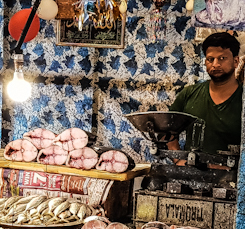
Johnson Market is for selling food. In addition to vegetables (including exotic vegetables like Chinese pak choi), there is a wonderful fishmongers shop and a beef market.

Near to the market, stands ‘Koshys Automatic Bakery’, which was the first mechanised bakery in the city. A stall beside it sells bread, cakes, and delicious filled puffs.

At both ends of the long building housing the Islamic Educational Board of India on Richmond Road, there are gateways leading to Muslim shrines well hidden from the road. One of them is a Sunni shrine, and the other is Shia/Sufi. Soon after the birth of Islam believers in this religion split into two main groups: Sunni and Shia. The majority of Muslims in India are Sunni, a small minority are Shia. It happens that there is a concentration of Shia establishments close to Johnson Market. This might be because Ali Asker and his descendants, many of whom had homes in the area, were Shias. Each of the shrines or ‘dargahs’ are peaceful enclaves, which although close to the main road, feel far away from the hustle and bustle of the city.

The leafy shaded Mysore Tobacco Company compound is across Richmond Road facing the two dargahs. Surrounded by trees and luxuriant foliage, the main building is a delightful example of colonial Bangalorean domestic architecture. Its windows are partially covered with monkey top woodwork. The large front porch is rich in wooden latticework and rustic carving that hints of idealised quaint country cottages in far-off England.

All Saints Church, founded by the Reverend Pettigrew (founder of Bangalore’s Bishop Cotton School for boys) and designed in Victorian gothic style by the English architect Robert Fellowes Chisholm and consecrated in 1870. It stands at the intersection of Richmond and Hosur Roads, and must have brought feelings of homesickness to Britishers living in pre-independence Bangalore. Stepping inside is like entering a village church in England. The garden surrounding the church contains a rich variety of plants, including a rather spindly olive tree, reflecting Pettigrew’s interest in botany. Tragically, part of this garden is under threat because the municipal authorities want it for use in the construction of a new metro line.

After visiting the church, Mansour took us to see another Shia dargah in a lane leading off Hosur Road. This shrine is connected with the battle of Karbala (600 AD) during which Hussain, grandson of the Prophet Muhammad, was slain by the caliph Yazid I. The shrine, which is revered by Shias, contains fine glass lamps and chandeliers which were probably made in Turkey over a century ago. Unlike mosques, where worshippers of different genders are kept separated, males and females can pray together in dargahs.

The Masjid e Askari is the only Shia mosque in Bangalore. Adjoining it, there is a recently built replica of a mosque in Karbala, the city close to where Hussain, sacred to the Shias, met his death. The replica, which is smaller than the original, is a beautiful construction with amazing mirror work mosaics in which words from the Koran are inserted in black tiling.

After spending three hours with Mansour, I felt that I had learnt much about the Shia branch of Islam and a great deal about a part of Bangalore which I have passed often without realising how interesting it is.

One body with two heads

HAPPY NEW YEAR

THE DOUBLE-HEADED EAGLE (‘DHE’) is a creature with a single body, two wings, and two heads each with its own neck. Of course it does not exist in nature but it is used quite widely as a symbol or emblem. I first became interested in the DHE after I became fascinated by Albania. The DHE has appeared as its national symbol for several centuries. It is also an emblem of Russia, Montenegro, Serbia, and the Indian state of Karnataka. In times past, the DHE was associated with the Hittites, several families in Cornwall, and the Byzantine Empire. It has also been used by some people in pre-Columbian America.

The DHE is an unusual symbol because it required considerable imagination to create it. Symbols like the cross, the crescent, the star, the swastika, and the circle are simple geometric emblems that could have easily arisen from thoughtless doodling. Likewise with emblematic animals like the lion, the eagle (with one head), and other creatures are based on observation of nature. The DHE, on the other hand, is neither an accident of geometry nor based on real life. It is, like the multi-limbed Hindu gods and the Egyptian sphinx, the result of human imagination.

The earliest archaeological evidence of the DHE is on rings used by the ancient Babylonians to mark ownership of containers of oils and other liquid goods. These seals have been dated as having been in existence between two and three millennia before the birth of Christ.

It is interesting to note that the DHE was not the only two headed creature conceive by the ancient Babylonians. There is plenty of archaeological evidence that shows that they created emblems depicting other creatures with a single body, two necks, each supporting a head.

In the future, I hope to explore the origins and the distribution of the DHE in far greater detail, maybe I will make this the subject of a book.

Hindu reform in Bangalore

IN AN AREA OF BANGALORE FILLED WITH TRADITIONAL HINDU TEMPLES, I STUMBLED ACROSS A CENTRE WHERE A REFORMED VERSION OF THE RELIGION IS PRACTISED.

FINDING SOMEWHERE THAT I HAD NOT NOTICED BEFORE IS OFTEN FASCINATING. I have often been driven past this particular place in central Bangalore at speed. One day, I walked past this compound, located close to RBANM’s Ground, at a leisurely pace and discovered that it contains three buildings arranged around a rectangular garden. The two side buildings are typical old Bangalorean structures with verandahs and monkey-top woodwork as well as other typical traditional architectural ornamentation. The central building facing the street but separated from it by the garden has a simple facade supported by four plain pillars with Doric capitals. A stone embedded in the outer wall of the compound reads “Brahma Mandir 1879”. This compound contains the buildings belonging to the Bangalore Brahmo Samaj.

The Brahmo Samaj is one of the attempts to reform the practise of Hinduism. Founded in about 1828 in Bengal, it was a monotheistic form of Hinduism. The Brahmo Samaj was not the only reforming movement in 19th century India, but, like Arya Samaj, it became one of the better known and enduring attempts to reform Hinduism.

In my recent book “Ideas, Bombs, and Bullets, I have tried to show how the two sets of reformers differ:
The Arya Samaj, in common with the Brahmo Samaj, strove to reform Hinduism, but differed from the Brahmo Samaj in many respects. Members of Arya Samaj had no faith in the goodness of the British Government, whereas the opposite was true for the Brahmo Samaj. Arya Samaj believed in the superiority of Hinduism over other religions, whereas the Brahmo Samaj put Hinduism on the same level as other religions. Another of many differences between the two movements was that Arya Samaj wanted to revive Vedic traditions and to reject modern western culture and philosophy, whereas the Brahmo Samaj accepted western culture and ideas.”

I have yet to stumble across an Arya Samaj place of worship in Bangalore, but I feel sure that there must be at least one in the city. The Brahmo buildings I saw are good examples of beautiful Bangalore architecture, much of which is being callously torn down to make way for ugly new structures.

Protesting on wheels

INDIAN INGENUITY KNOWS NO BOUNDS. Recently in many Indian cities, there have been public protests against unpopular new legislation. Bangalore is one of these cities.

To counter the protestors there have been temporary bans on large groups assembling to protest. In some places the police have arrested and even attacked some protestors, causing injuries and deaths.

On the 23rd December, I was walking along Museum Road in central Bangalore. Suddenly, I saw swarms of motorcycles streaming past. Many of the people on the cycles were carrying the Indian tricolour, the national flag. The flags flew behind the bikes. Some of the passengers on the motorcycles were carrying paper banners with words expressing dislike of the new legislation.

The motorcycles were most probably heading towards a planned public protest. But, they might also have been carrying out a mobile protest, which being at a high speed made it difficult for the police to control. Even if they were only travelling towards the site of a protest gathering, it struck me that this high velocity and noisy protest on wheels was an ingenious way of attracting public attention whilst minimising the risk of police interference.