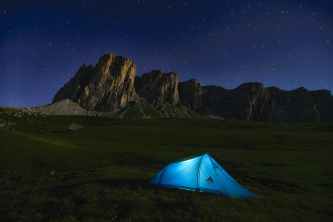
THE FIRST TIME I SLEPT in a tent was in 1972. With five other chaps including a friend from childhood and the now well-known Matthew Parris, we set out on a fortnight’s driving holiday around France. We did not stay in hotels. We camped in a large tent divided into two rooms. The inner one had its own fitted groundsheet. The outer one, which led to the inner, had no floor. So, it was necessary to lay out a separate groundsheet in this section. Without any prior knowledge or experience of camping (and without employing an ounce of common sense), I volunteered to position the outer groundsheet. I placed it so that the edge of one side of the sheet was just outside the wall of the tent.
]Photo by Sagui Andrea on Pexels.com]
At bedtime, I unrolled my recently purchased sleeping bag and wriggled inside it. I was assigned a position inside the outer room of the tent close to the wall mentioned above. I lay in my sleeping bag and felt every pebble and other irregularity of the earth beneath me through the bag’s meagrely padded material. Why, I wondered, was this uncomfortable bedding called a ‘sleeping bag’, when sleep appeared to be impossible inside it. Naively, I thought that a sleeping bag was supposed to encourage sleep. My fellow campers had all brought inflatable mattresses. I understood the reason but wished that someone had mentioned the necessity of these things before we had set off.
In the middle of the night, there was a heavy rainstorm with thunder and lightning. The inside of my sleeping bag began to feel cold. Soon, I realised that it was absorbing huge amounts of cold water. Then, I discovered why this was happening. My positioning of the outer ground sheet so that its edge was sticking out of the tent was the cause. Rain was hitting this exposed edge of a waterproof sheet, and then running into the tent. After a sleepless night, my sodden sleeping bag was tied on to the roof of the car and it dried gradually as we sped along French D class roads (we avoided motorways) in the sunshine that followed the storm. When we reached the appropriately named town of Tonnerre, the name means ‘thunder’ in French, I purchased an inflatable mattress. Equipped with this, I fell in love with camping.
We had decided to have picnics for our midday meals, and to eat in restaurants every evening. My five travelling companions were far more energetic and adventurous than I was. It was important for them that we either had our picnic by a running stream (for cooling the wine) or at the summit of a slope (to enjoy a view). Reaching either of these ideal picnic locations usually involved climbing or descending sleep slopes. I was not good at either activity. I used to arrive at the picnic spot long after my companions had begun eating. So, after a while, I armed myself with a bag of sweets so that I could do something to assuage my hunger whilst struggling to reach a picnic spot.
The two-week camping trip in France whet my appetite for more camping experiences. The next trip I made was with my own one-man tent and rucksack. I went for a short walking trip in the Eifel Mountains in what was then West Germany. I disembarked from a train at Gerolstein and knew from my detailed map that I needed to walk past a certain hotel to find the footpath that led to my first night’s campsite. As I left the station, I asked a man the way to that hotel. He took one look at my heavily laden rucksack and recommended that I should go there by taxi. I had not the heart to tell him that not only was I going to walk to the hotel but then eight miles beyond it.
That initial encounter in a part of Germany famous for hiking was a foretaste of what was to follow. The Eifel mountains, full of former volcanic craters containing mirror smooth lakes, is criss-crossed, as is much of Germany, with well-made well-signposted footpaths. The signage on these wonderful ‘Wanderwege’ is so thorough that you would have to be completely blind to get lost. Everyday, I left my campsite with my tent and rucksack and wandered along these paths to my next night’s stopping place. What I noticed was in accord with my brief meeting with the man at Gerolstein. The footpaths were largely unused apart from within less than a mile from a village. Near settlements, the footpaths were populated with men, often wearing lederhosen, and women out for a stroll. Almost all of them looked like professional hikers with proper boots and walking sticks often decorated with badges from places that they had visited in the past. However, none of them strayed more than a kilometre or so from their hotels and campsites. It was only I, who strode boldly through hill and dale from one village to another. My only companions were avian. I came away from my enjoyable wanderings in the Eifel with my illusion that the Germans were a nation of keen walkers shattered. This did not put me off making another camping trip in West Germany in the late 1970s.
With my rucksack and tent in the hold of a Lufthansa domestic flight, I flew from Frankfurt-am-Main to Nuremberg, a short hop. At Nuremberg airport, I waited to reclaim my baggage, but it did not appear on the conveyor belt. After all the other passengers on my flight had left the airport, I reported my missing baggage to an official, who answered:
“That is not a problem. It will probably arrive in a few hours’ time on the next flight from Frankfurt. Just give me the address of your hotel and, surely, we will deliver it for you.”
“But, there is a problem,” I answered.
“And, what is that?”
“Well,” I replied, “My hotel is contained within my missing baggage.”
The official looked at me curiously. I explained:
“I am planning to camp in Bamberg.”
“Ach, then you must wait for the next flight.”
I waited for about three hours in the empty airport accompanied only by the occasional security men with their Alsatian hounds at the end of stretched leads. My tent and other baggage arrived on the next flight, and I proceeded to Bamberg. I have no idea why I wanted to visit Bamberg, but I am glad I did. Many years later, I discovered that one of my mother’s ancestors, her great grandmother, Helene Springer, was born there in 1819.
From Bamberg, I travelled to Ljubljana in the former Yugoslavia. I made my way to an official campsite and pitched my tent. Then, I went into town for dinner. I ate a large and delicious fried breadcrumb-covered chicken breast stuffed with masses of molten cheese and salty ham. I returned to my tent, inflated my air-mattress, and settled down for the night. Two things troubled me throughout the night. The first was my digestive system that was struggling desperately with the extremely rich food I had enjoyed earlier. The second was incessant noise. The official campsite was located in a corner plot bounded on one side by a motorway, the main road from Western Europe to Turkey, and on another by a railway track, that which connected Western Europe with Bulgaria, Greece, and Turkey. Between the roar of the traffic on the road and the noisy rumblings of trains passing through the night, sleep was impossible. The next day, I flew between Ljubljana and Belgrade, where my friends Mira and Peter welcomed me at the airport. I had the impression that they were shocked that I had even thought of camping on my way to Belgrade.
Despite various hitches, I remained keen about camping, something my parents never admitted to having done. Some years later, I had several highly enjoyable camping holidays in northern Greece, but these I will describe on another occasion.