Ham and Highgate

LAUDERDALE IS A NAME, which until a few days ago I used to associate solely with Highgate in north London. Lauderdale House sits on Highgate Hill close to Waterlow Park. What you see of it today is a highly restored 18th century building that dates to 1760. Prior to that date, a finer looking timber framed house built in 1582 stood on the site. Built for the goldsmith Richard Martin (died 1617), who was Mayor of London in 1589, it was one of the finest country houses in Highgate. The present version, although acceptable aesthetically, is unremarkable. In 1645, the house became the property of John Maitland, 1st Duke of Lauderdale (1616-1682), a Scot.
Originally a supporter of Oliver Cromwell’s regime, he later became a supporter of King Charles II in 1660 soon before his restoration to the throne. During the reign of Charles II, Lauderdale held several of the highest offices in the land including Secretary of State and Lord High Commissioner. He was also involved in the Company of Royal Adventurers of England trading with Africa (founded 1663), which dealt much in slaves and gold.  

Lauderdale was first married to Lady Anne Home (1612-1671), a Scottish aristocrat. A year after Anne died, Lauderdale married Elizabeth Murray, Countess of Dysart (1626-1698), who had been an active and important supporter of Charles II during and after his exile. Evelyn Pritchard in her book “Ham House and its owners through five centuries 1610-2006” reports that it was rumoured that she had been having an affair with Lauderdale while she was still married to her first husband, Sir Lionel Tollemache (1624-1669). Lauderdale’s second marriage brings us across London from Highgate to the River Thames at Ham near Richmond.

Elizabeth Murray was the first born of the four daughters of William Murray, 1st Earl of Dysart (c 1600-1655) and his wife Catharine (née Bruce). Being the eldest, Elizabeth inherited her father’s title and the home he owned at Ham, Ham House.  Her father, William, acquired Ham House in 1626. During the Civil War, Elizabeth Dysart maintained good relations with both Oliver Cromwell and the exiled King Charles II and thus preserved her ownership of Ham House, where she and Tollemache produced eleven children.

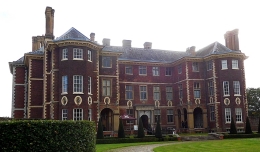
The house that William took over had been built between 1608 and 1610 by Sir Thomas Vavasour (1560-1620), a naval captain who had fought the Spanish at sea in the late 16th century. He had been awarded his knighthood at sea in 1597. The basic structure of Ham House, an ‘H plan’ typical of the Jacobean style, has survived although over the years newer parts have been added to it particularly at the rear. Seen from the front, Ham House has retained its original attractive Jacobean appearance. The rear of the house (the south facing garden side) has lost two of the original arms of the ‘H’ because the space between them was filled with an extension created by the Lauderdales in the 1670s. Thus, the north (front) façade is Jacobean, the southern one is in the later baroque style with sash windows, which make it look much newer than it is actually.

Because of the restrictions caused by the covid19 pandemic we were only allowed to view the ground floor rooms. However, this was sufficient to see what a splendidly decorated and furnished place the Lauderdales created. Every room we saw from the grand Great Hall and the fine carved wooden staircase to the smallest closets is a wonder to behold. A couple of rooms had beautiful ceilings with paintings, one by the German Franz Cleyn (c1582-1658) born in Rostock (Germany) and died in London, and another by the Italian Antonio Verrio (c1636-1707), born in Lecce (Italy) and died at Hampton Court.

Ham House has wonderful gardens, which we explored briefly before walking back to Richmond via the water meadows that flank the Thames. For me, the highlight of the grounds of Ham House was the geometrically perfect, formal garden to the east of the house. This was originally ‘the Cherry Garden’ where cherries are known to have been grown in 1653, when it was leased to one Samuel Purnell. The National Trust website (https://www.nationaltrust.org.uk/ham-house-and-garden/features/the-garden-at-ham-house) informs us that:

“… the garden re-creates what historically ‘might have been’, following work in the 1970s to reinstate 17th century character previously lost.”

A statue of Bacchus, the only original piece of garden sculpture to have survived at Ham, stands in the heart of this perfectly manicured example of man’s influence on nature.

The National Trust received Ham House from Sir Lyonel Tollemache (born 1931) and his son Cecil Lyonel Newcomen Tollemache in 1948. The 9th Earl of Dysart (1859-1935), a descendant of William Murray, inherited Ham House in 1884 but died childless in 1935. The Dysart title passed on to his niece Wynefrede (1889-1973) whilst Ham House was passed on to his second cousin Sir Lyonel.

We left Ham House, thoroughly intrigued, and satisfied by what we had seen and hope to return a few more times. From now on, when the name ‘Lauderdale, springs to mind, I will not automatically think of my old ‘stomping ground’, Highgate, but also Ham will spring to mind. There is a local north London newspaper “The Ham and High” that covers what happens in Hampstead and neighbouring Highgate. Now. that paper’s name has assumed a new meaning for me having learned of Lauderdale’s connection with both Ham and HIGHgate.
The story of a bookshop

THE BIOGRAPHY OF STANLEY Spencer, which I ordered online, was too large to fit through the letter flap on our front door. So, as is usual in such situations, the postman left a red and white postcard informing me that I could collect my oversized parcel from the local post office. Until October 2019, undelivered packages could be collected from a busy post office in Queensway. Since then, and throughout the 2020 ‘lockdown’, post can be collected from a new and much improved centre on nearby Westbourne Grove.

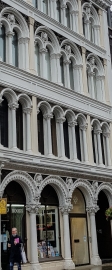
Much of the architecture on the stretch of Westbourne Grove between Chepstow Road and Queensway is unremarkable. An exception is number 26, which houses the Al Saqi bookstore. This elegant establishment specialises in selling (and publishing) books about the Middle East and North Africa. In 1978, two friends, André Gaspard and Mai Ghoussoub, left war-torn Lebanon to settle in London. They founded the Al Saqi book shop because:

“They yearned to recreate something of the heady intellectual freedom of pre-war Beirut, and to supply a then-untapped market for English and Arabic books on the Middle East and North Africa.” (https://saqibooks.com/about/history/).

They began publishing as ‘Al Saqi’ in 1983 and have been selling books, including some banned in certain countries, for well over thirty years.

Interesting as the bookshop might well be, its premises catch the eye and intrigue the passer-by. As the “Arab Weekly” wrote in December 2015 (https://thearabweekly.com/al-saqi-not-your-average-london-bookstore), the shop is;

“Not your average London Bookstore … London – Al-Saqi bookshop is housed in a conspicuous building in London’s Bayswater district. With colonnades and arches topped by 11 staring busts, its architecture recalls ruins that are found across Europe, North Africa and the Middle East.”

It was the shop’s exuberant and unusual façade that has often caught my attention.

It was not Al Saqi who designed the façade of the building housing it. After he had spoken with a customer in Arabic, I asked a learned looking man, who was working in the shop, about the history of the building in which it is housed. He had no idea.

The architectural historian and his co-author Bridget Cherry mention the building in “The Buildings of England, London 3: North West”. They wrote that the highlights of Westbourne Grove include:

“… No. 26 built as an ‘Athenaeum’, 1861, by A Billing, stuccoed with columns and a good deal of sculpture (musical angels, busts of Milton, Shakespeare, etc.)”

A Billing was Arthur Billing (1824-1896), whose career included construction of, and restoration of, many churches in London and south-east England. Most dictionaries define an Athenaeum as an institution for the promotion of literary or scientific learning. a library or reading room.

Another source (https://historicengland.org.uk/listing/the-list/list-entry/1066120) describes Saqi’s home as having once been a “… Theatre … built as a Shakespearean theatre”, but does not refer to it as an Athenaeum.  Just as I was beginning to despair of discovering whether number 26 was originally an Athenaeum or a theatre, or both, I stumbled across an informative website (https://archiseek.com/2013/vestbourne-athenom-westbourne-grove-b-wswater/). It describes the building as having been originally named ‘Westbourne Hall’ and quotes an article published in an issue of “The Building News” dated 31st of May 1861.

From the article, we learn that the newly built Westbourne Hall was attached to the Bayswater Athenaeum, which was on nearby Havelock Terrace (which, strangely, does not appear on a detailed map published in the late 1860s). From the detailed description of the façade of Westbourne Hall, it is certain that the premises of the bookshop are in the former Westbourne Hall, not the Athenaeum. The gaslit auditorium, equipped with lights installed by Mr G Reed, “the eminent gasfitter of Westbourne Grove”, had raked seats with “carved ends”. There was a gallery above the entrance end of the hall. The hall was equipped with what was then a “new patented system” of heating and cooling designed to keep the audience comfortable. The article added:

“When the new reading rooms, refreshment and committee rooms, and other offices are completed, the business of the Athenaeum will be removed into them, and look out upon Westbourne-Grove.”

So, it appears that The Athenaeum moved into Westbourne Hall. The article also gives an idea of the place’s original intention. It was to provide a place where the “respectable population” of the area could hear worthy events such as Shakespeare being read by:

“… a silver voiced popular preacher …Lectures on the Holy Land, Revelations, and Negro Slavery, an evening with amatory Thomas Moore …”

Another issue of “The Building News” (see  https://archiseek.com/2013/vestbourne-athenom-westbourne-grove-b-wswater/) gives a very full description of the building’s remarkable exuberant façade.

The subsequent history of the Westbourne Hall is found on an informative website (www.british-history.ac.uk/vch/middx/vol9/pp221-226). Here, slightly edited by me, is what is written:

“Westbourne hall in Westbourne Grove could hold 400 people for lectures and entertainments in 1860, when its lessee opened adjoining premises in Havelock Terrace as Bayswater Athenaeum and Literary Institution.  An ornate four-storeyed building with a hall for 1,000, designed by A. Billing, was built on the site of the first hall in 1861 and licensed for music alone by T. E. Whibley in 1863.  The Athenaeum, although welcomed for its educational value, had become the Athenaeum divan by 1865 and may have closed soon afterwards.  Westbourne hall continued to be used for concerts, plays, and public meetings until 1875 or later …”

A playbill preserved in the National Archives (https://discovery.nationalarchives.gov.uk/details/r/6497ee39-a6e5-4a92-9acc-551fda7680ed) gives a flavour of what was on offer at Westbourne Hall:

“Wednesday July 1st 1868.

‘Benefit and last appearance of Miss Lydia Howard, the Baby Actress, when she will sustain her characters of Katherine! in “The Taming of the Shrew”, Falstaff! in “King Henry the Fourth”, Prince Arthur! in “King John” and Matilda Mowbray! Hector Mowbray!! Foppington Mowbray!!! Cobbleton Mowbray!!!! in The Four Mowbrays’. Also appearing: Miss Hazelwood and Mr J S Fitzpatrick Paddington”

That must have been a memorable evening. According to Anne Varty in her book “Children and Theatre in Victorian Britain”, Lydia, who was not yet five years old, ‘retired’ from the stage in 1869. Child actors and actresses were popular in Victorian times. As for the other ‘stars’ of that evening in Westbourne Grove, I have not yet found anything about them. “The Four Mowbrays” was a one-act farce by John Poole (c 1786-1872), first performed in the late 1820s.

So, there you have it more or less: the story behind the building where books on Middle Eastern and North African subjects are on sale. It is appropriate that this former Athenaeum/ theatre is still being used for cultural purposes. I am curious to know whether there is anything remaining of the Westbourne Hall’s former auditorium. Part of the building is now used by the HBA (Hirsch Bedner Associates) Gallery. A photograph of this organization’s premises looks like the space being used might well have been part of the auditorium (see https://foursquare.com/v/hba-the-gallery/5151a5e1e4b0cbcf6b5f4568). So, all is not lost.

The Egyptian House

WE WERE NOT EXPECTING to see anything like it when walking down Chapel Street in the centre of the Cornish town of Penzance. What we saw immediately recalled the pseudo-Egyptian, art deco Carerras Building near Mornington Crescent in London. The building in London is far larger than that we found in Penzance, the Egyptian House. The Carreras Building was built in 1926-28. The Egyptian House was built far earlier, in 1835-36. Admittedly, the two buildings hardly resemble each other but when I saw the one in Chapel Street, I immediately thought of the structure in Mornington Crescent.

The Egyptian House is a regularly shaped building with an extraordinary façade. The front of the building is decorated in colourfully painted bas-relief with ornamentation that evokes thoughts of Ancient Egypt. The windows of this three-storey building are not rectangular. Each of them is framed in isosceles trapezoids (the top and bottom of each frame are parallel, the top being shorter than the bottom, and the sides of the frames form truncated isosceles triangles). All three layers of windows are framed in a large decorative isosceles trapezoid. This creates the illusion that the façade is tapering rather than rectangular. An informative merchant, who spoke to us from his shop across the road from the Egyptian House, pointed out that although the windows on the three floors look different in size, this is also an illusion; they are the same size on each floor.

The decorative features on the building include pillars with lotus capitals, sculpted human heads, a royal coat of arms and an eagle. Above the centrally located front door there is yet another feature, which I will describe soon. But first, a little bit of history.

Numbers 6 to 7 Chapel Street, the building now known as the Egyptian House, stands on the site of an earlier building that had been pulled down by 1835, when John Lavin (1796-1856), a Cornish mineralogist, purchased the site.  According to one source (https://medium.com/the-history-of-collecting/the-sir-russell-collection-of-cornwall-mineral-collections-439cfdb2ae2d) Lavin was:

“… was a stationer and bookbinder in Penzance, Cornwall, who was also dealing in minerals by 1830. Such was his success that he was able to build the famous Egyptian Hall, “Lavin’s Museum”, in Chapel Street in 1835–36.”

The building he created was typical of the early 19th century craze for building in the ‘Egyptian style’. It is said to resemble the now long-since demolished Egyptian Hall in London’s Piccadilly and the Oddfellows Hall in Devonport (constructed 1820s). Also, some of the tombs in the older, spookier, part of London’s Highgate Cemetery were designed to evoke the architecture of Ancient Egypt.  When Lavin died, his son Edward sold his father’s collection to Baroness Burdett-Coutts for £3,500.

The building became neglected and fell into disrepair. By the 1960s, the façade was in a poor state, In the 1970s, the building was restored, and its original colouring reproduced. Now, it is maintained by the Landmark Trust, which rents out rooms within it to visitors at a high price, so we were informed by a local.

The decorative feature that intrigued me most is on the lintel above the front door. It is a bas-relief depicting two outstretched wings attached to a centrally located sphere from which a pair of bird’s heads each, on their own curved necks project. The bird’s heads are shown in profile with their beaks pointing in opposite directions, one to the left and the other to the right. The style of the depiction of the birds is pseudo-ancient-Egyptian as are many other of the ornaments on the building.  As I am fascinated by the double-headed eagles that are used as the symbols of many places including, for example Albania, Serbia, Montenegro, Russia, and Karnataka, I was immediately curious as to whether what is above the doorway is a depiction of a double-headed eagle (‘DHE’).

Greatly simplifying matters, the earliest archaeological evidence of the DHE is in sites in Ancient Mesopotamia (3000-2000BC). The civilisations that thrived there were contemporary with Ancient Egyptian civilisations. Although DHE motifs have been discovered in Ancient Egyptian sites, they are not as prevalent there as in the lands between the Tigris and Euphrates. Without getting bogged down with the history of the usage of the DHE, I want to speculate on why Lavin included the two-headed bird decoration on his Egyptian-style building.

Was the centrally located motif simply chosen for its decorative symmetry or was John Lavin aware of some connection of the DHE with Ancient Egypt? Or was he making some reference to Cornish families, such as the Killigrews and the Godolphins, that included the DHE in their coats of arms? Sadly, I have no answer to these questions yet.

Our ‘discovery’ of the Egyptian House in Penzance was just one of many lovely things we saw during our brief first visit to the town. I have already written about the Turks Head pub in Chapel Street and I hope to reveal more of the town’s interesting sights in the near future.

An unusual feature

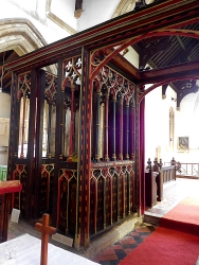
AN ELDERLY LADY WALKING with the help of a walking frame beckoned to us just after we had  walked around the Church of St Mary in the village of Guilden Morden near Royston in Cambridgeshire.  As with so many country churches we have visited since the onset of the covid19 pandemic, we had found that the church was locked up. However, the lady, who had called us over, was holding a large old-fashioned key and asked us whether we would like to see inside the church. I am so glad that we accepted her offer because she pointed out something that is very rarely found in English churches: a double rood screen.

A rood screen is often found in late mediaeval churches. Commonly made of wood and often ornate, the screens separate the nave where the congregation assembles from the chancel where the choir sings and the clergy officiate near to the high altar. The rood screen at St Mary’s in Guilden Morden, whose construction began in the 12th or 13th centuries, consists of two parallel screens on either side of a central passage leading between the chancel and the nave. It is decorated with some paintings of saints and on each side of the passage, there are small enclosures large enough for several congregants to sit during a service.

The lady, who pointed out the special nature of the rood screen, told us that in the past, the lord of one manor sat with family members in the ‘cubicle’ on one side of the central passageway and the lord of another manor sat in the cubicle on the other side. She told us that when she was a small child in the village, she had seen the local aristocrats occupying the rather cramped-looking booths between the parallel screens.

The website www.english-church-architecture.net doubts the church’s claim  that the double-rood screen is an original feature of the church. It quotes the architectural historian Nikolaus Pevsner, who:

“… declared it to be reassembled from the original rood screen and one or more parclose screens, to form “a double rood-screen, i.e. with a kind of pew left and right of a central passageway.  Three designs are represented, two very similar and clearly not too late in the fourteenth century, the third, early Perp.”  In fact, the early Perpendicular work forms the back of the screen and the re-used sections of parclose screens, if that is what they are, appear to have been built up against it on the side towards the nave.”

Whatever its history, neither my wife nor I had ever seen anything quite like that in British churches … and we have visited quite a few of them.

Before leaving the church and the kind old lady, I spotted the baptismal font that looks far older than the church. Our new friend thought it predated the present church. According http://www.british-history.ac.uk, the font’s basin is 12th century and the pillars supporting it are later.

Before we left the church and the lady locked it up, I asked her about the name Guilden Morden. She believed that it might mean something like ‘golden moor’. She was not far off the truth, which is that the name is derived from the Old English ‘Gylden More Dun’, meaning ‘Golden’ (rich or productive) ‘Moor Hill’.

Once again, a trip out of London into the countryside has proved to be not only refreshing but also enjoyable. England, from which we have always travelled abroad during the years before the current pandemic, is proving to be at least as interesting as the many far more exotic destinations we have been enjoying over the years.

Polish or Russian

BLOG HOOP 1l Eagle Lodge


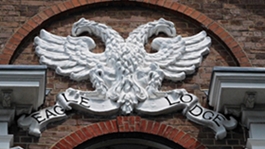
THE DOUBLE-HEADED EAGLE, the symbol of Albania, has fascinated me ever since I first became interested in the country in about 1967. This much-employed imaginary creature, whose origins go back at least 3000 years before the birth of Christ, is not only the national symbol of tiny Albania but also of Imperial, and now modern, Russia. A year or so ago, I was walking along Golders Green Road in northwest London, one of my childhood haunts, when I saw something I had never noticed before. It was a block of flats on which I spotted a large sculpture of a double-headed eagle. The building is appropriately named ‘Eagle Lodge’.

According to Pam Fox, author of “The Jewish Community of Golders Green” a detailed and fascinating book published in 2016, Eagle Lodge was one of a number of mansion blocks built on the sites of former large villas with extensive grounds that used to line Golders Green Road. Next to the mention of ‘Eagle Lodge’, Ms Fox refers to her endnote number 1, which reads:

“It was designed by a Polish architect who carved the Polish eagle onto its façade, giving the block its name.”

Although I doubt that Ms Fox’s book attracts many Polish nationalist readers, this footnote would certainly upset them. The Polish eagle used heraldically or as a symbol has only one head. Having been subjected to domination by the Russians for many years, to confuse the single-headed eagle of Poland with the double headed version used by their Russian neighbours would not go down too well amongst the Polish fraternity.

As for the “Polish architect”, there is another problem. Eagle Lodge was, according to the architectural historian Nikolaus Pevsner, designed by MV Braikevitch and built 1935-37. Mikhail Vasilievich Braikevitch (1874-1940) was a Russian engineer and art collector born in the Ukraine. I found an interesting pamphlet published by the London Borough of Barnet, which contains the district of Golders Green. Titled “The 1917 Revolution & Barnet’s Russian Heritage”, it says:

“Possibly the most interesting Russian resident was Mikhail Vladimirovitch Braikevitch of Woodstock Avenue. He had been an important engineer in the construction of the Trans-Siberian Railway, was the mayor of Odessa before the war, and had been a member of the interim government, who ran Russia between February 1917 and the October Revolution. Remarkable as all these things are, it was his art collection which was most important. Having settled in England, he started to collect works of art smuggled out of Russia from fellow refugees – both in London and Paris – and amassed one of the best collections of Russian art outside of Russia itself. On his death in 1940, he left the collection to the Ashmolean Museum in Oxford, but we can imagine an ordinary house in Golders Green with some of the greatest works of Russian art on the walls.”

It was at Braikevitch’s suggestion and following a visit to his home in Golders Green that the undeservedly lesser known but remarkable Russian composer Nicolas Medtner (1880-1951), a contemporary of Rachmaninoff and Scriabin, shifted from Paris to London in 1935.  The composer and his family settled into a new home on Wentworth Road in Golders Green.

Braikevitch, like Medtner, was buried at Hendon Cemetery and Crematorium, not far from Golders Green.  The architect’s funeral was held at St Philip’s Russian church, Buckingham Palace Road, London. So, all things considered, it is highly likely that the architect of the rather unappealing looking Eagle Lodge with its double-headed eagle was not Polish, and that the bird with two heads has nothing to do with Poland as erroneously suggested by Ms Fox in her end note.  

Onion on top

ONION DOME SMALL

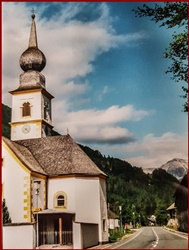
This piece, which is about onion shaped domes on some churches, was inspired by a chance discovery of a photograph of a church (see illustration) that I took somewhere in Slovenia about twenty years ago.

In the summer of 1975, I accompanied my PhD supervisor, Robert Harkness, and his wife, Margaret, both now no longer living, on their annual drive from Buckinghamshire in the UK to Platamon on the Aegean coast of northern Greece. It took about nine days in their Land Rover, which was towing a caravan that was to become their home in Greece for up to two months. Robert, a well-regarded physiologist, was also a keen naturalist as well as being interested in many other things. This excerpt from an unfinished biography of the Harkness’s that I began writing over a decade ago illustrate one of the varied interests that kept Robert happy.

Soon after we left our camping site on the following morning, we crossed the River Rhine and entered West Germany, where we began driving along its Autobahns. After some hours, we spotted the first of the many onion-domed church towers typical of southern Germany.

Robert speculated that there must be a line of places north and west of which it is almost impossible to find onion domed church towers. This idea made him think that there must also be an olive line north of which no olive trees grew, and a ‘karpousi’ (καρπούζι: Greek for watermelon) line below which watermelons grew. Original as this might seem, Robert’s concept of boundaries based on the presence of this or that particular item was apparently proposed earlier by a French author – it might have been Stendhal – who was writing about those nations whose inhabitants favour eating Brussels sprouts.

Divided but unified

CZECH BLOG

Notting Hill Gate, not to be confused with ‘Notting Hill’ as in the Hugh Grant film, on the western edge of central London is not lacking in mediochre modern architecture, mostly constructed in the 1960s and 1970s. One building stands out as being aesthetically a cut above the rest. This is the former Czechoslovak Centre, the Embassy of Czechoslovakia, a fine (if that is an appropriate adjective) example of ‘Brutalist’ concrete architecture.

The Centre was built between 1965 and 1970, and was designed by “…Šrámek, Stephansplatz and Jan Bočan, from the Atelier Beta Prague Project Institute, were the architects of the embassy, working in cooperation with British architect Robert Matthew and based in his office” (see HERE for detail). The building won an architectural award from RIBA in 1971. Unlike many buildings built at te same time, the Czechoslovak Centre building has not suffered from ageing. It stll looks in great condition.

In 1993, Czechoslovakia ceased to exist. It split into the Czech Republic and the Republic of Slovakia. Despite this, the Czechoslovak Centre building continued to have diplomati cfunctions. The building was divided into a Czech Embassy and a Slovak Embassy.

Before and after the separation of the two parts of what was once Czechoslovakia, I was a member of  the Dvorak Society, an English organisation for promoting interest in music from  the Czech and Slovak lands. The Czechoslovak, and then later the Czech and Slovak embassies used to host occasional congenial recitals of music for the Dvorak Society.

On one occasion after 1993, my wife and I attended a recital at the Slovak Embassy. After the music was over, we were treated to delicious food and Slovakian wine. The ambassador mingled amongst the guests. My wife asked him how the Czechs and Slovaks were coping with sharing the same building. Smiling, he replied:

We have to cope well because we have to share the central heating and hot water system that was installed to serve the building when it was a single embassy.”

Searching for Samsung

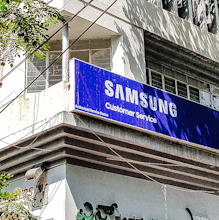
ONE OF OUR SAMSUNG mobile phones needed repairing while we were in Bangalore. Using the Google search engine, we discovered that the Samsung Service Centre nearest us is at Jayanagar. We gave the address provided by Google to an autorickshaw driver and after some navigational difficulties we reached the spot. There was no Service Centre but close to where we expected it to be, we found a Samsung showroom. Clearly, there was a mistake on Google.

Jayanagar gets scant mention in a new guidebook to Bangalore, so I turned to the (not always completely reliable) Google search engine to get a bit of background to this district of Bangalore close to the Lalbagh, a historic botanical garden. According to Wikipedia, a good starting place for research, Jayanagar means ‘victory city’. The area was established in 1948, and was one of the first planned suburbs of Bangalore. What little we saw of Jayanagar during our quest for the Samsung Service Centre reveals that the area is well planned in comparison with other areas of Bangalore. It gives the impression of being a prosperous suburb, which it is.

The people working in the Samsung showroom, where we stopped, confirmed that the address given by Google was indeed incorrect. They gave us directio s for finding the Service Centre, which was ten minutes’ walk away. This walk gave us a chance to gain some impressions of Jayanagar.

After walking past several palatial, fancy looking jewellery stores, we entered a long, mainly residential, street. Most of the houses were well spaced from each other, quite unlike the hugger mugger found in, for example, the prosperous but poorly planned suburb of Koramangala. The architecture of the houses along the street (7th Main Road) in Jayanagar is not uniform but interestingly varied. Several of the houses carry rakshasas, grotesque, scary masks to ward off the ‘evil eye’.

An elegant mandir, the Ganesha Vinayaka Temple, stands next to the intersection of 7th Main Road and New Diagonal Road. Established in the late 1970s, this temple attracts many politicians. Those seeking power come to worship at this place.

Beyond the temple, we reached 27th Cross Road. After crossing its central divider, we entered our destination, the Samsung Service Centre.

As with many faults of an electronic nature, when the engineer checked out the problem we were having with the phone, it had disappeared. Our search for the Samsung Service Centre had been unnecessary… so we thought.

PS After we had returned from Jayanagar, we discovered that our phone was repeating the fault which had caused us to make the apparently pointless journey to the pleasant suburb of Jayanagar.

RUDYARD KIPLING IN BOMBAY

KIPLING WAS BORN IN BOMBAY

IN 1857, THE YEAR OF THE FIRST INDIAN War of Independence, the British opened the first school of art in Bombay. It was named the ‘JJ SCHOOL OF ART’ after Sir Jamsethjee Jeejeebhoy, who donated much money towards its establishment.

We were very fortunate that a friend arranged a private tour of the campus for us. It began after we had eaten Yemeni food at the Hotel Stars on Chakala Street near Mohammed Ali Road.

We were shown the workshops and studios, many of which were built at the time of the School’s founding. The standard of work done by the students is high. We visited workshops for printing, textile weaving and printing, sculpture, metalwork, and ceramics. The walls of the largest part of the sculpture department are lined with models of great works by both western and Indian classical sculptors. This large room reminded me of images of how the Royal Academy in London looked long ago. Our guide explained that the JJ was modelled on the Royal College of Art in London.

We ended our tour at a building resembling a large English country house built in the Arts and Crafts Movement style of the late 19th century/early 20th century. This rustic looking edifice, which was built by 1865 long before the Movement flourished, used to be the residence for the deans of the School.

In 1865, Lockwood Kipling(1837-1911) and his new bride arrived in Bombay. Lockwood, an artist who created works in wrought iron, had been appointed Professor of Architectural Sculpture at the JJ. Soon after this, he was appointed Principal of the JJ and took up residence in the house already described. It was in this house that his son, the eminent author Rudyard Kipling(1865-1936), was born. The house is currently being restored beautifully.

The JJ also has a noted School of Architecture. This was founded by the British to train Indians to become architectural draughtsmen rather than architects. Their role was to draught the detailed plans of designs for buildings conceived by British architects. Likewise, the original colonial idea behind the JJ was to train Indians to carry out the ideas formulated by British artists. Today, the JJ no longer trains its students to be technicians to execute the plans of others, but educates them to enhance the creative life of India.

Finally, we learnt that many of the great buildings of British Imperial India were designed by architects in Great Britain, who never ever set foot in India. For example, the Deans’ house, where Rudyard Kipling was born, was built from a plan that was originally drawn up in England for a house that was never built in its intended location. Kipling’s birthplace was built from plans for a caretaker’s lodge for the Viceregal residence in Shimla, which never got built.

Now that I have seen where Rudyard Kipling was born, I feel that it is high tome that I read something he wrote!