A London square lacking a soul and New Delhi

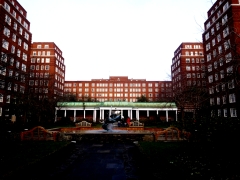
THE HIGHEST PLACE in north London’s Hampstead Garden Suburb (‘HGS’) is Central Square. Designed to be a focal point for people living in the Suburb, this often-windswept square is a dismal failure. Apart from the occasional communal fetes held on this large open space, this area is somewhere that people walk cross usually without stopping to linger. I was brought up in a house not far from the Square and rarely during the 30 or more years I lived in the area could this heart of the Suburb be described as a lively meeting place. Visits since leaving the area over 30 years ago, have never revealed much, if anything, going on in what might have been a wonderful heart for the local community.

Free Church, Central Square

HGS was created by Dame Henrietta Barnett (1851-1936), who was married to a cleric, Canon Samuel Augustus Barnett (1844-1913). The Barnetts lived close to the Spaniards Inn near Hampstead. The architect Raymond Unwin (1863-1940) was important in conceiving the layout and design for the Suburb. Another architect involved with the creation of HGS, especially the environs of Central Square was Edwin Lutyens (1869-1944).  Building commenced in about 1904/5. The plan for Central Square was finalised in 1911 after several changes in its design. These changes have been summarised as follows (https://londongardenstrust.org/conservation/inventory/site-record/?ID=BAR011):

“Raymond Unwin’s first design for the suburb (February 1905) had communal buildings including a church, chapel, hall, library and shops; the site of the square was to be levelled and extended to the north. Unwin and Edwin Lutyens, appointed architect in May 1906, proposed a more formal plan in 1906-7; this and a third scheme by Lutyens did not meet with Mrs Barnett’s approval. The final plan of 1911 of Central Square as built is a variant on Lutyens’ plan for a rectangle broken up into four clearly articulated spaces each defined by a double row of trees and a lily pond.” 

It was a shame that the shops and library never materialised. Had they been included in the final plan, the Square would have had a chance of becoming a vibrant communal centre and maybe the Suburb would not have developed into the staid and rather precious district that it has become. The architectural historian Nikolaus Pevsner, who lived close to HGS in Hampstead’s North End, did not differ from my assessment of the Square:

“The omission of shops from Central Square has proved a disadvantage; the square has never become a real social centre. Not only shops, but also cinemas, pubs, and cafés have been refused admission. Institute education and divine worship have not proved to be as much of a lively attraction as the social reformers hoped for.” (“Buildings of England. London 4: North” by Bridget Cherry and Nikolaus Pevsner, published 1998)

As for the lily pond, if that ever existed, it had disappeared by the time I was a young child in the 1950s.

Apart from the four lawns separated by footpaths, the Square has the following notable features: a church on its south side; a church on its north side; tennis courts on its eastern edge and near them, a monument to the memory of Dame Henrietta Barnett; and on its east side a large building called ‘The Institute’, which houses Henrietta Barnett School. Central Square is flanked by two equally sterile rectangular open spaces: North and South Squares.

Lutyens was responsible for the design of many of the structures standing around Central Square: St Jude Church with its tall spire, constructed 1909-1911; the Free Church with its dome, begun 1911, but only competed in the 1960s; the Henrietta Barnett Memorial, completed about 1938; and the Institute’s design has some input from Lutyens. And that is not all. Lutyens also designed some of the houses in North Square and in Erskine Hill that leads north from it. Friends of mine lived in a pair of semi-detached houses designed by Lutyens on Erskine Hill. Externally, they were not unattractive buildings, but inside I was not impressed; the ground floor rooms were small and not well fed with daylight. Taken in isolation, one might forgive Lutyens for this defect in his design, but since first seeing my friends’ homes, I have discovered that Lutyens was prone to creating designs that were less than ideal.

When visiting Runnymede, where Magna Carta was signed in the 13th century, we saw a couple of lodges that had been designed by Lutyens. A friend pointed out that he had omitted guttering in their design, which is a strange thing to miss out in a country where rain is not infrequent. The result is that over the years water running off the lodges’ roofs have damaged the brickwork of their external walls. The latest “National Trust Magazine” (Spring 2021) highlights a design failure at Castle Drogo near Dartmoor in Devon, designed by Lutyens and constructed between 1911 and 1930 for the founder of Home and Colonial Stores, Julius Drewe (1856-1931). Designed to look like a mediaeval fortress, the place was equipped with the latest of 20th century features including electricity generated by a ‘hydro-turbine’. Despite all of its up-to-date furnishings, it is prone to old-fashioned water leaks. This was largely due to Lutyens’ choice of asphalt, a relatively new material as far as roofing was concerned. In addition, the article in the magazine reveals:

“The windows were designed without windowsills …this leaves little protection from the Dartmoor elements…”

In 1897, Lutyens married Lady Emily Bulwer-Lytton (1874–1964), who was daughter of Edward Robert Lytton Bulwer-Lytton, 1st Earl of Lytton (1831-1891), Viceroy of India between 1876 and 1880. In 1911, the capital of British India shifted from Calcutta to Delhi. And with this move, Lutyens was chosen to head an architectural team to design a new administrative complex in Delhi. His views on the kind of architecture that he considered suitable were disdainful of Indian architecture:

“Lutyens regarded Indian architectural interventions as mere ‘spurts by various mushroom dynasties with as much intellect as there is in any art nouveau’. Indian buildings, according to him, reflected a childish ignorance of even the basic principle of architecture. He also firmly believed that in countries outside of Europe ‘without a great architectural tradition of their own, it was even more essential to adhere strictly to the canons of the architectural style’.” (https://thewire.in/history/friendship-faltered-raisina-hill).

This patronising and denigrating view of traditional Indian architecture that includes treasures like the Taj Mahal and the great stepwells in Gujarat and elsewhere, along with his dogged adherence to certain aspects of European classical architecture, are a poor reflection of Lutyens’ own aesthetic sensibilities and help to explain why I do not rate him amongst the best of 20th century architects. However, many might disagree with my judgement: chacun à son gout, as they say across The English Channel.

Although Lutyens’ creations in New Delhi are much admired, one part of his design showed lack of planning. This is evident in the Viceroy’s House, which he designed. It stands in a complex of buildings on Raisina Hill. Lutyens had wanted the House to stand prominently, like St Judes in HGS, so that it could be seen from all around. Unfortunately, Lutyens:

“…had seen the perspective plan of the buildings earlier but had failed to take adequate notice of the gradient. When he discovered it finally, it was perhaps too late. Lutyens wrote to his wife Emily: ‘I am having difficulty with Baker. You remember the perspective showing the secretariats with Government House. Well, he has designed his levels so that you will never see Government House at all from the Great Place. You will [only] see the top of the dome.’” (https://thewire.in/history/friendship-faltered-raisina-hill)

Well, in my humble opinion, a top-rate architect should never have made such an error and even worse blamed it on his colleague, the eminent architect Herbert Baker (1862-1946). To some outcry in India, there are plans to replace some of Lutyens’ creations in Delhi (www.thehindu.com/news/national/what-is-the-project-to-redevelop-lutyens-delhi-all-about/article29865323.ece)

I have never visited Delhi, New or Old, but I hope that what Lutyens created there is more joyous than the sombre atmosphere that reigns in and around the soulless Central Square in the Hampstead Garden Suburb.

The gate that has disappeared

NOTTING HILL GATE is a stretch of roadway, 670 yards long, that runs west from Bayswater Road to Holland Park Avenue. It is part of what was once a Roman Road that ran from London to places west and southwest of the city, passing through what is now Staines. The ‘gate’ in the street name refers to a tollgate that stood along it until about 1860. The gates of this barrier were placed so that there was no way of bypassing them via the few side roads that existed prior to the development of the area during the 19th century. I have no idea of how much was charged at this turnpike, but one might get a rough idea from a list of charges levied in early 18th century Wiltshire:

“1s. for a coach or wagon, 6d. for a cart, 1d. for a ridden or led horse, 10d. a score for cattle, and 5d. a score for sheep.” (www.british-history.ac.uk/vch/wilts/vol4/pp254-271).

I became curious to learn where the Notting Hill gate was located. I found the answer in a book that I bought whilst browsing the shelves of a local charity shop.

According to Florence Gladstone and Ashley Barker, authors of “Notting Hill in bygone days” (published in 1924), a detailed history of the area, the tollgate known as ‘Notting Hill Gate’:

“… was the first of three successive turnpikes at this spot and crossed the road east of the site of the Metropolitan Station. It seems possible that the toll-keeper’s house occupied the corner where that station is set back from the road. The very interesting view of this gate by Paul Sandby, R.A., dated 1793 … faces west and apparently shows the end of Portobello Lane and the Coach and Horses Inn.”

This gives a clear description of where the turnpike (tollgate) was located, but today, the appearance of the area described has changed considerably.

To begin with, Portobello Lane no longer exists, at least not with that name. It most likely followed the course of the present Portobello Road and connected with Notting Hill Gate along the southern stretch of what is now Pembridge Road. On a map surveyed in 1863-65, Portobello Road is marked in its present position but the northern stretch of it that led through what were then open fields to Portobello Farm was then still called ‘Portobello Lane’.

Today, the Underground station, formerly the ‘Metropolitan Station, is not visible on the road as it can only be accessed by staircases leading down from the pavements to a subterranean ticket hall. The platforms of the Circle and District Lines are housed in what was part of the original station, which is set back from the road. These platforms were opened in 1868 and were accessed through a building set back from the road as can be seen on an extremely detailed (1:1056) map surveyed in 1895.

During the 18th century, The Coach and Horses Inn stood at number 108 Notting Hill Gate, a few feet west of Pembridge Road (formerly ‘Portobello Lane’), where today a recently opened branch of Marks and Spencer is doing good business.

The tollgate disappeared long ago, and so did much of Notting Hill Gate that would have been recognisable to the two authors of the book mentioned above. The most prominent survivor of pre-WW2 days is the Coronet, currently the home of the Print Room theatre organisation. Near it but clothed in a dull, modern (1960s) exterior is The Gate Cinema, whose well-conserved auditorium was constructed in 1911 within a building that had been a restaurant since 1861 (https://historicengland.org.uk/listing/the-list/list-entry/1385016). Most of the rest of the architecture lining Notting Hill Gate is mostly 20th century and/or aesthetically unpleasing.  

I am not sure that what preceded the buildings that we see today was necessarily much better aesthetically, but we can get an idea from a short stretch of buildings, currently numbered 26 to 70, opposite the northern end of Church Street. These are mostly shops, whose ground floors stretch away from the road to join buildings with two or three storeys set back from the road. Judging by the architecture of the buildings above and behind these shops, they were probably already built by the end of the 19th century. A drawing created in 1912 by William Cleverley Alexander (1840-1916), who resided near Notting Hill Gate, shows some of these buildings looking remarkably like how they appear today. However, since he created his picture, the row of buildings has been changed by the construction of two banks, each with a neo-classical façade.

While I would not recommend visiting Notting Hill Gate for its own sake, it is the gateway to far more attractive sights such as Portobello Road, Kensington Gardens, Holland Park, and Notting Hill of movie fame. And if you are thirsty, there are at least nine cafés within a paper cup’s throw away from the Underground station, and the number continues to increase.

From Chelsea to Chiswick: travels of a gateway

BEAUFORT HOUSE IN CHELSEA was the home of Henry VIII’s ill-fated advisor, Thomas More (1478-1535), between 1521 and his arrest in 1535. After More’s death, the property passed through the hands of several owners, the last of which was the physician and founder of the British Museum Sir Hans Sloane (1660-1753). He bought the house and its grounds in 1737 (https://www.british-history.ac.uk/survey-london/vol4/pt2/pp18-27). During 1739 and 1740, Sloane demolished Beaufort House, and sold parts of it and its grounds to be used in other buildings. One of the items he sold was an elegant gateway designed by the British architect Inigo Jones (1573-1652), who introduced the neo-classical style to the UK.  The gateway, which was constructed in 1621, used to serve as an entrance to the grounds of the house from Kings Road.

The gateway, which now stands near to Chiswick House in west London, bears a carved stone with the words:

“Given by Sir Hans Sloane, Baronet to the Earl of Burlington 1738.”

Richard Boyle, 3rd Earl of Burlington and 4th Earl of Cork (1694-1753), an architect. He built the present Palladian-style mansion at Chiswick in 1717. An admirer of Inigo Jones, he was happy to install the gateway from Beaufort House close to his recently constructed building in Chiswick. Contrary to what appears on the inscription, he paid for the gateway rather than receiving it as a gift from Sloane. A poem by the architect and landscape designer William Kent (c1685-1748) relates the story of this fine gateway (quoted from “The Palladian Revival. Lord Burlington, His Villa and Garden at Chiswick” by John Harris):

“Ho! Gate, how came ye here?

I came fro’ Chelsea the last yere

Inigo Jones there put me together

Then was I dropping by wind and weather

Sir Hannes Sloane

Let me alone

But Burlington brought me hither

This architecton-ical

Gate Inigo Jon-ical

Was late Hans Slon-ical

And now Burlington-ical”

Burlington was so keen to have the gate that he agreed to pay Sloane however much it was valued.

As far as I can see, the gateway serves no other function than as a decorative garden feature. Burlington was a keen collector of the architectural drawings of Inigo Jones and had seen the Beaufort House gateway amongst them. As an enthusiast, he must have been thrilled to have acquired an actual work by the architect he admired. So, apart from being a garden feature, it was a fine collector’s item. I feel that it is a pity that he did not rescue more from the house that Sloane demolished because old drawings and plans of it make it appear as if it was a remarkable edifice.

The gardens of Chiswick House, close to the busy A4 highway, are open to the public free of charge and apart from the fine gateway, there are many other lovely man-made garden features: statues, neo-classical buildings (apart from the main villa), bridges, and a fine waterfall that empties into a lake. The gardens are interestingly laid out, both formal layouts with hedges and also less manicured areas. Come rain or shine, a visit to these gardens is a worthwhile and refreshing experience.

Fire! Fire!

WALKING ALONG THE ALBERT Embankment upstream from Lambeth Bridge, most people’s eyes will probably be focussed on the River Thames and the lovely views of the Houses of Parliament, Millbank Tower, and the Tate Britain. However, it is worth turning your eyes inland in order not to miss a wonderful example of, in my uninformed opinion, art-deco or, if you are fussy about distinctions, art-moderne architecture, whose decorative façade faces the river. Just in case you were wondering how these styles of architecture from the same time period differ, deco lays emphasis on ‘verticality’ and moderne on ‘horizontality’ (http://theantiquesalmanac.com/chicvssleek.htm). Important as this distinction might be to connoisseurs, the building on Albert Embankment is worth at least a few minutes’ examination.

The building in question is the former London Fire Brigade Headquarters, still a functioning fire station. The structure is built of bands of bricks separated by thin horizontal lines of white stone that form the top and bottom frames of the lines of windows, each consisting of lattices of rectangular windowpanes which are wider than they are tall. These design features help define the building’s horizontal sleekness, which is why it is considered by at least one authority (https://historicengland.org.uk/listing/the-list/list-entry/1392337)  to be ‘moderne’ rather than ‘deco’.  However, it was not this that first attracted us to the building but its decorative panels at various levels and dramatic doorways at ground level.

The doorways, which are wide enough to admit the passage of vehicles are closed with sets of folding doors, consisting of four panels, each of which has a brass window covering (grille) with a geometric design. Some of the building’s decorative panels depict firefighters at work. These are in bas-relief and made of a white coloured stone. These were made by Nicholas Babb (probably Stanley Nicholson Babb; 1873-1957). Other panels, at a higher level, adorn the central section of the façade. These are also bas-relief in white stone but  have backgrounds formed of gold coloured mosaic tiles.  Created by Gilbert Bayes (1872-1953), who studied alongside Babb at the Royal Academy, their subject matter is borrowed from ancient mythology.

The building itself was designed by EP Wheeler, architect to the London County Council. He was assisted by G Weald. Wheeler also designed the ‘horizontalist’ building on Charing Cross Road in 1939, which was the former home of St Martins School of Art (www.designcurial.com/news/foyles-war-4354398), where my mother worked as a sculptor during the 1960s. The Fire Brigade building was opened by King George VI and his wife on the 21st of July 1937, not a moment too soon, given what was in store for London soon afterwards: the WW2 Blitz, which put great strain on the Fire Brigade.

To the left of the façade, there is a yard in which stands a tall brick tower. This is the so-called ‘drill tower’, used for training firefighters. The building, in addition to having been the Brigade’s headquarters, was also a training centre. The rear of the building, which I have not yet seen, has three layers of balconies, from which members of the public used to be able to observe parades and displays of firefighting skills. Today, the edifice is still used as a fire station but not as the HQ of the Brigade, which is now in Union Street, Southwark.

I enjoy seeing art-deco (and ‘moderne’) architecture. While there are plenty of examples of this in London, which you can spot if you keep your ‘eyes peeled’, the greatest concentration of this style of building that I have seen is in central Bombay in India. Both the Marine Drive and the Oval Maidan in south Bombay are treasure troves for lovers of this style. So, as a lover of this style that broke away from traditional architectural styles in the 1920s and 1930s, I was delighted to have stumbled across the wonderful Brigade building on the Albert Embankment.           

Where there are dolphins

I HAVE NEVER VISITED MOSCOW, but I imagine that the huge, rather forbidding looking apartment block on Grosvenor Road facing the River Thames, would not look out of place in the Russian city. Covering seven and a half acres of land, built with twelve million bricks and almost seven thousand external window units, and containing at least twelve hundred flats, this mammoth building complex, which has been home to many of the famous and infamous, was completed in late 1936. This enormous residential complex is called Dolphin Square.

Maps surveyed in 1869 and 1913 reveal that the land on which Dolphin Square was built, which is west of St Georges Square, used to be the site of the several long buildings that together made up the Royal Army Clothing Department and its storage depots. Before that, the land was occupied by the work premises of the developer and builder Thomas Cubitt (1788-1855), who built much of Belgravia and Pimlico. A few years after his death, the army leased the site and the depot stood there until 1933, when the lease reverted to the Duke of Westminster (https://en.wikipedia.org/wiki/Royal_Army_Clothing_Depot).

An American firm, Fred F French Companies, bought the freehold of the former army clothing compound, and then, discovering it had insufficient funds to develop it, sold it on to Richard Costain Ltd. Costain commissioned the architect Stanley Gordon Jeeves (1888-1964), whose other works include the now demolished Earls Court Exhibition Centre and the still standing large, art-deco Latimer Court at Hammersmith, to design the residential complex that exists today. Writing soon after it opened, the writer AP Herbert (1890-1971) wrote a book extolling the virtues of Dolphin Square. He wrote that it is:

“…a city of 1,250 flats, each enjoying at the same time most of the advantages of the separate house and the big communal dwelling place …”

Commenting on the fact that the complex included a restaurant, he wrote:

“…fortunate wives will not have enough to do. A little drudgery is good for wives, perhaps. The Dolphin lady may be spoiled.” (quotes from www.theundergroundmap.com/article.html?id=2792)

From outside the building, Dolphin Square looks monolithic and forbidding. However, on entering the huge courtyard within it, this impression changes. For, the courtyard contains a lovely garden, which was designed by Robert Sudell in about 1937 (https://historicengland.org.uk/listing/the-list/list-entry/1455668). Though much modified since then, the formal garden retains much of the original design concept including an axial avenue lined with chestnut trees. Appropriately, the middle of the garden is adorned with a fountain with three sculpted dolphins. Created by the sculptor James Butler (born 1931), this was placed in 1987 to replace an earlier fountain. This pleasant garden would be one good reason to entice me to live in this extraordinarily massive complex. 

As mentioned already, Dolphin Square offers its residents a restaurant. It also contains an arcade of shops, a café, a gymnasium, a swimming pool, a laundrette, underground parking, a bar, a brasserie, a hotel, a tennis court, and more. And all of this is within a short walk of Westminster and the Houses of Parliament. This proximity to the centre of government means that many MPs have made use of Dolphin Square as their London ‘pads’.

Apart from politicians, including Harold Wilson, William Hague, David Steele, and many others, Dolphin Square has been home to people of fame and notoriety. According to an article in Wikipedia, some of these include Oswald Mosley and his wife Diana Mitford; the novelist Radclyffe Hall; Christine Keeler and Mandy Rice-Davies; the comedian Bud Flanagan; the spy John Vassall; and the tennis player Rod Laver. Princess Anne lived in Dolphin Square briefly in 1993, General de Gaulle based his Free French Government in part of the Square in WW2, and Sarah, daughter of Sir Winston Churchill, was:

“…evicted from the square for hurling gin bottles out of her window.” (https://www.bbc.co.uk/news/magazine-33785352).

It seems that a fascinating book about the residents of Dolphin Square is waiting to be written.

I had passed Dolphin Square plenty of times before entering its garden recently, but until now I had no idea that this far from attractive building was home to such a fascinating range of people nor that it contained such a fine garden. Just as one should not judge a book by its cover, it is a mistake to judge Dolphin Square from its exterior.

Finding Boy George and Bliss in north London

DURING THE COVID19 PANDEMIC, when travelling far afield has been discouraged for public health reasons, I have been exploring one of my old haunts, Hampstead, and have been becoming increasingly more interested in its attractions and historical associations. I invite you to join me on one of my rambles through a part of this intriguing area of north London.

Detail of house where Sir Arthur Bliss lived

East Heath Road runs eastwards, then southwards, relentlessly downhill from Hampstead’s Whitestone Pond towards South End Green, close to the Royal Free Hospital. The road marks the eastern edge of the spread of Hampstead into Hampstead Heath. Except for three well separated blocks of flats, there are no buildings on the eastern side of the Road. A winding lane leads off the road to the small settlement of the Vale of Health, an enclave which is surrounded by the Heath.

The block of flats facing Whitestone Pond at the top end of East Heath Road (‘EHR’) is called Bell Moor. Built in 1929, this edifice stands on the site of the home where the historian Thomas J Barratt (1841-1914) lived from 1877 to 1914. He was Chairman of the Pears soap manufacturing company and a pioneer in brand marketing as well as a historian of Hampstead. His “Annals of Hampstead”, published in 1912, is a detailed, monumental, beautifully illustrated, three volume account of Hampstead’s history. In addition to a plaque commemorating Barratt on Bell Moor there are two others. One of them records that the great conductor Sir Thomas Beecham (1879-1961) lived there from 1937-1941 and the other is placed to record that the surface of the soil at Bell Moor is 435 feet above sea level or 16.5 feet higher than the top of the cross on the dome of St Paul’s Cathedral.

Moving downhill, all the older houses are on the west side of East Heath Road. The writer Katherine Mansfield (1888-1923) and her husband, the critic John Middleton Murry (1889-1957), lived at the end of a short Victorian terrace, at number 17 EHR (formerly ‘Portland Villas’). Next door to this, there is a picturesque ivy-clad building, Heath Cottages, with one wall covered in wood cladding and a small balcony above one of its centrally placed pair of front doors. Barratt included a drawing of this building in his book but makes no comment about it.

A large house, The Logs, with an extravagant brick tower, eye-catching but not attractive, is reached further down EHR. This was built in 1868, designed by JS Nightingale for the drainage and water supply engineer and Justice of the Peace for Middlesex Edward Gotto (1822-1897; http://www.icevirtuallibrary.com/doi/pdf/10.1680/imotp.1897.19422). It has also been home to the comedian Marty Feldman and later the popular musician Boy George. The Logs neighbour is Foley House, which I have described elsewhere (https://adam-yamey-writes.com/2021/01/15/a-house-a-spa-and-grays-anatomy/).

Proceeding down EHR, we pass several large brick-built terraced houses until we arrive at the corner of a lane called Heathside. A large house on the corner of this and EHR bears a plaque that notes that the composer Sir Arthur Bliss (1891-1975) lived here in East Heath Lodge from 1929 to 1939. It was in this house that the painter Mark Gertler (1891-1939) painted the composer’s portrait in 1932 (https://www.npg.org.uk/collections/search/portrait/mw07115/Sir-Arthur-Bliss). During his residence on EHR, his musical compositions began to be come less avant-garde and he became a musical successor to the composer Edward Elgar. I wonder whether living in a house with views over Hampstead Heath might have influenced his change in composing style.

East Heath Lodge appears to have been divided into two residences. Bliss occupied the half of the building next to the Heath. It was built in about 1785 by the local builder Henry White and modified in about 1820 (https://historicengland.org.uk/listing/the-list/list-entry/1342097). A large bell hangs under a metal canopy outside the western half of the building, which bears the name ‘South Lodge’. West of East Heath Lodge along Heathside, there are some large cottages built in about 1814. South of Bliss’s former home, EHR is flanked to the east by a large public car park and to the west by a triangular green space whose apex is at the point where Willow Road meets the southern extension of EHR, South End Road. Just before it does that, EHR meets the eastern end of Downshire Hill soon before it crosses Willow Road.  

Number 2 Willow Road, a modern looking two-storey building can be seen across the grass from EHR. Modern it looks although it was designed and built by the architect of Trellick Tower Ernö Goldfinger (1902-1987) in 1939. In 1942, Goldfinger, who had Marxist sympathies, hosted an exhibition of leading artists in his new home in order to raise funds for “Aid to Russia” (www.nationaltrust.org.uk/features/who-was-ern-goldfinger).  Now owned and maintained by the National Trust, it is well worth visiting this superbly designed living space. Incidentally, Goldfinger’s house was constructed on the site of some 18th century cottages that were demolished to make place for it.

South of Willow Road, EHR becomes South End Road. The houses lining this road’s western side, but set well back from it, are in complete contrast to Goldfinger’s residence just north of them. Each of the houses is separated from the pavement by long strips of beautifully cared for gardens. Most of the dwellings have names: Hartley House (no. 103), where the architect Oswald Milne (1881-1968) once lived; Heath Cottage (no. 101); Guernsey Cottage (no. 93), home of the 19th century translator of “Heinrich Heine’s Book of Songs”, JE Wallis; Bronte Cottage (no. 89), home of the artist Mary Hill (1870-1949); St Johns Cottage (no. 87); Rose Cottage; Leighton House (no. 73), and Russell House (no. 71), an early 19th century house with a late 19th century enclosed veranda by Charles Francis Annesley Voysey (1857-1941), one of his earliest projects. Beyond these, there is Keats Grove, across which a line of shops commences. The architectural historian, Nikolaus Pevsner, who lived in Hampstead, described this row of buildings as:
“… a pleasant irregular sequence of early c19 houses.”

And that is a good description of them.

South End Road, the continuation of EHR, becomes Fleet Road and heads south east towards Chalk Farm. We end our ramble at Pond Square, where once there was a cinema, its site now occupied by Marks and Spencer’s superb food store. Just north of it is Hampstead Heath Overground Station, which is close to a pub with fake half-timbering called the Garden Gate. In 1855, a pub on this site was called ‘The Perseverance’. It was renamed ‘The Railway Tavern’ by 1871 and got its present name more recently. Closed at present because of the covid19 pandemic, the best place to refresh yourself, after walking down from Whitestone Pond and enjoying the varied architecture along the way, is the Matchbox Café next to the small, cobbled bus yard in Pond Square. Its friendly owner Mirko prepares good hot drinks and sells a variety of tempting snacks. And before you leave the area, pick up some great fruit and vegetables from the  well[stocked stall next to the station ticket office.

Accidental death of an architect

ELEGANT BELGRAVE SQUARE is but a stone’s throw from Hyde Park Corner. Many of its neo-classical buildings are home to diplomatic missions and their staff. As with many London squares, the centre of Belgrave Square contains a private garden. That at Belgrave Square is adorned with sculptures, mostly statues of eminent people. At each of its four corners, there is one. The people depicted at these four positions are Prince Henry the Navigator (1394-1460); Christopher Columbus (1451-1506); Simon Bolivar (1783-1830), the liberator of Venezuela, Bolivia, Colombia, Ecuador, Peru, and Panama; and José San Martin (1778-1850), liberator of Argentina, Chile, and Peru. Almost facing San Martin on the north east corner of the square is a statue of Sir Robert Grosvenor, First Marquess of Westminster (1767-1845), upon whose estate Belgrave Square was built.

Elias George Basevi

On the eastern side of the square, close to the statue of Simon Bolivar and within the garden, there is a sculpture by Enzo Plazzotta (1921-1981), which was completed after his death by Mark Holloway. It is called “Homage to Leonardo. The Vitruvian Man”.

Interesting as all the above-mentioned are, the sculpture that intrigued me most is a bust of Elias George Basevi (1794-1845), who is described on his plinth as ‘architect’. I guessed that he was likely to have been involved in the design of Belgrave Square, and I was right. According to a plaque on the base of Grosvenor’s statue, he designed the neo-classical terraces surrounding the square for the Haldimand Syndicate, which was under the control of the brothers George (1781-1851) and William (1784-1862) Haldimand, of Swiss origin, sons of a banker born in Switzerland and an English mother. In 1825, William, a Member of Parliament:

“… negotiated successfully with the 2nd Earl Grosvenor, Seth Smith and William Cubitt for a 99-year lease on Belgrave Square, where he had 49 houses built: 16 to be owned by George Haldimand, 14 by himself, eight by Prevost, four by Smith and three by Cubitt…” (www.historyofparliamentonline.org/volume/1820-1832/member/haldimand-william-1784-1862)

The Haldimands were related to Frederick Haldimand (1718-1791), who became Governor of Quebec in 1777. Thomas Cubitt (1788-1855), who was involved in creating the square, was a major Victorian property developer.

As for Basevi, at first, I thought that his surname sounded Italian. His family might have come from that country as its origins were Sephardic Jewish. The Basevi surname is particularly associated with Sephardic Jews in Verona (https://judaism_enc.enacademic.com/2089/BASEVI). His father, Joshua, usually known as ‘George’, was a London City merchant (www.jewishencyclopedia.com/articles/2616-basevi-george-joshua). Elias George’s aunt, George’s sister Maria (née Basevi), was married to Isaac D’Israeli, whose son was Benjamin Disraeli, Earl of Beaconsfield (1804-1881), who was Prime Minister between 1874 and 1880. In 1810, Elias became a pupil of the great architect John Soane (1753-1837), who specialised in creating in the neo-classical style. According to the Dictionary of National Biography (‘DNB’) (https://doi.org/10.1093/ref:odnb/1615), from which I have gleaned much information about Elias, he:

“… also studied at the Royal Academy Schools, where Soane had recently been appointed professor of architecture. In 1815 he visited Paris with his brother, and on completion of his architectural training in 1816 he embarked on a three-year study tour of Italy and Greece, staying the longest in Rome and Athens, but also travelling extensively elsewhere in Italy and even visiting Constantinople.”

Regarding Belgrave Square, the DNB relates:

“Basevi designed and handled the construction of the terraced houses making up the four sides of the square (1825–40), though not the four detached villas at the corners. He treated the stuccoed terraces of eleven or twelve houses on each side as single palatial façades, giving each a central columnar portico and end pavilions in a similar manner to John Nash’s terraces in Regent’s Park … The financial success of this speculative development during an economically depressed period was due in large part to Basevi’s precise and scholarly attention to detail, not just in the design of the individual houses but also in the paving, street furniture, and composition of the square as a whole.”

Elias Basevi’s other projects included, to give just a few examples, St Thomas, Stockport, Cheshire (1822–5); work at several country houses; a building at Balliol College Oxford; Beechwood House and The Elms in Highgate; and the Fitzwilliam Museum in Cambridge, whose construction was completed after his death. Beechwood House was built for the architect’s brother Nathaniel, a barrister, in 1840, who was married to a niece of Sir Robert Peel (1788-1850).

Noticing Basevi’s buildings in Highgate, I looked at John Lloyd’s “History, Topography, and Antiquities of Highgate”, published in 1888, and discovered more about Basevi. He wrote that the Basevi family had been prominent in the Anglo-Jewish community. One member of the family, Napthali, the grandfather of Benjamin Disraeli’s mother, was an early President of The Jewish Board of Deputies, which was involved in the struggle for the emancipation of the Jews. The Basevis moved away from the Jewish faith as did their kinsmen the Disraelis.

Elias Basevi married Frances Agneta Biscoe. They produced eight children, one of whom was given the name James Palladio Basevi (1832-1871), who became an officer in the Royal Engineers.

On a personal note, I attended Highgate School between 1965 and 1970. Some years later, I acquired a copy of the “Highgate School Register 1833-1988”. Today, I looked up ‘Basevi’ in the index of pupils and discovered that in March 1840, James Palladio Basevi joined the school. This son of the architect joined the school two years after the Reverend John Bradley Dyne (1809-1898) had become headmaster. Dyne was to raise the school’s reputation considerably.  Other Basevi family members attended the school were William Augustus Basevi (joined January 1841), George Henry Basevi (joined January 1842) Frederick Biscoe Basevi (joined April 1844), Charles Edward Basevi (joined June 1844). All of these fellows were sons of the architect of Belgrave Square. Why they went to Highgate School is a bit of a mystery. Part of the reason might have been that their uncle, Nathaniel, had his home at Beechwood, a short walk from the school. however, their father, the architect lived in central London. The historian Alan Palmer, who used to teach at the school, wrote that out of the 43 graduates of Dyne’s first ten years, only 16 came from homes near the school. His reputation as a headmaster was already excellent by the time that the first of the architect’s sons entered the school, which attracted boarders.

Elias, who became a Member of the Royal Institute of British Architects, and a Fellow of both the Society of Antiquaries and the Royal Society, ended his life in a frightening way. The DNB relates his tragic ending:

“He died on 16 October 1845, aged fifty-one, after falling through an opening in the floor of the old bell chamber of the west tower of Ely Cathedral while inspecting repairs. His remains were buried in Bishop Alcock’s chapel at the east end of the cathedral.”

The bust of Elias George Basevi is smaller than the other commemorative sculpture placed in and around Belgrave Square and easy to miss if you are walking around the square. I only noticed it because I was watching two people walking with their dogs within the square’s private garden. Had I not seen the bust, I might have never explored the life of this man whose family had connections with Highgate, where I attended secondary school.

Organs and archaeology

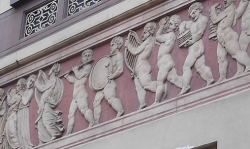
THE EYES OF MOST VISITORS to Kensington Gore are attracted to the spectacular Royal Albert Hall and, opposite it, the monument to Albert, Queen Victoria’s consort. Immediately to the west of the Royal Albert Hall, there stands the comparatively less impressive twentieth century building housing the Royal College of Art (‘RCA’), designed by H T Cadbury Brown and opened in 1962. Next to this geometric structure of concrete and glass and on its south side, there is an edifice whose appearance is a dramatic contrast to it. The walls of the RCA’s southern neighbour are covered with figurative illustrations, created in the ‘sgraffito’ technique.  Bands of ‘putti’ carrying musical instruments, scrolls of paper, or singing, appear to be scurrying across the walls of the building. Maybe this is not surprising because once this place housed The Royal College of Organists (‘RCO’).

Founded in 1864 by the organist Richard Limpus (1824-1875) to promote advanced organ playing, it received its Royal Charter in 1893. The building next to the present RCA and facing the Royal Albert Hall was designed by Lieutenant Henry Hardy Cole (1843-1916) of the Royal Engineers, and the ‘sgraffiti’ decorating it was created by Francis Wallaston Moody (1824-1886).

Lieutenant Cole was a son of Sir Henry Cole (1808-1882), a civil servant who had an extremely important role in organising the Great Exhibition of 1851. His building, erected 1874-75, was originally constructed to house The National Training School for Music. It was paid for by Sir Henry Cole’s friend, music lover, and a fellow member of the Society of the Arts, the developer Charles James Freake (1818-1884), who lived in Cromwell Road (www.londonremembers.com/memorials/sir-c-j-freake).

The architect, Lieutenant Cole had little practical architectural experience as is revealed in “The Survey of London Vol.38” (www.british-history.ac.uk/survey-london/vol38/pp217-219):

“Lieutenant Cole had returned in 1871 from India, where he had been Superintendent of the Archaeological Survey, North-West Provinces, and his previous architectural work seems to have been confined mainly to publications on ancient Indian architecture and archaeology, and the preparation of casts for the Indian section of the South Kensington Museum, which he catalogued.”

Consequently:

“He was not left to design the school on his own. It was evolved in consultation with his father and was subjected to criticism by members of the Science and Art Department. A committee of management was appointed in July 1873 …”

Moody was a protégé of Sir Henry and a teacher at the National Art Training School, a forerunner of the RCA.

Between 1883 and 1896, the building was used by the newly founded Royal College of Music, which moved into its new premises south of the Royal Albert Hall in about 1896. The large variety of musical instruments that have been depicted on the building’s walls reflect the place’s first occupants.  Between 1896 and 1903, it stood empty. Then it was leased to the RCO for 100 years at a ‘peppercorn’ rent. When it was learnt that after expiry of the lease the rent would be increased considerably, the RCO moved into new accommodation in 1991. Currently, at least in 2018, it is owned by an entrepreneur, Robert Tchenguiz.

The Lieutenant, who designed the RCO building, became the Curator of Ancient Monuments in India. His “First Report Of The Curator Of Ancient Monuments In India” was published in 1882 in Simla. This contains some of his views on dealing with archaeological items and sites. For example, he wrote:

“Experience has shown that the keenest investigators have not always had the greatest respect for the maintenance of monuments. Archaeological research has for its object the elucidation of history, and to an enthusiast the temptation to carry off a proof of an unravelled mystery is undoubtedly great. If there were no such things as photographs, casts, and other means of reproducing archaeological evidence, the removal of original stone records might perhaps be justified …”,

and, regarding the now controversial British possession of some famous sculptures in the British Museum:

“Sometimes, indeed, the removal of ancient remains is necessary for safe custody; and in the case of a foreign country, we are not responsible for the preservation in situ of important buildings. We are not answerable for keeping Grecian marbles in Greece; neither were we concerned for the rights of Egypt when Cleopatra’s Needle left Alexandria for the Thames embankment.”

However, regarding India, the Lieutenant wrote:

“In the case, however, of India—a country which is a British possession—the arguments are different. We are, I submit, responsible for Indian monuments, and that they are preserved in situ, when possible. Moreover, as Mr. Eergusson remarks, Indian sculpture is so essentially a part of the architecture with which it is bound, that it is impossible to appreciate it properly without being able to realise correctly the position for which it was originally designed …”

In order to satisfy the needs of museums in Europe, the lieutenant suggested that perfect replicas of artefacts can be made as is well demonstrated by the superb life-like plaster casts that can be seen in the Cast Courts of the Victoria and Albert Museum, which were opened in 1873 and established by Sir Henry Cole and the art collector John Charles Robinson (1824-1913). In general, Sir Henry’s son was against moving historical remains from British possessions. To make his point, he wrote:

“The removal, for instance, of Stonehenge to London would, I imagine, provoke considerable excitement in England, and be condemned by a majority in the scientific and artistic world.”

I am not sure that Lieutenant Cole’s views were shared by the American sculptor and collector of antiques George Grey Barnard (1863-1938), who bought and whole cloisters and other architectural items in France and then had them shipped to New York City. There, they were reassembled and displayed in the superb Cloisters Museum at the northern tip of Manhattan.

Looking at the outside of the former RCO building, I could not detect anything that reflected its architect’s experiences in India except, if I stretch my imagination, for the upper storey windows that faintly recall the projecting windows that can be found on ‘havelis’, for example, in Gujarat and Rajasthan. But maybe I am letting my imagination run a little wild.

History at the end of a narrow alley

A WIDE FOOTPATH runs south from Piccadilly along the eastern edge of Green Park. We have walked along this many times, but it was not until a few days ago that we noticed a small alleyway leading east from the footpath about 190 yards south of Piccadilly. This unmarked footway, which is barely wide enough for two people to pass each other, passes under a building and emerges opposite the Stafford Hotel on St James Place, a short cul-de-sac with a dogleg, which leads off St James Street. St James Place, whose construction began in 1694, is an attractive short street lined with many fine buildings, some of which I propose to describe. What made this lovely quiet road interesting for me was that several fascinating people have been associated with it. I will begin with a relatively recent inhabitant.

Number 9 was home to Sir Francis Chichester (1901-1972), who circumnavigated the world single-handedly in 1966/67. He lived here from 1944 to 1972. He sailed in his boat named Gypsy Moth IV. In 1929, Sir Francis attempted another exploit, to fly from New Zealand to Australia in his ‘plane, a de Havilland Gypsy Moth. He made the first ever flight from New Zealand to Australia. He was also the first person to land a ‘plane on both Norfolk and Lord Howe islands. If you want to see his historic boat, then you need to get down to Greenwich, where it is on display close to the much larger Cutty Sark.

There is another building in St James Place, which associated with water transport. The elegant number 20, an 18th century building, has been the London Club House of the Royal Ocean Racing Club since 1942. The Club was founded in 1925. Between 1822 and 1857, the building housed the servants who worked in number 21, which was demolished during WW2 (www.british-history.ac.uk/survey-london/vols29-30/pt1/pp511-541#h3-0019).

Not far from Chichester’s house is number 4. This is the house from which the short-lived Polish born pianist and composer, Frederick Chopin (1810-1849), departed to give his last public performance at the Guildhall on the 16th of November 1848 (www.chopin-society.org.uk/articles/chopin-britain.htm). It was held:

“… in aid of a Polish charity, came at the end of a difficult six-month British sojourn, which had included concerts in Manchester (one of the largest audiences he ever faced), Glasgow and Edinburgh… Finally back in London, the composer-pianist spent three weeks preparing for what turned out to be his final recital by sitting wrapped in his coat in front of the fire at St James’s Place, attended by London’s leading homeopath and the Royal Physician, a specialist in tuberculosis. A week after the concert, he was on his way home to Parisian exile and death the following year.” (www.londonremembers.com/memorials/frederic-chopin-st-james-s-place).

Before discussing the most curious inhabitant of St James Place, I will discuss one of its famous residents, the writer and politician Joseph Addison (1672-1719), who founded “The Spectator” magazine in 1711. According to Peter Cunningham in his “Handbook of London” (published in 1850), Addison was living in St James Place by 1710. I am sure that we did not see any memorial celebrating this on any of the buildings in the street. Cunningham wrote, quoting from another source:

“Addison’s chief companions before he married Lady Warwick (in 1716) were Steele, Budgell, Philips, Carey, Davenant, and Colonel Brett. He used to breakfast with one or other of them at his lodgings in St James Place …”

His companions listed above were probably sympathetic to Addison’s Whig politics.  However, Cunningham gives no indication of Addison’s address. He frequented the St James Coffee House in nearby St James Street, as he recorded in issue number 104 of his “Spectator”:

“That I might begin as near the fountain head as possible I first of all called in at St. James’s, where I found the whole outwardroom in a Buzz of Politics. The Speculations were but very indifferent towards the Door, but grew finer as you advanced to the upper end of the room, and were so very much improved by a knot of Theorists who sate in the inner Room, within the steam of the Coffee Pot, that I there heard the whole Spanish Monarchy disposed of; and all the line of Bourbons provided for in less than a Quarter of an Hour.” (https://www.british-history.ac.uk/survey-london/vols29-30/pt1/pp459-471#h3-0014)

The coffee house was at number 87 St James Street. It was demolished to make way for a new building, erected 1904/05.

Wikipedia (https://en.wikipedia.org/wiki/St_James%27s_Place)  lists many other notable residents of St James Place, including Oscar Wilde and Lord Randolph Henry Spencer-Churchill, but omits one very interesting person, William Huskisson (1770-1830), whose residence at number 28 is commemorated by a plaque. This records him as having been a ‘statesman’. He was that as well as a financier and several times a Member of Parliament. He lived in Paris between 1783 and 1792 and witnessed the French Revolution. Although he had an active political life, what makes him remarkable was the manner of his death.

Against the better judgement of his physician, Huskisson attended the opening of the Liverpool and Manchester Railway on the 15th of September 1830. Thomas Creevey (1768-1838) related the story in a letter written to a Miss Ord on the 19th of September 1830:

“Jack Calcraft has been at the opening of the Liverpool railroad, and was an eye-witness of Huskisson’s horrible death. About nine or ten of the passengers in the Duke’s car had got out to look about them whilst the car stopt. Calcraft was one, Huskisson another, Esterhazy, Billy Holmes, Birch and others. When the other locomotive was seen coming up to pass them, there was a general shout from those within the Duke’s car to those without it, to get in. Both Holmes and Birch were unable to get up in time, but they stuck fast to its sides, and the other engine did not touch them. Esterhazy, being light, was pulled in by force. Huskisson was feeble in his legs, and appears to have lost his head, as he did his life. Calcraft tells me that Huskisson’s long confinement in St. George’s Chapel at the King’s funeral brought on a complaint that Taylor is so afraid of, and that made some severe surgical operation necessary, the effect of which had been, according to what he told Calcraft, to paralyse, as it were, one leg and thigh. This, no doubt, must have increased, if it did not create, his danger and [caused him to] lose his life.”

(quoted from “The Creevey papers; a selection from the correspondence & diaries of the late Thomas Creevey, M.P., born 1768 – died 1838. Edited by Sir Herbert Maxwell”)

Thus, Huskisson achieved the dubious distinction of becoming one of the first widely reported casualties in a railway accident. The ‘Duke’ mentioned above was the Duke of Wellington and the engine that caused Huskisson’s death was the “Rocket”, a pioneering locomotive designed by Robert Stephenson in 1829. I wonder why his demise was not noted on the commemorative plaque.

Huskisson’s former home has a superb front door flanked by iron lampstands each with its own conical torch flame snuffer. St James Place has plenty of fine 18th century buildings as well as some newer ones. These include the Stafford and Dukes Hotels, which are late 19th and early 20th century in appearance. Number 26 St James Place, a mid-twentieth century building, bears a Civic Trust Award. It is a block of flats built 1959/60 to the designs of the architect Denys Lasdun (1914-2001), who also designed the National Theatre on the South Bank. It replaced an 18th century house that was destroyed by bombing in WW2. Although not unpleasing, it stands in stark contrast to the far more elegant older buildings near it.  

Even greater contrast to its surroundings is the building on the northern corner of St James Place and St James Street. This avant-garde metal-clad structure, the Target Building, designed by Rodney Gordon (1933-2008) and completed in 1984, is opposite William Evans gun shop and houses the Stern Pisarro art gallery on its ground floor. One of the galleries owners, Lélia Pissarro, is a great-granddaughter of the Impressionist artist Camille Pissarro (1830-1903). The gallery specialises in Impressionist art amongst other things. While on the subject of art galleries, it would be easy to walk past number 6 St James Place without noticing a small plate on its front door that says ‘Agnews Est 1817’. Between 1877 and 2013, this gallery, which deals in the highest quality works of fine art (e,g. Caravaggio, Rubens, Rembrandt, and Velasquez) was on Old Bond Street. Then, it relocated to number 6.

St James Place is only 180 yards in length, but as can be seen from the small selection of buildings I have chosen to describe, it is choc-full of historical associations. I am pleased that we discovered the tiny alley that led from Green Park to this fascinating cul-de-sac. And, finally, if you find that you are getting tired of staying at the Ritz Hotel, you would do well to book into one of the two hotels discreetly located in St James Place.

[PS I have not dealt with Spencer House because I hope to write about it in the future]

Then and now: Holland House in London before and after the 2nd World War

HOLLAND HOUSE in Holland Park (west London) was built in the early 17th century (about 1604) in the Jacobean style. It was designed by the architect John Thorpe (dates uncertain: c1555-c1655), who is thought to be the creator of Audley End House in Essex. In 1939, King George VI and his wife Queen Elizabeth (the Queen Mother) attended a debutante ball at Holland House. Little did they know that this was to be the last great ball to be held at the house. After the German Luftwaffe began devastating London, Holland House was hit by twenty-two incendiary bombs during a ten-hour raid on the night of the 27th of September 1940. Much of the old house was destroyed apart from the east wing. Fortunately, the library and its valuable contents remained undamaged. A video (www.britishpathe.com/video/holland-house-damaged) made by Pathé News shows the house shortly after it was bombed.

The house remained as a ruin until 1952 when its then owner, Giles Fox-Strangways, 6th Earl of Ilchester (1874-1959), a Member of the Royal Commission on the Historical Monuments of England from 1939–1959, sold the remains of the house and its extensive grounds (now Holland Park) to the London County Council. Eventually in 1986, what was left of the building was transferred to the Royal Borough of Kensington and Chelsea. In normal, non covid19, summers, the now well-preserved remains of the house become the home of a temporary theatre where opera is performed. For many years, but no longer, the relatively intact part of the house was used as a youth hostel by the YHA.

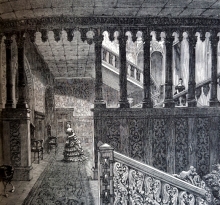
Recently, I have acquired a facsimile edition of “History and Antiquities of Kensington” by Thomas Faulkner, which was published originally in 1820. I have also my own copy of an original edition of Volume 5 of “Old and New London” by Edward Walford, published in 1878. Both books were published when Holland House was still intact, and both contain engravings showing how the house looked both outside and inside.  Faulkner’s book contains a lengthy detailed listing of all the artworks and books that the house contained. These items included several paintings by artists as famous as Teniers, Canaletto, Joshua Reynolds, and Hogarth, to name but a few. Luckily, most of the art treasures in the house were removed for safety before the outbreak of WW2.  The illustrations, some of which I have reproduced, demonstrate how great a tragedy it was that Holland House no longer remains intact.

The illustrations to this article can be viewed at: https://londonadam.travellerspoint.com/60/