A lady from England who saved a nation in the Balkans

MARY EDITH DURHAM (1863-1944), usually known as ‘Edith Durham’, who is well-known to many Albanians but little-known amongst British people, was a remarkable woman. Trained at Bedford College and the Royal College of Art, she was an accomplished artist, a prolific writer, a skilled anthropologist, and a formidable political lobbyist. On the evening of 14 March 2025, the Embassy of Kosovo in London hosted an event to celebrate the life and achievements of this lady, whose work was of great importance in the Balkans, especially in what is now Albania and Kosovo. It was organised by the Anglo Albanian Association led by its Chairman Stephen Nash and members of the association’s committee. Several speakers gave interesting talks about different aspects of Edith’s life. Between the speakers, the actress and presenter Joanna Lumley read short excerpts from some of the books written by Edith Durham.

In 1900, Edith’s medical advisor suggested that for the good of her health, she should take a break from her busy life in England. She travelled to Montenegro, and thus began her many years of arduous travelling around the Western Balkans, learning about the people who lived there, their traditions and ways of life, their problems, and the complex political situation in the region. The Oxford historian Noel Malcolm was the first speaker. Briefly and succinctly, he gave a comprehensive outline of the complex political situation prevailing in the Balkans when Edith worked there. In a nutshell, the region was the epicentre of the struggle to determine how the Balkan territory was to be divided up as the Ottoman Empire was suffering its death throes.  The translator (of Albanian novels including those of Ismail Kadare, who died in 2024) John Hodgson gave a fascinating talk about his first visits to Kosovo in the early 1980s when many country people were still living the way that they were when Edith Durham visited them before WW1, and then wrote about them in her books.

James Hickson, who is the grand nephew of Edith Durham, gave a fascinating talk about Edith’s family: her parents and her eight siblings, many of whom, like Edith, went on to do remarkable things. Edith was the oldest child, and after her father died, she was left to care for some of the family as well as continuing her work as a successful artist. It was the stress of this overworking that caused her to become so unwell that her doctor recommended she took the holiday, which led to her involvement with the Balkans and the Albanian people, in particular. Wherever she travelled in the Balkans, Edith was welcomed by local people. While staying with them, she observed their customs and all aspects of their daily lives. She was given and purchased many items (clothing, domestic tools, fabrics, and much more), which she brought back to England. Many of these precious mementoes of her trips are housed in two museums: one in the Bankfield Museum in Halifax (Yorkshire), and the other, the Horniman Museum in Forest Hill (London). Rachel Terry of the Bankfield and Peronel Craddock of the Horniman both spoke, and explained how their museums obtained the exhibits collected by Edith Durham, and what items their collections house. Hearing them has made me want to revisit the Horniman, and to pay a first visit to the Bankfield.

Elizabeth Gowing, who has written a very personal account of her ‘discovery’ of Edith Durham after she first visited Kosovo in 2006, also spoke (via a Zoom link from Prishtina) briefly about Edith and how she came across this extraordinary woman. Another speaker was David Oakley-Hill, whose father Dayrell R. Oakley-Hill (1898-1985) played a leading role in running the Gendarmerie of Albania during the reign of King Zog. He lived and worked in the country between 1929 and 1938. His son related that his father and Edith Durham communicated with each other. David is currently completing a book about another formidable English woman, who worked in Albania: Margaret Hasluck (1885-1948). Edith and Margaret wrote letters to each other, and David will be including some of them in his forthcoming book.

I wrote earlier that Edith is far from well-known in Britain. Brian Ferris, another speaker, is valiantly trying to remedy this situation by attempting to get a commemorative plaque attached to a house where Edith lived in London (36 Glenloch Road in Belsize Park). He related the frustrating difficulties that he is facing in trying to achieve this. I have discovered that she also lived, albeit briefly, at two other addresses around Belsize Park (see: https://historywiki.therai.org.uk/index.php?title=Mary_Edith_Durham).

Joanna Lumley read extracts from some of Edith’s books in between the various speakers’ presentations. Most of them came from “High Albania” (first published in 1909), which is, so far, one of the best books that has been written about Albania in English. Before reading the first extract of the evening, she explained that after her first brief visit to Albania, she fell in love with the country. With her readings and the excellent presentations by the various speakers, all introduced by Stephen Nash, the event hosted by His Excellency the Ambassador of Kosova, Ilir Kapiti, was both enjoyable and highly informative. It was a fine appreciation of the woman whose empathy with the Albanians, observations, and political lobbying saved what is now the country of Albania from being carved up by the countries around it and becoming incorporated into them.  

Two Albanian heroes

JUST AS THE ALBANIAN Skanderbeg (Gjergj Kastrioti: c1405-1468) heroically resisted the invasion of his country by the Ottomans in the 15th century, Khwaja Safar, also an Albanian, bravely led forces opposed to the Portuguese, who were attacking his adopted country India during the 16th century. Both were forcibly converted to Islam. One remained a Muslim, and the other returned to Christianity.

Khwaja Safar was a soldier; a merchant; the treasurer of Cairo; advisor to the Sultans of Egypt and Gujarat; and the Governor of the city of Surat. His parents were Albanian, yet he is remembered by a name which is not Albanian. You can discover why this is when reading my book about his extraordinarily fascinating life. “An Albanian in India” is available both as a paperback and a Kindle (eBook) from Amazon:

Three buildings of historic interest in London’s Endell Street

IN THE 1980s, there was a shop that sold a variety of products imported from Communist Albania, which was then ruled by the Stalinist dictator Enver Hoxha and, after 1985, by his successor Ramiz Alia. I visited it once or twice. Although it had a few items of interest, it was quite expensive. The shop, which had closed by 1990, was in Betterton Street, which leads from Drury Lane to Endell Street, which is not far from the Seven Dials.

Yesterday (20th of June 2024), we walked along a part of Endell Street and then into Betterton Street, on our way to the Garden Cinema (in Parker Street). We watched a completely weird, arthouse film called “Daisies”, which was made in Communist Czechoslovakia in 1966. Despite being awarded a Czech film prize in 1966, it was banned by the censors in 1967.

Returning to Endell Street, we spotted three buildings of interest. The first of these is on the southeast corner of Endell Street and Shorts Gardens. It bears a commemorative plaque that reads:

“Zepherina Veitch (1836 -1894) Dame Rosalind Paget (1855 – 1948) Pioneering midwives trained at the British Lying-in Hospital, founded 1739 and sited here, 1849 – 1913.”

The tall Victorian building, to which this plaque is attached, is red brick with white stone facings. Between 1849 and 1913, this place housed a hospital for married women in the last month of pregnancy. A website concerned with former hospitals (https://ezitis.myzen.co.uk/britishlyingin.html) related:

“The staff consisted of two physicians and two surgeons who practiced midwifery, a Matron skilled in the same, a chaplain, an apothecary, nurses and ‘other inferior servants’.  Women were admitted in the last month of their pregnancy – they were only permitted to stay for three weeks – and needed a letter of recommendation from a subscriber (patients were not charged by the Hospital) and an affidavit of their marriage and their husband’s settlement.”

Adjoining the former lying-in hospital, there is an edifice made with layers of bricks that vary in colour and white stone trimmings. It has Victorian gothic features, and its Endell Street facade bears an inscription, which reads:

“Lavers and Barraud Stained Glass Works”

This firm was founded in 1858 by Nathaniel Wood Lavers (1828–1911) and Francis Philip Barraud (1824–1900). When Barraud (of Huguenot descent) became dissatisfied with the firm’s designs, he was recommended to hire Nathaniel Westlake (1833-1921) as a designer. Westlake’s knowledge of mediaeval art and skills in the pre-Raphaelite style of art brought fame and fortune to the firm in the 1860s. In 1858. He became one of the firm’s partners, and in 1880, he became the firm’s sole owner.

A building on the corner of Betterton Street and Endell Street, across the road from the former stained glass works bears a plaque that informs the viewer that in this house, number 20 Endell Street, Westlake resided in the 1880s. His firm continued in business until his death.

So, today, neither the lying-in hospital nor the stained-glass works are still operating, and the Albanian shop has long gone. However, one place that would have been in business when those two places were functioning, is still in business: The Cross Keys Pub. Established in 1848, this pub has a baroque Victorian façade. The interior of this long narrow hostelry is most people’s idea of a real old-fashioned pub. A long bar with brass fittings runs along one side of the saloon, The walls are covered with numerous paintings and prints and several glass cases containing stuffed (taxidermy) fish. All manner of things, including a brass instrument and an archaic diver’s helmet, are suspended from the ceiling. Yet, despite this great amount of assorted ‘clutter’, the pub has a cosy atmosphere. When we dropped in for some mid-afternoon refreshment, there were a few other customers – mostly elderly local people. Although in the heart of the city, the pub has a rustic feeling about it. I suspect that workers and other staff from the stained-glass factory used to pop into the Cross Keys for liquid refreshment. But I wonder if many of those associated with the lying-in hospital -staff or patients – were patrons.

After dallying in Endell Street, we walked the short distance to the Garden Cinema in Parker Street to see the Czech film. If you have not been to this cinema, you are missing a treat – it is a truly independent, art-house cinema (see www.thegardencinema.co.uk).

A builder cast in metal in London’s Pimlico near the Albanian embassy

THE ALBANIAN EMBASSY is on St Georges Drive in London’s Pimlico. On our way there we passed a statue that stands on a triangular plot where St Georges Drive meets Denbigh Street at an acute angle. The statue commemorates Thomas Cubitt (1788-1855), who was born in Norfolk and died in Surrey. It was created in 1995 by William Fawke (1948-2018).

The metal sculpture depicts Cubitt standing on a platform facing a pile of building bricks. In his left hand, he holds a long, notched stick – a brick measure. The platform upon which he stands is supported by balustrade bottles (‘balusters’) that are used to support the railing that rests upon them. The bottles supporting Cubitt are the type found on the houses built by Cubitt.

Cubitt was the son of a carpenter. During his trip to India as a ship’s carpenter, Thomas earned sufficient money to be able to establish a building business in London’s Holborn. In cooperation with his younger brothers, William and Lewis (who designed Kings Cross station), his firm took off. He was an excellent organiser, and created teams of builders that included every branch of the trade. Some of his projects are listed in an interesting web page (https://victorianweb.org/art/architecture/cubitt/bio.html):

“By now he was a close friend of the royal family, having collaborated with Prince Albert on the design for Osborne House, which he then built for him. He also won the contract to extend Buckingham Palace, and it was Cubitt as well who orchestrated the dismantling of Nash’s Marble Arch there, and its reassembly at Hyde Park, ready for the Great Exhibition. The Exhibition itself was a project suggested to Prince Albert by Cubitt, after a conversation with a friend who had recently visited an exhibition in Paris. From 1839 Cubitt was an active member of the Institution of Civil Engineers; he was a leading figure in the campaigns for a main drainage system and a more extensive Thames Embankment, and rooted for limiting smoke emissions and conserving open space: Battersea Park owes its existence largely to him.”

In addition to this and other major projects, he built much of Tavistock Square and great swathes of housing in Pimlico. So, it is fitting that his statue has placed in the midst of the houses which his firm created in Pimlico. It was interesting to ‘discover’ the statue of Cubitt shortly before we entered the embassy which is housed in one of the houses he built in Pimlico.

Three informative, illustrated books about Albania and the Albanians

In the last few years, I have published 3 books about Albania and the Albanians:

ALBANIA ON MY MIND

This book describes Albania as I saw it when I made a trip there in 1984. Then, the country was being ruled by the isolationist, Stalinist dictator Enver Hoxha. The country was even more isolated from the rest of the world than is the case with North Korea today.

REDISCOVERING ALBANIA

This is a description of a visit I made to Albania in 2016. The book describes Albania as we found it then, and compares it with what I saw in 1984. It also contains descriptions of Albania made by other travellers at various times in the last 300 years.

FROM ALBANIA TO SICILY

This is one of the few books in English to describe the past and present of the Albanian-speaking people who migrated to Sicily in the 15th century to escape from the Ottoman armies that were invading the Balkans. It provides an in-depth study of the lives of this interesting group of people.

These three books are available as paperbacks and as Kindles from Amazon

A DRINK ENJOYED BY ATATURK IN ISTANBUL, AND DEVELOPED BY A MAN FROM PRIZREN IN OTTOMAN ALBANIA

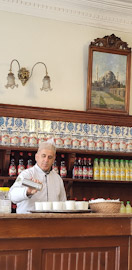
BOZA IS A TURKISH drink, popular both in Turkey and in the Balkans. It is made from fermented grains – such as millet and wheat. It originated in Central Asia. We tried some today. It was light yellow, had the consistency of custard, and tasted both sweet and slightly sour. It was also slightly fizzy (because of the fermentation). It was mixed with cinnamon powder and another customer told us that it is usually drunk with dried chickpea seeds.

We came across the boza shop – an old-fashioned place with tiling – in the Vefa district of Fatih in the European part of Istanbul. The shop is called “Vefa Bogacisi” and it was founded by Haci Sadik Bey.

Haci Sadik Bey came from Prizren in Ottoman Albania (now in Kosova) in 1870. He noticed that the boza then sold in Istanbul (by numerous sellers) was fairly runny, dark in colour, and sour. He developed a new version of it, which was lighter in colour, and as already described in my first paragraph.

At first, like other vendors of boza, he sold it on street corners. Eventually, his customers encouraged him to open a shop in the then upmarket district of Vefa. This he did in 1876. It was in this shop, which we encountered quite by chance, that we sampled boza. The business is still run by the same family – the fourth generation since Haci Sadik Bey opened his shop. Opposite this shop, there is another, which sells the chickpeas (‘leblebicisi’).

Finally, although Haci Sadik Bey (died1933) and his brother Ibrahim (died 1944) came to Istanbul (during the Turco-Russian War), I have not yet discovered whether or not they had Albanian heritage.

Within the shop, locked in a glass case, there is a glass drinking vessel from which the father of Modern Turkey Mustafa Kemal Atatürk (1881-1938) drank boza on Monday the 4th of January 1937. It was good to know that we tried boza in the same place as that great man.

An Albanian conductor and a wonderful orchestral performance

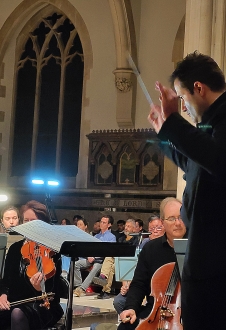
ONCE AGAIN, OLSI QINAMI has conducted the London City Philharmonic Orchestra superbly. Last night (the 28th of October 2023), they performed Rachmaninov’s Piano Concerto number 2 and Stravinsky’s “The Rite of Spring” in the Victorian gothic St James church at the Lancaster Gate end of Sussex Gardens.

Olsi Qinami was born in Albania. At the age of six, he began studying the piano. Then, he studied in Tirana’s Lycée Artistique “Jordan Misja”. Later, he studied at London’s Royal College of Music and also at both the Royal Birmingham Conservatoire and the Ecole Normale de Musique de Paris. A website with his biography (www.olsiqinami.com) noted:

“Olsi continued his studies with Paavo Jarvi at the “Jarvi Conducting Academy”, Riccardo Muti at the “Riccardo Muti Opera Academy” with Orchestra Giovanile Luigi Cherubini, “Orkney Advanced Conducting Course” with Alexander Vedernikov & Charles Peebles and “the Royal Northern College of Music Advanced Conducting Masterclasses” with Mark Heron. He also studied with, Jorma Panula, Michalis Economou, Marco Guidarini, Stefano Ranzani, Alexander Vedernikov, Daniele Rossina, Roland Çene, Petrika Afezolli, Bujar Llapaj, Howard Williams, Neil Thomson and others.”

This impressive education has certainly paid off, as we experienced last night at the concert.

Both works were played superbly. The piano soloist Angela Szu-Hsuan Wu played what seemed like a technically challenging piece by Rachmaninov with great verve and skill, and deserved the tumultuous applause that followed the performance. After a short interval, the orchestra increased in size, getting ready to tackle “The Rite of Spring”. Olsi mounted the conductor’s stand to face an enormous orchestra. Before commencing the performance, he said a few words about the many challenges that Stravinsky’s work poses the orchestra playing it. For example, he explained that within the approximately 40 minutes that the “Rite” takes to perform, there are well over 400 changes of time signature (measures of rhythm). Then, he asked a horn player to play various versions of a tune that Stravinsky had composed in various versions of his work. After that, the orchestra performed the great work. It was an exhilarating performance. Under Olsi’s direction, the orchestra had the audience spellbound. In such a complex piece of music, so much could have gone wrong, but in Olsi’s hands nothing did.

Listening to music played ‘live’ is so much more satisfying than even the best quality recorded music. The three-dimensional spatial appreciation of the sound in a concert hall, or in the case of last night, in a church, can barely be reproduced with the best of hi-fi equipment. As with live theatre, when attending live music, the audience is somehow intimately engaged with the energy and enthusiasm of the players. After a great performance, such as last night’s concert, I am left feeling both exhausted and exhilarated. Last night’s concert performed by the London City Philharmonic orchestra with Olsi Qinami was no exception to this. If you have not yet experienced Olsi conducting, then it is high time that you get to one of his concerts.

Mud sweeter than honey: Albania under Enver Hoxha

IN MAY 1984, I visited Albania, which was then still under the rule of its Stalinist dictator Enver Hoxha (1908-1985). The year before, I had spent a fortnight in Bulgaria. My impression was that Bulgaria was much less vibrant than Albania. In Albania, which had to be visited in an organised group tour, we were treated well, shown a great deal, and were fed well. I knew that by 1984, Albania was far more sealed off from the rest of the world than North Korea is today. Several things were curious about our visit. First, we were not allowed to converse with any Albanians apart from our three official guides or ‘minders’, and other Albanians were unable to converse with, or even approach, us. Secondly, we were watched carefully, even followed by plainclothes agents. Thirdly, and most strangely, whenever we ate a meal, we were kept out of sight of Albanian onlookers. Either we dined in a private room, or our tables were surrounded by curtains or screens, which separated us from other diners and staff in hotels or restaurants.

Our Albanian hosts successfully showed us some of their country’s beautiful towns, countryside, and other attractions. Their aim was to show us westerners what an ideal country Enver Hoxha and his regime had created. And to some extent, I was fooled by what I saw. Many years later, I visited the country (in 2016), and met people who told me that what I had seen was carefully stage managed – a sort of Potemkin village on a grand scale. One person told me that three days before visitors (foreign or state officials) visited the village to which he had been exiled, the town would be cleaned up, the usually empty shops would be stocked, and other things would be arranged to give the place the appearance of prosperity. And as soon as the visitors had passed through, everything would be returned to its normal depressing condition.

After returning from my second trip to Albania, I read a biography of Enver Hoxha written by Blendi Fevziu, and published in 2016. In it, I discovered something that really shocked me. He wrote that by 1984, when I was being wined and dined royally by our Albanian hosts, most Albanians were starving because of a man-made famine that had begun a couple of years earlier. It was no wonder that whenever we ate, we and our food was kept out of sight of all but the most trusted waiters and staff.  

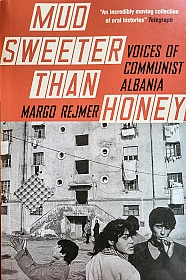
Even when I was in Albania in 1984, I was aware that Hoxha’s regime, like many others run by dictators, was home to prison camps for those who were alleged to have upset the dictator and his paranoid security services. As Margo Rejmer shows in her excellent book “Mud Sweeter Than Honey”, it did not take much to land up in one of Hoxha’s hellish prison camps, and many people suffered this fate.

Rejmer interviewed many people who had lived during Hoxha’s long reign. She successfully demonstrated that every Albanian from the humblest peasant to the highest state official lived in a constant state of fear. Up to one in three people were employed as informers for Hoxha’s secret police – the Sigurimi. It was even dangerous to express one’s thoughts to close members of one’s family. The paranoid dictator ruled, as did Stalin, by endlessly imprisoning or killing anyone that could even slightly be considered a threat to him. Rejmer’s book illustrates this very well and also describes the unbelievable cruelty that prisoners had to suffer in the camps, where they were made to do unpleasant unpaid work, especially in mines.

I am very glad that Rejmer’s book had not yet been written in 1984, because had I read it then, I am certain I would never have set foot in Albania. It is a highly readable, compelling book about the horrific era during which most Albanians had to suffer. My only criticism of it is that she tends to concentrate on people who suffered badly under the regime. However, I suppose it was difficult for her to find anyone who honestly thought that Hoxha had created the paradise, the existence of which our tour guides hoped to persuade us in 1984.

PS My memories of the 1984 visit to Albania are recorded in my book “Albania on My Mind” (https://www.amazon.co.uk/Albania-My-Mind-Adam-Yamey/dp/1291111476/)

An out of date passport and a different world

OFTEN WHEN ONE IS SEARCHING for something, something, which you were not looking for, comes to light. A day or so ago, one of my old passports was discovered. It is an old-fashioned, blue-covered book with barely a trace of the wording and crest that used to be on the cover. I used to carry my passport in a trouser pocket, which rubbed against it and gradually denuded the cover. The ten-year document expired on the 19th of March 1990. This was a couple of months before I made my last trip to what was still known as ‘Yugoslavia’. Soon after that, civil wars erupted, and the country became divided into smaller independent units.

The passport gives my height but not my eye colour, which used to be recorded in earlier passports. It contains eight Hungarian visa stamps (one is illustrated above), all issued in London except for one which was affixed in Belgrade. There is also a Bulgarian visa stamp, which was issued in March 1983. In addition to these visa stamps, for which I was charged roughly $10 each, there are many border stamps – entry and exit. Most of these are for Hungary and Yugoslavia, which I visited frequently throughout the 1980s. In those days, Brits did not need a visa to enter Yugoslavia.

One of the border stamps is of special interest. It was issued when I entered Yugoslavia at Bozaj on the 5th of June 1984. Bozaj, now in the Republic of Montenegro, was a Yugoslav border post on the shore of Lake Shkodra. The stamp was placed in my passport a few minutes after leaving the Albanian border post, also beside the lake, at Han-i-Hotit. It was here that an Albanian entry stamp was put in my passport two weeks earlier when I visited the country, which was then even far more mysterious than North Korea is to us today. In 1984, the Stalinist regime headed by Enver Hoxha was still in place. The two weeks spent in Albania were both fascinating and unusual to say the least. I have described that holiday in my book “Albania on My Mind.”

In addition to the visas and stamps issued by socialist countries, there is one Greek entry and one exit stamp, both issued at Athens airport in August 1981. It seems that I was in Greece from the 11th to the 17th. Another stamp issued on the 13th by the Piraeus branch of the National Bank of Greece takes up most of one page and has something to do with money and traveller’s cheques, but my Greek is not up to translating it.

The accidental finding of this old passport brings back many happy memories of travelling in parts of Europe that have now changed beyond recognition – for better or for worse.                                                                                                 

All wrapped up

TODAY, WE SENT some books from Kolkata to Bengaluru (Bangalore) to lighten our luggage because domestic flights in India restrict the amount of baggage one can carry. The process reminded me of sending books from other countries.

I used to visit Yugoslavia a lot when it still existed. One one occasion, I wanted to send some heavy books from Belgrade to London. I went to a large centrally located post office. Within the building there was a counter for wrapping parcels. For book post, the books had to be wrapped a certain way. They had to be packed so that a part of each book was left uncovered. This was so that the customs and postal people could see that it was books that were being dispatched.

In 1984, I visited Yugoslavia’s neighbour Albania, which was then under the strict Stalinist dictatorship headed by Enver Hoxha. We had to travel through Yugoslavia to reach and leave Albania. I had read that books from Albania would be confiscated by the Yugoslav customs, and that it was best to post any books bought in Albania back to the UK. In anticipation of this and following the advice that parcel wrapping materials were not available in Albania, I brought brown wrapping paper, adhesive tape, and string from home.

I bought several books in Albania and wrapped them up with the materials I had brought from England. Along with a fellow traveller, an Australian post office official, I took the parcels to a post office in central Tirana. The parcels were weighed by a person at a counter, and he handed me the right amount of stamps for each package. After affixing the stamps, I handed the parcels to the Albanian post office worker. He examined them, then tore off one of the stamps before rapidly reapplying it. I had inadvertently stuck on the stamp upside down. As he restuck the stamp, which bore an image of Albania’s fictator, he said “Enver Hoxha “. Apparently, sticking him upside down was considerable disrespectful. My Australian companion was horrified. He exclaimed:
“Removing postage stamps from mail is against international postal regulations. He shouldn’t have done that.”

Today, in Kolkata, we took our books to a post office in Park Street. Pn ots steps, there are several men who wrap and label parcels to be posted. One of them took our books, wrapped them in cloth bags, and then in a strong plastic sheet, which he carefully sewed up with a beedle and thick thread. This was then wrapped in another layer of plastic, sealed with tape. Upon this he wrote the address to which it was being sent, and our address in Kolkata. Then the whole thing was wrapped in tough transparent plastic to protect the parcel from adverse weather conditions. After this, he carried to parcel to the correct counter, where we paid the postage: about £2.75 for 8 kilograms. The wrapper’s charge was less than £1.

The books I sent from Yugoslavia and Albania arrived safely. So have other parcels I have sent by post from one Indian city to another. So, I am reasonably optimistic that our 8 Kg packet will arrive ‘in good nick’.