In the last few years, I have published 3 books about Albania and the Albanians:
ALBANIA ON MY MIND
This book describes Albania as I saw it when I made a trip there in 1984. Then, the country was being ruled by the isolationist, Stalinist dictator Enver Hoxha. The country was even more isolated from the rest of the world than is the case with North Korea today.
REDISCOVERING ALBANIA
This is a description of a visit I made to Albania in 2016. The book describes Albania as we found it then, and compares it with what I saw in 1984. It also contains descriptions of Albania made by other travellers at various times in the last 300 years.
FROM ALBANIA TO SICILY
This is one of the few books in English to describe the past and present of the Albanian-speaking people who migrated to Sicily in the 15th century to escape from the Ottoman armies that were invading the Balkans. It provides an in-depth study of the lives of this interesting group of people.
These three books are available as paperbacks and as Kindles from Amazon
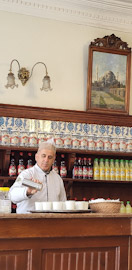
BOZA IS A TURKISH drink, popular both in Turkey and in the Balkans. It is made from fermented grains – such as millet and wheat. It originated in Central Asia. We tried some today. It was light yellow, had the consistency of custard, and tasted both sweet and slightly sour. It was also slightly fizzy (because of the fermentation). It was mixed with cinnamon powder and another customer told us that it is usually drunk with dried chickpea seeds.
We came across the boza shop – an old-fashioned place with tiling – in the Vefa district of Fatih in the European part of Istanbul. The shop is called “Vefa Bogacisi” and it was founded by Haci Sadik Bey.
Haci Sadik Bey came from Prizren in Ottoman Albania (now in Kosova) in 1870. He noticed that the boza then sold in Istanbul (by numerous sellers) was fairly runny, dark in colour, and sour. He developed a new version of it, which was lighter in colour, and as already described in my first paragraph.
At first, like other vendors of boza, he sold it on street corners. Eventually, his customers encouraged him to open a shop in the then upmarket district of Vefa. This he did in 1876. It was in this shop, which we encountered quite by chance, that we sampled boza. The business is still run by the same family – the fourth generation since Haci Sadik Bey opened his shop. Opposite this shop, there is another, which sells the chickpeas (‘leblebicisi’).
Finally, although Haci Sadik Bey (died1933) and his brother Ibrahim (died 1944) came to Istanbul (during the Turco-Russian War), I have not yet discovered whether or not they had Albanian heritage.
Within the shop, locked in a glass case, there is a glass drinking vessel from which the father of Modern Turkey Mustafa Kemal Atatürk (1881-1938) drank boza on Monday the 4th of January 1937. It was good to know that we tried boza in the same place as that great man.
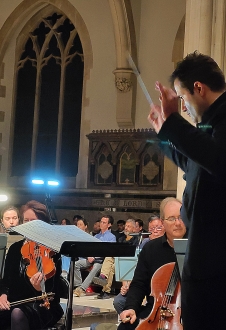
ONCE AGAIN, OLSI QINAMI has conducted the London City Philharmonic Orchestra superbly. Last night (the 28th of October 2023), they performed Rachmaninov’s Piano Concerto number 2 and Stravinsky’s “The Rite of Spring” in the Victorian gothic St James church at the Lancaster Gate end of Sussex Gardens.
Olsi Qinami was born in Albania. At the age of six, he began studying the piano. Then, he studied in Tirana’s Lycée Artistique “Jordan Misja”. Later, he studied at London’s Royal College of Music and also at both the Royal Birmingham Conservatoire and the Ecole Normale de Musique de Paris. A website with his biography (www.olsiqinami.com) noted:
“Olsi continued his studies with Paavo Jarvi at the “Jarvi Conducting Academy”, Riccardo Muti at the “Riccardo Muti Opera Academy” with Orchestra Giovanile Luigi Cherubini, “Orkney Advanced Conducting Course” with Alexander Vedernikov & Charles Peebles and “the Royal Northern College of Music Advanced Conducting Masterclasses” with Mark Heron. He also studied with, Jorma Panula, Michalis Economou, Marco Guidarini, Stefano Ranzani, Alexander Vedernikov, Daniele Rossina, Roland Çene, Petrika Afezolli, Bujar Llapaj, Howard Williams, Neil Thomson and others.”
This impressive education has certainly paid off, as we experienced last night at the concert.
Both works were played superbly. The piano soloist Angela Szu-Hsuan Wu played what seemed like a technically challenging piece by Rachmaninov with great verve and skill, and deserved the tumultuous applause that followed the performance. After a short interval, the orchestra increased in size, getting ready to tackle “The Rite of Spring”. Olsi mounted the conductor’s stand to face an enormous orchestra. Before commencing the performance, he said a few words about the many challenges that Stravinsky’s work poses the orchestra playing it. For example, he explained that within the approximately 40 minutes that the “Rite” takes to perform, there are well over 400 changes of time signature (measures of rhythm). Then, he asked a horn player to play various versions of a tune that Stravinsky had composed in various versions of his work. After that, the orchestra performed the great work. It was an exhilarating performance. Under Olsi’s direction, the orchestra had the audience spellbound. In such a complex piece of music, so much could have gone wrong, but in Olsi’s hands nothing did.
Listening to music played ‘live’ is so much more satisfying than even the best quality recorded music. The three-dimensional spatial appreciation of the sound in a concert hall, or in the case of last night, in a church, can barely be reproduced with the best of hi-fi equipment. As with live theatre, when attending live music, the audience is somehow intimately engaged with the energy and enthusiasm of the players. After a great performance, such as last night’s concert, I am left feeling both exhausted and exhilarated. Last night’s concert performed by the London City Philharmonic orchestra with Olsi Qinami was no exception to this. If you have not yet experienced Olsi conducting, then it is high time that you get to one of his concerts.
IN MAY 1984, I visited Albania, which was then still under the rule of its Stalinist dictator Enver Hoxha (1908-1985). The year before, I had spent a fortnight in Bulgaria. My impression was that Bulgaria was much less vibrant than Albania. In Albania, which had to be visited in an organised group tour, we were treated well, shown a great deal, and were fed well. I knew that by 1984, Albania was far more sealed off from the rest of the world than North Korea is today. Several things were curious about our visit. First, we were not allowed to converse with any Albanians apart from our three official guides or ‘minders’, and other Albanians were unable to converse with, or even approach, us. Secondly, we were watched carefully, even followed by plainclothes agents. Thirdly, and most strangely, whenever we ate a meal, we were kept out of sight of Albanian onlookers. Either we dined in a private room, or our tables were surrounded by curtains or screens, which separated us from other diners and staff in hotels or restaurants.
Our Albanian hosts successfully showed us some of their country’s beautiful towns, countryside, and other attractions. Their aim was to show us westerners what an ideal country Enver Hoxha and his regime had created. And to some extent, I was fooled by what I saw. Many years later, I visited the country (in 2016), and met people who told me that what I had seen was carefully stage managed – a sort of Potemkin village on a grand scale. One person told me that three days before visitors (foreign or state officials) visited the village to which he had been exiled, the town would be cleaned up, the usually empty shops would be stocked, and other things would be arranged to give the place the appearance of prosperity. And as soon as the visitors had passed through, everything would be returned to its normal depressing condition.
After returning from my second trip to Albania, I read a biography of Enver Hoxha written by Blendi Fevziu, and published in 2016. In it, I discovered something that really shocked me. He wrote that by 1984, when I was being wined and dined royally by our Albanian hosts, most Albanians were starving because of a man-made famine that had begun a couple of years earlier. It was no wonder that whenever we ate, we and our food was kept out of sight of all but the most trusted waiters and staff.
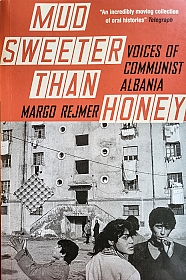
Even when I was in Albania in 1984, I was aware that Hoxha’s regime, like many others run by dictators, was home to prison camps for those who were alleged to have upset the dictator and his paranoid security services. As Margo Rejmer shows in her excellent book “Mud Sweeter Than Honey”, it did not take much to land up in one of Hoxha’s hellish prison camps, and many people suffered this fate.
Rejmer interviewed many people who had lived during Hoxha’s long reign. She successfully demonstrated that every Albanian from the humblest peasant to the highest state official lived in a constant state of fear. Up to one in three people were employed as informers for Hoxha’s secret police – the Sigurimi. It was even dangerous to express one’s thoughts to close members of one’s family. The paranoid dictator ruled, as did Stalin, by endlessly imprisoning or killing anyone that could even slightly be considered a threat to him. Rejmer’s book illustrates this very well and also describes the unbelievable cruelty that prisoners had to suffer in the camps, where they were made to do unpleasant unpaid work, especially in mines.
I am very glad that Rejmer’s book had not yet been written in 1984, because had I read it then, I am certain I would never have set foot in Albania. It is a highly readable, compelling book about the horrific era during which most Albanians had to suffer. My only criticism of it is that she tends to concentrate on people who suffered badly under the regime. However, I suppose it was difficult for her to find anyone who honestly thought that Hoxha had created the paradise, the existence of which our tour guides hoped to persuade us in 1984.
OFTEN WHEN ONE IS SEARCHING for something, something, which you were not looking for, comes to light. A day or so ago, one of my old passports was discovered. It is an old-fashioned, blue-covered book with barely a trace of the wording and crest that used to be on the cover. I used to carry my passport in a trouser pocket, which rubbed against it and gradually denuded the cover. The ten-year document expired on the 19th of March 1990. This was a couple of months before I made my last trip to what was still known as ‘Yugoslavia’. Soon after that, civil wars erupted, and the country became divided into smaller independent units.
The passport gives my height but not my eye colour, which used to be recorded in earlier passports. It contains eight Hungarian visa stamps (one is illustrated above), all issued in London except for one which was affixed in Belgrade. There is also a Bulgarian visa stamp, which was issued in March 1983. In addition to these visa stamps, for which I was charged roughly $10 each, there are many border stamps – entry and exit. Most of these are for Hungary and Yugoslavia, which I visited frequently throughout the 1980s. In those days, Brits did not need a visa to enter Yugoslavia.
One of the border stamps is of special interest. It was issued when I entered Yugoslavia at Bozaj on the 5th of June 1984. Bozaj, now in the Republic of Montenegro, was a Yugoslav border post on the shore of Lake Shkodra. The stamp was placed in my passport a few minutes after leaving the Albanian border post, also beside the lake, at Han-i-Hotit. It was here that an Albanian entry stamp was put in my passport two weeks earlier when I visited the country, which was then even far more mysterious than North Korea is to us today. In 1984, the Stalinist regime headed by Enver Hoxha was still in place. The two weeks spent in Albania were both fascinating and unusual to say the least. I have described that holiday in my book “Albania on My Mind.”
In addition to the visas and stamps issued by socialist countries, there is one Greek entry and one exit stamp, both issued at Athens airport in August 1981. It seems that I was in Greece from the 11th to the 17th. Another stamp issued on the 13th by the Piraeus branch of the National Bank of Greece takes up most of one page and has something to do with money and traveller’s cheques, but my Greek is not up to translating it.
The accidental finding of this old passport brings back many happy memories of travelling in parts of Europe that have now changed beyond recognition – for better or for worse.
TODAY, WE SENT some books from Kolkata to Bengaluru (Bangalore) to lighten our luggage because domestic flights in India restrict the amount of baggage one can carry. The process reminded me of sending books from other countries.
I used to visit Yugoslavia a lot when it still existed. One one occasion, I wanted to send some heavy books from Belgrade to London. I went to a large centrally located post office. Within the building there was a counter for wrapping parcels. For book post, the books had to be wrapped a certain way. They had to be packed so that a part of each book was left uncovered. This was so that the customs and postal people could see that it was books that were being dispatched.
In 1984, I visited Yugoslavia’s neighbour Albania, which was then under the strict Stalinist dictatorship headed by Enver Hoxha. We had to travel through Yugoslavia to reach and leave Albania. I had read that books from Albania would be confiscated by the Yugoslav customs, and that it was best to post any books bought in Albania back to the UK. In anticipation of this and following the advice that parcel wrapping materials were not available in Albania, I brought brown wrapping paper, adhesive tape, and string from home.
I bought several books in Albania and wrapped them up with the materials I had brought from England. Along with a fellow traveller, an Australian post office official, I took the parcels to a post office in central Tirana. The parcels were weighed by a person at a counter, and he handed me the right amount of stamps for each package. After affixing the stamps, I handed the parcels to the Albanian post office worker. He examined them, then tore off one of the stamps before rapidly reapplying it. I had inadvertently stuck on the stamp upside down. As he restuck the stamp, which bore an image of Albania’s fictator, he said “Enver Hoxha “. Apparently, sticking him upside down was considerable disrespectful. My Australian companion was horrified. He exclaimed: “Removing postage stamps from mail is against international postal regulations. He shouldn’t have done that.”
Today, in Kolkata, we took our books to a post office in Park Street. Pn ots steps, there are several men who wrap and label parcels to be posted. One of them took our books, wrapped them in cloth bags, and then in a strong plastic sheet, which he carefully sewed up with a beedle and thick thread. This was then wrapped in another layer of plastic, sealed with tape. Upon this he wrote the address to which it was being sent, and our address in Kolkata. Then the whole thing was wrapped in tough transparent plastic to protect the parcel from adverse weather conditions. After this, he carried to parcel to the correct counter, where we paid the postage: about £2.75 for 8 kilograms. The wrapper’s charge was less than £1.
The books I sent from Yugoslavia and Albania arrived safely. So have other parcels I have sent by post from one Indian city to another. So, I am reasonably optimistic that our 8 Kg packet will arrive ‘in good nick’.
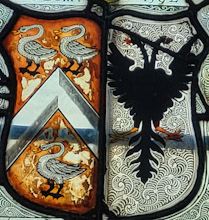
THE GREAT HALL of Lytes Cary Manor House in Somerset has some stained glass windows decorated with crests relating to the Lyte family, who owned the property between the 15th and 18th centuries. One of the crests caught my eye because the crest contains a double-headed eagle. This is a symbol that began to interest me in my teens when I first became fascinated by the Balkans. The double-headed eagle figures on the flags of Albania and some of its neighbours. The earliest known use of this peculiar creature is on seals used to secure goods in Babylon during the 3rd century BC.
The crest at Lytes Cary Manor is a combination of the Lyte family crest and that of the Worth family, which incorporates the two headed bird.
In 1592, Thomas Lyte (c1568-1638) married Frances Worth (1580-1615) who was born in Charlton Mackrell in Somerset. Thus, the double-headed eagle of the Worth family became joined with the three swans of the Lyte family crest. This marriage which was celebrated so long ago, is recorded in glass on a window of the Great Hall at Lytes Cary.
Why the Worths employed the double-headed eagle on their crest is something I would like to know, and will investigate. The double-headed eagle appears on British crests less frequently than other heraldic creatures. Possibly, andI am only guessing, it relates to the fact that a son of King John, Richard, Duke of Cornwall (1209-1272) was appointed King of The Germans, that was a senior position in the Holy Roman Empire. The symbol of that empire was the double-headed eagle.
THE ITALIAN WORD ‘scuola’ (plural: scuole) does not always mean ‘school’ (i.e., an educational establishment). In Venice, there are several scuole, which were never schools, but confraternities (or guilds). Well-known examples of these include the Scuola Grande di San Rocco, which contains many fine paintings by Tintoretto (1518-1594), and the Scuola Dalmata dei Santi Giorgio e Trifone, which contains a superb set of paintings by Carpaccio (1465-1525). The latter, also known as the Scuola di San Giorgio degli Schiavoni, was founded by Slavs (‘schiavoni’ in Italian) from Dalmatia (now mainly Croatia).
Another group of migrants from the Balkans, Christian (mostly Catholic) Albanians, began arriving in Venice in the early 15th century, both as traders and refugees from the Ottomans. In 1442, the Albanian community in Venice established its own confraternity, the Scuola di Santa Maria degli Albanesi. The building that housed it from the end of the 15th century still stands on a narrow passageway, the Calle dello Spezier, connecting Campo San Stefano and Campo San Maurizio. During our annual family holidays in Venice in the late 1950s and throughout the 1960s, we often passed along the passageway whilst walking from the Academia Bridge to Saint Mark’s Square. After my interest in Albania was first kindled in about 1967, I learnt about the Albanian scuola and always felt excited when we walked past its façade decorated with bas-relief stone carvings.
Three of the sculptures, which are affixed above the ground floor windows, depict two saints (Gallo and Mauritius) with the Mother and Child between them. Above them and located between the two second floor windows there is a larger bas-relief. It portrays a scene with two men in turbans standing on a rock facing a high hill on top of which there is a building with two heraldic crests. One of the men is brandishing a curved sword. This scene is a representation of the great Siege of Shkodër (1478-79). The city was then a Venetian possession. One of the men with a turban is a depiction of Mehmed II. The shields on the building and on the top corners of the sculpture were those of the Loredan and Da Lezze families, who were heroes of the siege.
The Albanian community in Venice was quite important during the period of the Venetian Republic, which ended in 1797. Several years ago, I met the Kosovan scholar and diplomat Bejtullah Destani, who told me that the city’s archives contain many documents charting the activities of the Albanians in Venice, and they have yet to be examined in detail.
Like the Scuola Dalmata, the Scuola degli Albanesi was decorated with a series of paintings by Carpaccio. In 1780, the Albanian scuola was closed. Its building became home to a bakers’ confraternity. 28 years later, when Venice was under Napoleonic rule, the other scuole were all suppressed. The Carpaccio paintings have long since been removed from the Albanian scuola, and can be found in museums in Venice, Milan, and Bergamo.
To get some idea of how splendid the Scuola degli Albanesi must have been in its heyday, a visit to the wonderful Scuola Dalmata should do the trick. Even if you have minimal interest in either Albania or Dalmatia, the paintings by Carpaccio make a good reason to visit Venice.
AFTER WW2 MANY thousands of concrete bunkers were built all over Albania because the country’s paranoid and brutal dictator Enver Hoxha, who ruled between 1944 and 1985, was concerned that the country would be invaded by its neighbours or others further afield. The invasion never happened. Likewise, the much-feared invasion of the UK during WW2 never occurred (except for the Channel Islands). However, in anticipation of a feared German invasion of the UK, the country, like Albania, was covered with concrete fortifications in many shapes and sizes. During a recent visit to Sidmouth in Devon, I spotted one of these, a small concrete ‘pill box’.
Located high on a cliff (overlooking Jacob’s Ladder Beach) next to Sidmouth’s Connaught Gardens, this small bunker was probably constructed as part of a coastal defence system in 1940-41. Later in WW2 when the risk of a German invasion was getting smaller, it was used during the training exercises that were performed prior to the Allied invasion of Normandy in early June 1940. It was from the south Devon coast that the invasion force set out for France.
Designed to resist destruction, bunkers such as the small one I saw in Sidmouth (and the multitude of mostly hemispherical bunkers I have seen in Albania), they are both difficult and expensive to remove when they are no longer needed. Interestingly, these concrete defences are no guarantee against successful invasion, as can be seen from the ineffectiveness of the Maginot Line in eastern France and the huge structures built by the Germans on the Atlantic coast of that country.
BETWEEN LANCASTER GATE and Queensway, at the corner of Bayswater Road and Leinster Terrace, there stands number 100 Bayswater Road, which was built in 1820 and was the home of the author JM Barrie (1860-1937) from 1900 onwards. It was here close to Hyde Park that he wrote “Peter Pan” as a play in 1904 and as a novel in 1911. It is worth wandering along Leinster Terrace and its continuation Leinster Gardens.
Almost opposite Barrie’s home but a little north of it is number 74 Leinster Terrace. It was here that the American author Francis Bret Harte (1836-1902) lived and died. He had settled in London in 1885. Northwest of this house and on the south corner of the Terrace and a passageway called Craven Hill Gardens, there is a Greek restaurant that has long intrigued me. It is called Mykonos and has the Swedish words “Kalle på Spången” written on it in several prominent places. This is the name of a well-known Swedish film made in 1939, in which a character called Kalle owns and runs a pub. Formerly called Zorba’s, it was closed in 2017 because of hygiene problems. Now (2022) called Mykonos, it looks as if it is no longer in business. It also bears a sign with the name of a Swedish County, Skåne, in which the inn that figures in the film was located. Unless it was to attract Swedish tourists, I am not clear why this Greek restaurant associated itself with a Swedish film. North of the restaurant, Leinster Terrace becomes Leinster Gardens.
Real windows on the left and fake windows on the right
Much of the west side of Leinster Gardens is lined by Victorian terraced housing with neo-classical features. Close examination of numbers 23 and 24 reveals that unlike their neighbours on either side, the windows do not have glass panes. Where the windowpanes should be, there are painted blanks. These two houses in the terrace were demolished when the subterranean London Underground lines were being built in the 1860s. The façades of numbers 23 and 24 have no building behind them. They hide a ventilation shaft that provides air to a section of the Circle and District lines running between Bayswater and Paddington stations. By walking along Craven Hill Gardens west to Porchester Terrace, which runs parallel to Leinster Gardens, you can see the featureless rear of the fake façade and beneath it you can just about see the tracks of the railway.
Moving north along Porchester Terrace, you can see number 30, which is adorned with a sculpted lion and some lion heads. It was here that the family of the author Wilkie Collins (1824-1889) moved from Hampstead in 1830, when he was six years old. Collins’s father, William Collins (1788-1847) was a painter, whose paintings at one time exceeded those of John Constable in value. Another artist, John Linell (1792-1882), a friend of William, lived a few doors north of this at number 36 from 1830 until 1851. Many years later, this house was occupied by the photographer Camille Silvy (1834-1910) between 1859 until 1868.
Not far away from Porchester Terrace and close to Queensway, a sculpted bust of a man in a distinctive helmet stands on a plinth at the corner of Inverness Terrace and Porchester Gardens. This depicts Albania’s most highly regarded hero George Kastrioti Skanderbeg (1405-1468), who defended his native Albanian territory from the invading Ottoman armies for a few years.
Between Peter Pan’s birthplace and the monument to Albania’s national hero is a few feet more than one third of a mile on foot. Yet in this short distance, there is much to see. This is what makes London such a fascinating place in which to live.