What is the opposite of ‘selfie’?
Is it ‘selfless’?
Or just: ‘photo’?

Photo by Lisa Fotios on Pexels.com

What is the opposite of ‘selfie’?
Is it ‘selfless’?
Or just: ‘photo’?
Photo by Lisa Fotios on Pexels.com

I was reminded of what follows, a true story, after seeing an excellent photograph (reproduced above). The photographer Ajay Ghatage (from Bangalore) has kindly allowed me to use this photo.
Until I first visited India in 1994, I had never seen a monkey except in a zoo. Even in the hearts of big cities in India, these creatures are as successful as other city fauna such as pigeons, wild dogs, and birds of prey. I never cease to be fascinated by the monkeys’ antics, but I do recognise their nuisance value.
Kitchen windows need to be protected to stop monkeys from entering. At least once I walked into the family kitchen and startled a monkey, which was about to leap out of the window clasping a bunch of bananas.
Once my wife’s family decided that it would be fun to go on an outing to the Big Banyan, a few miles outside Bangalore. The Big Banyan is at least 400 years old and lives up to its name – it is a vast rambling tree that spreads its branches and aerial roots over a huge area. It is a popular picnic place, but, having visited it, I fail to see why. We found a clearing within the area covered by the tree, and then laid out a blanket for a picnic. Before we could sit down, many monkeys appeared. One of them began tugging at the blanket, and others looked greedily at our picnic baskets. The situation became so menacing that we abandoned the idea of a picnic and retired to eat in the car.
Many years later, my wife, our daughter, and I visited Badami in northern Karnataka. This place is famed for its fabulous Hindu, Jain, and Buddhist temples, some of which were carved in the living rock by the Chalukya dynasty in the 5th to 8th centuries AD. The area was infested with monkeys on the look-out for almost anything they could get hold of.
Some of the ancient temples are located next to a ‘tank’ or lake. While we were looking at these, our daughter wanted to take a photo. So, my wife held her bag. Suddenly, I heard my wife making loud growling sounds. She was tugging our daughter’s bag while a monkey was trying to pull it away from her. The monkey was strong, but my wife’s growls scared it into releasing the bag.
A short while later, we sat down to have soft drinks under some trees. Our daughter ordered a virulently coloured orange carbonated drink. It was not one we would have recommended, but it appealed to our daughter. After the bag incident, we had warned her not to let go of anything, but she forgot momentarily. She put the opened bottle of drink beside her on the bench. Before she could say “monkey”, the bottle had disappeared. We looked up into one of the trees, and saw a monkey putting the bottle to its lips.
A few seconds later the monkey turned the bottle upside down, and then poured its contents down through the branches. Clearly, it was a creature with a discerning palate.

All the world is a stage
we play our unique parts
and then take our leave
Drill a bit, not too far.
In the tooth is a nerve:
do not disturb it

It would not have been fair to my patients if I had written what follows before I had retired from practising dentistry. If I had been one of my patients, I might have lost confidence in my dentist after reading this.
Before dental students are allowed to drill teeth on living patients, much training is required. A great deal of this is done using plastic teeth mounted in the jaws of the heads of a mannequin, known as a ‘phantom head’. The plastic teeth are held in the artificial jaws with metal screws. The screws fit into holes on the undersides of the teeth so that the crowns of the teeth appear intact. As a dental student, I spent many hours each week practicing cutting standardised cavities. The cavities had to be cut to very precise dimensions, which were neither to be exceeded nor the opposite. I recall that certain parts of the plastic teeth had to be cut to exactly two millimetres deep and much the same width. At first, I found this extremely difficult. Not only was I not yet used to using dental drills, but also the plastic cuts in an awkward way.
Eventually, the time arrived for a practical test. Unsupervised, we were required to cut one of the several cavities that we had been learning to prepare. Disaster struck. Within a few seconds of starting my tooth, I had cut too deep. The metal of the screw retaining the plastic tooth in the phantom head was staring me in the face. I called over the examiners. They studied the tooth carefully, and then one of them said to me:
“I think you have exposed the nerve, Mr Yamey.”
“We might be looking at a root treatment, here, don’t you think?” asked the other examiner.
I could not believe what I was hearing.
“I think we’re looking at a failure here,” I replied.
They agreed.
I spent another few weeks in the phantom head room, and retook the exam, which I passed with flying colours, you will be relieved to learn. Now, I was deemed ready to treat dental cavities on real teeth in real patients – under supervision, of course.
The first tooth that I had to work on had only a little decay. Nevertheless, after the intense training, which emphasised cutting teeth should be done as conservatively as possible, cutting only as little of healthy tooth tissue as was strictly necessary to retain the restoration (‘filling’), I approached my first ‘real’ tooth with much trepidation. After boring down to the two-millimetre depth that was ingrained in my mind, I could see nothing but healthy tooth – no sign of decay. I summoned the clinical teacher (the ‘demonstrator’). He looked at the tiny hole I had created with great care and laughed.
“You have not yet cut through the enamel. Keep going,” he said.
The enamel, for those who are uncertain about dental anatomy, is the outer covering of the part of the tooth that is visible in the mouth. Beneath it, is the dentine, and below that the dental pulp chamber, which contains nerves and blood vessels. Decay spreads much more rapidly through dentine than through enamel.
I looked at the demonstrator, and said:
“But in the phantom head room we were told never to go deeper than two millimetres.”
“Those were just plastic teeth,” the demonstrator replied, “forget all that.”
[Picture from “Der Zahnarzt in der Karikatur” by E Henrich]
So many people say “thank you so much”,
but how much
do they truly mean?
Films from India made in Bombay, the so-called Bollywood productions, are popular all over the world. When we visited post-Communist Albania in 2016, 31 years after the death of its long-time dictator Enver Hoxha, we encountered Albanian Bollywood fans in several places. The following three excerpts from my book “Rediscovering Albania” describe some incidences when we met local lovers of Bollywood.
In the northern town of Pukë:
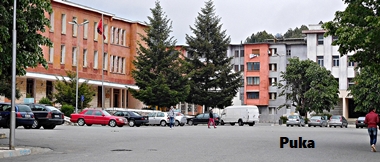
“Our shopping expedition continued in a tiny stationery/gift shop, where I bought a notebook. The sales lady wanted to know where we came from. When she learnt that Lopa came from India, she pointed at a small television set hidden under her counter. We saw that she was watching a Bollywood movie with Albanian subtitles. Every afternoon on Albanian television, there is an episode of a Bollywood TV soap opera. Those ‘in the know’ never ring ladies between certain hours in the afternoon so as not to disturb their enjoyment of this addictive show. The inter-continental cultural traffic is not one-way: in 2013, the Albanian actress Denisa Gokovi starred in a film (Phir Mulaquat Ho Na Ho) directed by the Indian Bobby Sheik.”
In the southern city of Korçë:

“Weary and hot, we tried to retrace our steps back into the centre. Quite by chance, we began walking along a road that led straight to the Mirahorit mosque, which was closed when we arrived. However, some men were gathering outside it, and soon the imam arrived to unlock it for afternoon namaaz (prayers). They were all friendly and welcoming. While we were waiting, we were joined by a German lady, who was keen to see this mosque that dates back to 1496. Restored by a Turkish organisation in 2014, it was worth waiting to enter it. The interior was decorated with attractive frescoes depicting various mosques and Muslim pilgrimage places including the Kaaba. One of the men who was waiting with us to enter the mosque asked Lopa where she was from. When she said India, he exclaimed “Rye Kapur”, that being his pronunciation of Raj Kapoor, a well-known Bollywood film star. As we had already discovered in Pukë, Bollywood is popular in Albania.”
In the large seaport of Vlorë:
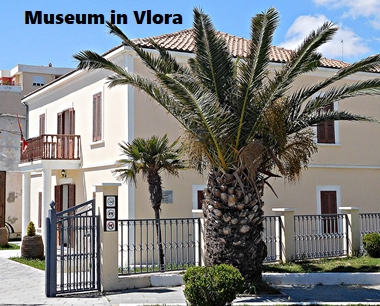
“This small building of great historic importance was dwarfed by huge cranes and ocean-going freighters in the nearby port area. Its windows had slatted wooden shutters, and there was a balcony projecting over its main entrance. It was from this balcony that Ismail Qemal read the declaration of Albania’s independence in 1912. Vlorë, which was invaded by the Italians in 1914, was the country’s first capital. In 1920, Tirana assumed this role.
We were guided around the museum, and shown photos, documents, and furniture, connected with the historic events that occurred around 1912. Driton kindly translated our lady guide’s interesting commentary into English. Sadly, we were not permitted to stand on the historic balcony because it has become too fragile. As we moved from room to room, I noticed that our guide was becoming more and more interested in Lopa, touching her occasionally. At the end of the tour, she told us that she loves watching the Bollywood films and soap-operas broadcast on Albanian television. It was a pity, she said, that Lopa had not been dressed in a sari. Lopa’s arrival in the museum had meant a great deal to her. It was as if one of the characters in the films, which she enjoyed watching, had stepped out of her television and into her museum. She said that Lopa was the first female Indian visitor to the museum since she began working there eleven years earlier.”
Prior to 1991, Albanians would not have been able to watch Bollywood or even Hollywood productions. Under the dictatorship created by Enver Hoxha, which lasted from 1944 until late1990, the Albanian population was almost completely isolated from external influences. A few people watched Italian TV at their peril. If discovered, they would have risked dire punishment. Today, everything has changed; Albania is wide open to foreign culture.
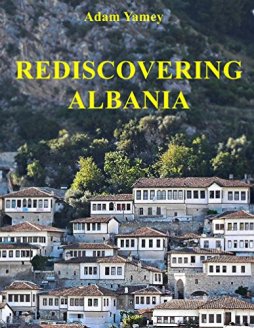
REDISCOVERING ALBANIA by Adam Yamey is available from:
Amazon, Bookdepository.com, lulu.com, Kindle,
and your local bookshop (will need to be ordered)

Abstract in concept
A sculpture in metal
Created by Caro
The first film (movie) that I remember seeing was “The Red Balloon”. Directed by Albert Lamorisse (1922-70), a French film-maker, it was released in France in 1956, and then worldwide a year later, by which time I was five years old. After seeing the film, I was given a book with the story, which was illustrated by stills from the production.
Thinking back on it, the plot (see: https://en.wikipedia.org/wiki/The_Red_Balloon), written for children, is a little bit too sad for young children. Nevertheless, the short film won awards all over the world.

My parents were not frequent cinema-goers. However, they took me to see the film at the Everyman Cinema in Hampstead. This cinema, which still exists, was first a drill hall, then a theatre, and in 1933 it became a cinema. I saw many more films there in my childhood and adolescence. Every year, there used to be a festival of Marx Brothers films. I loved these. In those days, the cinema’s auditorium had a strange smell that strongly resembled gas. Indeed, there were gas lamps attached to the walls of the auditorium, but I am certain that I never saw them working. The Everyman is located in Holly Bush Lane, which is close to Hampstead Underground Station and is, I am told, now a very luxurious place. The seats are comfortable and have tables beside them, at which waiting staff serve food and drinks. This is a far cry from what I can remember of the rather basic cinema in the 1960s. Back in those days, the Everyman, like the now long-gone Academy cinemas in Oxford Street, favoured screenings of ‘arty’ films rather than the more popular films that most cinemas showed. My parents, who tended to avoid popular culture, probably selected the “Red Balloon”, an arty French film, because it was a little more recherché than the much more popular Disney films that appeared in the late 1950s.
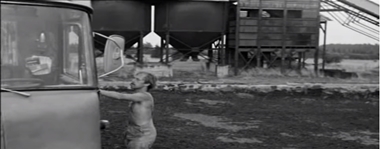
The “Red Balloon” kindled my love of cinema. For a long while I preferred ‘off-the-beaten-track films’ of the sort that were shown at the Everyman and on the three screens of the Academy. I used to enjoy slow-moving films like Eric Rohmer’s “Claire’s Knee”, Andrei Tarkovsky’s “Solaris”, and Wim Wender’s “Kings of the Road.” Now, my taste in film has changed dramatically.
The change began in mid-1993, shortly before marrying my wife, who is from India. She took me to meet an Indian couple, who lived in south London. After feeding us a great lunch, we watched the Bollywood film “Sholay”, which was released in 1975. After seeing this, I could not get enough of Bollywood films. Also, my love for slower-paced European and American films diminished.

What is it that attracts me to Bollywood films? First, they are colourful, lively, fast-paced, and filled with strong emotion, music and dancing: never a dull moment. They are also filled with meaning at various levels. There is the story, often complicated and ridiculously unlikely. Parts of the plot are often based on aspects of Hindu mythology. Then, the films often convey important moral or civic messages. For example, the 1977 film “Amar Akbar Anthony” is about inter-religious tolerance. More recently, the 2018 film “Padman” is about the importance of using disposable pads to promote women’s health.
I prefer to watch Bollywood films with subtitles, but great enjoyment can be gained without them. Many of the films have dialogue in Hindustani. However, many viewers in India have little or no understanding of this language. Therefore, the films are produced in such a way that much of the message of a film, maybe not the finer details, can be understood by people with no knowledge of Hindustani. In fact, Bollywood films are not only popular in India, but in many other countries of the world. Once some years ago, some Uzbek neighbours invited us for dinner. After serving us a national dish, plov (like pilaff), they sat us in front of a television and played a DVD with a Bollywood film. They told us that this kind of film is very popular in Uzbekistan and, also, in most parts of the former Soviet Union.
Although I have come to love Bollywood films, I am not sure that they would have been to my parents’ taste. They never took me to see Disney films when I was too young to go alone. Had there been more ‘sophisticated’ children’s films like “The Red Balloon”, maybe I would have been taken to the cinema more often in my earliest years.
Image source: YouTube

The price rises
the tension’s growing:
the excitement of an auction


From worlds far apart,
Two folk come together:
Cupid’s bow does its job
When our daughter was a little girl in junior school, the members of her class were asked to name the greatest Briton in history. She nominated Queen Victoria. Her choice was based on the following facts: her mother’s parents were born in India and my parents were born in South Africa. When Queen Victoria reigned, she argued, both countries were part of the British Empire. This, she felt, made it more likely that both her parents would study in England and meet. Without Victoria, she concluded, my wife Lopa and I might never have met, and she would not have existed. Well, maybe she was right. I believe that the reason we met was due to two men who gave us career’s advice: Professor Lewis Wolpert in London and Major General SL Bhatia in Bangalore.
As I approached the time when I had to choose a university undergraduate course, I had no idea which subject to select. I was interested in biology, physics, and chemistry, but had no interest in studying medicine, or even dentistry, which I studied many years later. Careers advice at my secondary school was not helpful.
My South African-born parents knew many South Africans living in London. One of these was my father’s close friend, the late Cyril Sofer, a sociologist. It was through the Sofer family that we met Lewis Wolpert, who was born in South Africa. First, he trained to become a civil engineer. By the time I first met him, he had become an eminent biologist, specialising in cell and developmental biology.
Wolpert, on learning that I was having difficulties choosing a course of study, kindly invited me to his office in Middlesex Hospital in central London. He spent about an hour with me, listening to what I had found interesting in the science subjects I had studied at school. Having heard me out, he suggested that I study physiology at university. This subject would, he thought, encompass all that interested me so far. He told me that the best places to study physiology were Cambridge and University College London (‘UCL’). Of these, he considered the physiology department at UCL to be the best. I was pleased to hear this.
About five years before meeting Wolpert, my father and I had visited UCL because a friend of the family, the art-historian Leopold Ettlinger, worked there. All that I can remember of this visit was walking across the lawns in UCL’s elegant Front Quadrangle and thinking how beautiful it seemed. So, when Lewis Wolpert suggested that I apply for admission to UCL, I was happy about that.
At about the time I was discussing my academic future with Wolpert in London, a young lady, my future wife Lopa, was discussing the same thing with another eminent scientist 5000 miles away in Bangalore. The scientist, Major General SL Bhatia (1891-1982), had known Lopa’s mother’s father from when he studied medicine in Bombay. The two medics became close friends. When Lopa’s mother Chandra was born, Bhatia became the equivalent of Chandra’s god-father.
Chandra’s father died young having succumbed to blood poisoning while treating one of his patients. His friend Bhatia had a glittering career in science, medicine and the Indian Army. It was during his retirement that Lopa met him at his beautiful old-fashioned bungalow in Bangalore. Bhatia had studied medicine not only in India but also at St Thomas’s Hospital in London during the second decade of the 20th century. While in London, he had conducted research with leading physiologists. Like Wolpert had done for me in London, Bhatia recommended that Lopa, who was not keen on studying medicine at that time, pursue a course of physiology at UCL, because he knew it to have a fine reputation in that subject.
One morning in October 1970, I arrived at the Physiology Department at UCL, having travelled from my home in north-west London. I was one of nine students who had been accepted for the course. Lopa was one of the others. She had travelled over 5000 miles to join the department. We were greeted by the department in the Starling Room, named after a famous physiologist who had worked at UCL. This common room is where I met the young lady who was eventually to marry me.

In the bar at the Bangalore Club
Our wedding reception in Bangalore was held in 1994 at the Bangalore Club, a prestigious ex-colonial institution in the heart of Bangalore. Although he could not attend, Major SL Bhatia was the first Indian President of that elite club. Before that, all the Presidents had been British. Bhatia’s widow was at the wedding. She claimed, not without some reason, that it was she and her late husband, who were responsible for getting Lopa and me together.

Just as our daughter is eternally grateful to Queen Victoria for bringing Lopa and me together, I am equally thankful to Professor Wolpert and Major General Bhatia for getting our paths to cross. I cannot acknowledge them for what was to follow; Cupid and his arrows are to be thanked for that.
Picture sources: semanticscholar.org (Bhatia) & retractionwatch.com (Wolpert)

