
A tangled chain of events
linked only by fate
leads always to an end

A tangled chain of events
linked only by fate
leads always to an end
Years ago, I knew a dentist, who owned his own practice. His residence was in the same building. His patients could ring him any time of the day or night. If there was an urgent out-of-hours problem, he would usually open the surgery and try to help the unfortunate patient. Most of his patients were considerate and did not ring him at inconvenient times. However, once someone rung him at three in the morning. The caller said that his toothache was so bad that he was unable to sleep. My friend, an intelligent man, said to him:
“You come and see me at eight in the morning. That way only one of us will have a sleepless night.”

Occasionally, I had to be ‘on call’ for out-of-hours and weekend emergencies. When I worked in Kent before the widespread use of mobile ‘phones had begun, I had to carry a small radio receiver in my pocket during the hours I was ‘on-call’. If the gadget bleeped, I had to ring the telephone number of some remote call-handling centre. The centre would then provide me with the telephone number of the person in trouble. Usually, the ‘emergency’ turned out to be someone wanting to make or cancel a dental appointment in the middle of the night or on a Sunday or bank holiday. There was little I could do about these abuses of the emergency system.
One Easter weekend, I was contacted by a mother, whose son’s front tooth had snapped off and he was in pain. I asked the caller to bring her son to see me in the surgery, which I opened specially for her son. The boy arrived. The situation was not good. The child had managed to snap off a lateral incisor, leaving the root below gum-level. The tooth was un-saveable and needed to be removed. To extract it, I knew that I would have to perform some minor surgery, lifting the gum and then replacing it (using sutures). It was a job that would have been difficult to perform alone without an assistant. Fortunately, I had the ‘phone number of one of the practice nurses, who lived nearby. Luckily, she was able to come to assist. The operation was done without problem.
When I had finished treating the child, the mother neither thanked my assistant nor me. She was typical of many National Health Service (‘NHS’) patients, who do not appreciate what is done for them because it is done free of charge. Many of the services provided by the NHS are free, and because of this a proportion of patients show no gratefulness. They take the system for granted, feeling that what is done for them is their birth right.
It was Good Friday morning when this emergency treatment was carried out. The boy’s mother said:
“What a shame that this happened today of all days, Good Friday.”
Silently, I agreed with her. I said:
“Well it’s been a bad Good Friday for your child.”
After a few moments, I added:
“It was also not an awfully good day for Jesus Christ.”
The mother gave me a dirty look, and then took her child home.
[Picture source: “Der Zahnarzt in der Karikatur” by E Henrich (1963)]
What is reality ?
What is reflect-ed?
Who will tell me? Can you?
I have always had difficulty reproducing my signature. Sometimes, this can create problems.
It was a warm day, lunchtime, in Spring 1982 when I walked to the local branch of my bank in the village, where I had just begun practising dentistry in north Kent. I needed some money. I wanted to cash a cheque to obtain ten Pounds.
I filled in one of my cheques, signed it, and handed it along with my bank card to the teller. She looked at the card and the cheque, and then said:
“I am sorry, sir, but your signatures do not match. Please re-sign your cheque.”
I did as was requested. But, the third signature differed significantly from the first two, which also looked unalike.
“Try again, Sir.”
My fourth attempt was yet another variation on a theme. The teller did not approve of it. By now, I was feeling both sweaty and slightly hypoglycaemic. I snatched my cheque and card and stormed out of the bank.
After returning to the dental practice, I calmed down. I still needed that £10. I rang the bank and asked to see the manager immediately. I was asked to return, which I did. On my arrival, the manager, dressed in a smart suit, was summoned to the counter. He said to me:
“How can I help you, sir?”
“I have just begun working as a dentist in the practice up the…”
Before I could finish, the manager invited me into his office. He offered me a chair, and then sat down. I explained what had happened earlier, and that I was concerned about having similar problems in the future as his branch was the most convenient bank to reach on my working days.
“Please give me the cheque, Mr Yamey.”
I handed him my cheque, which was covered with a selection of vaguely similar signatures.
“Please wait a moment,” the manager said, leaving the room.
A couple of minutes later, he returned and then handed me the cash.
I used that branch of the bank for the next eleven years and was never again asked to show my bank card when I wanted to cash a cheque. Such was the respect that the dental profession commanded several decades ago. Since then, I have simplified my signature so that I am able to reproduce it more or less reliably.
This flavoursome bulb
Brings tears to the eyes
Oh, and much joy to the tongue
When I first qualified as a dentist and went into practice in 1982, nobody possessed mobile telephones (cell-phones). By the time I retired in 2017, practically all of my patients, even some of the children, carried and used these ‘phones. Believe it or not, my patients often tried using their ‘phones during my appointments.

It was very annoying and ruinous for concentration when a patient stopped me in the midst of performing a delicate operation in his or her mouth in order to answer the ‘phone. Some patients even attempted speaking on their mobiles when their mouths were full of impression materials.
One day, I met my next patient at the reception desk. He had arrived punctually, but had his ‘phone up to his ear. He smiled at me, and then said:
“Give me a minute, I am in the middle of a telephone interview for a job.”
“Ok,” I replied, “come into my surgery when you are finished.”
Ten minutes of his half an hour appointment passed, then fifteen, and then twenty…
At the end of half an hour, I returned to the reception desk. My patient laid down his ‘phone, smiled, and said:
“I’m ready now. My interview is over.”
I replied:
“So is your dental appointment. You had better book another one another day.”
Even more annoying were those who insisted on asking me a question and then, instead of listening to my reply, began sending SMS messages. I recall one lady, who had very complex dental problems, which required much explanation of treatment options before I could proceed any further with helping her. Did she listen to me? Oh, no she did not. For half an hour, she sent a series of SMS messages whilst I spoke. At the end of her appointment, she asked me to repeat what I had been telling her because she had had to send a series of “very important” messages. After that experience, I put up a notice in my surgery, forbidding the use of mobile ‘phones. It was a successful move. Patients would reach for their ‘phones, and then my assistant or I would point at the notice. The patient would then apologise, and turn off the ‘phone.

Father and son
Thirty-three years apart
That’s a family for you
Between 1944 and 1991, Albania was ruled by a Stalinist dictatorship under the leadership of Enver Hoxha until his death in 1985, and then under Ramiz Alia. The country was even more isolated from the rest of the world than North Korea is today. It was impossible for individuals to visit the country unless they were members of a tour group. In May 1984, I joined one of these groups and spent a most interesting fortnight in the country. Our hosts, the state-run Albturist company, made sure that we had little or no contact with Albanians other than our tour guides and driver, who was a trusted Communist party member. Our hosts hoped that we would only see what the authorities wanted us to see. Their aim was to make us come away from Albania feeling that its repressive regime was one to be admired. I was the only dentist in our group. I managed to gain a tiny insight into the state of dentistry in Albania. The following extracts from my book “Albania on my Mind” reveal something of what I learned. ‘Aferdita’ and ‘Eduard’, mentioned below, were our Albanian tour guides. Although their job included keeping us ‘under control’ and away from other Albanians, they were curious about the world beyond Albania’a watertight borders.
Our tour began in the northern city of Shkodër.
“Our coach headed out of Shkodër along the main road leading southwards. Once we were out of town, Aferdita delivered the first of her brief daily lectures. Every day, she treated us to a discourse on one of a variety of different aspects of life in Albania. The one that I can recall best was on the subject of medicine. She informed us, whilst we were travelling towards Sarandë some days well into our tour, that since the advent of the communists not only had malaria been eradicated, but also tuberculosis and syphilis. After extolling the virtues of her country’s medical facilities, she offered to answer any questions that had arisen in our minds as a result of her lecture. No one said anything. Then, Julian, our British chaperone, knowing already that the young lady doctor travelling with us was a reticent person, asked me, the dentist on board, to pose a question. I asked whether antibiotics were readily available in Albania. My reason for asking this was that I believed that the country, which was clearly trying to be totally self-reliant, would have been reluctant to import costly pharmaceuticals. Aferdita replied indignantly: “Why, of course they are.”
And then, spreading her hands wide apart, she exclaimed:
“When we reach the next town, I will get you a packet of antibiotics this large.”
Sadly, she never fulfilled this unusually generous offer.”
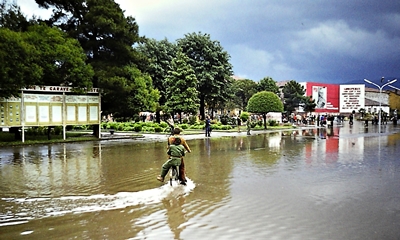
Flash flood in Shkodër, 1984
“After an unexceptional lunch, I roamed around the streets of Shkodër. I came across a small public garden, which was dominated by a chunky statue of Joseph Stalin. Even 30 years after his death, Albania continued to honour him. It was the only country in Europe still revering that illustrious Georgian. There was even a town, Qyteti Stalin (now known by its pre-Communist name as ‘Kuçovë’), named in his memory, but we did not visit it. I am pleased that I saw this statue, because although I did see many other statues on our trip, they were mostly depictions of Enver Hoxha.
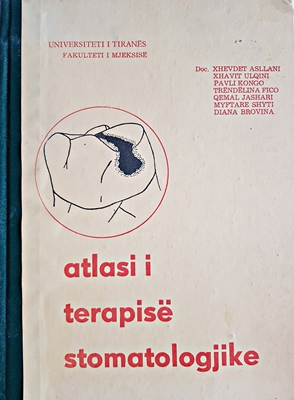
I discovered a bookshop near to Stalin’s monument, and being addicted to such establishments, I entered. I was surprised to find an Albanian textbook of dentistry prominently displayed there. Though crudely illustrated with line-drawings, I could make out that it was quite up-to-date. To the evident surprise of the shop’s staff, I purchased it and another dental book. I still treasure these two unusual souvenirs from Shkodër.”

Backstreet in Gjirokastër
Later during our tour, we visited the historic city of Gjirokastër. Its hotel, like others in Albania, was equipped with a night club, where we, the foreign guests, were entertained by musical ensembles in splendid isolation: no Albanians apart from our guides and a waiter were permitted to enter the club. Incidentally, wherever our group ate in Albania, we were isolated by screens or curtains from other (i.e. Albanian) diners. I later learnt that this was because in 1984 there were great food shortages in the country. We were well-fed, but it was important that Albanians were not able to see that.
“That evening after dinner, a number of us sat with Aferdita and Eduart in the hotel’s night club. Each of the hotels in which we stayed had one of these. With the exception of our two guides and the musicians who performed in them, these clubs were out of bounds for Albanians. This evening we were entertained by a small band that played western pop music, mainly tunes originally performed by the Beatles. The noisy background of these clubs provided our two young guides with opportunities to ask us about life beyond their country’s tightly sealed borders. However, it was clear that Aferdita was trying to eavesdrop on Eduart and vice-versa. As the musicians strummed away in the semi-gloom of the club in Gjirokastër, Aferdita turned to me, rolled her lower lip away from her teeth, and asked my opinion of her gums. She wanted to know if they had been treated properly. I told her that I was unable to give her an opinion in such poor light.
The following morning, I spotted some tubes of Albanian toothpaste on display in a locked glass display case near the hotel’s main entrance. I tried to communicate to the receptionist (who did not understand English) that I wished to purchase a tube. I used to collect toothpastes from wherever I travelled and was curious to taste its contents. Whilst I was doing this, Aferdita appeared, and asked me what I wanted. I told her. She explained my desire to the receptionist, and moments later I had become the proud owner of a tube of Albanian dentifrice.”

Many years later…
“In 2001, long after my trip to Albania, I began working in a dental practice in west London. Many of my patients were, and still are, refugees from the places in the world, which are stricken by military and political conflicts. Algerians, Iraqis, Afghans, Kurds, Palestinians, Eritreans, and many other others who have fled their far-off disturbed homes sit in my surgery and reveal the ravages that life has inflicted on their teeth. During the terrible conflicts in the former Yugoslavia, many of my patients hailed from Kosovo, and usually spoke poor English in addition to their native Albanian. Many were the smiles that I elicited from them when I quoted the old party slogans, undoubtedly poorly pronounced, and wished them ‘Mir u pafshim’ instead of ‘Goodbye’ at the end of their appointments.”
“ALBANIA ON MY MIND” by Adam YAMEY may be purchased from Amazon, lulu.com, bookdepository.com, your bookshop. It is also available as a Kindle

Rain, wet leaves
flattened on the pavement:
very slippery underfoot
American and English
similar lingos
sometimes different

Some years ago, I practised dentistry in a surgery near Ladbroke Grove in West London. One day while I was waiting for the next patient to arrive, I found myself alone at the reception desk, the receptionists having gone off somewhere briefly. The telephone rang. Being a helpful sort of person, I picked it up.
“Hello, this is the dental surgery,” I said.
A man with an American accent said to me:
“I want to speak with June Courtney.”
June was a dentist, who used to work in the practice.
“I am afraid she does not work here anymore,” I replied.
“Well, maybe you’re her husband?”
“No, I am not.”
“Well, maybe I can interest you in buying some bonds,” continued the trans-Atlantic caller.
“I’m not really interested,” I replied.
“Well, that means you might be a little bit interested,” the caller replied.
“let me explain something to you,” I began, “if someone English says that they are not really interested, it does not mean that they are ‘slightly interested. It is a polite way of saying that they are not at all interested; they are totally uninterested.”
“Well, thank you for explaining that, sir,” the caller said before ending the call.
I guess that sometimes it pays to speak bluntly.

