HERE IS SOMETHING WORTH seeing if you can. It is on display at the Tate Britain until the 31st of January 2021 and you need not enter the gallery building to see it. Originally created to celebrate Diwali, the Hindu Festival of Light, in late 2020, this is a wonderfully joyous celebration of both Indian and British culture in light and colour.
The artist Chila Kumari Singh Burman was born in Bootle, near Liverpool, daughter of Punjabi Hindu parents. She graduated at the Slade School of Fine Art in 1982 after having also studied at Southport College of Art and Leeds Polytechnic.
Burman has temporarily transformed the main (Thames facing) entrance of the Tate Britain, its staircase and pillared portico into a pleasing and often humorous riot of colour that makes many references to her upbringing and India’s culture and mythology. To do this, she has made use of coloured lights, neon tubing lights, coloured photographs, and decorative printed coloured paper. The Tate’s website (https://www.tate.org.uk/whats-on/tate-britain/exhibition/chila-kumari-singh-burman) describes Burman’s installation, “Remembering a Brave New World” as follows:
“This magnificent installation, remembering a brave new world, combines Hindu mythology, Bollywood imagery, colonial history and personal memories. Inspired by the artist’s childhood visits to the Blackpool illuminations and her family’s ice-cream van, Burman covers the façade of Tate Britain with vinyl, bling and lights. She changes the figure of Britannia, a symbol of British imperialism, into Kali, the Hindu goddess of liberation and power. The many illuminated deities, shapes and words are joined by Lakshmibai, the Rani (queen) of Jhansi. Lakshmibai was a fierce female warrior in India’s resistance to British colonial rule in the 19th century.”
This description provides a fair summary of what is to be seen. It does not mention the entertainingly decorated autorickshaw (three-wheeler) that was on display in the vestibule of the gallery when we visited. The doorways are also worth examining because they are lined with images taken from the Amar Chitra Katha’s comic books that are published in India to teach Indian children about both Hindu mythology and Indian history. Our daughter, whose background, is both Indian and European, used to enjoy reading these. Despite what the Tate has written, the artwork does not come across as polemical or anti-British, at least not to me. On the contrary, the artist appears to be enjoying her joint cultural heritage: both British and Indian. My wife said of the installation:
“If this is multi-culturalism, let’s have more and more of it!”
However, words are quite insufficient to describe the visual impact of this wonderful spectacle. It has to be seen to be believed and enjoyed. We saw it during daylight when it can be enjoyed in fine detail, but I imagine that seeing it after dark would also be quite magical.
I WAS HAPPY TO find a reprint of “History and Antiquities of Highgate” by Frederick Prickett, first published in 1842. He wrote in detail about the early history of Highgate School, which was founded in 1565 and which I attended between 1965, when the school celebrated its 400th anniversary, and 1970. While not wanting to reproduce all he wrote, I will present several aspects of his history of the early years of my ‘old school’, which attracted me.
Part of Highgate School
The story of Highgate School begins at Muswell Hill, one and a third miles north of Highgate. In mediaeval times, there was a holy well located there in what was an outpost of the central London Parish of Clerkenwell. Also, there was an image of Our Lady of Muswell, to which many pilgrims were attracted. The chapel associated with it was established in 1112 by the then Bishop of London. Pilgrims travelling from London to Muswell Hill would have had to ascent the steep slope of Highgate Hill. At the summit, there used to be a chapel or hermitage established some time before Robert de Braybrook (died 1404), Bishop of London, gave it to the poor hermit William Lichfield in 1386. Pilgrims could stop at the chapel to say prayers or rest in a small room attached to the chapel.
In 1531, Bishop John Stokesley (c1475-1539), the Roman Catholic Bishop of London and opponent of Lutheranism who christened the future Queen Elizabeth I, granted the hermitage/chapel to William Forte, the last hermit of Highgate. In 1565, the firmly Protestant Bishop Edmund Grindall (c1519-1583), who was Archbishop of Canterbury between 1576 and 1583, granted the chapel and “ houses, edifices, etc., gardens and orchards”, to the ‘Grammar School’. It is at this point that we need to meet Sir Roger de Cholmeley (c1485-1565).
According to Prickett, Sir Roger:
“…turned his attention to the law, and so effectually that he became successively reader in Lincoln’s Inn, a bencher of that society, serjeant at law, king’s serjeant, chief baron of the exchequer, and, finally, chief justice of the Kings Bench.”
Disaster struck when Queen Mary (reigned 1553-1558) came to the throne. Sir Roger was imprisoned in the Tower of London for his part in drawing up the will of King Edward VI and for signing Lady Jane Grey’s instrument of succession as queen, and his daughters were disinherited. On his release, he settled in Hornsey, did not resume any of his former governmental positions, and worked as a barrister.
Sir Roger was a self-made success, not having relied on parental assistance. Out of gratitude to God, he:
“… he entertained the desire, participated in by many other pious and distinguished Protestants, of endowing a public grammar school, for the diffusion of knowledge and maintenance of true religion …”
He founded what was to become Highgate School in 1565, shortly before his death that year and left money in his will to support its existence.
In December 1571, the school’s six governors, one of whom was Sir Roger’s son, Jasper Cholmeley Esq., signed the school’s rules, laws, and statutes. There were thirteen of these regulations, the first of which included the words:
“ … there be an honest and learned schoolmaster appointed and placed to teach the scholars coming coming to this free school; which schoolmaster that so shall be placed, be Graduate of good, sober, and honest conversation, and no light person, who shall teach and instruct young children in their ABC and other English books …”
The ‘ABC’ mentioned was not, as I first thought, a simple introduction to the alphabet, but, as Prickett points out:
“… a black letter book, called the ABC with the Catechisme: that is to say, an instruction to be taught and learned of every child before he be brought to be confirmed by the Bishop…”
Prickett wrote that the “ABC with the Catechisme” was written by King Henry VII and then reprinted in the reign of Edward VI. Ian Green suggests that the text in this booklet first appeared as a section in the 1549 Book of Common Prayer and then later separately (https://extra.shu.ac.uk/emls/03-3/rev_bru2.html#).
The school is no longer a ‘free school’ and has not been so for a long time. By the 1820s, the school, like many others in England at that time, had declined considerably, both materially and pedagogically. New classrooms and school buildings were built. Then, in 1824, the statutes were modified considerably. Forty scholars chosen by the governors, and no more than this, from Highgate, Holloway, Hornsey, Finchley, Kentish Town, and other close areas, were to be admitted free of charge. Boys had to be between 8 and 18 years old. Each pupil, on being admitted to the school, had to pay twenty-one shillings (£1.05) towards the library. In addition to the forty scholars, other boys could attend the school for an annual fee of £12 and 12 shillings (£12.60).
How times have changed, Today, the school admits children between the ages of 3 and 18, both boys and girls. Sir Roger de Cholmeley would be pleased to learn that recently the school he founded has been recognised as the winner of ‘The Independent School of the Year 2020’ award. However, he might be shocked to learn that the annual fees for his ‘free school’ are in excess of £21,000
USUALLY, I LOOK out of the window whenever I am travelling by train. During the 1980s, I often visited London from Kent by train, usually arriving at Victoria Station. The train crosses the River Thames on the Grosvenor Railway Bridge just before it reaches the platforms of Victoria Station. If you are looking out of the left side of the train whilst it is on the bridge, you can spot a building with a curious roof and ornate mansard windows, features that might make you think of nineteenth century Paris (France). For many decades, I have been meaning to investigate this building and today, the 14th of December 2020, whilst walking along the Thames embankment between Chelsea and the Tate Britain, I decided to satisfy my curiosity.
Western Pumping Station
The building with the convex curved roof, which has diagonally shaped tiling, overlapping like fish scales, and mansard windows, is the Western Pumping Station. This sewage pumping station was built in 1875 by William Webster (1819-1888) as part of London’s grand sewage system designed initially by Joseph Bazalgette (1819-1891), which was built mainly between 1865 and 1875. The tall square-based brick chimney next to the pumping station was once an outlet for the steam from the pumps. Now, it serves as a ‘stink pipe’ for exhausting fumes that build up in the sewer. It is 272 feet high. Writing in the 1880s, Edward Walford noted that the pumping station:
“… provides pumping power to lift the sewage and a part of the rainfall contributed by the district, together estimated at 38,000 gallons per minute, a height of eighteen feet in the Low Level Sewer, which extends from Pimlico to the Abbey Mills Pumping Station, near Barking in Essex, The requisite power is obtained from four high-pressure condensing beam-engines of an aggregate of 360-horse power.”
The pumping station and its tall chimney stand between the railway tracks, east of it, and an inlet from the Thames, west of it. A narrow waterway passes from the Thames under Grosvenor Road. Then it moves ‘inland’ via a series of lock gates. This waterway and the dock into which it flows, a watery cul-de-sac surrounded by modern buildings, a rather sterile looking precinct supposed to entice property owners, who want to live in a waterside location, is called ‘Grosvenor Waterside’. The watery appendix sprouting off the Thames is all that remains of the Grosvenor Canal.
The canal was opened in 1824. It was built along the course of a tidal creek that led to a tide mill that pumped water to the Serpentine in Hyde Park and the lake in St James Park. A tide mill works by collecting tide water behind a dam with a sluice, and then allowing the tidal water to escape from it via a watermill as the tide goes out. Modern tidal-barrage electricity generators work that way.
The conversion of the creek to a canal was conceived by Robert Grosvenor (1767-1845), 1st Marquess of Westminster. The short canal, about three quarters of a mile in length, was mainly used for the transportation of coal to the neighbourhood through which it ran. Gradually, the canal was shortened as parts of it were filled in. By 1860, Victoria Station had been built over the Grosvenor Canal Basin. More of the canal was filled in in about 1899 to build new railways tracks. This halved the remaining length of the canal. In 1925, even more of the waterway was covered over to allow the building of Westminster Council’s Ebury Bridge Estate. What remained of the canal was then used as a dock for loading barges with rubbish. The rump of the canal served this purpose until 1995. Five years later, the construction of the upmarket and rather sterile-looking Grosvenor Waterside housing development, which can bee seen today, began. This includes lock gates, mooring pontoons, and a working swing bridge, but boats are not seen within what remains of the former canal. It is a modern ‘folly’.
Most of the former Grosvenor Canal has disappeared for ever. This is quite unlike many of the so-called ‘Lost Rivers’ of London, which still exist but are hidden from view in underground conduits. One of these, the River Westbourne, flows out of its conduit and into the Thames 270 yards west of the former canal’s entrance, at the southern edge of the Ranelagh Gardens in which Sir Christopher Wren’s magnificent Royal Hospital Chelsea stands.
I hardly ever travel by train to or from Victoria anymore, especially as we now tend to use our car. However, whenever I see the interesting roof of the pumping station and its mansard windows, I remember the days back in the early 1980s when I used to travel between the Medway Towns, where I worked as a dentist, and London, where most of my friends and family resided.
ROWERS AT THE 2012 Olympics would have become familiar with Dorney Lake. Built at great expense by Prime Minister Boris Johnson’s alma-mater, Eton College, this 1.4-mile-long waterway, a rowing lake, was ready for use by 2006. From the air, it looks like a long, wide airport runway filled with water. Prior to 2012, it was used for several international rowing competitions. In 2012, the lake was the site of both the Olympic and the Summer Paralympics. The lake continues to be used for rowing and members of public are allowed to use the parkland surrounding it when events are not taking place.
Monkey Island
We reached the outer fence of the rowing lake after crossing the elegant Summerleaze footbridge across the River Thames. It allows cyclists and pedestrians to travel between Bray (Berkshire) and Dorney (Buckinghamshire). The bridge takes its name from the company that built it in 1996. It was constructed originally to carry a gravel conveyor belt, which transported gravel from the construction site of the Dorney Lake across the river to the Summerleaze company’s gravel pits next to Monkey Island near to the village of Bray.
The view from the top of the footbridge is magical. The Thames flows briskly beneath it. Upstream the water flows around Monkey Island. Then it travels as a single stream beneath the bridge before being divided into two streams by another island a few yards downstream, Queen’s Eyot. On the chilly Saturday afternoon, when we crossed the bridge, several small cruisers and canoeists passed beneath us. If you are lucky, and we were, you can see the towers and turrets of Windsor Castle in the distance on the south-eastern horizon.
Looking upstream and through the trees on Monkey Island, you can catch a glimpse of part of the Monkey Island Estate, currently a grand hotel built in and around a house with a fascinating history (www.monkeyislandestate.co.uk/pages/our-story.html). Many people assume that Monkey Island is so-called because of the paintings of monkeys in one of the buildings on the island, but this is probably erroneous. The name is most likely derived from the island’s earlier name ‘Monk’s Eyot’. The monks lived in Amersden Bank near Bray Lock on the Buckinghamshire side of the Thames. Their monastery, a cell of Merton Priory, was in existence by 1187, but was dissolved when Henry VIII put an end to such establishments.
The Great Fire of London of 1666 gave the area around Monkey Island a particular importance. For it was from here that Berkshire stone (for details, see: http://hanneyhistory.org.uk/wp-content/uploads/2018/08/Berkshire_Building_Stone_Atlas.pdf) was shipped down river to aid the reconstruction of London. Gravel from the damaged city was brought back upriver and dumped on and around Monkey Island. This resulted in both raising the level of the island to above flood level and providing a solid foundation upon which to construct buildings. Well, getting to know this was alone a good consequence of having crossed the Summerleaze bridge, but wait, there is more to follow.
An ancestor of the wartime Prime Minister, Winston Spencer Churchill, Charles Spencer, the 3rd Duke of Marlborough (1706-1758), purchased the island in about 1723. He had:
“…seen the property whilst attending meetings of the notorious Kit-Kat Club at nearby Down Place in Water Oakley. The Club which met from 1720 purported to be a gathering of ‘men of wit and pleasure about town’ but beneath a facade of joviality had more sinister objectives concerned with the defence of the House of Hanover.” (www.berkshirehistory.com/castles/monkey_island.html).
The Duke had two buildings constructed on his recent purchase: a ‘fishing temple’ and a ‘fishing lodge’. The latter, constructed from wooden blocks that were cut to look like stone, still stands and is known as The Pavilion. Lady Hertford (1699-1754), Frances Seymour, later the Duchess of Somerset, writing in 1738, described the Pavilion as follows:
“He has a small house upon it, whose outside represents a farm – the inside what you please: for the parlour, which is the only room in it except the kitchen, is painted upon the ceiling in grotesque, with monkeys fishing, shooting etc., and its sides are hung with paper.”
The Monkey paintings, which still exist, were the work of a French artist Andien de Clermont (died 1783), who worked in England between about 1716 and 1756. Painted before 1738, they decorated the ceiling of what was once a banqueting room. It is now known as the ‘Monkey Room’.
By about 1840, the pavilion had become an inn, which could be reached by ferry from near Bray on the Berkshire side of the Thames. The hostelry became quite popular during the early 20th century, when its regular guests included King Edward VII and his immediate family. The authors HG Wells and Rebecca West enjoyed visiting the place. West makes many references to the island in her novel “The Return of the Soldier” (published in 1918). Here is an excerpt:
“So they went to Monkey Island, the utter difference of which was a healing, and settled down happily in its green silence. All the summer was lovely; quiet, kind people, schoolmasters who fished, men who wrote books, married couples who still loved solitude, used to come and stay in the bright little inn.”
In 1956, a footbridge was built from the Berkshire shore to the island. Additional accommodation was added to the original Pavilion in 1963 and then the inn became known as the ‘Monkey Island Hotel’. After a brief period of decline in the early 1980s, the hotel was restored and has become a successful luxury destination with a fine restaurant, which we have yet to sample.
Our friend who lives in Bray kindly introduced us to the Summerleaze footbridge from where we glimpsed the building on Monkey Island. She suspected that the place had an interesting history, and she was quite right. I will leave you with one more quote from Rebecca West’s novel, one which captured the atmosphere of the place well both when she wrote and today:
“…a private road that followed a line of noble poplars down to the ferry. Between two of them—he described it meticulously, as though it were of immense significance—there stood a white hawthorn. In front were the dark-green, glassy waters of an unvisited back-water, and beyond them a bright lawn set with many walnut-trees and a few great chestnuts, well lighted with their candles, and to the left of that a low, white house with a green dome rising in its middle, and a veranda with a roof of hammered iron that had gone verdigris-color with age and the Thames weather. This was the Monkey Island Inn. The third Duke of Marlborough had built it for a “folly,” and perching there with nothing but a line of walnut-trees and a fringe of lawn between it and the fast, full, shining Thames, it had an eighteenth-century grace and silliness.”
A FRIEND POSTED A PICTURE of something he had created in wood at school when he was about 14 or 15 years old. It looks to be an extremely competent creation. Seeing this, reminded me of when I had to attend woodwork classes at roughly the same age at my secondary school, Highgate in north London.
Once a week, under the watchful eye of the woodwork teacher, Mr Bowles, I participated in a woodwork class in the school’s specially equipped workshop. Mr Bowles was well-known for saying of the timber he supplied in the class:
“Don’t waste it. You know that wood does not grow on trees.”
Although many years later, I was able to perform complex manual tasks whilst practising dentistry, in my early teens I was not skilled at performing three-dimensional manual exercises. I could draw and paint reasonably well, but model-making and woodwork were not amongst my skills.
I struggled with a tool called the sliding bevel when trying to create dovetail joints, which seemed to be of great importance to Mr Bowles. We were set what he regarded as simple tasks. With great difficulty, I completed two of these. I produced a tea tray, which was next to useless as it was only able to rest on two of its four corners at any one time. The bookshelf which could hold up to eight average thickness paperbacks suffered the same problem. Somehow, I had managed to introduce a twist into it so that its two ends were not in alignment. My parents, for whom it was suggested by our teacher that these would make fine gifts, were totally unimpressed. It would have been dishonest of them to have been otherwise.
My prospects of becoming a skilled carpenter were not looking great. Then, my fate changed suddenly one afternoon. I had just finished the school day and was walking across a polished wooden floor, when I slipped and fell. As I began to get back on my feet, I noticed that my left wrist was bent in an unnatural way and was a bit painful. Having recently completed a first-aid course, during which we were taught to tie complicated bandages instead of learning resuscitation and life support, I realised that I had most probably broken a bone.
I walked over to the caretaker’s home across the school’s quadrangle and found him. He said that he would ring my parents and while we were waiting for them to arrive, he gave me a cup of tea and biscuits. This kind gesture meant that I had to wait several hours before it was safe for me to have a general anaesthetic for setting my arm at the nearby Whittington Hospital.
My arm was encased in plaster, which remained in place for six weeks or longer. This accident was a lucky break for me. First of all, my popularity rating rocketed. Prior to my accident, many of my school fellows believed that I was rather unexciting and unadventurous, not even a ‘nerd’. Seeing my arm in plaster, suggested to these classmates that I must have been up to no good. Maybe, I had fallen out of a tree or had an accident on roller skates or on a bicycle. I kept quiet about the innocuous cause of my fracture and enjoyed experiencing the increase in my ‘street cred’. Even after my plaster was removed, my schoolmates retained their improved opinion of my personality.
Doing woodwork with one arm in plaster was not thought advisable. So, I was excused from the second and final term of woodwork classes. Actually, I doubt that using only one arm would have affected my woodwork much, as it was already appalling with two arms.
At the end of the school year during which we had to study woodwork, we had to make subject choices. Basically, the choice was to follow the ‘arts’ or the ‘sciences’. The choices were history or physics; geography or chemistry; and … wait for it … Latin … or … woodwork. To be honest, the latter was a ‘no brainer’ of a choice. Woodwork did not get my (or my parents’) vote. But, as it is good to be truthful, my Latin was barely better than my woodwork. Although I struggled with Latin at school, it has proved useful especially when studying anatomy and, also, when wandering amongst tombstones. As for woodwork, Mr Bowles might be pleased to learn that over the years I have put up several shelves that were able to carry heavy loads. Now, as you read this, do not get any ideas about getting in touch with me to put up shelving in your homes.
THE BATTLE OF PORTOBELLO (or ‘Porto Bello’) was fought between the forces of Britain and Spain on the 20th of November 1739. The British were aiming to capture the settlement of Porto Bello in Panama during the early stages of the War of Austrian Succession (1740-1748). The victorious British naval force of only six heavily armed vessels was commanded by Admiral Edward Vernon (1684-1757). This gentleman has been accredited for coining the word ‘grog’, meaning rum diluted with water.
Rail bridge over Portobello Road
A map of Kensington drawn in about 1810 marks a ‘Portobello Farm’ next to what is now Portobello Road. The owner of the farm is said to have named his farm thus to honour Admiral Vernon’s capture of the Panamanian town of Porto Bello. The road or track running past the farm was called ‘Portobello Lane’. In the early 19th century, the farm stood alone amongst open fields where cows, pigs, and sheep grazed.
A detailed map surveyed in 1865 shows the farm located near a slight bend in Portobello Lane, about 270 yards north of a bridge carrying the railway across the lane, 280 yards east of ‘Notting Hill Station’ (now Ladbroke Grove Station). Almost across the road from the farm, there is marked ‘Notting Barn Lodge’. A lane led west from there to a larger building marked ‘Notting Barn’.
Notting Barn was the manor house of the Manor of Knotting Barns. Writing in 1820, Thomas Faulkner, author of “History and Antiquities of Kensington”, noted:
“In the midst of these meadows stands the Manor House of Knotting Barns, now occupied by William Smith esq. of Hammersmith, it is an ancient brick building, surrounded by spacious barns, and outhouses; the road to Kensal Green passes through the farmyard.”
The manor was part of the property of the De Veres, as is evidenced by a document dated 1476. In that year, it was seized by the Crown. In 1543, when the manor was owned by Robert Wright, it was sold to King Henry VIII. Then, through the centuries the manor changed hands frequently. The manor gave its name to the area now known as ‘Notting Hill’. The name of the manor and the present district might well have Saxon origins. Florence Gladstone, writing in 1924 (www.theundergroundmap.com/article.html?id=56157&annum=3000), suggested that a:
“…Saxon family, the Cnot-tingas, or ” sons of Cnotta,” may have made a clearing for themselves in the denser wood to the north. No less an authority than Dr. Walter W. Skeat suggests this Saxon solution for the name of Notting Hill. Other writers have thought that the encamp-ment was founded by followers of King Knut. Whether Saxon or Danish in its origin the little colony seems to have been entirely wiped out before the Norman Conquest; nothing but the name remaining to testify to its former existence. The popular belief that Notting Hill owes its name to the nut bushes which grew upon its slopes is a pleasant, but untenable, tradition. The name occurs in the Patent Rolls for A.D. 1361. There it is ‘Knottynghull’, proving that the ‘k’ is original as is also the double ‘t’ .”
By 1897, both Notting Barn and Portobello Farm no longer appeared on the map and Portobello Lane had been renamed ‘Portobello Road’. Notting Barn Manor House stood approximately where today St Marks Road and Bassett Road meet. Where the farm had once stood, there were residential streets that still exist, including Bevington, Blagrove and Raddington Roads. Across Portobello Road almost opposite the site of the farm there was a large building labelled ‘Franciscan Convent’ and opposite it just north of the former farm there was another large building, which is unlabelled on the map but was ‘St Joseph’s Home for the Elderly’.
St Josephs was founded by a Roman Catholic order, The Little Sisters of the Poor (https://ezitis.myzen.co.uk/stjosephshome.html). They bought Portobello Farm on the 7th of June 1865. They resided nearby whilst the farm buildings were demolished and their new convent and home for the elderly was being built. The home for the elderly opened in 1869. The home was finally closed in 1978. After being demolished in the early 1980s, a new housing estate, St Josephs Close, was built in 1986 with its entrance on Bevington Road. The old convent wall that runs along the east side of Portobello Road has become an open-air public art gallery.
Across the road and almost opposite the former farm and its successor, St Josephs, stands a formidable looking building that currently houses a Spanish school, the Vicente Cañada Blanch Spanish School. This was originally occupied by nuns of the Third Order of St. Francis, whose convent had been founded in 1857. The building was designed by Henry Clutton (1819-1893) and built in 1862, but it was modified and enlarged later.
Nothing remains of either the manor house or Portobello Farm. However, the slight bend in Portobello Road near the Spanish school is as it was when the farm existed as can be seen on detailed maps that marked the farm. The entrance to the farm was on a stretch of Portobello Road north of the elevated Westway (the M40 motorway). On Fridays and Saturdays, this section of the road becomes an open-air ‘flea market’, a scruffy extension of the main Portobello Road market south of the motorway and railway bridges that have been built close to each other where they traverse the busy market precinct.
I worked in Golborne Road for several years, near the streets that now cover the former Portobello Farm. Many of my patients lived in those streets. Most of them are probably unaware of the erstwhile existence of the farm, as was I until I researched this short essay.
IT IS LESS THAN THREE and a half miles as the crow flies between Shepherds Bush Market in the west and Shepherds Market (in Mayfair) due east of it, but there is a world of difference between the two places.
Let us get one thing straight immediately, and that is the markets’ names and their relation to sheep. Shepherds Bush Market is named in connection with actual sheep. The place, Shepherds Bush, might either refer to a family name or to shepherding. A ‘shepherd’s bush’ is a bush from which a shepherd can shelter from the elements to watch his (or in the case of Little Bo Peep, her) flock. The place name might also refer to a place where shepherds rest their sheep on their way to Smithfield Market. However, today you are unlikely to spot a sheep anywhere in the area except in a butcher’s shop. In contrast Shepherds Market in Mayfair is named after an important London architect Mr Edward Shepherd (died 1747), who owned or developed some of the land on which fashionable Mayfair was built in the early 18th century.
“The core of the market consisting of butchers’ shops and the upper floors containing a theatre.”
There is a large building in the heart of Shepherds Market that bears the market’s name. It looks to me as if this was the building referred to in this quote.
Shepherds Market is a quaint village-like enclave surrounded by fashionable Mayfair, an extremely prosperous part of London. Although it bears the name ‘Market’, it is no longer a bustling market with stalls such as you would find in, say, Borough Market, Petticoat Lane, Ridley Road (Dalston), Portobello Road, and relevant to this essay, Shepherds Bush. The Mayfair enclave is a series of quiet streets with small boutiques, cafés, picturesque old pubs, hairdressers, a village-style newsagent-cum-postoffice, and upmarket eateries. This is not a place you should visit if you are planning to buy good value groceries or cheap clothing. It is now a part of London for meeting people and relaxing.
One restaurant, which closed in 1998, was a landmark in Shepherds Market. This was ‘Tiddy Dol’s’, which was named after a famous Georgian street-seller of gingerbread snacks (see: http://scrumpdillyicious.blogspot.co.uk/2013/10/mayfair-memories-tiddy-dols-welsh.html?m=0). I remember entering this rather gloomy eatery with my Italian brother-in-law, who wanted to try ‘real’ English food. We ordered him Welsh Rarebit, for which the restaurant was justifiably renowned. He looked at the dish in front of him, prodded its cheesy topping, and then made an involuntary expression that conveyed ‘disgust’ to me.
In the past (and maybe still today), Shepherds Market was a place where prostitution was not uncommon. Tiddy Dols was in the ‘epicentre’ of the prostitution ‘business’. So much so that:
“…in the late Seventies, commissionaires in the grand hotels of Park Lane would tell families of tourists not to go to Tiddy Dolls, such was the gauntlet of girls they would have to run.” (see: “The Independent” newspaper, 14th March 1996)
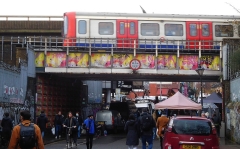
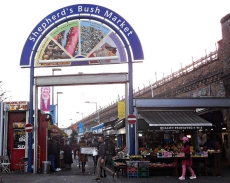
Shepherds Bush Market (‘Bush’ for short) is many things that Shepherds Market is not. The Bush market runs along a lane next to the railway arches above which trains run between Shepherds Bush Market and Goldhawk Road stations. Although it is an enjoyable place to visit. the Bush market is not at all ‘chic’ or ‘luxurious’; it is the opposite. However, it is a real street market with a few full-size shops that are housed in the arches under the railway tracks. The clientele of the market looks far less prosperous than the people you can see in Shepherd Market, and they come from a wealth of diverse ethnic backgrounds. On a recent visit, many of the vendors were Sikh men.
The Bush market offers a wide variety of fruit, vegetables, meat, fish, spices, pulses, plenty of other food products from all over the world, and many non-food items. If you are looking for, clothes, hats, shawls, shoes, suitcases, cooking utensils, ‘phone accessories, artificial flowers, tailoring, household goods, and you name it, you should head for the Bush market. Normally, this street market is crowded and busy. However, when we went there in early December 2020, there were few other shoppers to be seen. One stall holder explained that the decline in footfall was due the covid19 pandemic. This did not surprise us as much as what he said next. And that was the market had suffered because of lack of tourists due to the pandemic’s effects on tourism. According to him, the Bush market depends heavily on foreign visitors. That astonished me because I had always assumed that it was a market that catered mainly to locals.
Like Shepherds Market, the Market in Shepherds Bush contains a variety of eating places and nearby Shepherds Bush Green is surrounded by reasonably priced eateries.
Although I have not done it yet, a walk from Shepherds Market to Shepherds Bush Market would be most fascinating. It would be a stroll through the history of London’s westward spread that occurred between the early 18th century and the beginning of the 20th.
Both of the markets I have described are well-worth exploring. If I had to choose one over the other, that would be most difficult for me. I love the bustle and variety of markets such as that at shepherds Bush. However, that is not the only place you can enjoy such an atmosphere in London. Shepherds Market in Mayfair has a uniqueness that I have not found in other parts of London. It is a serene yet vibrant oasis in one of the busier parts of the city. So, let me drink a cortado or macchiato at Shepherds Market, and let me buy my halal lamb at Shepherds Bush Market. I will enjoy both experiences equally.
A CROWD OF CROOKS is out to steal your money, but they vary considerably in skill. Today, I received the following email bearing the triangular logo of the DVLA (Driver and Vehicle Licensing Agency). It was addressed to my email address not to me, the licence holder, by name. It reads as follows:
_________
𝗬our 𝘃ehicle is no 𝗹onger 𝘁axed.
Dear myemailaddress@hotmail.com,
𝐃VLA have been notified electronically about you latest 𝐩ayment for your 𝐯ehicle tax failed because there is not enough 𝐦oney on you debit card.
We sent you a 𝐃VLA bill, and we still haven’t received 𝐩ayment.
Acknowledge that it’s illegal to drive your 𝐯ehicle until you’ve taxed it.
𝗧ax 𝘆our 𝘃ehicle – 𝗦TART 𝗡OW >
Notice: Un-taxed vehicles risk a fine of up to £240. 𝗬our 𝘃ehicle is no 𝗹onger 𝘁axed.
Many of the letters in the email were in bold type. The words ‘START NOW’ is a hyperlink, which I did not click. Initially, I was concerned, but only for a few seconds. This obvious scam contains something in common with many other scam emails that try to worry the reader into believing that something momentous might happen if the instructions in the email are ignored. That common factor, which is well-illustrated above is bad use of the English language. For example, in this case:
“𝐃VLA have been notified electronically about you latest 𝐩ayment …”,
and
“Acknowledge that it’s illegal to drive your 𝐯ehicle until you’ve taxed it.”
Neither of these mistakes would have been made by the DVLA, nor would that organisation have signed itself as “@GOV.UK, Vehicles Service Manager”
Also, the DVLA would know my name and would address me by that, rather than by my email address. Just in case you missed the erroneous wording of the email, you might become suspicious of the sender’s email address: pashegm@hotmail.com, which does not look like the kind of email address that the official DVLA would use.
So, there is a great need to brush up on your use of the English language if you wish to succeed, you contemptible bunch of damnable scammers.
In brief, this scam email was hardly convincing, and the dishonest sender deserves to reap a poor reward, if any, for his or her pathetic attempt to rob me of cash or, worse, sensitive banking or similar details. So, please read all emails carefully before making an error that you might easily regret.
I have received news of two books about Albania. One, an intriguing novel, is written by American born Kim Malaj. The other, a collection of Albanian folk tales is written by her husband, Arti Malaj, who was born and brought up in Albania. I look forward to reading them in the future. Why not give them a try, and let me know how you enjoyed them?
THE NOVEL:”CASTLE OF TESKOM” by Kim Malaj
‘Shiny ember rocks are fuel for time; the dull rocks are a fool’s dime.’An old nursery rhyme, or so they think. Itra and Danae stumble across an ancient secret kept hidden behind a reflection in time near their Albanian home. A faded memory and cryptic messages have propelled them to risk an encounter with foes from Greek mythology, altering their perception of Albanian folklore and reality. Itra and Danae grapple with events set in motion centuries ago and must choose toprotect and serve or risk having the secret exposed. Will love, loyalty, and lineage be enough to hold them together, or will they lose their way in auniverse they are only beginning to understand?
THE FOLK TALESNORTHERN ALBANIAN FOLKTALES, MYTHS AND LEGENDS
by Arti Malaj
Generations of Northern Albanian are known as great storytellers. They shared many folk tales, myths, and legends with their descendants. The collected short stories include mysterious legends of lost treasures, mystical tales of mountain fairies, superhuman powers, century-old witches, blood feuds, and more written by a twelfth-generation Albanian. The lands described in the stories are still visible today, and locals share a sense of wonder and respect the mysteries that hide beneath. Northern Albania is a true treasure of raw natural beauty and a hidden gem in Southeastern Europe.
A WIDE FOOTPATH runs south from Piccadilly along the eastern edge of Green Park. We have walked along this many times, but it was not until a few days ago that we noticed a small alleyway leading east from the footpath about 190 yards south of Piccadilly. This unmarked footway, which is barely wide enough for two people to pass each other, passes under a building and emerges opposite the Stafford Hotel on St James Place, a short cul-de-sac with a dogleg, which leads off St James Street. St James Place, whose construction began in 1694, is an attractive short street lined with many fine buildings, some of which I propose to describe. What made this lovely quiet road interesting for me was that several fascinating people have been associated with it. I will begin with a relatively recent inhabitant.
Number 9 was home to Sir Francis Chichester (1901-1972), who circumnavigated the world single-handedly in 1966/67. He lived here from 1944 to 1972. He sailed in his boat named Gypsy Moth IV. In 1929, Sir Francis attempted another exploit, to fly from New Zealand to Australia in his ‘plane, a de Havilland Gypsy Moth. He made the first ever flight from New Zealand to Australia. He was also the first person to land a ‘plane on both Norfolk and Lord Howe islands. If you want to see his historic boat, then you need to get down to Greenwich, where it is on display close to the much larger Cutty Sark.
There is another building in St James Place, which associated with water transport. The elegant number 20, an 18th century building, has been the London Club House of the Royal Ocean Racing Club since 1942. The Club was founded in 1925. Between 1822 and 1857, the building housed the servants who worked in number 21, which was demolished during WW2 (www.british-history.ac.uk/survey-london/vols29-30/pt1/pp511-541#h3-0019).
Not far from Chichester’s house is number 4. This is the house from which the short-lived Polish born pianist and composer, Frederick Chopin (1810-1849), departed to give his last public performance at the Guildhall on the 16th of November 1848 (www.chopin-society.org.uk/articles/chopin-britain.htm). It was held:
“… in aid of a Polish charity, came at the end of a difficult six-month British sojourn, which had included concerts in Manchester (one of the largest audiences he ever faced), Glasgow and Edinburgh… Finally back in London, the composer-pianist spent three weeks preparing for what turned out to be his final recital by sitting wrapped in his coat in front of the fire at St James’s Place, attended by London’s leading homeopath and the Royal Physician, a specialist in tuberculosis. A week after the concert, he was on his way home to Parisian exile and death the following year.” (www.londonremembers.com/memorials/frederic-chopin-st-james-s-place).
Before discussing the most curious inhabitant of St James Place, I will discuss one of its famous residents, the writer and politician Joseph Addison (1672-1719), who founded “The Spectator” magazine in 1711. According to Peter Cunningham in his “Handbook of London” (published in 1850), Addison was living in St James Place by 1710. I am sure that we did not see any memorial celebrating this on any of the buildings in the street. Cunningham wrote, quoting from another source:
“Addison’s chief companions before he married Lady Warwick (in 1716) were Steele, Budgell, Philips, Carey, Davenant, and Colonel Brett. He used to breakfast with one or other of them at his lodgings in St James Place …”
His companions listed above were probably sympathetic to Addison’s Whig politics. However, Cunningham gives no indication of Addison’s address. He frequented the St James Coffee House in nearby St James Street, as he recorded in issue number 104 of his “Spectator”:
“That I might begin as near the fountain head as possible I first of all called in at St. James’s, where I found the whole outwardroom in a Buzz of Politics. The Speculations were but very indifferent towards the Door, but grew finer as you advanced to the upper end of the room, and were so very much improved by a knot of Theorists who sate in the inner Room, within the steam of the Coffee Pot, that I there heard the whole Spanish Monarchy disposed of; and all the line of Bourbons provided for in less than a Quarter of an Hour.” (https://www.british-history.ac.uk/survey-london/vols29-30/pt1/pp459-471#h3-0014)
The coffee house was at number 87 St James Street. It was demolished to make way for a new building, erected 1904/05.
Wikipedia (https://en.wikipedia.org/wiki/St_James%27s_Place) lists many other notable residents of St James Place, including Oscar Wilde and Lord Randolph Henry Spencer-Churchill, but omits one very interesting person, William Huskisson (1770-1830), whose residence at number 28 is commemorated by a plaque. This records him as having been a ‘statesman’. He was that as well as a financier and several times a Member of Parliament. He lived in Paris between 1783 and 1792 and witnessed the French Revolution. Although he had an active political life, what makes him remarkable was the manner of his death.
Against the better judgement of his physician, Huskisson attended the opening of the Liverpool and Manchester Railway on the 15th of September 1830. Thomas Creevey (1768-1838) related the story in a letter written to a Miss Ord on the 19th of September 1830:
“Jack Calcraft has been at the opening of the Liverpool railroad, and was an eye-witness of Huskisson’s horrible death. About nine or ten of the passengers in the Duke’s car had got out to look about them whilst the car stopt. Calcraft was one, Huskisson another, Esterhazy, Billy Holmes, Birch and others. When the other locomotive was seen coming up to pass them, there was a general shout from those within the Duke’s car to those without it, to get in. Both Holmes and Birch were unable to get up in time, but they stuck fast to its sides, and the other engine did not touch them. Esterhazy, being light, was pulled in by force. Huskisson was feeble in his legs, and appears to have lost his head, as he did his life. Calcraft tells me that Huskisson’s long confinement in St. George’s Chapel at the King’s funeral brought on a complaint that Taylor is so afraid of, and that made some severe surgical operation necessary, the effect of which had been, according to what he told Calcraft, to paralyse, as it were, one leg and thigh. This, no doubt, must have increased, if it did not create, his danger and [caused him to] lose his life.”
(quoted from “The Creevey papers; a selection from the correspondence & diaries of the late Thomas Creevey, M.P., born 1768 – died 1838. Edited by Sir Herbert Maxwell”)
Thus, Huskisson achieved the dubious distinction of becoming one of the first widely reported casualties in a railway accident. The ‘Duke’ mentioned above was the Duke of Wellington and the engine that caused Huskisson’s death was the “Rocket”, a pioneering locomotive designed by Robert Stephenson in 1829. I wonder why his demise was not noted on the commemorative plaque.
Huskisson’s former home has a superb front door flanked by iron lampstands each with its own conical torch flame snuffer. St James Place has plenty of fine 18th century buildings as well as some newer ones. These include the Stafford and Dukes Hotels, which are late 19th and early 20th century in appearance. Number 26 St James Place, a mid-twentieth century building, bears a Civic Trust Award. It is a block of flats built 1959/60 to the designs of the architect Denys Lasdun (1914-2001), who also designed the National Theatre on the South Bank. It replaced an 18th century house that was destroyed by bombing in WW2. Although not unpleasing, it stands in stark contrast to the far more elegant older buildings near it.
Even greater contrast to its surroundings is the building on the northern corner of St James Place and St James Street. This avant-garde metal-clad structure, the Target Building, designed by Rodney Gordon (1933-2008) and completed in 1984, is opposite William Evans gun shop and houses the Stern Pisarro art gallery on its ground floor. One of the galleries owners, Lélia Pissarro, is a great-granddaughter of the Impressionist artist Camille Pissarro (1830-1903). The gallery specialises in Impressionist art amongst other things. While on the subject of art galleries, it would be easy to walk past number 6 St James Place without noticing a small plate on its front door that says ‘Agnews Est 1817’. Between 1877 and 2013, this gallery, which deals in the highest quality works of fine art (e,g. Caravaggio, Rubens, Rembrandt, and Velasquez) was on Old Bond Street. Then, it relocated to number 6.
St James Place is only 180 yards in length, but as can be seen from the small selection of buildings I have chosen to describe, it is choc-full of historical associations. I am pleased that we discovered the tiny alley that led from Green Park to this fascinating cul-de-sac. And, finally, if you find that you are getting tired of staying at the Ritz Hotel, you would do well to book into one of the two hotels discreetly located in St James Place.
[PS I have not dealt with Spencer House because I hope to write about it in the future]






 yamey
yamey 