A stroll along Gujarati Road

SOME YEARS AGO, I bought a book in the antique shop on Princess Street in Fort Kochi. It is a modern reproduction of a book published in about 1910. Its subject matter, mostly in English, is a detailed description of the benefits of living in Cochin. Its intended audience was Gujarati speaking people thinking of settling in the area. It was aimed at Hindus, Moslems, Jains, and Parsis.

A few days ago (in February 2023), I purchased a recently published book by Bony Thomas called “Kochiites”. It describes the many different communities that have settled in Kochi. One brief chapter is about the small group of Dawoodi Bohri, Shia Moslems, who live south of the historic centre of Kochi. Another is about the Hindu and Jain Gujaratis (and Kutchis), whose communal activities are centred along the 1 mile long Gujarati Road. As my wife has roots in Kutch and the rest of Gujarat and we enjoy visiting those parts, we decided to take a stroll along Gujarati Road, which is in the Mattancherry District of Fort Kochi. It was Sunday morning.

Gujarati Road runs in a north south direction. We began our exploration at the Jain temple and moved southwards. At the Jain temple, we were not the only tourists. My wife was the only visitor who could speak in Gujarati with the lady who showed us around the spotlessly clean Mandir. Its interior has a beautiful inlaid multicoloured floor and the inside of the main dome was a replica of the kind of domes with concentric ridges that one sees in mediaeval Hindu and Jain temples, as well as in mosques constructed during that period. Photography was not permitted within the temple.

Our next port of call was the shop of Chamanlal H Mithalwala. For many generations, this shop, owned by Gujaratis, has been selling Gujarati sweets and farsan (savoury snacks). We were able to buy some freshly made dhokla. However, we were told that khandvi always runs out in the early morning on a Sunday, soon after it has been made. The owner is Kutchi, as are many of the folk who live near Gujarati Road.

The Sri Jalaram Dham, a Hindu temple frequented by Gujaratis and financed by them, is almost opposite the sweet shop. Built quite recently (2012), it is not particularly noteworthy architecturally. It contains several brightly coloured idols and a small tulsi tree grows outside. The priest (pandit) told us he came from Rajkot, and almost all of the worshippers are Kutchis.

Just to the south of the Jalaram Dham, we reached the Sri Cochin Gujarati Vidyalaya, a Gujarati school in which most of the teaching is done in English. Founded in 1920, it has about 3000 pupils and covers education from lower kindergarten to college entry.

Within the school’s compound, there is a Hindu temple – about 140 years old. Its ceiling is decorated with larger than life bas-relief lotus flowers. We spoke with a trustee of the temple, who showed us some of the original idols and explained that in the area there are about 200 Gujarati families. Of these, 48 are Kutchi Bhatias, about 100 are other Hindu Gujaratis, and the rest are Jain. The temple is Shaivite. Our informant told us about another temple, which is Vaishnav and is frequented by the local Kutchi Bhatias. This interested us because my wife’s mother was a Kutchi Bhatia.

As can be seen all over Gujarat, there is a chabutra (dovecote) next to the temple. There is another one at the Jain temple, mentioned above

We continued south along Gujarati Road, passing the Gujarati Bhavan (which we did not enter) and several wonderful fruit and vegetable stalls.

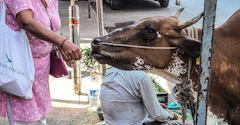
Near the fruit and veg shops, which are located near the southern end of Gujarati Road, there is yet another temple – the Shri Navneeta Krishna Mandir. This is the Vaishnav temple used by many of the Kutchi Bhatias. The main temple was locked up, but behind it there was a lot of activity. This was centred around the mandir’s gaushala (cow shelter), where cows are provided with a pleasant home.

Worshippers were feeding the cows and calves. They were also placing cloths on the cows before handing them to the priest who was standing amongst the congregation. We were asked to touch one of these cloths before it was handed to the priest. The congregants took it in turns to touch the priest’s feet, and receive a blessing.

Near to the temple, there is a large housing compound, all of whose residents are Kutchi Bhatias. One sweet couple invited us into their ground floor flat, saying to us: “Welcome to our home. As guests, you are gods.”
We chatted with them both in English and Gujarati. They gave us lovely cups of chhaas (buttermilk, a typical Kutchi drink). They offered to cook us lunch, but we declined because we had to get somewhere else. This charming couple, Deepika and Harish, did not want us to leave. When we did eventually go, I felt that we had been in the company of genuinely warm-hearted loving people.

Before setting off for Gujarati Road, I was worried that it might offer little of interest. How wrong I was! Although I have only briefly summarised our experiences, we saw many interesting places and met many friendly people. Over the years I have been falling in love with Gujarat and Kutch. This small outpost of people from that part of India in Kerala has only increased my affection for Kutch and Gujarat.

[NB Kutch, which is now a large district in the State of Gujarat, was an independent kingdom until 1947. Even today, no self-respecting Kutchi likes to be called a Gujarati!]

A letter box in Kerala

I VISITED INDIA at least 50 times over the last 29 years. It was not until this trip (2022-2023) that I began noticing letter boxes of historic interest. I spotted three of interest in Bangalore, and now I have found one outside the post office in Fort Kochi in Kerala.

Painted green with some gold coloured details it is hexagonal with a decorative top. Between the words “Post” and “Office”, there is a British royal cipher with the lion and unicorn. Beneath this is a V and a R entwined, a logo I have seen on Victorian letter boxes in the UK.

The old letter box, now sealed up so that nothing can be put in it, stands close to the verandah at the front of the post office. Within the verandah, there is a panel giving some information about postal services in the former Kingdoms of Cochin and Travancore

Postal services began in the Kingdom of Cochin in about 1864. It was known as the Anchal Service. The letter box described above might have been an Anchal post box originally, although it is unlikely.

According to an article (https://englisharchives.mathrubhumi.com/news/offbeat/last-anchal-runner-of-kerala-passes-away-1.3462681#:~:text=Anchal%20Post%20was%20the%20postal,on%20which%20bells%20were%20attached):
“Anchal Post was the postal service system started and existed during the Kingdom of Travancore to transfer official letters and documents. The post man of this system was called anchal pillai. He used to run carrying the dispatches in a bag with a stick on his other hand on which bells were attached.”
He used to run eight miles a day. People were required to make way for this important courier, and not to impede his progress. The last surviving anchal pillai, Kannan Chapli, died aged 90 in 2019.

The post office outside which stands the historic letter box is on Ridsdale Road opposite the east end of the church of St Francis (Church of South India), and was constructed in May 1928. At that time, Fort Kochi was in the Kingdom of Cochin. In 1949, it and its neighbour, The Kingdom of Travancore, were integrated into India and merged to form the State of Thiru-Kochi. In 1956, this state was renamed Kerala and its postal service became incorporated into the Indian Post system.

Interestingly, the post box outside the Fort Kochi post office bears the intertwined V and R. The information panel has a drawing of an anchal letter box. Similar in shape to the Victorian post box, the one in the drawing bears a different logo and the words “Travancore Anchal” and something in Malayalam script. If I am not mistaken, Cochin, unlike Travancore, became a British Protectorate. In which case it might well have become part of the British Indian postal system. This could explain why the historic letter box in Fort Kochi has a British logo instead of that used in the Anchal system. There might also have been Anchal boxes in the Kingdom of Cochin, but I am uncertain about that.

Today, letters are posted in a simple red cylindrical letter box not far from the historic one. The Victorian letter box is one of a huge number of interesting historic survivals that can be seen whilst wandering around Fort Kochi.

Six-pointed stars in Kochi (Kerala)

SIX-POINTED STARS IN KOCHI

MY FIRST VISIT TO Fort Kochi (Fort Cochin) in Kerala was in 1994. By then, I already knew that there was one or more Jewish communitis in Fort Kochi (‘Kochi’). As we drove into Kochi, I noticed many six-pointed stars, all identical to Jewish Stars of David (‘Magen David’). For a while I was amazed by the sight of so many of what I believed then to be Jewish shops and other establishments. Not long after this, I became aware that like the Om and the swastika, the six pointed star is a commonly used Hindu symbol. For example, the Canara Bank, not a Jewish outfit, uses the six pointed star as its logo.

Several communities of Jewish people lived in Jew Town, which is in the district of Mattancherry. Today, flocks of tourists visit the area to explore its numerous handicraft shops and the beautifully preserved Dutch (Paradesi) Synagogue, whose floor is paved with blue and white tiles made many centuries ago in Holland.

Apart from the much-visited synagogue, there are very few other buildings that have recognisable marks that indicate their former Jewish connections. On previous visits, I spotted what must have been another synagogue; a house bearing Magen Davids; and a locked up, well maintained Jewish cemetery.

Today, the 10th of February 2023, I spotted a building with Hebrew lettering above its main door. This edifice, which is undergoing restoration, is close to the Masjid Aisha on Jew Street, and about 0.5 miles south of the Dutch Synagogue. In need of much work, this is what remains of the Kadavumbhagam Mattancherry Synagogue (constructed by 1544 AD).

Kadavumbhagam Synagogue under restoration

Another building with well-documented Jewish connections, but no obvious marks, is currently being used to house exhibitions contemporary with the 2022/23 Kochi Muziris Art Biennale. Called the Kashi Hallegua House, this grand dwelling is about 150 yards south of the Dutch Synagogue. Above its carved wooden framed front door is the date 1761. This was during the period that the Dutch were the dominant European presence in the area: they were intimately connected with Kochi between 1663 and 1814.

For over 250 years, the Dutch house, formerly known as Krathi Veedu, was home to many generations of the Hallegua family. From where they originated, I have not yet found out but they were Paradesi – European Jews who arrived in Kerala from abroad, as opposed to Jewish people whose origins were other than European (no one knows from where they arrived in Kerala).

The last Jewish residents of the house, 85 year old Mrs Juliet Hallegua and her daughter Yael, left for Israel in 2019. The place was then purchased by Edgar Pinto, who converted the huge family home into an art gallery. Although the furnishings used by the Hallegua family have been removed, many of the original wooden window frames and cupboard doors are in place. The kitchen, now a gallery space, has a huge oven and a special carved stone workspace used for grinding food ingredients with a stone rolling pin.

The two Hallegua women were amongst the last of the Kochi Jews living in the town. There was another, Sarah Cohen (1922-2019) who lived very close to the Dutch Synagogue. Until she was in her nineties, she had a shop selling tablecloths and other handmade cloth items, many of them with Jewish decoration. Today, the only Jews in Kochi’s Jew Town are visiting Jewish tourists, a few of whom might have had ancestors who lived there.

Since our last visit in 2019, a couple of shops have opened. Named Shalom, their signboards bear the Jewish six pointed star. The company sells ready-made garments, but I suspect that apart from the name, it has no Jewish connections … but I might be wrong!

Cloud with a silver lining

AFTER A VERY DISAPPOINTING experience at a café we have often enjoyed when staying in Fort Kochi, we went to another eatery, which had been recommended by our friend Sharada S , when we visited Kochi at Christmas in 2019.

Our friend had introduced us to Oceanos. In this pleasant but unpretentious restaurant, we have enjoyed some of the best prepared sea food in Kochi. The dishes served at Oceanos are not only tasty but also authentic, by which I mean that they are not prepared to be ‘fine dining’ fancy; instead they give a good experience of genuine Keralan food.

Currently (February 2023), In addition to an á la carte menu, there is a seafood set lunch – a seafood thali. This included deep fried mackerel; clams (vongole) out of their shells; Aleppey fish curry; roasted prawn curry; sardine steamed in a banana leaf; Malabar paratha; rice; chhaas (buttermilk); and payasam (a local dessert). Every item was exquisitely prepared and tasted very fresh. This wonderful, faultless meal was 390 INR (£3.90) per head. We plan to explore the rest of the menu at Oceanos in the next few days.

Had it not been for the incompetent management at Kashi Art Café today, we would have eaten lunch there. However, as we had not been served our food for almost one our after ordering it, we asked for an explanation of the delay, and were told that there was a problem with the gas in the kitchen. Having been told that we would have our food “in about 10 minutes”, we walked out. If we had been served our food sooner, or been given an explanation without having to ask for one, we might have missed out on the superb lunch at Oceanos.

A statue and an art biennale

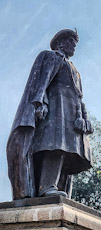
SUBHASH CHANDRA BOSE Park, formerly named Irwin Park, runs parallel to the seashore at Ernakulam in Kerala. At the south end of this pleasant open space, there is a tall statue depicting Sri Sir Rama Varma GCIE, LLD, Maharaja of Cochin (c1861-1941). He reigned between 1932 and 1941. The statue was unveiled in January 1939 by the then Viceroy of India, Lord Linlithgow during a visit to the city. He was Viceroy from 1936 to 1943.

Rama Varma

While visiting Ernakulam that day, the Maharajah arranged for him to watch a display of Bharatnathyam dancing (https://www.cochinroyalhistory.org/). This was held before tea in the grounds of the Maharaja‘s nearby Durbar Hall. The statue was unveiled after tea.

The Durbar Hall was constructed over 100 years ago in extensive grounds owned by the Maharajahs of Cochin. For many years, it has been used as an art gallery. Beautifully restored by the organisation that runs the Kochi Muziris art biennale, it serves as one of the art festival’s venues during the 4 months that the Biennale runs. The current 2022/23 event in the Durbar Hall is a show called “Idam” which contains a variety of visual art exhibits, all of which have been created by 34 Malayali artists. Overall, it is an enjoyable exhibition by artists displaying an exciting variety of interesting imaginative ideas, all expressed in well executed artworks.

The works in the Durbar Hall are in stark contrast to the Maharaja‘s statue that stands in the hot sun not too far away. Unlike the Maharajah, who was probably unwilling to break out of his comfortable colonial mould, the artists are showing that they are willing to attempt to escape from prevailing convention

Black Horse and a festival

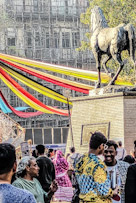
THE KALA GODHA (Black Horse) is a statue in the heart of old Mumbai. It was erected in 2017 and designed by Alfaz Miller and sculpted by Shreehari Bhosle. It stands on the site of an equestrian statue of King Edward VII, which was removed from this spot in 1965 (and can now be seen in Byculla Zoo).

The Kala Godha

The statue gives its name to an annual arts festival, The Kala Godha Festival, that has been held since.1999. It has grown over the years and attracts many visitors. People come to enjoy film, literary events, heritage walks, booksales, exhibitions, artworks, other cultural happenings, and sales of handicrafts from all over India.

Held for nine days in February, this festival is a lot of fun.

A temple in Mandvi: architectural revival or survival?

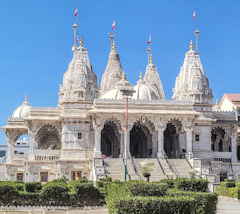
THE SWAMINARAYAN TEMPLE in Mandvi (Kutch, Gujarat) was constructed between 1991 and 1999 to replace a smaller Mandir on the site. Without going into the details of its very fine architectural and decorative features, this edifice was financed by local Kutchi followers of Swaminarayan. The Rajasthani Marble that forms the temple’s structure was hand carved by workmen, all of whom were followers of Swaminarayan. The stones that make up the building were carved in Rajasthan, transported to Mandvi where they were put together to make the edifice. This is similar to how the great temple in London’s Neasden was constructed.

Swaminarayan Mandir in Mandvi

The temple at Mandvi looks very similar to ancient Hindu temples I have seen elsewhere in India. As you look around it, you can see how the very old temples looked when they had just been built many centuries ago. Apart from the fact that Mandvi’s Swaminarayan Mandir looks recently built, a layman like myself, would find it difficult to age the building.

In 19th century England, many new churches were built in the gothic style. Like the newish temple at Mandvi, may of them faithfully reproduce the churches built in mediaeval times. The only thing that differentiates the 19th century Gothic Revival churches from their mediaeval predecessors is that they look too new to be as old as them.

In a book about Gothic Revival written by the art historian Kenneth Clark (1903-1983), he suggests that in England the use of gothic style in architecture never actually died out, and this suggested to me the Gothic Revival was really gothic survival. As far as I can gather, the same is the case for Hindu mandir architecture. If this is really the case, new temples such as Mandvi’s Swaminarayan Mandir is not the revival of the use of an ancient style of architecture, but an example of its survival. Put another way, the new temple at Mandvi is a reincarnation of its predecessor.

Exotic vegetables and a building in Paddington

EXOTIC VEGETABLES AND PADDINGTON STATION

CRAWFORD MARKET IN central Mumbai was completed in 1869. Its British architect William Emerson (1823-1924) designed it in an Indo-Saracenic style, which attempted to combine Victorian Gothic and Indian architectural features.

Crawford Market

I am familiar with some of Emerson’s other buildings. One of them is the Nilambagh Palace in Bhavnagar, Gujarat. Now a hotel, we have stayed there. Another building, which is closer to our home in London, is the Clarence Wing of the St Mary’s Hospital in London’s Paddington. You can read more about the hospital in my book “BEYOND MARYLEBONE AND MAYFAIR: EXPLORING WEST LONDON”, which is available from Amazon.

Two of the entrances to the market hall are surmounted by lovely bas-reliefs, which were created by Rudyard Kipling”s father John Lockwood Kipling (1837-1911). The building was the first in India to be lit by electricity. This was added in 1882. There is a noteworthy Gothic revival drinking fountain in the market hall. This was gifted by Cowasji Jehangir. Many cats and kittens were running around its base. No doubt at night, they threaten the rodents that might be lurking around the market. During the day, they are given tidbits by the market traders.

The market is mainly for food and household goods. When driving past it on the nearby JJ Flyover, there is usually a whiff of fish emanating from it. However, within the market, this is not noticeable.

Amongst the numerous vegetable stalls, we noticed a few selling typical European products such as lollo rosso lettuce, fresh basil leaves, and other herbs associated more with European cuisine than Indian. At one of these stalls, we spotted Chinese cabbage and pak choi. The stalls selling these described themselves as purveyors of “exotic” or “English” vegetables.

A visit to Crawford Market is always worthwhile. You are likely to be approached by porters who will offer to follow you around whilst you shop. They will carry your shopping in cylindrical baskets, which they balance on their heads. As we were ‘just looking’, we did not take up their offers.