Unknown's avatar

About yamey

Active author and retired dentist. You can discover my books by visiting my website www.adamyamey.co.uk .

A tropical Utopia

WE MADE A BRIEF VISIT TO THE TOWNSHIP OF AUROVILLE near Pondicherry to visit a friend, one of the approximately 3000 members of this international ‘utopian’ community. Created in 1968, it was inspired by Mirra Alfassa (1878-1973), the spiritual companion and collaborator of Sri Aurobindo. She wrote:
“Auroville wants to be a universal town where men and women of all countries are able to live in peace and progressive harmony, above all creeds, all politics and all nationalities. The purpose of Auroville is to realize human unity.”

Whether or not this has been achieved, I am not qualified to judge. However, Auroville, fifty years after its conception, is a lovely place to visit. It is home to many people with a creative turn of mind and attracts many people who take an interest in the arts.

Members of the Auroville community have built themselves homes and workshops with aesthetically pleasing ‘modern’ and contemporary architecture. These buildings, including structures for communal use, such as galleries, performance spaces, and restaurants, are well spaced and separated by tamed luxuriant wilderness.

During our short visit, I noticed a building, the offices of an architect, that reminded me of the Sangath Studio in Ahmedabad (Gujarat). Sangath was built between 1978 and ‘80 by the architect BV Doshi, who still uses them as his offices. Both the offices in Auroville and in Ahmedabad make use of long hemi-cylindrical concrete roofs covered with mosaics of fragments of white, sun reflecting broken ceramic tiling. Our friend thought that the studio in Auroville was built in the 1990s, but did not know whether the architect who works there was ever Doshi’s student or collaborator.

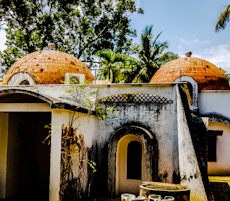
Near to the studio, we saw a tile covered brick dome above a small building. Our friend explained that this was the first free standing brick dome to be built in Auroville. In order to build it, he and his associates had to rediscover the lost art of constructing free standing brick domes.

We ended our short visit to Auroville with a superb lunch at the attractive Garden Café, which was designed by the architect whose office in Auroville I have described above.

Anybody visiting Pondicherry with an interest in the future of humanity should take a look at Auroville because, in the words of Mirra Alfassa: “For those who are satisfied with the world as it is, Auroville obviously has no reason to exist.”

Denmark in the tropics

I HAVE WANTED TO VISIT TRANQUEBAR (now called Tharambangadi) since I first heard of the place when I was a teenager in the 1960s. Danish settlers established a fort and their first trading post in India there in 1620. I had already visited the former Danish colony at Serampore (established by 1770) on the River Hooghly, and was keen to see what remains of Tranquebar.

We drove south from Pondicherry for three hours through flat terrain, passing huge rice paddies, negotiating sprawling towns and villages, and crossing numerous rivers and streams.

Tranquebar, a sleepy little place on the wave washed shore of the Bay of Bengal, contains a sizeable collection of buildings constructed by the Danes during their tenure of the town, which finally ended in 1845, when the Danes sold it to the British.

During the Danish era, there were three main churches. One of them built by the seashore was been destroyed by the sea long ago. The Zion Church, the oldest Protestant church in India, was consecrated in 1701. It is now used by the Church of South India. It was founded by a German Bartholomew Ziegenbald (1682-1719). He was educated at the University of Halle, where my great great grandfather received his doctoral degree in the early 19th century, and was sent (with his fellow student Heinrich Plütschau) by the King of Denmark to become the first Lutheran missionary in India.

Ziegenbald was a remarkable man. During the last few years of his life, which were spent in India, he was involved in Lutheran missionary work (countering the activities of Catholic missionaries), literary work, translating the Holy Bible into Tamil, running a printing press, and conducting church services.

The New Jerusalem Church, larger than the nearby Zion and designed with its nave equal in length as its transept, was consecrated in 1717, two years before Ziegenbald died. He was buried in it. The church remains a Lutheran place of worship. Its parish priest, Mr Samson, guided us around its plain interior and told us that about sixty local families worship there regularly. The church is partly surrounded by a small cemetery, some of its gravestones bearing Danish names.

Ziegenbald’s home, now located within the grounds of a school, contains a small museum. The groundfloor contains a portable reed organ, some manuscripts related to Ziegenbald, and two printing presses that were acquired long after Ziegenbald died. One of these presses, made in London in the 19th century, was being demonstrated to a group of Tamil Lutheran visitors.

I watched as Tamil letters were covered with red ink before being covered with a sheet of white paper. The press was then operated manually. When the paper with Tamil letters was removed and shown to the visitors crowding around with cameras poised in readiness, everyone applauded. Then, the demonstration completed, the group sung a hymn in Tamil, praising God for creating such a technological miracle.

The Ziegenbal house museum is currently curated by a German, Jasmine. She encouraged us to see a small bur lovely exhibition of artworks by two German artists from Halle, where Ziegenbald studied long ago. Then, she introduced us to an Indian artist Asma Menon, who is creating a Cabinet of Curiosities similar to a very old one that is kept in Halle and contains objects collected in India long ago. Her creation that will be housed in a cabinet similar to the one in Germany will contain a series of object that captures the ‘essence’ of Germany, as she found it on a recent visit to Halle and other German cities. We spent time talking with Asma and a young volunteer from Germany.

Aaron Hall, next to the former home of Ziegenbald, is named in memory of Reverend C Aaron (1698-1745). A Tamil, he was the first ever non-European to be ordained as a Lutheran pastor. He was ordained in December 1733. He had been baptized earlier by Ziegenbald. Jasmine told us that when Aaron was ordained, there had been massive objections to this back in Germany, but the ordination took place despite these.

The Neemrana “non-hotel” hotel at Tranquebar is housed in the picturesque former British Collector’s Bungalow close to the sea shore. Unfortunately, its restaurant proved to be rather a ‘non-restaurant’: poor food and very poor service. Most of the other diners were late middle-aged Danish tourists nursing cans of Kingfisher beer. Foolishly, I ordered pasta with “aglio olio”. What turned up was penne drowning in an a virulently bright reddish orange coloured sauce that tasted as if it contained tomato ketchup as its main ingredient.

Lunch over, we strolled along the beach passing a monument recording the arrival of Ziegenbald in India. This overlooks a small harbour surrounded by partially ruined stone walls. Men were bathing in its water which was calmer than the sea around it. From where we were walking, we could see row after row of foam crested waves breaking on the shoreline that stretched away to the southern horizon.

The fort built by the Danes under the command of Admiral Ove Gjedde (1594-1660), Fort Dansborg, is still pretty much intact. It contains a small museum with an odd assortment of exhibits – a bit of a jumble. I was intrigued by several fading Maratha paintings and a 12th century Indian stone carving in good condition.

As I stood by the well in the large central open air courtyard of the Fort with the afternoon sun beating down on me at the temperature well in excess of 30 degrees Celsius, I wondered how the Danish settlers and soldiers coped with a climate so different to what they were used to in Denmark. I was able to dive back into our air conditioned taxi after a few minutes in the sun. This option was not available in the centuries when the Danes and Germans spent months and years in Tranquebar. Even the interior of the Fort, with its thick walls, was not greatly cooler than outside.

The Fort is separate from the former British Collector’s Bungalow and the former Danish Governor’s House by a spacious sandy maidan. The Danish Governor’s House neighbours a smaller and more recent edifice named “Danish Indian Cultural Centre”. This contains a library and a small museum. Amongst the exhibits, there are several drawings and paintings by the former Danish Governor Peter Anker (lived 1744-1833; governed 1788-1806). All of his attractive artworks on display are of Indian subjects.

The former Danish Colony of Tranquebar is in Tamil Nadu. About ten kilometres or less the coastal road leading south from Tranquebar leaves the state of Tamil Nadu and enters a part of the Union Territory of Pondicherry separated from the city of that name by over a hundred kilometres of Tamil Nadu. Like Mahe, a tiny part of Pondicherry on the coast of the Arabian Sea and Chandernagore in West Bengal, this southern territory, containing the town of Karaikal, was a French colony. Yanaon, surrounded by Andhra Pradesh, was yet another French colony and is now part of the Union Territory of Pondicherry.

Karaikal became a French colony in 1674 and remained as such until about 1954. At first sight, it looks like a typical, unexceptional modern Tamil urban area with a few decaying old buildings stuck within a mass of architecturally unexceptional buildings. However, our driver, a Tamil named Pierre, drove us to see what little remains of French colonial Karaikal.

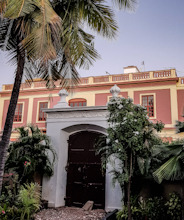
The most notable souvenir is the former French Governor’s mansion. Well conserved, the Governor lived on the first floor and his administration used the ground floor. This building, which is well over 200 years old, is now the Collector’s Office of Karaikal. Nearby, there is a French war memorial commemorating those who died in the two World Wars. The monuments single out campaigns in Algeria and Indo-China. Near this, there are a few architectural details that might have existed during the French era, but little else.

Unlike Pondicherry, which has retained its colonial charm and attracts many tourists, there is little to attract the average tourist to Karaikal. I am glad we went there because I find places like this, which hint at their largely forgotten history, very evocative and fascinating.

While I would not reccomend a visit to Karaikal, a few hours or more spent in Tranquebar will be very rewarding both to those interested in history and to lovers of the seaside.

THOSE MORONS

DR BR AMBEDKAR (1891-1956), lawyer and fighter for the rights of dalits (‘untouchables’), was the chief ‘architect’ of the Constitution of India ( adopted for use in late 1949). Highly educated, he had degrees from the Columbia University (USA) and the London School of Economics (LSE). While at the LSE, Ambedkar lived in a house near Primrose Hill, which has been preserved as a museum dedicated to his memory.

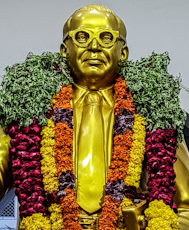
While walking along the splendid seaside promenade in Pondicherry, we visited a monument to Ambedkar, the Ambedkar Manimandapam. Opened in March 2008, this memorial complex contains a large statue of Ambedkar, some highly enlarged photos taken during his lifetime, and a small library.

The captions to the pictures are currently in the local language, Tamil, only. One huge painting depicting Ambedkar handing over a copy of the Constitution dated 1952 to various worthies including Jawaharlal Nehru and Maulana Azad had no caption identifying the persons in it. We asked a young lady, a Bengali, if she could name any of the men. She pointed at Motilal Nehru, Sardar Patel, and Rajagopalachari in addition to those we could identify ourselves. Pointing at Rajagopalachari, she said: “He must be some kind of ‘southie’.” He was a Tamil.

And then, pointing at the portraits, she added: “If it had not been for that bunch of morons, India would have become independent much sooner. They should have left it to Netaji.” She was referring to her fellow Bengali, the late Subhas Chandra Bose, whose Indian National Army gave the British an important jolt towards allowing India to leave the British Empire.

Black and white

HAVING PARENTS WHO WERE BROUGHT UP IN RACIALLY conscious South Africa, I feel easier calling the two parts of old Pondicherry by their French names, ‘Ville noire’ and ‘Ville blanche’, rather than their English names, ‘Black Town’ and ‘White Town’. The English names are redolent of the sad days of racial segregation in apartheid South Africa.

While Pondicherry was a French colony, most Europeans lived in White Town, and people of local Indian origin lived in Black Town. This kind of racial separation was not unique to the French in India. The British were also keen to keep races separate. Bangalore, for example, was divided into the Cantonment (European area) and the City (local Indian area).

A rather malodorous partially covered canal or drain separates White Town from Black Town (now called ‘Heritage Town’). White Town lies between Black Town and the shore of the Bay of Bengal.

Today, more than 60 years after the French ceased to Govern Pondicherry, the White Town continues to retain its appearance as a French colonial town. Many of the buildings were built by the French and are distinctly European in architectural style. The streets are neatly laid out, tree lined, and wide. There is none of the hustle and bustle associated with most Indian towns and villages. This might be because there is little commercial activity apart from tourist related facilities (accommodation and eateries). You can enjoy a good but costly meal in White Town, but buying a newspaper or fruit and vegetables is hardly, if at all, possible.

Since our last visit to Pondicherry five years ago (just before the great storm that flooded Chennai in late 2015), the city’s authorities have placed plaques along the streets of White Town. Written both in Tamil and English (not French!), they provide short informative histories of the streets’ names.

Cross the covered drain into what used to be called ‘Black Town’, and familiar Indian urban life is flourishing. The streets are crowded; there are shops aplenty; the area is full of traffic: two, three ,four (and more) wheeled vehicles; and there are Hindu temples (as well as churches). Apart from tiny roadside Hindu shrines, the only places of worship in White Town are churches.

In contrast to White Town, the architecture in the old Black Town is not so fine. There are a few traditional Tamil style buildings, but much of the architecture is relatively new and generally lacking in visual appeal.

Apart from being a very pleasant place to visit, Pondicherry and its well preserved historical layout offer an interesting reminder of colonial life and its less savoury racist aspects. That said, the place and its beautiful seaside promenade is a joy for all visitors whether or not they have any interest in history.

So near, yet so far

THE FLIGHT FROM BANGALORE to Chennai (Madras) is short: about forty minutes flying time. Some friends collected us from the airport in Chennai, and plied us with a tasty lunch. They recommended hiring an Uber taxi to ferry us from Chennai to Pondicherry (now ‘Puducherry’), a distance of about 100 miles. After three abortive attempts, a fourth driver pitched up and we set off for Pondicherry.

Our Uber driver was excellent and drove carefully. After just over two hour’s journey southwards along the luxuriant, verdant, well cultivated coastal plain, we reached a Pondicherry check post.

From 1674 until 1954, Pondicherry and its environs was a French colony. Occasionally, it was taken over by the British, but most of the time it was part of France. In 1954, a large majority of city elders voted in favour of ceding drom France. That year it became, and remain, an Indian Union Territory, independent of its hige neighbour Tamil Nadu. Old Pondicherry still contains many fine French colonial buildings and the policemen wear képis. Many of the road names are bilingual: Tamil and French. In addition, the town has no shortage of restaurants offering what is described as ‘French cuisine’. Although well populated with both Indian and foreign tourists, Pondicherry is a delightful place to relax and enjoy warm sea breezes.

To enter the Union Territory of Pondicherry, drivers of cars with registration plates from outside Pondicherry have to buy a permit to drive there. Our Uber driver’s car had Tamil Nadu plates. He stopped at the check post, which is about ten minutes drive from the heart of Pondicherry, and told us it would take about five minutes to get the permit. He gathered up his relevant documents and headed inside the checkpost. While we were waiting for our driver, we were parked next to an unpretentious stall serving Bengali food. It bore signs in three scripts: Bangla, English, and Tamil.

Instead of taking five minutes, we sat waiting for him for forty five minutes. This was because he had set out with one document missing. I sat waiting in the car thinking that without the entry permit, we were so near yet so far from our destination.

After some time and several telephone calls, our driver re-entered the checkpost, and emerged with the desired permit. He explained that he had bern sent a photo of the missing document by WhatsApp. This image of the document, rather than the original, satisfied those who issued the entry permit. We continued our journey. Just beyond the checkpost, I saw an obelisc, which looked old enough to have been put up by the French colonial authorities.

After settling into our accommodation, which I will describe at a later date, we took a pre-prandial stroll along the lovely seaside promenade. I was very pleased to discover that a place that had opened on the promenade a few months before our last visit to Pondicherry five years ago was still flourishing.

The Gelateria Montecatini Terme is a superb ice cream shop. It was set up just over five years ago by an Italian who has a business making luxury boats, anything from canoes to millionaires’ yachts. The gelateria is fully equipped with Italian equipment and refrigerated ice cream display counters. Stepping into this popular ice cream parlour in Pondicherry is just like stepping into a gelateria in Italy, and the ice cream is top class. The queues of customers attest that I am not alone in saying that.

The so-called ‘French food’ in Pondicherry is popular, but in no way matches up to the high standards often encountered in France. In contrast, the ice cream served at the Gelateria Montecatini Terme easily rivals the best in Italy. India never fails to be surprising!

Died in vain

THE FOCAL POINT OF GOLDERS GREEN (in north west London) is where Finchley Road meets Golders Green Road and North End Road. Here, there stands a monument to those inhabitants of Golders Green who lost their lives in the two World Wars.

The monument’s basic design is typical of many British war memorials erected all over the British Empire during the 1920s. Standing on a square base, this type of memorial resembles a tall obelisk, truncated by not rising to a point. The monument, which doubles up as a clock tower, in Golders Green, was erected in 1923. It includes lists of the names of those who were killed during each of the two World Wars.

A similarly designed memorial (but without clocks) was erected in Bangalore in 1928. It stands on a triangular traffic island at the intersection of Residency and Brigade Roads. It commemorates members of various battalions and regiments of the Madras Pioneers, who fell in the following campaigns: East Africa 1914-18; Mesopotamia 1916-18; The Great War; and The North West Frontier 1915.

The monument in Bangalore bears no names, but only numbers. For example, in Mesopotamia the following fell: 1 British officer, 3 Indian Officers, and 69 “NCOs and Pioneers”. For each campaign the statistics are given in both English and Tamil scripts.

Most of those men of Golders Green, whose names appear on the memorial there, were most likely volunteers, who believed that the British Empire had to be defended. I wonder if the same could be said for the Indian soldiers who are commemorated on the monument close to one of the busy shopping streets in central Bangalore.

Many Indians sacrificed their lives for the British Empire during the two World Wars and other military campaigns designed to maintain British dominance in the world. Unlike the men of Golders Green, many of the Indian victims were fighting for a cause in which they had no interest and from which they could expect little or no benefit, especially during First World War.

A great tragedy, which accounts for much loss of Indian life during WW1, was the belief amongst many Indian leaders (including MK Gandhi during the last months of the War) that by helping Britain to fight they would be rewarded with reforms that would bring India closer to self government. Indians had been as good as promised increased freedoms in exchange for fighting in the First World War. Although, many Indian lives were lost in WW1, these sacrifices were not considered by the British to merit any loosening of their grip on India, the jewel in the crown. Indeed, the opposite occurred. One needs only remember the Jalianwalla Bagh massacre of 1919 to see what I mean.

I found it sad that whereas in Golders Green, the dead are remembered by their names, in Bangalore the monument only records statistics. In 1928, the individual Pioneers were, apparently, not important enough to be remembered as individuals, members of families like those in Golders Green.

Searching for Samsung

ONE OF OUR SAMSUNG mobile phones needed repairing while we were in Bangalore. Using the Google search engine, we discovered that the Samsung Service Centre nearest us is at Jayanagar. We gave the address provided by Google to an autorickshaw driver and after some navigational difficulties we reached the spot. There was no Service Centre but close to where we expected it to be, we found a Samsung showroom. Clearly, there was a mistake on Google.

Jayanagar gets scant mention in a new guidebook to Bangalore, so I turned to the (not always completely reliable) Google search engine to get a bit of background to this district of Bangalore close to the Lalbagh, a historic botanical garden. According to Wikipedia, a good starting place for research, Jayanagar means ‘victory city’. The area was established in 1948, and was one of the first planned suburbs of Bangalore. What little we saw of Jayanagar during our quest for the Samsung Service Centre reveals that the area is well planned in comparison with other areas of Bangalore. It gives the impression of being a prosperous suburb, which it is.

The people working in the Samsung showroom, where we stopped, confirmed that the address given by Google was indeed incorrect. They gave us directio s for finding the Service Centre, which was ten minutes’ walk away. This walk gave us a chance to gain some impressions of Jayanagar.

After walking past several palatial, fancy looking jewellery stores, we entered a long, mainly residential, street. Most of the houses were well spaced from each other, quite unlike the hugger mugger found in, for example, the prosperous but poorly planned suburb of Koramangala. The architecture of the houses along the street (7th Main Road) in Jayanagar is not uniform but interestingly varied. Several of the houses carry rakshasas, grotesque, scary masks to ward off the ‘evil eye’.

An elegant mandir, the Ganesha Vinayaka Temple, stands next to the intersection of 7th Main Road and New Diagonal Road. Established in the late 1970s, this temple attracts many politicians. Those seeking power come to worship at this place.

Beyond the temple, we reached 27th Cross Road. After crossing its central divider, we entered our destination, the Samsung Service Centre.

As with many faults of an electronic nature, when the engineer checked out the problem we were having with the phone, it had disappeared. Our search for the Samsung Service Centre had been unnecessary… so we thought.

PS After we had returned from Jayanagar, we discovered that our phone was repeating the fault which had caused us to make the apparently pointless journey to the pleasant suburb of Jayanagar.

Under the trees

The outdoor café at Airlines Hotel in Bangalore has been in existence for many decades and still remains a popular eatery and coffee place. What a great joy it is to sit induer the leafy branches of the trees surrounding the outdoor chairs and tables.

People can be served while they sit in their cars parked in the small car park next to the outdoor seating area. At times, this parking lot can become very full. Cars queuing for entry to Airlines can cause traffic congestion in the street (Madras Bank Road) on which the eatery is located.

The walls enclosing Airline’s compound are decorated with paintings and quotations about tree leaves from the poetry of Kabir Das (1440-1518).

I have been visiting Airlines regularly since 1994, when I first visited Bangalore, and my enjoyment of the place had never diminished.

An Indian hero or villain?

VINAYAK DAMODAR SAVARKAR (1883-1966) has been dead for over half a century. Yet, his ideas continue to influence political thinking in India today. A controversial freedom fighter, writer, and politician, he is either admired uncritically by his biographers or damned by them. Vikram Sampath’s recently published book “Savarkar:Echoes from a Forgotten Past 1883-1924″ provides a reasonably balanced story that is neither over critical (as is, for example, AG Noorani) or hagiographic (as are D Keer and J Joglekar).

The period covered in the book by Sampath, 1883 to 1924, is the most important part of his life as far as the present is concerned.

From an early age, Savarkar, who was much influenced by Giuseppe Mazzini, was involved with secret societies and conspiracies, all connected with his desire to rid India of its British imperialist rulers.

In 1906, Savarkar travelled to London to study to become a barrister. He was funded by a scholarship granted by Shyamji Krishnavarma and his wealthy supporters. For most of his stay in London, he resided at India House in Highgate, founded by Krishnavarma (and described in my book “Ideas, Bombs, and Bullets).

Savarkar’s years in London (1906-10) were productive in several ways. He wrote a biography of Mazzini and a history of the First Indian War of Independence (1857-58). Both works reflected his aim of expelling the British from India. In addition to writing, he became deeply involved in: what the British authorities might have called ‘terrorism’; bomb making; smuggling ‘seditious’ literature and weaponry into India; assassinations; and so on. This is all described well and interestingly by Sampath.

The British police and their counterparts in India became desperate to put Savarkar behind bars. He left for France in late 1909 and his freedom fighting friends there, including Krishnavarma and Madam Cama, tried to persuade him not to return to England. However, he did and was arrested.

Savarkar was kept in custody in Brixton prison for months whilst a lengthy case for his extradition to face charges in India, was fought. In the end, he lost and began his long journey to India as a political prisoner.

At Marseilles, Savarkar escaped from the ship and was rearrested on French soil by British police, who had been accompanying him. This arrest on foreign, not British, soil gave rise to an international tribunal in the Hague. However, by the time when the legality of this irregular arrest was decided, Savarkar was in prison in Bombay, being tried without a jury. He was condemned to two terms of life imprisonment (50 years) in the Cellular Jail, a hellhole on the almost inhospitable Andaman Islands. Interestingly, it was the terrible years he spent there that were to lead to his development of important ideas about Hindu Nationalism.

Savarkar underwent unbelievably horrendous experiences in the Cellular Jail. Regarded as highly dangerous by the British, he was singled out for particularly harsh treatment. Despite often being so unwell that he was close to dying, Savarkar survived his prison ordeals. As the years passed, he was able to educate his fellow prisoners and to develop his ideas on the shape of a future India free of British domination. It was while in the Andamans that his views on who could be counted as a ‘true Indian’ began to form in earnest.

Many of Savarkar’s detractors brand him as a coward for having written many petitions for clemency to the British authorities. Sampath shows, as does another recent biographer (V Purandare) that Savarkar was far from being alone amongst the political prisoners in trying to cut short his prison sentence. He made promises to abstain from political activity if his sentence was shortened. In addition to wanting to save himself from future torments, Savarkar believed that a politician behind bars was far less use to his country than outside prison. Sampath shows that both he and the British officials believed that his promises of good behaviour were of questionable value.

Sampath’s description of Savarkar’s time in the Andamans is heavily dependent on Savarkar’s own detailed account of it, which was published a few years after his release. I have read parts of this fascinating story (available in English on savarkar.org). However, one should be a little cautious about its accuracy because I felt that although much of what Savarkar described was probably accurate, he wrote it not only as a piece of personal history but also with political intentions, as was the case with his earlier history of the so-called ‘Indian Mutiny’. That said, any biographer of Savarkar needs to depend heavily on Savarkar’s own story of his imprisonment.

Eventually, Savarkar was moved from the Andamans to prisons on the Indian mainland, and then later was released but confined to living within one district without being allowed to engage in politics. It was in the period following his release from the Andamans and before 1924, when Sampath ends his biography, that Savarkar wrote and published (using a pseudonym) his highly influential book on Hindutva, the ‘highway code’ or ‘road map’ for Hindu nationalism and Hindu nationalists. The ideas contained within the book, which Sampath discusses with clarity, have had great importance in recent Indian politics.

Even though a lengthy volume, I have enjoyed reading Sampath’s detailed, informative, and exciting account of the first part of the life of Savarkar. It is a well written and engaging book, almost a ‘page turner’.

Most importantly, in this age of uncritical damning of people whose political views do not chime with one’s own, Sampath has written a balanced account of a man who until recently has either been described as being purely a hero or a total villain.

I Read Sampath’s book and discovered a man, Savarkar, who, with all fairness, cannot be easily characterised as either good or evil. Instead, Sampath reveals him as being intriguing and multi-faceted: a man who played a not insignificant role in India’s struggle for independence.

I recommend this book by Sampath to all who take an interest in the current Indian political scene and/or the fascinating story of the India’s difficult road to independence.