THE BIENNALE IN Venice was first held in 1895. The original international bi-annual art exhibition was contained in public gardens at the Eastern end of the city of Venice in the Castello district.
Initially, there was a Central Pavilion, opened in 1894. Later, various participating countries built national pavilions, the first being Belgium in 1907. The latest is the Australian pavilion, built only a few years ago.
The national pavilions reflect both the politics and architectural styles prevailing at the time they were built. Therefore, they are at least as interesting as the artworks that take up temporary residence within them at each exhibition.
I will discuss two of the pavilions in this short essay, and hope to write about some of the others at a later date.
The Russian pavilion bears the date 1914 and several double-headed eagles. It was constructed before the 1917 Revolution, and has some traditional Russian architectural features.
Next to the Belgian pavilion, stands the Spanish one. First constructed in 1933, its facade was replaced by a modern brick one in 1952.
Both the Spanish and the Russian pavilions appear to be empty, but for quite different reasons. For the 2022 Biennale, the artist Ignasi Aballi (born 1958 in Barcelona) has left the pavilion empty but shifted its internal walls in an attempt to correct a discrepancy between its original architectural plan and what ended up being constructed. The result is an empty pavilion with a strange internal layout. It was at first disconcerting to discover a pavilion empty of artworks, but soon it became pleasurable to see the strange vistas and connections between neighbouring rooms.
The Russian pavilion, unlike the Spanish, is closed. But it is also devoid of exhibits. Russia was not invited to the Biennale this year. The reason for this was Mr Putin’s unwise decision to invade his neibour, Ukraine.
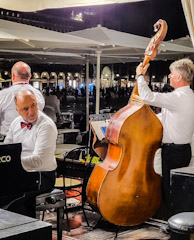
MUSIC IS A PART of what I associate with St Marks Square in Venice (Italy). Whether it be the occasional outdoor orchestral concerts that used to be held in on summer evenings in the 1960s, when we made annual family visits to the watery city, or the small bands that play on stages next to some of the square’s costly cafés. One of these ‘cafs’ is Florian’s, where a 6 Euro charge is added to your bill for the music.
Florian with its beautiful neo-baroque rooms that are entered beneath the arcade surrounding the Square was founded in 1720 as ‘Alla Venezia Trionfante’ but soon became known by its present name.
We looked at the menu at Florian, but although it is an extremely romantic place, there is a substantial price to pay to be an active part of it!
THE LAST TIME I flew into Venice’s Marco Polo airport was in the late 1960s with my parents. In those days, the airport was tiny in comparison with what it is now. Back then, there were two ways of reaching the city of Venice from Marco Polo: by bus to Piazzale Roma, or far more expensively, in a private water taxi, in effect a speed boat. Despite my mother’s tendency to become seasick easily, we always took the speedy water taxi from the airport to our pensione on the Fondamente Zattere. In those now distant times, the airport arrival hall was much closer to the shore of the lagoon than it is today.
Water bus
Times have changed. The airport has grown and is far from the waterfront. Although there are still plenty of speedy water taxis carrying passengers, there is now a regular, moderately priced water bus service, which links Marco Polo to many points in Venice. We used this service.
As we crossed the lagoon, many water taxis sped past us. We passed Murano and the cemetery island of St Michele. Then, as we approached the Fondamente Nuova on Venice proper, I spotted the curious domed Bell Tower of the church of Madonna dell’Orto. I looked at it and felt a lump in my throat as I remembered the numerous times I visited that church with my parents to see the frescos within it. It was one of my favourite Venetian excursions, being taken to see that edifice.
After getting off at the wrong stop (mea culpa) and boarding another vessel, we reached our destination near the Gardens where much of the Venice Biennale happens. There is no doubt that arriving in Venice by traversing the water in a boat is far more dramatic and pleasant than arriving across the bridge by train or bus.
VINCENZO MARIA CORONELLI (1650-1718) who was most likely born in Venice (Italy) was not only a Franciscan friar but also a cartographer. Recently, I spotted one of his maps hanging in a frame in a friend’s home. It is a beautiful work of art, bearing the title (translated from French): “Maritime route from Brest to Siam and from Siam to Brest”. It was made between 1685 and 1686, based on information provided to Coronelli by six Jesuit priests sent out to the Indies by the King of France. Coronelli, based in The Republic of Venice, drew the map.
I was particularly interested to see what of modern India is represented on the map. On the coast of “Guzararatte ou Cambaje” (i.e. Gujarat or Cambay), the Island of Diu, then a Portuguese settlement, is marked, as are “Surate” (Surat) and “Bombaim” and “Chaul” (also Portuguese settlements). Further south, Goa is marked, and yet further south along the west coast, we can see Calicut and Cochin. On the east coast of India, we can see “Fort S. Thomé” and “Mahapur”, being old names for a place immediately south of Chennai and Mahabalipuram respectively.
The map becomes more interesting when you look at the “Bouches du Gange” (the mouths of the Ganges). Coronelli draws a complex collection of island’s that depict the Ganges delta, but where one would expect to find Calcutta (Kolkata) on modern maps, there is only a small inset town plan of a place called “Louvo”. This is not a place in India but in modern Thailand (once known as ‘Siam’): its modern name is Lopburi.
The reason that Calcutta is not marked on Coronelli’s map is simple: the place with that name did not exist when the Jesuit priests reported back to Coronelli. Had they made their survey only a little later, they would have been able to report its existence because in August 1686 Job Charnock (c1630-c1692/3) established a trading post (‘factory’) on the River Hooghly, and that became known as Calcutta. I have visited his grave and mausoleum in central Kolkata.
THE ESTORIC COLLECTION in London’s Highbury houses a fine permanent exhibition of modern Italian artworks, mainly creations of the so-called Futurists. In one of the galleries, I spotted the name of an artist who was born in a town, which I have visited, in the northeast of Italy: Gorizia. When the artist Anton Zoran Music (1909-2005) was born, Gorizia was part of the Austro-Hungarian empire. After WW1, the town became part of the Kingdom of Italy within the region of Venezia-Giulia. Soon after WW2, the eastern part of the region became absorbed into the Yugoslav republic of Slovenia (now an independent state). When that happened, the border between Italy and Slovenia ran through the eastern part og the town, the part in what was then Yugoslavia (a country I visited often between 1973 and 1990) became named ‘Nova Gorica’. Most of Gorizia, an attractive old town, is on the Italian side of the border.
Slovenians still live on both sides of the border. Music, actually Anton Zoran Musič (pronounced mus-ich) was born into a Slovene-speaking family. Zoran, who went to schools in Maribor, studied art at the Academy of Fine Arts in Zagreb between 1930 and 1935. His first one-man exhibition (outside Yugoslavia) in Venice in 1943, where he had moved. Soon after this, he was arrested by the German Gestapo and then sent to Dachau concentration camp. After WW2, he moved to Ljubljana (in Yugoslavia), but soon shifted to Venice, where he lived (on and off) for the rest of his life. His career after the War was successful: he received several prestigious prizes for his artistic creations.
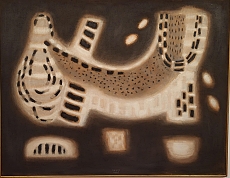
The Estorick displays five of Music’s paintings. They were created between 1951 and 1983 and illustrate his versatility as a painter. All the paintings hanging are between abstract and figurative in style, but slightly nearer the latter than the former. I had seen his paintings on previous visits to the Estorick, but until my most recent viewing of his art, I had not been aware of how many aspects of his life mesh with things that interest me.
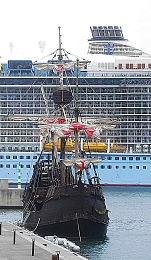
DURING THE ELEVEN days we spent in Funchal, the capital of Madeira, the city was visited by two enormous cruise ships. Resembling huge blocks of flats (apartments, my North American friends!) floating on water, they arrived in the port at night, remained a whole day, and then departed the next evening.
When these vessels disgorge their cargos of tourists, the centre of Funchal becomes crowded; the queue t the cable-car grows longer; and the frequency at which toboggans slide down from the Monte increases.
The port at Funchal is designed to accommodate these ‘humungous’ people carriers, so their arrival does not have the same damaging effect (on buildings and the shoreline) as is created by them in Venice (Italy). Cruising in vessels of this size appeals to many but not to me.
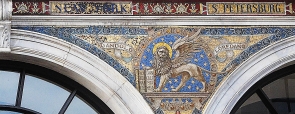
LONG BEFORE IT became the Apple Store on Regent Street in central London, I used to look at the colourful mosaics on its building’s façade. Running in a line along the top of the mosaics, which are above the four arches of the shopfront, are the names of several cities including St Petersburg. This used to intrigue me a lot in the years before Communist rule ended in Russia and the city was then called Leningrad.
The mosaics contain depictions of several coats-of-arms including and two lions, each resting a paw on an object. One of the lions has wings and rests its paw on an open book on whose pages are the words: “PAX TIBI MARCE ENVANGELISTA MEUS”. For, this creature is the lion of St Mark, symbol of Venice and its former empire. On both sides of the lion, there are depictions of streamers. One reads “DANDOLO” and the other “LOREDANO”. Both are the names of important patrician families in Venice. Two other crests also appear, one on each side of the winged lion and the two names. One is for the island of Murano and the other for the island of Burano. These two islands in the Lagoon of Venice, especially Murano, are known for their glassmaking activity.
The mosaics were originally installed when the Venetian glass-making company Salviati opened its store in this building, designed by GD Martin, on Regents Street in 1898. The business made both fine glassware and mosaics. Soon after the firm was founded in 1859, it began to be established in England. According to a company history (www.salviati.com/en/our-story/):
“It was also in London, on 21st December 1866, that the “Società Anonima per Azioni Salviati & C.” was established with the support of diplomat Sir Austen Henry Layard and historian William Drake.”
Fortunately, the lovely mosaic has survived and has been kept in good condition. I have always marvelled at it when wandering along Regent Street, but I wonder how many people rushing into Apple’s attractive looking shop notice it.
A ROW OF HOUSEBOATS is moored alongside the bank of the River Thames that runs past Cheyne Walk in London’s Chelsea. The floating dwellings are faced by Lindsey House, one of the oldest buildings in the Royal Borough of Kensington and Chelsea. Built in 1674 by Robert Bertie, 3rd Earl of Lindsey (1630-1701) on land that was once part of Thomas More’s riverside garden, it was remodelled by Count Nicolaus Zinzendorf (1700-1760) for London’s Moravian community in 1750. Five years later, the edifice was divided into separate dwellings. Today, they are numbered 96 to 101 Cheyne Walk. The American artist James McNeill Whistler (1834-1903) lived in number 96, and the engineers Sir Marc Isambard Brunel (1769-1849) and his son Isambard Kingdom Brunel (1806-1859) lived in number 98. My friends Kit and Sheridan lived in a ground floor flat in number 100.
Lindsey House, Chelsea, London
I first met Kit and Sheridan during one of our annual family holidays to Venice. Kit, who was a colleague of my father at the London School of Economics, and her husband Sheridan used to stay in the Pensione Seguso that was next door to the Pensione La Calcina, where John Ruskin (1819-1900) once stayed, and we always stayed in Venice. During one of our holidays when we stopped on the Fondamente Zattere to talk with Kit and Sheridan in Venice, they asked me whether I liked classical music. When I told them that I did, they said that they would invite me to their musical evenings held some Saturdays in their home. I attended quite a few of these during the second half of the 1960s.
On arrival at 100 Cheyne Walk, Kit used to welcome the guests by offering us coloured sugar-coated almonds, which she described as ‘stones of Venice’, an illusion to Ruskin’s book about Venice (“The Stones of Venice”), where the almonds had been purchased. After discarding coats, all of the guests, twenty to thirty in number, had to find somewhere to sit in the large, low-ceilinged living room. I was always directed by Kit to the same seat. She used to want me to sit next to the telephone. She always told me:
“If it rings during the music, dear, lift the receiver and say: ‘Sorry, we are having a party. Please ring again tomorrow’”
It never did ring, but I used to sit nervously in anticipation of having to perform my important duty.
Sheridan was a fine ‘cellist, who knew many professional musicians, all of them quite famous. He used to invite several musicians, anything from two to four, to perform a couple of chamber works with him. Kit knew what was to be performed at each soirée, but the invited musicians were not told until they arrived (at the same time as the audience). Without prior rehearsal, Kit and his musical guests performed chamber works, often by Brahms and Beethoven, beautifully and, except for Sheridan, from ‘scratch’. The acoustics of the 17th (or 18th) century living room were perfect for the music performed. These wonderful evenings engendered my enduring love of the chamber music of Brahms. During the music, Kit sat a few feet away from Sheridan on his right. Her eyes never wandered from him and she always smiled sweetly as he played. Whenever we saw them in Venice, they were always walking hand-in-hand like two lovers.
I believe that Kit and Sheridan married late in life. Sheridan told me once that he was pleased when he married, because as a married man he was able to perform a service, for which only married people were eligible at the time. He was at last able to become a marriage guidance counsellor.
Sheridan told me once that there was a lot of planning before putting on each musical evening. He ensured that none of his guest musicians ever played the same piece together more than once. Also, he tried to make sure that nobody in the audience ever heard the same combinations of pieces more than once. He did this by recording who had played what and who had heard what in a set of notebooks.
Two works were played at each soirée. During the interval, everyone stood up, many relieved to get off the not always comfortable seating provided. Kit served glasses of red wine and crackers with pieces of cheese that contained cumin seeds. Every soirée, the same refreshments were provided.
A few of the musicians that I can remember hearing playing with Sheridan included the violinist Maria Lidka (1914-2013) and her son, a ‘cellist; individual players from the Amadeus Quartet; and once the pianist Louis Kentner (1905-1987). At the end of the evening when Kentner had played, Kit asked him to give me a lift part of the way back to north west London. He agreed, but as we drove together, I had a distinct feeling that this famous pianist was not at all keen about giving me a lift and said not a word to me during the short journey.
As Sheridan grew older, he became increasingly frail and began looking gaunt. During the last few concerts I attended, I noticed that he covered his hands with woollen fingerless gloves. Maybe, he had a circulation problem. Sheridan died in 1991. Kit lived on another seven years. I believe that the last time I spoke to her was just after I married in late 1993, but she showed little interest in my news.
Whereas back in the 1960s, when I used to attend the musical evenings at Lindsey House, one could walk from the street to the front door, today this is impossible without being able to unlock a gate leading into the grounds of the house. Currently owned by the National Trust and rented to tenants, Lindsey House is rarely opened to the public. Fortunately, we did once manage to attend one of these openings, but all seemed to have changed since I last listened to chamber music being played close to the river.
ON 13th AUGUST 2020, MANY YOUNGSTERS in England received the results of the state’s university admission examinations. This year of plague and social distancing, 2020, the results have not been determined by the students themselves writing examination papers but by a clumsy, somewhat arbitrary, algorithm that takes various factors other than a student’s own ability into account. Things were quite different last year and back in 1970 when I sat the A-Level examinations required for admission to university.
Back then, as now, universities offered places to potential students subject to achieving or exceeding certain grades at A-Level. The place that was my first choice amongst the six universities I chose was University College London (‘UCL’). In ‘my time’, UCL invited potential students for extensive interviewing. I was invited to spend a whole day at the Physiology Department. During that day, I was interviewed at least three times by different people and met both members of the academic staff as well as students already embarked on their courses of study.
Several days later, I received a letter from UCL offering me a place on the BSc course providing I achieved three E grades at A-Level. The top grade at A-Level was A, the lowest pass grade was E. At first, I was not sure whether to be pleased that all I needed was just to pass my three A-Level examinations. Was that the best that they thought I could manage? No, it was not. In those days, if UCL liked a candidate at interview, they took the strain off the candidate by not expecting high grades. Thee Es was normal for most subjects except medicine and dentistry when 3 Cs were required. These days, candidates to places like UCL would be expected to get 3 A grades or something awfully close to this. Well, having been offered a place subject to my attaining at least 3 E grades and being neurotic by nature, I began to worry. What if I could not manage the three Es?
I became obsessed by examination papers to such an extent that I used to use my father’s typewriter to compose examination questions that I hoped would never appear in front of me in the examination hall. Whether or not composing these impossible questions was a kind of self-therapy or simply an opportunity to enjoy using the typewriter, I cannot tell, but it did me no harm. At the very least, It gave me short breaks in what for me was long hours trying to understand what I was studying.
My three A-Level subjects were Biology, Physical Science (a mixture of chemistry and physics), and mathematics. I found that all of them were most interesting and not too taxing. When I was at school, it was possible to opt to attempt supplementary papers in the subjects chosen for A-Level. These papers were known as ‘S-Levels’ and were designed to test a candidate’s deeper understanding of a subject. I chose to do S-Level papers in biology and mathematics. The biology S-Level paper was enjoyable. I was able to show off what I had learnt from reading around the subject. One of the questions was something to do with discussing the origins of life on earth. Well, in addition to various then current theories I decided to include what is described in the first chapter of the Old Testament. I passed that S-Level. The mathematics S-Level paper was a quite different ‘cup of tea’. Even though I had attended special classes to learn the mathematics that was required, I was stumped. For the first 30 minutes of the three-hour paper, I just stared at the questions. There was not one that I could even begin to tackle. So, after 20 minutes, I walked out of the examination room, leaving a blank script on my desk.
I can remember where I was when I received the A-Level results in August 1970. I was in Italy with my parents and sister on one of our annual visits to that country. We were in Venice, staying, as we always did, at the Pensione La Calcina, where many decades earlier the eminent John Ruskin(1819-1900) used to reside when visiting the island. The establishment’s façade is on the Fondamente Zattere across the water (of the Giudecca Canal) from the famous Santissimo Redentore church (completed 1592) designed by the architect Andrea Palladio.
We had just eaten lunch at the pensione and were taking the air on the waterfront prior to retiring indoors for a siesta when Signorina Steiner, the manageress, came rushing up to us with a telegram. My parents opened it to discover that my aunt in London had sent my A-Level results, which to my great relief were way in excess of the minimum required to gain admission to UCL.
If I had not managed to attain even 3 E grades, I would certainly not have expected to be admitted to any university. I would have had to accept the result and might well have decided to re-sit the examinations a few months later. As far as I am aware, in my day, there was no appealing to have papers re-marked as has become normal in the last twenty or thirty years. During recent times, it is not unusual for someone who is not satisfied with a grade to have his or her examination papers re-marked. Often, the revised grade is higher than the original, but things can go less favourably for the candidate.
This year, when young people have not been able to attend school since March and have not been awarded A-Level grades based on final papers written under strict examination conditions, they have been awarded grades based largely on statistics (generated by what appears to be a poorly conceived algorithm) rather than individual ability. Many students have been awarded grades well below what they and their teachers expected. Thank heavens that there are appeal procedures in place.
I remember how much of a nail-biting experience it was waiting for my A-Level results back in 1970. This year, it was far worse for candidates. Not only did they not know on what basis their grades would be estimated, but also many of them will have to remain anxious for even longer whilst their appeals are being considered.
I NEVER IMAGINED THAT I WOULD SEE THE VENETIAN WINGED LION of St Mark in Bhuj (Kutch, western India), but I did. A carving of this well known symbol of a once powerful European empire stands at the entrance to the Aina Mahal (Palace of Mirrors) in Bhuj, which was built during the reign of Maharao Lakhpatji that lasted from 1752 to 1761.
In 1742, Ram Singh Malam, aged about 16 left his native town of Okhi in Saurashtra (Kathiawad), now a part of Gujarat, and set out to sea. His boat was shipwrecked and he was rescued by passing Dutch vessel, which took him to Holland. Ram Singh remained in the Netherlands until about 1760.
During his stay in Holland, Ram Singh Malam learnt various skills including: clockmaking, mirror making, glass making, ship building, cannon manufacturing, tile making, enamelling, tool making, and more. When he returned to Saurashtra, he offered his skills to various local rulers, but to no avail. Then, he travelled to the Kingdom of Kutch, where his knowledge was recognised and employed by its ruler, Lakhpatji. The latter was so pleased with the technical advances that Ram Singh had imported from Holland that he was sent back to that country two more times. During his trips to Europe, Ram Singh also visited Austria and the Republic of Venice. No doubt the Lion of Venice sculpted in Kutch and placed at the Aina Mahal was designed after Ram Singh had been to Venice.
The Aina Mahal contains tiles and mirrors that were made using the knowledge acquired by Ram Singh. Statues that decorate both the inside and the outside of the Aina Mahal and the adjoining Rani Mahal depict men wearing European clothes, such as Ram Singh would have seen people wearing in 18th century Europe.
In 2001, Bhuj was struck by a huge earthquake, which caused much damage to both the Aina Mahal and the Rani Mahal. Their neighbour, the 19th century Victorian Gothic Prag Mahal, suffered considerably less damage.
The former curator and archivist at the Prag Mahal, a keen researcher of the history of Kutch, is Mr Pramod Jethi. He told us that after the earthquake the Dutch government were apparently considering assisting in the restoration of the damaged Aina Mahal palace, provided that documentary evidence was provided to prove that Ram Singh Malam had really been staying in Holland. Apparently, despite many accounts by various writers that he did spend years in Holland, this did not constitute evidence that would satisfy the Dutch.
Anyone, who arrived in Holland on a Dutch ship in the 18th century must surely be recorded in a ship’s records or registered in the books kept by Dutch port authorities. However, it is likely that quite a few ships arrived in Holland at the time that Ram Singh disembarked there. Dutch ships sailing in the vicinity of Gujarat were most probably connected with the Dutch East India Company. If someone has the enthusiasm and energy to search through the Company’s records, maybe the evidence that the Dutch government requires will be found. Regardless of whether or not the Dutch government can be satisfied, it is clear that Ram Singh was a very remarkable man who greatly advanced technology in Kutch and brought the winged lion of St Mark to India.






 yamey
yamey 